
Pjotr Iljitsch Tschaikowski
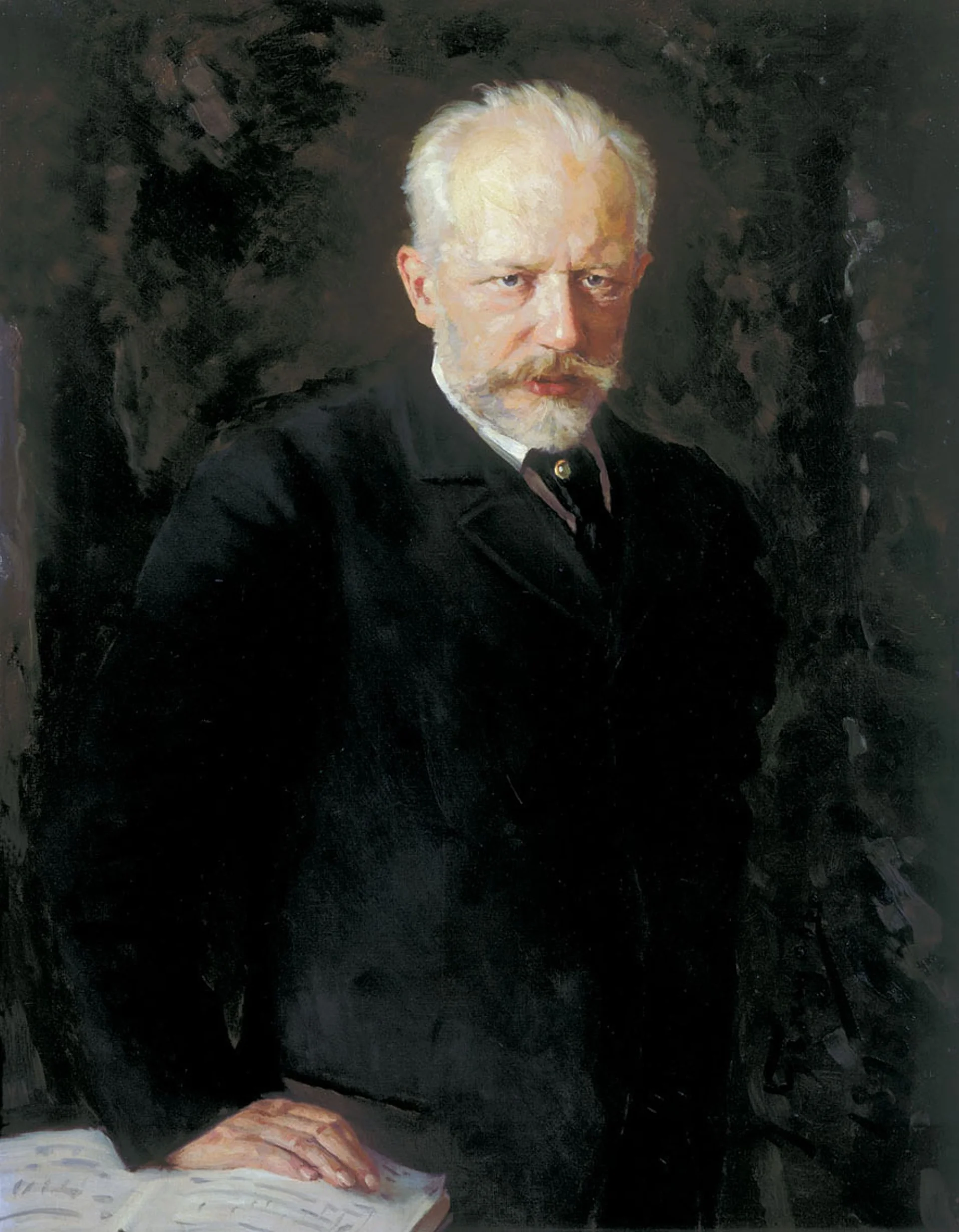
Image from Wikipedia
Image from Wikipedia
Pyotr Ilyich Tchaikovsky
Between Heart and Orchestra: How Tchaikovsky Transformed the Sound Language of Romanticism into a Global Idiom
Pyotr Ilyich Tchaikovsky is regarded as one of the defining composers of Romanticism – a musical storyteller who merged grand melodies with dramatic architecture, captivating millions in opera houses and concert halls. Born on April 25/May 7, 1840, in Votkinsk and died on October 25/November 6, 1893, in St. Petersburg, he left behind an extensive discography that reflects his oeuvre: seven symphonies (including the Manfred Symphony), three ballets, eleven operas, concertos, suites, chamber music, and songs. His works – from Piano Concerto No. 1 to Eugene Onegin and The Nutcracker – are now part of the canon with which orchestras, ballet companies, and soloists worldwide shape their musical identities.
Early Years and Education: From Lawyer to Composer
Tchaikovsky grew up in an educated middle-class family and displayed a strong musical talent from an early age. An education rooted in conservatory training led him – unlike the national romantic "Mighty Handful" – to a solid craftsmanship school that instilled a sense of style and form. Early compositions emerged in his youth; the 1860s and early 1870s shaped his musical career through teaching, composition, and engagement with Russian folk music as well as Western European formal tradition. This dual influence – Russian idioms and Western compositional techniques – remained the foundation of his artistic development, making his scores relevant to orchestral cultures worldwide. Sources confirm that Tchaikovsky consciously sought and shaped the path between national style and "Western" conservatory aesthetics.
Moscow, Stage Presence, and Early Successes
In Moscow, Tchaikovsky quickly established himself: string quartets, early orchestral works, and operas reflect a composer in search of his own dramatic voice. In 1875, he composed Symphony No. 3 in D major – unique in its symphonic structure for being in a major key and its five-part form – and worked that same year on his first ballet, Swan Lake. The Piano Concerto No. 1 in B minor, composed between 1874 and 75, initially received critical reception from Nikolai Rubinstein but celebrated sensational success in 1875 in Boston under Hans von Bülow – an early sign of Tchaikovsky's international appeal and his ability to meld virtuosity, orchestral brilliance, and singable themes into an audience-friendly form. This phase solidified his authority as a composer of worldly handwriting.
Breakthrough and International Reputation
The late 1870s and 1880s mark the transition from promising composer to internationally celebrated creator of major works. Symphonies, suites, and operas cemented his status alongside significant occasional compositions. In 1891, Tchaikovsky traveled to the USA, where he performed as conductor of his Marche solennelle at the opening of New York's "Music Hall" – later Carnegie Hall. This event made a visible mark on his stage presence beyond Europe and documented how his music connects cultural spaces. His musical career thus attained symbolic dimensions: Tchaikovsky as a global sound ambassador of Romanticism.
Opera as Psychogram: Eugene Onegin and the Art of Musical Theater
With the opera Eugene Onegin, based on Pushkin, Tchaikovsky created in 1877/78 a psychological chamber play that makes internal motions the dramatic guiding principle. The premiere in 1879 in Moscow, followed by its establishment in major houses, showcased an opera composer who favored fine economies of affect, singing melodies, and orchestral colors rather than large tableaux. The composer – also the librettist alongside Konstantin Shilovsky – employs motivic connections and colorful woodwinds as well as string textures to model characters and social spaces. Onegin became the epitome of a "lyrical scenes" format that independently expands operatic history between Grand Opéra and Verismo.
The Great Ballets: Swan Lake, Sleeping Beauty, The Nutcracker
Tchaikovsky's ballets transformed the genre: he combined dance with symphonic thinking and created scores that stand independently in the concert hall, apart from the stage. Swan Lake (1876), Sleeping Beauty (1890), and The Nutcracker (1892) establish a sound language characterized by memorable themes, orchestral color direction, and dramatic economy. The orchestral production employs distinctive leitmotifs – harp arpeggios, woodwind solos, dotted brass signals – while the form drama mediates between number structure and a perceivable larger form. These ballets continue to shape the repertoire of ballet companies and set standards for the symbiosis of choreography and music.
Symphony and Concerts: Form Drama, Thematic Work, Emotional Tension
The last three symphonies – No. 4, 5, and 6 ("Pathétique") – are considered milestones of Romantic symphonic music. Here, Tchaikovsky sharpened the tension curve between personal expressive intensity, rhythmic energy, and clear form. Symphony No. 6 in B minor, completed in 1893 and premiered shortly before his death under his baton, condenses his symphonic poetics: the deeply felt slow final movement, the harsh dynamics of inner movements, and the skillful orchestration create a sound narrative that resonates deeply with audiences to this day. His concertos – primarily Piano Concerto No. 1 and Violin Concerto in D major – combine virtuosity demands and orchestral profiles into works with a distinctive character.
Style and Sound Language: Melody, Orchestration, Form
Tchaikovsky's compositional handwriting is characterized by broad melodic arcs that interact with dynamic contrasts and colorful orchestration. His output utilizes the full palette of the late Romantic orchestra: warm woodwind colors, shimmering string sections, prominent brass signals, and timbral details in percussion. Harmonically, he oscillates between diatonic clarity and tension-building chromatisms; formally, he connects traditional schemas with dramaturgically motivated deviations. The result is music that is both immediately accessible and exhibits a solid compositional architecture – a hallmark of his expertise in composition, arrangement, and production in the late Romantic sense.
Cultural Influence and Canonization
Tchaikovsky's work radiated far into music history: subsequent composers like Rachmaninoff or – in symphonic development – Mahler and Shostakovich encountered an emotional aesthetic that redefined the interplay of grand form and subjective intensity. In performance practice, Tchaikovsky strengthened the role of the orchestra as a narrative entity beyond opera. The reception in music press continues to emphasize the duality of his art: popular melody and sophisticated compositional technique. This dual structure explains why his discography – from historical conductors to recent complete recordings – continues to grow, keeping his music present in concert halls, opera houses, and ballets worldwide.
Stage and Global Career: Carnegie Hall and Symbolic Moments
A historical highlight of his stage presence was his participation in the opening of the New York Music Hall (Carnegie Hall) in 1891, where he conducted. This performance represents the international stature of his musical career and the early global networking of classical music. Tchaikovsky, whose works circulated internationally during his lifetime, thus became a symbol of a composer who transposes national idioms into an international sound idiom – an artistic cosmopolitan who influenced concert culture equally in Europe and America.
Shifting Biographical Perspectives: Between Tragedy and Joy of Life
Modern research paints a more nuanced picture of Tchaikovsky's personality. In addition to the traditional narrative of the suffering Romantic, new studies emphasize humor, worldliness, and a vibrant social environment. This correction of historical narratives also influences the interpretation of his works: instead of a purely biographical "sound of suffering," the focus shifts to the precisely crafted composition, the stage of emotions, and the calculated dramaturgy. For music historical classification, this strengthens the view of Tchaikovsky as a sovereign architect of form, sound, and expression.
Current Projects, Performances, and New Releases
Even long after his death, Tchaikovsky's music remains contemporary art. New productions of Eugene Onegin in leading houses, international concert cycles of his symphonies, and modern complete recordings keep the repertoire alive. Practical reinterpretations – such as in tempo and articulation, the balance between string brightness and brass presence – sharpen the interpretive diversity. Festivals, opera houses, and orchestras regularly present his works in thematic series, while new releases in the recording market cyclically bundle his oeuvre. Thus, Tchaikovsky remains a reference point for conductors, soloists, and ensembles measuring their artistic development against his music.
Overview of Works: Discography in the Sense of the Oeuvre
Tchaikovsky's "discography" as a work catalog includes: the symphonies (including Nos. 4, 5, 6 "Pathétique"), concertos (Piano Concertos Nos. 1–3, Violin Concerto), ballets (Swan Lake, Sleeping Beauty, The Nutcracker), operas (Eugene Onegin, Queen of Spades/Iolanta, among others), suites (for example, the 3rd orchestral suite), tone poems and overtures (Romeo and Juliet, 1812, Francesca da Rimini), chamber music (string quartets, Souvenir de Florence), piano pieces, and songs. This diversity explains his lasting cultural influence: whether during the Christmas season with The Nutcracker, opera season with Onegin, or symphony cycles – Tchaikovsky remains a cornerstone of the classical repertoire.
Conclusion: Why Tchaikovsky Continues to Electrify Today
Tchaikovsky connects melodic immediacy with structural intelligence. His artistic development progressed from early works, where he tested stylistic paths, to master scores that define Romanticism as the sound language of the heart and theater. Those who listen to his ballets experience composition as a scenic breath; those who hear his symphonies perceive the arc between individual sensation and formal clarity. Live in concert, these works unleash their full energy – a pull that transforms every hall. Anyone wishing to experience classical music in its emotional, physical, and architectural power should hear Tchaikovsky live: the stage is his resonance space, the orchestra his voice.
Official Channels of Pyotr Ilyich Tchaikovsky:
- Instagram: No official profile found
- Facebook: No official profile found
- YouTube: No official profile found
- Spotify: No official profile found
- TikTok: No official profile found
Sources:
- Encyclopaedia Britannica – Pyotr Ilyich Tchaikovsky (Biography, Overview of Works)
- Encyclopaedia Britannica – Years of Fame (Style Classification, Reception)
- Mariinsky Theatre – Eugene Onegin (Work Information, Premiere Dates, Production Details)
- Mariinsky Theatre – Eugene Onegin (Current Production Dates and Information)
- Tchaikovsky Research – Chronology (Life Dates, Work Chronology)
- Tchaikovsky Research – Autobiography (Source Document)
- Wikipedia – Carnegie Hall (Opening 1891, Tchaikovsky's Involvement)
- Wikipedia – Festival Coronation March (Marche solennelle, American Premiere)
- Wikipedia – Symphony No. 3 (Work Information, Particularities)
- Wikipedia – Symphony No. 6 "Pathétique" (Work Information, Creation)
- The Guardian – Biographical Reevaluation (Simon Morrison, 04.08.2024)
- Wikipedia: Image and Text Source