
Frida Kahlo
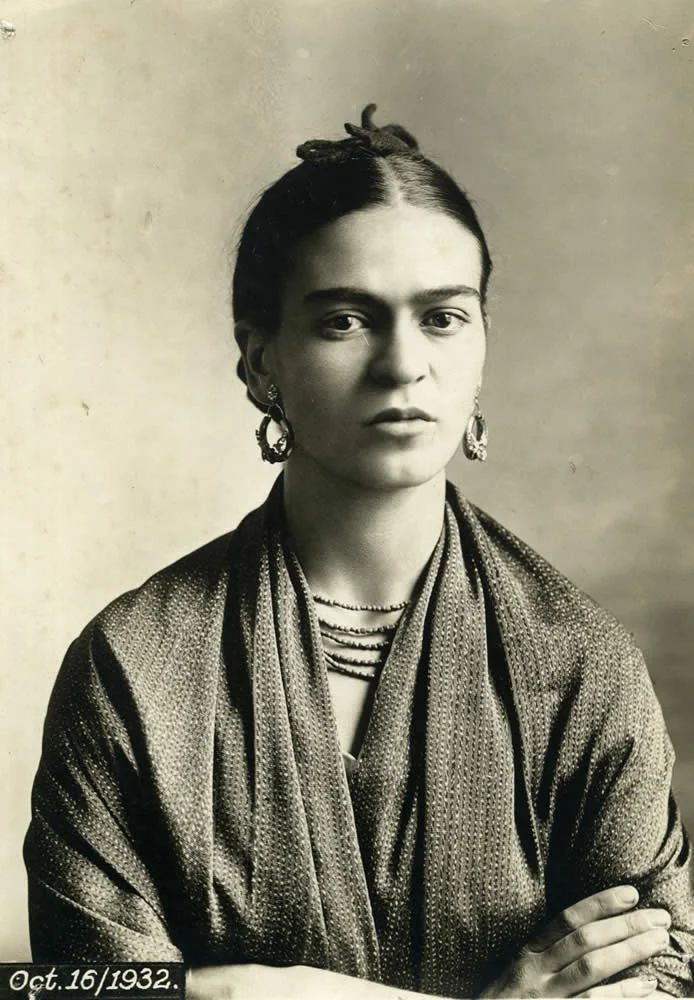
Image from Wikipedia
Image from Wikipedia
Frida Kahlo: The Uncompromising Icon of Pain, Self-Assertion, and Art History
An Artist Whose Life Became a Legend
Frida Kahlo de Rivera, born on July 6, 1907, in Coyoacán near Mexico City and died on July 13, 1954, in the same city, is one of the most influential female artists of the 20th century. She is regarded as the most renowned artist from Mexico and as a central voice of a folk-influenced variant of Surrealism, whose visual language sometimes incorporates elements of New Objectivity. Her work combines autobiographical intimacy with political stance, cultural identity, and a relentless exploration of her own body. ([britannica.com](https://www.britannica.com/biography/Frida-Kahlo?utm_source=openai))
When one views Frida Kahlo’s work, it is not merely painting that is seen but an artistic existence that draws strength from vulnerability, self-presentation, and radical truthfulness. Her art feels immediate even today because it does not smooth over biographical experience; rather, it transforms it into images that remain both personal and universally interpretable. This very quality fuels her enduring brilliance in museums, research, and pop culture. ([britannica.com](https://www.britannica.com/biography/Frida-Kahlo?utm_source=openai))
Childhood, Education, and the Early Path to Art
Frida Kahlo grew up in Coyoacán and entered the male-dominated National Preparatory School in Mexico City in 1922, where she encountered intellectuals and political debates early on. This phase of her education not only marked her academic journey but also opened up a pathway to an artistic and intellectual self-location that later became evident in her works. The engagement with Mexican culture, history, and identity became a foundational tone of her oeuvre. ([kahlo.org](https://www.kahlo.org/de/biografie/?utm_source=openai))
A life-altering accident in her young adulthood permanently changed her life and significantly influenced her art. From the experience of physical pain, medical interventions, and restricted mobility, Kahlo developed a visual language that does not idealize the body but depicts it as a site of conflict, self-questioning, and resistance. It is precisely this combination of biographical hardship and formal precision that makes her works unmistakable. ([britannica.com](https://www.britannica.com/biography/Frida-Kahlo?utm_source=openai))
The Artistic Career: Between Self-Portrait and Symbolism
Kahlo primarily worked in the genre of self-portraiture, creating one of the most distinctive archives of modern imagery. Her works are not mere representations of her own face but complex compositions in which clothing, animals, plants, wounds, symbols, and landscapes form a dense web of meaning. This precise construction of image spaces imparts a tension to her work that intertwines personal experience with cultural cipher. ([britannica.com](https://www.britannica.com/biography/Frida-Kahlo?utm_source=openai))
Early international attention grew with exhibitions and an increasingly independent reception of her work. The fact that Kahlo was later recognized not merely as a companion to Diego Rivera but as a significant artist with her own canon marks one of the most important shifts in 20th-century art history. The Museo Frida Kahlo and other institutions today secure this position by placing her works, correspondence, and biography within a broader historical context. ([museofridakahlo.org.mx](https://www.museofridakahlo.org.mx/visita/?utm_source=openai))
Important Works and Thematic Constants
Among the most frequently received works are self-portraits in which Kahlo portrays her identity as a woman, Mexican, and a suffering yet defiant personality. Works such as The Two Fridas, The Broken Column, and Self-Portrait with Monkey exemplify her ability to translate psychological states into iconic visual formulas. The result is an art that works with symbolism without sacrificing emotional directness. ([kahlo.org](https://www.kahlo.org/de/?utm_source=openai))
Even in museum and scholarly reception, it becomes clear how profoundly Kahlo's work extends beyond individual motifs. The British Museum features works and references to Kahlo in its collection context, while the National Museum of Women in the Arts makes her letters and archival materials accessible as a central research resource. This underscores the point: her work lives not only on canvas but also in documents, letters, and an exceptionally rich legacy. ([nmwa.org](https://nmwa.org/learn/library-research/?utm_source=openai))
Personal Life, Relationships, and Political Stance
Frida Kahlo was not only an artist but also a public figure whose life was intertwined with politics, love, and loyalty. Her marriage to Diego Rivera is legendary in art history, yet Kahlo never remained in his shadow; rather, she developed her own distinctive position within Mexican and international modernity. Her visual world is permeated by self-determination, bodily experience, and a clear awareness of cultural heritage. ([britannica.com](https://www.britannica.com/biography/Frida-Kahlo?utm_source=openai))
The connection between the private and the political forms a core of her artistic authority. Kahlo used her art not as a space of distance but as a stage for identity, conflict, and stance. This immediacy is precisely what explains why her works are so intensely discussed in exhibitions, archives, and collections today. ([nmwa.org](https://nmwa.org/about/annual-reports/year-in-review-2025/?utm_source=openai))
Current Relevance, Exhibitions, and New Contexts 2024 to 2026
Even decades after her death, Frida Kahlo remains highly present in cultural discourse. The Museo Frida Kahlo keeps alive the memory of her life in Coyoacán, while the National Museum of Women in the Arts worked with the Frida Kahlo Papers in 2024 and 2025, thereby opening up new access to her estate. At the same time, the Museum of Modern Art plans for 2026 the exhibition Frida and Diego: The Last Dream, which will place selected works by Kahlo in a new curatorial context. ([museofridakahlo.org.mx](https://www.museofridakahlo.org.mx/visita/?utm_source=openai))
Recent cultural-historical contexts also include documentary films, research, and museum programs. The documentary film Frida from 2024 demonstrates how strongly her life continues to inspire artistic and media formats. The ongoing attention proves that Kahlo is not perceived as a finished monument but as a living reference figure for contemporary art, feminism, and cultural self-assertion. ([en.wikipedia.org](https://en.wikipedia.org/wiki/Frida_%282024_film%29?utm_source=openai))
Discography? Why Frida Kahlo Left a Visual Rather Than a Musical Legacy
In terms of a classic discography, there is no collection of albums or singles by Frida Kahlo, as she was not a musician. Nevertheless, her cultural presence is so extensive that her name repeatedly appears in music, stage, and popular iconography. The crucial difference lies in the fact that her work lives on not through recordings but through paintings, letters, exhibitions, and reproductions. ([britannica.com](https://www.britannica.com/biography/Frida-Kahlo?utm_source=openai))
It is precisely in this circumstance that part of her myth lies: Frida Kahlo is an artist whose visual language is so strong that it transcends media boundaries. If we understand her "discography" as a cultural echo, it consists of countless reinterpretations, book projects, exhibitions, and references that continually update her visual power in new forms. This makes her one of the most impactful figures in art history. ([fridakahlo.it](https://www.fridakahlo.it/en/music.php?utm_source=openai))
Critical Reception and Cultural Influence
The critical reception particularly highlights the independence of Kahlo's painting. Britannica describes her as one of the most important artists from Mexico; the Museo Frida Kahlo presents her development as a product of adversity, relationships, and artistic consistency. In summary, this creates an image of a personality whose work transforms biographical injuries into aesthetic authority. ([britannica.com](https://www.britannica.com/biography/Frida-Kahlo?utm_source=openai))
Her cultural influence extends far beyond art history. Frida Kahlo today stands for female self-empowerment, for Mexican identity, and for a form of expression that unites intimacy and political symbolism. The fact that a self-portrait of hers was auctioned in 2025 for around 48 million euros, making it the most expensive work sold by a woman at auction, underscores the enduring market and symbolic power of her oeuvre. ([britannica.com](https://www.britannica.com/biography/Frida-Kahlo?utm_source=openai))
Voices of the Fans
No clearly official social media channels were found for Frida Kahlo in web searches. Thus, this section is consciously omitted, without fabricated fan quotes or unofficial reactions. Today's resonance around Kahlo manifests instead in museums, archives, exhibitions, and the unbroken popularity of her images. ([socialveins.com](https://socialveins.com/influencer/instagram/fridakahlo?utm_source=openai))
Conclusion: Why Frida Kahlo Continues to Captivate Today
Frida Kahlo fascinates because she has created a universal visual language from personal pain. Her art connects uncompromising self-exploration, cultural identity, and formal strength into a work that has remained unique in modernity. Engaging with Kahlo means encountering not just a painter but an attitude: radical, vulnerable, sovereign, and timeless. ([britannica.com](https://www.britannica.com/biography/Frida-Kahlo?utm_source=openai))
That is precisely why it is especially worthwhile to encounter her originals in museums or grand exhibitions. Frida Kahlo remains an artist whose work does not function from a distance but from closeness, intensity, and presence. Those who experience her paintings live understand immediately why her name has long transcended art to become a cultural symbol. ([museofridakahlo.org.mx](https://www.museofridakahlo.org.mx/visita/?utm_source=openai))
Official Channels of Frida Kahlo:
- Instagram: no official profile found
- Facebook: no official profile found
- YouTube: no official profile found
- Spotify: no official profile found
- TikTok: no official profile found
Sources:
- Britannica – Frida Kahlo Biography
- Kahlo.org – Biography of Frida Kahlo
- Museo Frida Kahlo – Museum
- Museo Frida Kahlo – Visit
- National Museum of Women in the Arts – Library & Research Center
- National Museum of Women in the Arts – Archive Transcribe-a-thon: Frida Kahlo Papers
- The Museum of Modern Art – Frida and Diego: The Last Dream
- British Museum – Collection Object: Nude with beads (Frida Kahlo)
- Wikipedia – Frida Kahlo
Upcoming Events
Germany - Mexico. Frida Kahlo. Family Stories.
Frida VR
Exhibition on Screen: Frida Kahlo
Exhibition on Screen: Frida Kahlo
Cabaret the World - Church Cabaret in Kiefersfelden