
Dresdner Kreuzchor
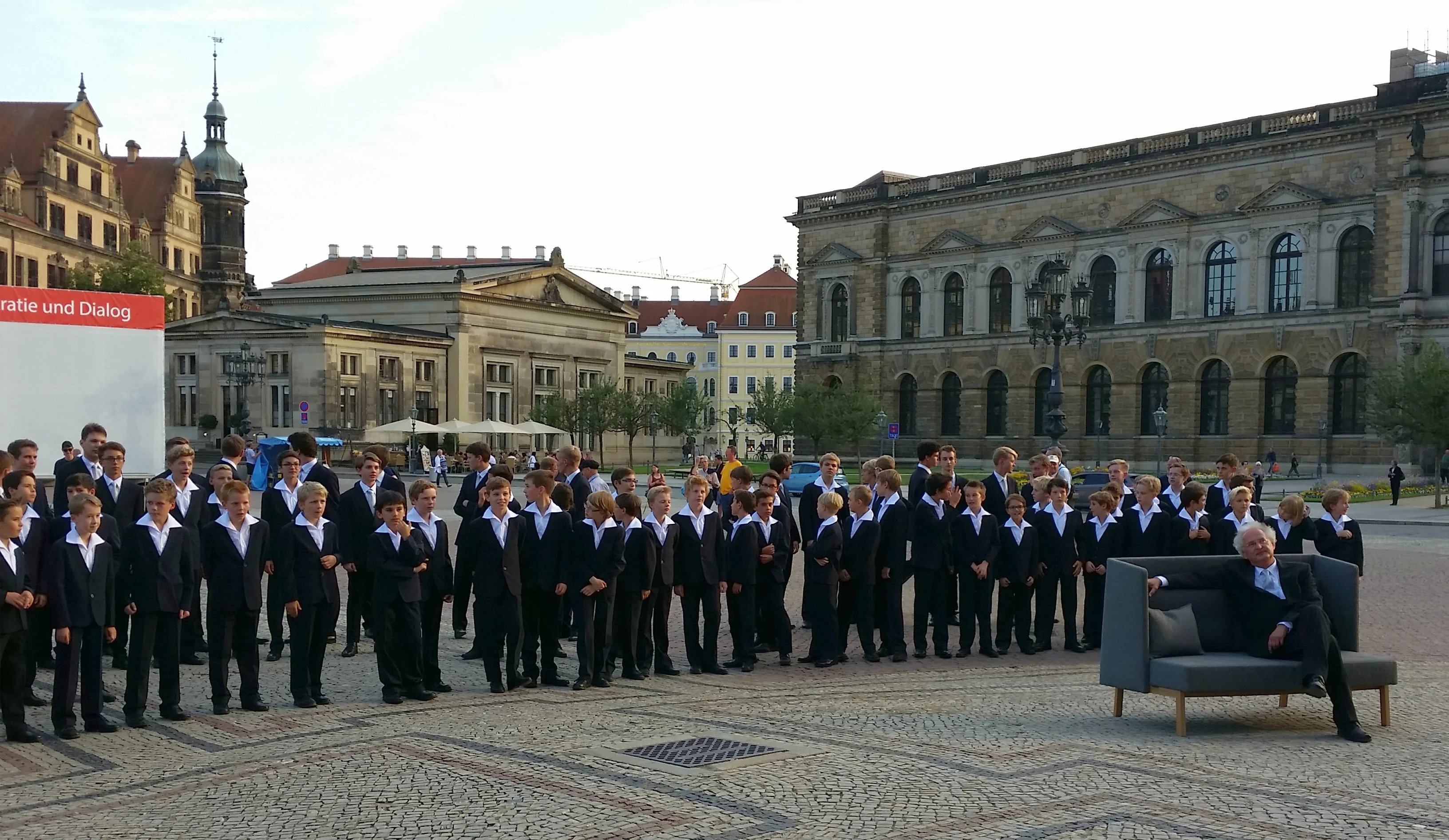
Image from Wikipedia
Image from Wikipedia
Dresden Kreuzchor – Sound Tradition, Present, and Global Impact
A boy's choir as a cultural institution of European significance
The Dresden Kreuzchor is one of the most significant boys' choirs in Europe and has shaped the musical life of the Saxon capital for centuries. Its history, as it states, goes back to the early days of Dresden; the tradition of Vespers has been continuously maintained since 1371, and the choir still sings today in the Kreuzkirche at Altmarkt, its spiritual and artistic center. The ensemble combines liturgical practice, concert culture, and musical education into a rare unity that goes far beyond the framework of a classical choir. ([kreuzchor.de](https://kreuzchor.de/kreuzchor))
Historical roots and identity
The development of the Dresden Kreuzchor is closely tied to the history of the city and the Kreuzkirche. The exact beginnings are not well documented, but the choir has traditionally been associated with the foundation of the city of Dresden in 1216; it emerged visibly as part of Protestant church music at the latest with the Reformation of 1539. Throughout the centuries, the choir has participated in church services, Vespers, and Matins, as well as in secular performances and opera projects. ([kreuzchor.de](https://kreuzchor.de/kreuzchor))
Particularly influential was the time of Rudolf Mauersberger from 1930 onwards, who strengthened the tradition of the Christmas and Easter Matins and restructured the choir after the destruction of Dresden in 1945. His work "Wie liegt die Stadt so wüst" became a musical memorial of the city and is performed annually to this day. Later, Martin Flämig led the choir through the GDR period, before Roderich Kreile and since 2022 Martin Lehmann brought the ensemble into the present. ([kreuzchor.de](https://kreuzchor.de/kreuzchor))
Musical training as the foundation for the Kruzianers
The distinctive quality of the Dresden Kreuzchor arises not only from tradition but from a strict and comprehensive training system. The Kruzianers receive daily vocal lessons, instrumental instruction, and music theory; rehearsal work, section rehearsals, and integration after voice changes are part of their daily routine. This creates a musical socialization that equally promotes vocal development, ensemble awareness, and interpretative precision. ([kreuzchor.de](https://kreuzchor.de/kreuzchor))
The choir explicitly sees itself as a living community, open to boys without church affiliation. This openness connects the Kreuzchor with a strong educational commitment: the training encompasses not only vocal technique but also musical and personal foundations for a long-term artistic career. This marks a significant difference from many pure concert formations. ([kreuzchor.de](https://kreuzchor.de/kreuzchor))
Repertoire spanning Bach, Brahms, and contemporary music
The repertoire of the Dresden Kreuzchor is stylistically broad and historically rich. The focus is on the major sacred works of Johann Sebastian Bach, including the Christmas Oratorio and St. Matthew Passion, as well as Johannes Brahms' "German Requiem". In addition, the range includes Gregorian chant and a cappella literature to world premieres of contemporary compositions, making the choir an important entity for current music as well. ([kreuzchor.de](https://kreuzchor.de/kreuzchor))
This breadth shapes the artistic character of the ensemble. The Kreuzchor cultivates the pure, bright boy choir sound without limiting itself to a historical niche. In current programs, works by Heinrich Schütz, Johann Sebastian Bach, and new composers are deliberately presented side by side, allowing historical depth and contemporary relevance to complement each other productively. ([kreuzchor.de](https://kreuzchor.de/kreuzchor))
Career, tours, and international presence
The Dresden Kreuzchor is not only present in Dresden but has also been internationally active since the early 20th century. The choir undertook its first foreign trips to Sweden and the Netherlands as early as 1920; today, the ensemble travels several times a year for concerts and guest performances both domestically and abroad. In this way, the choir has established itself as a musical ambassador for the city of Dresden. ([kreuzchor.de](https://kreuzchor.de/kreuzchor))
Under Roderich Kreile, the choir gained further international recognition, notably through world premieres and tours to Asia. With Martin Lehmann, who has been the Kreuzkantor since 2022, the ensemble continues this approach, combining historically informed programming with modern cultural mediation. The appointment of a former Kruzianer as leader further underscores the continuity of the institution. ([kreuzchor.de](https://kreuzchor.de/kreuzchor))
Current projects and musical present 2024/2025
The recent season showcases a choir that does not treat tradition as a relic but actively develops it further. The official website announces, among other things, renewed participation in Bach's St. Matthew Passion, a memorial concert featuring Bach's Mass in B minor, as well as youth formats and family Vespers for 2025 and 2026. The St. Matthew Passion will alternate annually with the St. John Passion starting in 2025. ([kreuzchor.de](https://kreuzchor.de/?utm_source=openai))
On the level of new releases, the choir remains present: For 2025, the album "Mass & Gloria" and the world premiere of Sven Helbig's "Requiem A" have been highlighted in press releases and industry notices. Additionally, the Dresden Kreuzchor returned to the ZDF Advent Concert from the Frauenkirche, thus once again participating in a widely viewed television format. ([kulturfreak.de](https://kulturfreak.de/neues-album-mit-dem-dresdner-kreuzchor-mass-gloria?utm_source=openai))
Discography, recordings, and reception
The discography of the Dresden Kreuzchor is closely linked to the history of German church music recordings. The choir appears on recordings of Bach, Brahms, Christmas programs, and thematic church music editions; both recent and historical releases document the specific sound of the ensemble under various conductors. Notably, available sources mention recordings such as "Christmas with the Dresden Kreuzchor", the "Mass & Gloria" project, and collections related to Dresden church music. ([arkivmusic.com](https://arkivmusic.com/products/weihnachten-mit-dem-dresdner-kreuzchor?utm_source=openai))
Critical reception regularly highlights the connection of clarity, sound discipline, and spiritual intensity. Music media and organizers describe the choir as stylistically versatile yet deeply grounded in the sacred repertoire; particularly the blend of liturgical authenticity and artistic presence is regarded as a trademark. The choir's receipt of the Brahms Prize further confirms its status in the German-speaking music scene. ([kulturpalast-dresden.de](https://www.kulturpalast-dresden.de/en/events/calendar/dresdner-kreuzchor-in-kulturpalast/?utm_source=openai))
Cultural influence and significance beyond Dresden
The cultural influence of the Dresden Kreuzchor extends far beyond the local context. As an institution of the city of Dresden, it carries historical memory, religious practice, and musical excellence into a shared public space. Its role after 1945 and its continuity through political upheavals have made the choir a symbol of cultural resilience. ([kreuzchor.de](https://kreuzchor.de/kreuzchor))
Additionally, it serves as a training ground for future musical personalities. The example of Peter Schreier, who began as an alto in the choir and made his first professional recording there, demonstrates the lasting impact of this musical school. The choir is thus not only an interpreter but also a talent incubator with historical depth and international resonance. ([deutschegrammophon.com](https://www.deutschegrammophon.com/de/katalog/produkte/the-young-peter-schreiber-dresdner-kreuzchor-12767?utm_source=openai))
Conclusion: A living myth with a future
The Dresden Kreuzchor combines centuries-old liturgy, excellent training, and exceptional stage presence into a sound that continues to fascinate today. Its strength lies in the balance of tradition and renewal: Bach, Brahms, and contemporary works appear not as opposites but as parts of a living musical identity. Those who experience the choir live encounter an ensemble that does not merely preserve history but makes it audible anew with every performance. ([kreuzchor.de](https://kreuzchor.de/kreuzchor))
Official channels of the Dresden Kreuzchor:
- Instagram: No official profile found
- Facebook: No official profile found
- YouTube: No official profile found
- Spotify: No official profile found
- TikTok: No official profile found
Sources:
- Dresden Kreuzchor – History, Duties, and Repertoire
- Dresden Kreuzchor – Homepage / News
- Dresden Kreuzchor – Press Materials
- Dresden Kreuzchor – CD
- Wikipedia – Dresden Kreuzchor
- Dresden Kreuzchor – News
- Dresden Kreuzchor – ZDF Advent Concert
- Dresden Kreuzchor – European Youth Prize
- Kreuzkirche Dresden – Sing-along Concert / Vespers
- Dresden Philharmonie – Kreuzchor and Philharmonie
- Deutsche Grammophon – The Young Peter Schreier & Dresden Kreuzchor
- Presto Music – Masters of Dresden Church Music
Upcoming Events
Concert of the Dresden Kreuzchor at the Stadttheater Fürth
Dresden Boys' Choir at Fürth City Theatre
Dresden Kreuzchor – Summer Journey: A-Cappella Concert