
Anniversary of an Old Municipal Honorary Office
600 Years of Siebener in Langenzenn: Why This Stone Brings Peace
In Horbach, Langenzenn celebrated a double anniversary of the field juror system – thus putting a voluntary office in the spotlight that usually remains inconspicuous in everyday life, but can be crucial in cases of conflict. Where property boundaries run, who is allowed to use what, and how boundary points are permanently secured is not only a matter of surveying technology, but often also of neighborhood peace.
Celebration and Occasion
On May 23, several hundred field jurors as well as representatives from politics, municipalities, agriculture, and surveying administration gathered in the Langenzenn district of Horbach. The occasion was 600 years of field jurors in Langenzenn and ten years since the inclusion of the field juror system in the list of Intangible Cultural Heritage. Thus, not only a historical date was celebrated, but also a municipal function that still has practical effects today.
Why the Voluntary Office Remains Relevant Locally
Field jurors, mostly called "Siebener" in Franconia, oversee property boundaries, participate in the permanent marking of boundary points, and support the surveying administration. The importance becomes particularly apparent when boundaries are no longer clear – for example, due to structural changes, unclear historical markings, or differing expectations between neighbors. In such situations, it is not the loudest argument that decides, but the comprehensible, documented boundary line. Those who make boundaries visible and verifiable help to avoid disputes.
For Langenzenn, the office is documented unusually early: The first documentary mention of the Langenzenn Siebener dates from 1426. The city of Langenzenn refers to this mention in the records of the city archive and describes the Siebener system as one of the oldest municipal honorary offices in Bavaria.
Lifelong Appointment and Requirements
A special feature is that, according to the German UNESCO Commission, field jurors are appointed for life. A conscientious, impartial exercise of office and confidentiality are expected – requirements that explain why the activity enjoys trust locally: When it comes to property boundaries, neutrality is not just a virtue, but the basis for decisions to be accepted.
The Siebener Secret
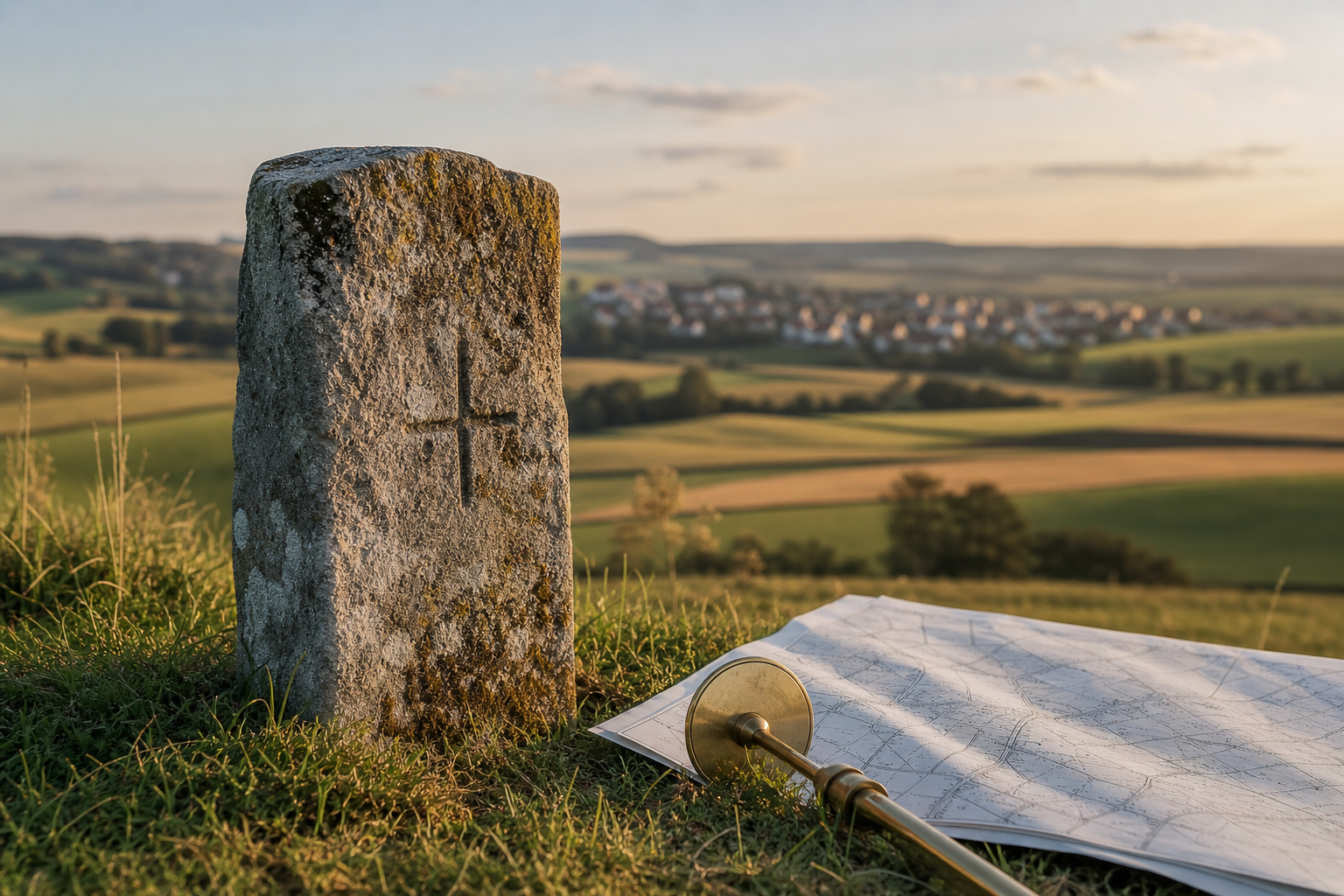
Another feature is the so-called Siebener secret: When marking boundary stones, secret signs can be used that are only known to the field jurors. In practice, this serves as additional protection against manipulation – not as folklore, but as a historically evolved security principle intended to strengthen the reliability of boundary markers.
The Celebration Connected History with Municipal Practice
The venue for the anniversary celebration was the machine hall in Horbach, near the Siebener café, Siebener square, and open-air museum. During the day, a commemorative stone was unveiled: a granite stone more than two meters high, donated by the local stonemasons Kai and Oliver Vogel. Such visible signs fulfill a double function for an office that usually works in the background: They remind us of the long continuity – and they explain why "boundary maintenance" is more than just a technical task for a community.
The festive day was opened with a church service led by Dean Kathrin Klinger. The further program included:
- Exhibition
- Demonstrations with surveying offices and Siebener
- Children's program
- Carriage rides to Siebener square
- Tours
- Film screenings
Thus, it was not just about ceremonial speeches: The event showed how the honorary office is concretely connected to administrative practice – and why boundary issues are always also social issues in the end.
Greetings and Significance
In the greetings, the importance of the office for local peace and neighborly coexistence was emphasized. District administrator Bernd Obst honored the work of the Siebener as a service to the community. Homeland and Finance State Secretary Martin Schöffel also attended the celebration. Nina Dederichs from the German UNESCO Cultural Heritage Office sent a greeting via video message. Siebener chairman Hans Satzinger highlighted the reliability of those who often perform this office quietly – a reminder of how much municipal stability depends on people who rarely stand in the spotlight.
Statewide Significance in Bavaria
The fact that the topic is not only of local importance is shown by the scale in the Free State: According to the state surveying administration, there are around 25,000 field jurors in Bavaria; a large part of them are active in Franconia. The honorary office is therefore not a special case of individual places, but a supporting element of Bavarian boundary security, embedded in a modern surveying administration.
Tradition Remains – and Changes
The celebration also made it clear that the field juror system is deeply rooted in the region, but has not remained unchanged. There are now also women in the office of field juror in the region. Among others, Jutta Massl from Großhabersdorf, Heidi Stinzendörfer, and Madeleine Espach were honored for their commitment. For Langenzenn, this change is also concretely visible: The city had already announced in 2023 the swearing-in of Heidi Stinzendörfer and Madeleine Espach as new field jurors for the Langenzenn district.
The anniversary celebration in Horbach was thus more than a look back at 600 years of history. It made visible why the field juror system still plays a key municipal role today: It creates clarity where ambiguity can quickly become a burden – and thus, often without much public attention, contributes to peace between property boundaries.
Frequently Asked Questions
Sources
- https://fuerthaktuell.de/landkreis-fuerth/10444/600-jahre-siebener-langenzenn-feiert-ein-besonderes-ehrenamt/, 28.05.262026
- https://www.langenzenn.de/unser-langenzenn/siebener-feldgeschworene
- https://www.unesco.de/staette/feldgeschworenenwesen-in-bayern/
- https://www.finanzministerium.bayern.de/vermessung/feldgeschworene/
- https://www.langenzenn.de/fileadmin/Dateien/Dateien/2_Rathaus_Verwaltung/Mitteilungsblatt/Langenzenn_aktuell-Heft_2_2023St.pdf