
Fürth
Münchener Str. 21, 90478 Nürnberg, Deutschland
Meistersingerhalle Nürnberg | Program & Parking
The Meistersingerhalle Nürnberg has been a staple for concerts, congresses, and social events in the region since 1963. Named after the Nuremberg Meistersinger tradition and protected as a historic monument with its functionalist architecture, the venue combines historical significance with modern event logistics. The centerpiece is the Great Hall with 2,121 seats, complemented by the Small Hall as well as spacious foyers and conference rooms. Visitors benefit from excellent tram and bus connections, a large digital parking system directly at the venue, and practical services such as free coat check and clearly regulated house rules. Whether classical, film music, shows, comedy, congresses, or trade fairs – here, organizers find the right stage and guests enjoy a comfortable concert experience with short distances, clear signage, and a reliable service offering from entry to intermission catering.
Event Program and Current Events
The Meistersingerhalle presents a diverse program ranging from philharmonic concerts to international touring productions, readings, shows, and award ceremonies. As an open house with numerous guest organizers, there is no single, all-encompassing annual brochure – instead, the program is dynamically maintained. The official event calendar of the Meistersingerhalle is continuously updated and provides a quick overview of publicly accessible dates. Since not all rentals appear in the central calendar (for example, closed corporate events, congresses, or rentals at the request of the organizers), it is worthwhile to take an additional look at the pages of major series and producers in Nuremberg. Among the defining series are classical concert series, such as the Master Concerts, which regularly take place in the Great Hall and feature international soloists, large orchestras, or renowned choirs. In addition, universities and regional cultural institutions present special projects – including university concerts, graduation projects, or thematic programs in cooperation with city partners. For visitors, this means: If you are looking for a specific genre, it is best to check both the calendar of the Meistersingerhalle and the websites of the main partners and organizers to not miss any program points. The venue is particularly suited for symphonic music, oratorios, and choral projects – also due to the Steinmeyer organ installed in the hall, which enables special concert formats. Additionally, there are cross-genre evenings such as film music shows, comedy and cabaret programs, or popular tribute productions that round out the spectrum. Tip for quick orientation: Use the search function of the online calendar with filters by date, genre, and hall. Those who are flexible often find exciting evenings at short notice, as guest performances and additional dates sometimes go online shortly before the event. For regular concert series, subscriptions with the respective organizers are available; these often include fixed seats, price advantages, and exclusive information via newsletter. Visitors choosing Nuremberg as a travel destination often combine their evening at the Meistersingerhalle with a walk around Dutzendteich or in Luitpoldhain – both are in close proximity and provide a relaxed setting before and after the event.
Parking and Access to the Meistersingerhalle
The Meistersingerhalle is easily accessible by both car and public transport. For access by car, the recommended address is Münchener Straße 21, 90478 Nuremberg; in the context of events in the Great Hall, the address Schultheißallee 2–4 is also commonly used. There are about 850 parking spaces directly on the premises, divided into a large parking lot in front of the Great Hall (around 650 spaces) and another area at the Small Hall or the conference rooms (around 200 spaces). Since July 1, 2024, a digital, barrier-free, and ticketless parking management system has been in operation. Upon entry, a system recognizes the license plate, and the parking duration is automatically recorded. Payment is made at the touchscreen machine by entering the license plate or conveniently via app or online – even up to 24 hours after entry. The rates are visitor-friendly: 30 minutes are free, the short-term parking rate for two hours is 2 euros, and for events, a day ticket is available for a flat rate of 5 euros; a day rate is designated for buses/trucks. The machines accept coins as well as EC, Visa, and Maestro. Those arriving by public transport can take tram line 8 from Nuremberg Central Station or bus line 36 from Plärrer towards Doku-Zentrum. The stop “Meistersingerhalle” is located directly at the venue; the paths are short and barrier-free. During major events, the schedules on the relevant lines are usually adjusted to ease departure. Generous drop-off and parking options are available for tour buses in front of the Great Hall; the access points are clearly marked. Guests using navigation apps should note that maps sometimes lead to both addresses (Münchener Straße 21 and Schultheißallee 2–4) – both are correct and lead to the appropriate parking lot depending on access. Designated disabled parking spaces are set up directly in front of the entrances for visitors with mobility impairments. A practical note: The system operates strictly based on license plates – those who exit without payment risk a fee. Therefore, complete the parking process at the machine or via the app; payment is very flexible thanks to the online option.
Seating Plan, Seats, and Balcony View in the Great Hall
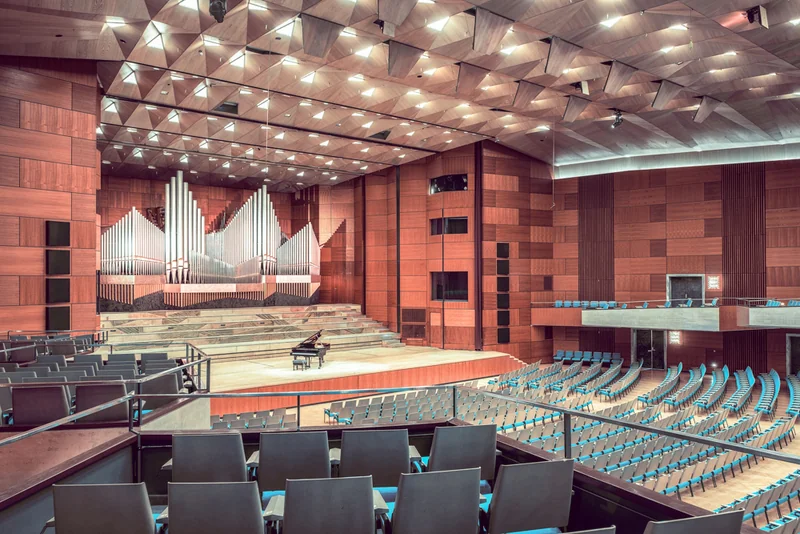
The Great Hall of the Meistersingerhalle is one of the renowned concert venues in Germany and offers over 2,100 seats in row seating. The division into stalls and balcony provides clear orientation. Official seating plans are provided by the hall as a PDF; these show variants for concerts, shows, and special setups. For lovers of direct, close-to-body sound, the middle stall rows are often recommended: Here, the direct and hall reverberation mix evenly, which is convincing in large symphonies as well as in amplified chamber music. Those who prefer an overview of the orchestra setup and choir often choose the front balcony – the elevated perspective makes it easier to follow complex formations and lighting direction. Acoustically, the hall delivers very homogeneous results over large parts of the stalls; the hall is entirely made of wood, the ceiling is composed of pyramid-shaped elements and equipped with triangular crystal lights – a design that combines acoustic diffusion and a calm overall effect. For visitors with hearing aids, permanently installed induction loops are available in selected areas; the exact seating locations are indicated in a special seating plan. Wheelchair spaces are arranged at the hall doors for safety reasons; balcony seats are only accessible via stairs. Those sensitive to very high sound levels should avoid the immediate vicinity of large speaker arrays at rock or show-oriented productions and orient themselves more towards the center axis. For organizers, the flexibility of the hall is central: There are seating examples for stalls and mixed forms that consider pressure and traffic routes. The stage measures about 160 square meters; retractable steps, a lift, and a point hoist system allow adjustments for choir and large ensembles. A special feature is the Steinmeyer organ with 86 registers and 6,646 pipes. It not only enables organ solo repertoire but also large-scale oratorios with organ participation; corresponding disposition information is available in separate documents. During intermissions, it is advisable to take a look at the foyer with its integrated art – including a large copper relief in the area of the Great Foyer – before returning to the seat.
Great Hall, Small Hall, and Capacity Overview
The Meistersingerhalle is designed as an ensemble. The Great Hall offers 2,121 seats and is an example of functionalist architecture from the early 1960s with its wooden paneling, characteristic ceiling, and clear design language. In 2007, the entire facility was placed under monument protection – with a justification highlighting the linear cubature outside and the use of high-quality materials inside. In the Great Hall, a large copper relief spans an entire wall area; it is one of the prominent artworks in the house. The Small Hall complements the offering for formats with up to over 500 seats in row seating. Its total area is about 470 square meters, and the stage measures around 70 square meters. Due to its design without glazing, it is suitable for presentations and events where light or projection technology is used; it is often used for lectures, product presentations, chamber concerts, theater performances, congresses, as well as smaller fairs and markets. The adjacent Small Foyer can be equipped with additional seating, allowing for flexible audience capacities. Both halls have spacious foyers that are suitable for intermission catering, reception situations, or exhibitions. Additionally, several conference rooms are available for organizers, which can serve as breakout spaces, press areas, or VIP lounges depending on the seating arrangement. The venue provides technical data sheets, seating examples, room plans, and form packages online, including venue sheets, stage lighting plans, hanging points, and power connections. In operation, the Meistersingerhalle relies on clear visitor guidance and short distances: Most rooms are located on the ground floor and are therefore easily accessible; restrictions only apply to access to the balcony of the Great Hall and to certain conference rooms that are not accessible by elevator. In the outdoor area, the transport connection is another advantage: The ensemble is located between Dutzendteich and Luitpoldhain – a location that not only offers tranquility and greenery but is also logistically sensibly embedded between the city center and trade fair traffic hubs.
Tickets, Box Office, and Entry: How to Book Correctly
Since the Meistersingerhalle is a rental and guest performance venue, ticket sales usually occur through the respective organizers. Many series offer comfortable online ticketing with precise seat selection; classic seating plans are embedded in the booking process. The box office usually opens about an hour before the concert begins; for large series, fixed times are communicated (for example, entry to the Great Hall 30 minutes before start). Digital tickets on smartphones are scanned at the entrance – a printout is not required if the QR code is clearly readable. Those who wish to attend multiple events per season benefit from subscriptions for some concert series, which include reserved seats and price advantages. For discounted parking rates, it should be noted: The large parking system of the Meistersingerhalle operates independently of downtown parking garages – payment is made directly via the license plate; separate theater parking garages in the city center with special rates primarily concern opera/theater visits and are not relevant for the Meistersingerhalle. On-site, intermission catering by an experienced caterer ensures short waiting times: Orders can be placed at the order point before the event begins and picked up during the intermission without queuing. In concert seating, bringing food and drinks into the hall for safety reasons is usually not permitted; the house rules clearly regulate this. Photo and video recordings during ongoing performances in the auditorium are generally prohibited; information on this is explained in the visitor notes and FAQs of the organizers. Tip for a relaxed arrival: Those using the digital parking system can purchase the day ticket online in advance or complete payment up to 24 hours after entry. Those unsure about seat selection will find good orientation in the PDFs of the seating variants. For specific questions (groups, accessible seats, accompanying persons), it is advisable to contact the respective organizer or the hall service directly.
On-Site Service: Coat Check, Accessibility, and Gastronomy
To ensure a smooth concert evening, the Meistersingerhalle has established processes that provide clarity for visitors. A key rule is the coat check requirement: Coats, jackets, and bags larger than DIN A4 must be checked – this serves to keep escape routes clear in the tightly seated rows. The service is reportedly free of charge. The house rules also regulate the handling of lost property, the carrying of items, and photography/filming. Reserved spaces for people with mobility impairments are available directly in front of the entrances; the majority of audience areas are on the ground floor, but the balcony of the Great Hall is only accessible via stairs. Wheelchair spaces are located at the hall doors for safety reasons, not in the middle of the hall; the building regulations do not allow for other positions. Hearing aid users benefit from permanently installed induction loops in selected areas – a specific seating plan indicates the exact zones. Sanitary facilities are generously sized, and accessible restrooms are located in the entrance areas of both halls. The culinary offering is provided before the event and during intermissions by an experienced caterer with bars in the Great Foyer: In addition to coffee and tea specialties, non-alcoholic and alcoholic beverages as well as savory snacks are offered; orders can be placed in advance at order points. Due to its location at Luitpoldhain/Dutzendteich, the surrounding area also offers dining options within walking distance if one plans to spend a bit more time before the concert. For families and groups, it is advisable to arrive a bit earlier to handle coat check and orientation calmly and discover the exhibition elements in the foyer. Those who appreciate architecture should take a moment for the large copper relief in the Great Foyer and the clear lines of the Small Foyer – both shape the atmosphere of the house and are part of the identity of the Meistersingerhalle. For organizers, the website offers checklists, safety requirements, and forms – from booking requests to seating examples – which speeds up planning and quickly clarifies technical questions (stage dimensions, hanging points, power). For visitors, this means: Information is centrally accessible, the rules are transparent, and the stay is thus comfortable and safe.
Sources:
- Meistersingerhalle Nürnberg – Official Website
- Great Hall – Elegance and Versatility (City of Nuremberg)
- Technical Details Great Hall incl. Organ and Plans (City of Nuremberg)
- Small Hall – Unique and Perfectly Sized (City of Nuremberg)
- Parking and Tickets – Digital Parking (City of Nuremberg)
- Arrival by Car – Address and Parking Spaces (City of Nuremberg)
- State Theater Nuremberg – Directions to Meistersingerhalle (Public Transport)
- Your Visit – Coat Check, House Rules, Intermission Catering (City of Nuremberg)
- Information for Disabled Visitors – Accessibility & Induction Loops
- Downloads – Seating Plans and Venue Sheets
Mehr anzeigenWeniger anzeigen
Meistersingerhalle Nürnberg | Program & Parking
The Meistersingerhalle Nürnberg has been a staple for concerts, congresses, and social events in the region since 1963. Named after the Nuremberg Meistersinger tradition and protected as a historic monument with its functionalist architecture, the venue combines historical significance with modern event logistics. The centerpiece is the Great Hall with 2,121 seats, complemented by the Small Hall as well as spacious foyers and conference rooms. Visitors benefit from excellent tram and bus connections, a large digital parking system directly at the venue, and practical services such as free coat check and clearly regulated house rules. Whether classical, film music, shows, comedy, congresses, or trade fairs – here, organizers find the right stage and guests enjoy a comfortable concert experience with short distances, clear signage, and a reliable service offering from entry to intermission catering.
Event Program and Current Events
The Meistersingerhalle presents a diverse program ranging from philharmonic concerts to international touring productions, readings, shows, and award ceremonies. As an open house with numerous guest organizers, there is no single, all-encompassing annual brochure – instead, the program is dynamically maintained. The official event calendar of the Meistersingerhalle is continuously updated and provides a quick overview of publicly accessible dates. Since not all rentals appear in the central calendar (for example, closed corporate events, congresses, or rentals at the request of the organizers), it is worthwhile to take an additional look at the pages of major series and producers in Nuremberg. Among the defining series are classical concert series, such as the Master Concerts, which regularly take place in the Great Hall and feature international soloists, large orchestras, or renowned choirs. In addition, universities and regional cultural institutions present special projects – including university concerts, graduation projects, or thematic programs in cooperation with city partners. For visitors, this means: If you are looking for a specific genre, it is best to check both the calendar of the Meistersingerhalle and the websites of the main partners and organizers to not miss any program points. The venue is particularly suited for symphonic music, oratorios, and choral projects – also due to the Steinmeyer organ installed in the hall, which enables special concert formats. Additionally, there are cross-genre evenings such as film music shows, comedy and cabaret programs, or popular tribute productions that round out the spectrum. Tip for quick orientation: Use the search function of the online calendar with filters by date, genre, and hall. Those who are flexible often find exciting evenings at short notice, as guest performances and additional dates sometimes go online shortly before the event. For regular concert series, subscriptions with the respective organizers are available; these often include fixed seats, price advantages, and exclusive information via newsletter. Visitors choosing Nuremberg as a travel destination often combine their evening at the Meistersingerhalle with a walk around Dutzendteich or in Luitpoldhain – both are in close proximity and provide a relaxed setting before and after the event.
Parking and Access to the Meistersingerhalle
The Meistersingerhalle is easily accessible by both car and public transport. For access by car, the recommended address is Münchener Straße 21, 90478 Nuremberg; in the context of events in the Great Hall, the address Schultheißallee 2–4 is also commonly used. There are about 850 parking spaces directly on the premises, divided into a large parking lot in front of the Great Hall (around 650 spaces) and another area at the Small Hall or the conference rooms (around 200 spaces). Since July 1, 2024, a digital, barrier-free, and ticketless parking management system has been in operation. Upon entry, a system recognizes the license plate, and the parking duration is automatically recorded. Payment is made at the touchscreen machine by entering the license plate or conveniently via app or online – even up to 24 hours after entry. The rates are visitor-friendly: 30 minutes are free, the short-term parking rate for two hours is 2 euros, and for events, a day ticket is available for a flat rate of 5 euros; a day rate is designated for buses/trucks. The machines accept coins as well as EC, Visa, and Maestro. Those arriving by public transport can take tram line 8 from Nuremberg Central Station or bus line 36 from Plärrer towards Doku-Zentrum. The stop “Meistersingerhalle” is located directly at the venue; the paths are short and barrier-free. During major events, the schedules on the relevant lines are usually adjusted to ease departure. Generous drop-off and parking options are available for tour buses in front of the Great Hall; the access points are clearly marked. Guests using navigation apps should note that maps sometimes lead to both addresses (Münchener Straße 21 and Schultheißallee 2–4) – both are correct and lead to the appropriate parking lot depending on access. Designated disabled parking spaces are set up directly in front of the entrances for visitors with mobility impairments. A practical note: The system operates strictly based on license plates – those who exit without payment risk a fee. Therefore, complete the parking process at the machine or via the app; payment is very flexible thanks to the online option.
Seating Plan, Seats, and Balcony View in the Great Hall
The Great Hall of the Meistersingerhalle is one of the renowned concert venues in Germany and offers over 2,100 seats in row seating. The division into stalls and balcony provides clear orientation. Official seating plans are provided by the hall as a PDF; these show variants for concerts, shows, and special setups. For lovers of direct, close-to-body sound, the middle stall rows are often recommended: Here, the direct and hall reverberation mix evenly, which is convincing in large symphonies as well as in amplified chamber music. Those who prefer an overview of the orchestra setup and choir often choose the front balcony – the elevated perspective makes it easier to follow complex formations and lighting direction. Acoustically, the hall delivers very homogeneous results over large parts of the stalls; the hall is entirely made of wood, the ceiling is composed of pyramid-shaped elements and equipped with triangular crystal lights – a design that combines acoustic diffusion and a calm overall effect. For visitors with hearing aids, permanently installed induction loops are available in selected areas; the exact seating locations are indicated in a special seating plan. Wheelchair spaces are arranged at the hall doors for safety reasons; balcony seats are only accessible via stairs. Those sensitive to very high sound levels should avoid the immediate vicinity of large speaker arrays at rock or show-oriented productions and orient themselves more towards the center axis. For organizers, the flexibility of the hall is central: There are seating examples for stalls and mixed forms that consider pressure and traffic routes. The stage measures about 160 square meters; retractable steps, a lift, and a point hoist system allow adjustments for choir and large ensembles. A special feature is the Steinmeyer organ with 86 registers and 6,646 pipes. It not only enables organ solo repertoire but also large-scale oratorios with organ participation; corresponding disposition information is available in separate documents. During intermissions, it is advisable to take a look at the foyer with its integrated art – including a large copper relief in the area of the Great Foyer – before returning to the seat.
Great Hall, Small Hall, and Capacity Overview
The Meistersingerhalle is designed as an ensemble. The Great Hall offers 2,121 seats and is an example of functionalist architecture from the early 1960s with its wooden paneling, characteristic ceiling, and clear design language. In 2007, the entire facility was placed under monument protection – with a justification highlighting the linear cubature outside and the use of high-quality materials inside. In the Great Hall, a large copper relief spans an entire wall area; it is one of the prominent artworks in the house. The Small Hall complements the offering for formats with up to over 500 seats in row seating. Its total area is about 470 square meters, and the stage measures around 70 square meters. Due to its design without glazing, it is suitable for presentations and events where light or projection technology is used; it is often used for lectures, product presentations, chamber concerts, theater performances, congresses, as well as smaller fairs and markets. The adjacent Small Foyer can be equipped with additional seating, allowing for flexible audience capacities. Both halls have spacious foyers that are suitable for intermission catering, reception situations, or exhibitions. Additionally, several conference rooms are available for organizers, which can serve as breakout spaces, press areas, or VIP lounges depending on the seating arrangement. The venue provides technical data sheets, seating examples, room plans, and form packages online, including venue sheets, stage lighting plans, hanging points, and power connections. In operation, the Meistersingerhalle relies on clear visitor guidance and short distances: Most rooms are located on the ground floor and are therefore easily accessible; restrictions only apply to access to the balcony of the Great Hall and to certain conference rooms that are not accessible by elevator. In the outdoor area, the transport connection is another advantage: The ensemble is located between Dutzendteich and Luitpoldhain – a location that not only offers tranquility and greenery but is also logistically sensibly embedded between the city center and trade fair traffic hubs.
Tickets, Box Office, and Entry: How to Book Correctly
Since the Meistersingerhalle is a rental and guest performance venue, ticket sales usually occur through the respective organizers. Many series offer comfortable online ticketing with precise seat selection; classic seating plans are embedded in the booking process. The box office usually opens about an hour before the concert begins; for large series, fixed times are communicated (for example, entry to the Great Hall 30 minutes before start). Digital tickets on smartphones are scanned at the entrance – a printout is not required if the QR code is clearly readable. Those who wish to attend multiple events per season benefit from subscriptions for some concert series, which include reserved seats and price advantages. For discounted parking rates, it should be noted: The large parking system of the Meistersingerhalle operates independently of downtown parking garages – payment is made directly via the license plate; separate theater parking garages in the city center with special rates primarily concern opera/theater visits and are not relevant for the Meistersingerhalle. On-site, intermission catering by an experienced caterer ensures short waiting times: Orders can be placed at the order point before the event begins and picked up during the intermission without queuing. In concert seating, bringing food and drinks into the hall for safety reasons is usually not permitted; the house rules clearly regulate this. Photo and video recordings during ongoing performances in the auditorium are generally prohibited; information on this is explained in the visitor notes and FAQs of the organizers. Tip for a relaxed arrival: Those using the digital parking system can purchase the day ticket online in advance or complete payment up to 24 hours after entry. Those unsure about seat selection will find good orientation in the PDFs of the seating variants. For specific questions (groups, accessible seats, accompanying persons), it is advisable to contact the respective organizer or the hall service directly.
On-Site Service: Coat Check, Accessibility, and Gastronomy
To ensure a smooth concert evening, the Meistersingerhalle has established processes that provide clarity for visitors. A key rule is the coat check requirement: Coats, jackets, and bags larger than DIN A4 must be checked – this serves to keep escape routes clear in the tightly seated rows. The service is reportedly free of charge. The house rules also regulate the handling of lost property, the carrying of items, and photography/filming. Reserved spaces for people with mobility impairments are available directly in front of the entrances; the majority of audience areas are on the ground floor, but the balcony of the Great Hall is only accessible via stairs. Wheelchair spaces are located at the hall doors for safety reasons, not in the middle of the hall; the building regulations do not allow for other positions. Hearing aid users benefit from permanently installed induction loops in selected areas – a specific seating plan indicates the exact zones. Sanitary facilities are generously sized, and accessible restrooms are located in the entrance areas of both halls. The culinary offering is provided before the event and during intermissions by an experienced caterer with bars in the Great Foyer: In addition to coffee and tea specialties, non-alcoholic and alcoholic beverages as well as savory snacks are offered; orders can be placed in advance at order points. Due to its location at Luitpoldhain/Dutzendteich, the surrounding area also offers dining options within walking distance if one plans to spend a bit more time before the concert. For families and groups, it is advisable to arrive a bit earlier to handle coat check and orientation calmly and discover the exhibition elements in the foyer. Those who appreciate architecture should take a moment for the large copper relief in the Great Foyer and the clear lines of the Small Foyer – both shape the atmosphere of the house and are part of the identity of the Meistersingerhalle. For organizers, the website offers checklists, safety requirements, and forms – from booking requests to seating examples – which speeds up planning and quickly clarifies technical questions (stage dimensions, hanging points, power). For visitors, this means: Information is centrally accessible, the rules are transparent, and the stay is thus comfortable and safe.
Sources:
- Meistersingerhalle Nürnberg – Official Website
- Great Hall – Elegance and Versatility (City of Nuremberg)
- Technical Details Great Hall incl. Organ and Plans (City of Nuremberg)
- Small Hall – Unique and Perfectly Sized (City of Nuremberg)
- Parking and Tickets – Digital Parking (City of Nuremberg)
- Arrival by Car – Address and Parking Spaces (City of Nuremberg)
- State Theater Nuremberg – Directions to Meistersingerhalle (Public Transport)
- Your Visit – Coat Check, House Rules, Intermission Catering (City of Nuremberg)
- Information for Disabled Visitors – Accessibility & Induction Loops
- Downloads – Seating Plans and Venue Sheets
Meistersingerhalle Nürnberg | Program & Parking
The Meistersingerhalle Nürnberg has been a staple for concerts, congresses, and social events in the region since 1963. Named after the Nuremberg Meistersinger tradition and protected as a historic monument with its functionalist architecture, the venue combines historical significance with modern event logistics. The centerpiece is the Great Hall with 2,121 seats, complemented by the Small Hall as well as spacious foyers and conference rooms. Visitors benefit from excellent tram and bus connections, a large digital parking system directly at the venue, and practical services such as free coat check and clearly regulated house rules. Whether classical, film music, shows, comedy, congresses, or trade fairs – here, organizers find the right stage and guests enjoy a comfortable concert experience with short distances, clear signage, and a reliable service offering from entry to intermission catering.
Event Program and Current Events
The Meistersingerhalle presents a diverse program ranging from philharmonic concerts to international touring productions, readings, shows, and award ceremonies. As an open house with numerous guest organizers, there is no single, all-encompassing annual brochure – instead, the program is dynamically maintained. The official event calendar of the Meistersingerhalle is continuously updated and provides a quick overview of publicly accessible dates. Since not all rentals appear in the central calendar (for example, closed corporate events, congresses, or rentals at the request of the organizers), it is worthwhile to take an additional look at the pages of major series and producers in Nuremberg. Among the defining series are classical concert series, such as the Master Concerts, which regularly take place in the Great Hall and feature international soloists, large orchestras, or renowned choirs. In addition, universities and regional cultural institutions present special projects – including university concerts, graduation projects, or thematic programs in cooperation with city partners. For visitors, this means: If you are looking for a specific genre, it is best to check both the calendar of the Meistersingerhalle and the websites of the main partners and organizers to not miss any program points. The venue is particularly suited for symphonic music, oratorios, and choral projects – also due to the Steinmeyer organ installed in the hall, which enables special concert formats. Additionally, there are cross-genre evenings such as film music shows, comedy and cabaret programs, or popular tribute productions that round out the spectrum. Tip for quick orientation: Use the search function of the online calendar with filters by date, genre, and hall. Those who are flexible often find exciting evenings at short notice, as guest performances and additional dates sometimes go online shortly before the event. For regular concert series, subscriptions with the respective organizers are available; these often include fixed seats, price advantages, and exclusive information via newsletter. Visitors choosing Nuremberg as a travel destination often combine their evening at the Meistersingerhalle with a walk around Dutzendteich or in Luitpoldhain – both are in close proximity and provide a relaxed setting before and after the event.
Parking and Access to the Meistersingerhalle
The Meistersingerhalle is easily accessible by both car and public transport. For access by car, the recommended address is Münchener Straße 21, 90478 Nuremberg; in the context of events in the Great Hall, the address Schultheißallee 2–4 is also commonly used. There are about 850 parking spaces directly on the premises, divided into a large parking lot in front of the Great Hall (around 650 spaces) and another area at the Small Hall or the conference rooms (around 200 spaces). Since July 1, 2024, a digital, barrier-free, and ticketless parking management system has been in operation. Upon entry, a system recognizes the license plate, and the parking duration is automatically recorded. Payment is made at the touchscreen machine by entering the license plate or conveniently via app or online – even up to 24 hours after entry. The rates are visitor-friendly: 30 minutes are free, the short-term parking rate for two hours is 2 euros, and for events, a day ticket is available for a flat rate of 5 euros; a day rate is designated for buses/trucks. The machines accept coins as well as EC, Visa, and Maestro. Those arriving by public transport can take tram line 8 from Nuremberg Central Station or bus line 36 from Plärrer towards Doku-Zentrum. The stop “Meistersingerhalle” is located directly at the venue; the paths are short and barrier-free. During major events, the schedules on the relevant lines are usually adjusted to ease departure. Generous drop-off and parking options are available for tour buses in front of the Great Hall; the access points are clearly marked. Guests using navigation apps should note that maps sometimes lead to both addresses (Münchener Straße 21 and Schultheißallee 2–4) – both are correct and lead to the appropriate parking lot depending on access. Designated disabled parking spaces are set up directly in front of the entrances for visitors with mobility impairments. A practical note: The system operates strictly based on license plates – those who exit without payment risk a fee. Therefore, complete the parking process at the machine or via the app; payment is very flexible thanks to the online option.
Seating Plan, Seats, and Balcony View in the Great Hall
The Great Hall of the Meistersingerhalle is one of the renowned concert venues in Germany and offers over 2,100 seats in row seating. The division into stalls and balcony provides clear orientation. Official seating plans are provided by the hall as a PDF; these show variants for concerts, shows, and special setups. For lovers of direct, close-to-body sound, the middle stall rows are often recommended: Here, the direct and hall reverberation mix evenly, which is convincing in large symphonies as well as in amplified chamber music. Those who prefer an overview of the orchestra setup and choir often choose the front balcony – the elevated perspective makes it easier to follow complex formations and lighting direction. Acoustically, the hall delivers very homogeneous results over large parts of the stalls; the hall is entirely made of wood, the ceiling is composed of pyramid-shaped elements and equipped with triangular crystal lights – a design that combines acoustic diffusion and a calm overall effect. For visitors with hearing aids, permanently installed induction loops are available in selected areas; the exact seating locations are indicated in a special seating plan. Wheelchair spaces are arranged at the hall doors for safety reasons; balcony seats are only accessible via stairs. Those sensitive to very high sound levels should avoid the immediate vicinity of large speaker arrays at rock or show-oriented productions and orient themselves more towards the center axis. For organizers, the flexibility of the hall is central: There are seating examples for stalls and mixed forms that consider pressure and traffic routes. The stage measures about 160 square meters; retractable steps, a lift, and a point hoist system allow adjustments for choir and large ensembles. A special feature is the Steinmeyer organ with 86 registers and 6,646 pipes. It not only enables organ solo repertoire but also large-scale oratorios with organ participation; corresponding disposition information is available in separate documents. During intermissions, it is advisable to take a look at the foyer with its integrated art – including a large copper relief in the area of the Great Foyer – before returning to the seat.
Great Hall, Small Hall, and Capacity Overview
The Meistersingerhalle is designed as an ensemble. The Great Hall offers 2,121 seats and is an example of functionalist architecture from the early 1960s with its wooden paneling, characteristic ceiling, and clear design language. In 2007, the entire facility was placed under monument protection – with a justification highlighting the linear cubature outside and the use of high-quality materials inside. In the Great Hall, a large copper relief spans an entire wall area; it is one of the prominent artworks in the house. The Small Hall complements the offering for formats with up to over 500 seats in row seating. Its total area is about 470 square meters, and the stage measures around 70 square meters. Due to its design without glazing, it is suitable for presentations and events where light or projection technology is used; it is often used for lectures, product presentations, chamber concerts, theater performances, congresses, as well as smaller fairs and markets. The adjacent Small Foyer can be equipped with additional seating, allowing for flexible audience capacities. Both halls have spacious foyers that are suitable for intermission catering, reception situations, or exhibitions. Additionally, several conference rooms are available for organizers, which can serve as breakout spaces, press areas, or VIP lounges depending on the seating arrangement. The venue provides technical data sheets, seating examples, room plans, and form packages online, including venue sheets, stage lighting plans, hanging points, and power connections. In operation, the Meistersingerhalle relies on clear visitor guidance and short distances: Most rooms are located on the ground floor and are therefore easily accessible; restrictions only apply to access to the balcony of the Great Hall and to certain conference rooms that are not accessible by elevator. In the outdoor area, the transport connection is another advantage: The ensemble is located between Dutzendteich and Luitpoldhain – a location that not only offers tranquility and greenery but is also logistically sensibly embedded between the city center and trade fair traffic hubs.
Tickets, Box Office, and Entry: How to Book Correctly
Since the Meistersingerhalle is a rental and guest performance venue, ticket sales usually occur through the respective organizers. Many series offer comfortable online ticketing with precise seat selection; classic seating plans are embedded in the booking process. The box office usually opens about an hour before the concert begins; for large series, fixed times are communicated (for example, entry to the Great Hall 30 minutes before start). Digital tickets on smartphones are scanned at the entrance – a printout is not required if the QR code is clearly readable. Those who wish to attend multiple events per season benefit from subscriptions for some concert series, which include reserved seats and price advantages. For discounted parking rates, it should be noted: The large parking system of the Meistersingerhalle operates independently of downtown parking garages – payment is made directly via the license plate; separate theater parking garages in the city center with special rates primarily concern opera/theater visits and are not relevant for the Meistersingerhalle. On-site, intermission catering by an experienced caterer ensures short waiting times: Orders can be placed at the order point before the event begins and picked up during the intermission without queuing. In concert seating, bringing food and drinks into the hall for safety reasons is usually not permitted; the house rules clearly regulate this. Photo and video recordings during ongoing performances in the auditorium are generally prohibited; information on this is explained in the visitor notes and FAQs of the organizers. Tip for a relaxed arrival: Those using the digital parking system can purchase the day ticket online in advance or complete payment up to 24 hours after entry. Those unsure about seat selection will find good orientation in the PDFs of the seating variants. For specific questions (groups, accessible seats, accompanying persons), it is advisable to contact the respective organizer or the hall service directly.
On-Site Service: Coat Check, Accessibility, and Gastronomy
To ensure a smooth concert evening, the Meistersingerhalle has established processes that provide clarity for visitors. A key rule is the coat check requirement: Coats, jackets, and bags larger than DIN A4 must be checked – this serves to keep escape routes clear in the tightly seated rows. The service is reportedly free of charge. The house rules also regulate the handling of lost property, the carrying of items, and photography/filming. Reserved spaces for people with mobility impairments are available directly in front of the entrances; the majority of audience areas are on the ground floor, but the balcony of the Great Hall is only accessible via stairs. Wheelchair spaces are located at the hall doors for safety reasons, not in the middle of the hall; the building regulations do not allow for other positions. Hearing aid users benefit from permanently installed induction loops in selected areas – a specific seating plan indicates the exact zones. Sanitary facilities are generously sized, and accessible restrooms are located in the entrance areas of both halls. The culinary offering is provided before the event and during intermissions by an experienced caterer with bars in the Great Foyer: In addition to coffee and tea specialties, non-alcoholic and alcoholic beverages as well as savory snacks are offered; orders can be placed in advance at order points. Due to its location at Luitpoldhain/Dutzendteich, the surrounding area also offers dining options within walking distance if one plans to spend a bit more time before the concert. For families and groups, it is advisable to arrive a bit earlier to handle coat check and orientation calmly and discover the exhibition elements in the foyer. Those who appreciate architecture should take a moment for the large copper relief in the Great Foyer and the clear lines of the Small Foyer – both shape the atmosphere of the house and are part of the identity of the Meistersingerhalle. For organizers, the website offers checklists, safety requirements, and forms – from booking requests to seating examples – which speeds up planning and quickly clarifies technical questions (stage dimensions, hanging points, power). For visitors, this means: Information is centrally accessible, the rules are transparent, and the stay is thus comfortable and safe.
Sources:
- Meistersingerhalle Nürnberg – Official Website
- Great Hall – Elegance and Versatility (City of Nuremberg)
- Technical Details Great Hall incl. Organ and Plans (City of Nuremberg)
- Small Hall – Unique and Perfectly Sized (City of Nuremberg)
- Parking and Tickets – Digital Parking (City of Nuremberg)
- Arrival by Car – Address and Parking Spaces (City of Nuremberg)
- State Theater Nuremberg – Directions to Meistersingerhalle (Public Transport)
- Your Visit – Coat Check, House Rules, Intermission Catering (City of Nuremberg)
- Information for Disabled Visitors – Accessibility & Induction Loops
- Downloads – Seating Plans and Venue Sheets
Upcoming Events
No events found
Frequently Asked Questions
Reviews
Angelica
5. November 2025
I attended the Nino de Angelo concert.. Everything was clean and perfect!!! Comfortable seats, plenty of legroom, which I find important when sitting, free cloakroom with nice staff, clean restrooms, and the offered service was reasonably priced. There were plenty of parking spaces available, and the payment process was easy, either at the available terminal or via app... The concert was amazing, the sound was great, Nino is authentic and sings top-notch lyrics that many can relate to... All in all, I can wholeheartedly recommend the Meistersingerhalle for events .....👍🏽
Markus Lischka
29. October 2025
My mother-in-law invited me to a concert here. Not very experienced in this regard, I found the Meistersingerhalle to be very clear and impressive. Getting there is easy and the parking lot is huge. We got a spot right away and didn't have to walk far. The parking fee is settled at a terminal at the entrance of the hall, available both outside and inside. I find the 5€ day ticket reasonable. The license plate is automatically recorded upon entry and completed at the terminal prompt for selection. You can pay in cash or by card. On the way from the entrance to the hall, you pass a huge, free cloakroom and the basement exits to the large, well-maintained restrooms. After the ticket/check-in control, where you enter a lobby that encompasses the hall through glass doors, you can buy snacks and drinks directly (let's say at "normal prices") and also pre-order for the intermission. That will be on a table with a number you receive when ordering, so you can start right away without waiting. The seating arrangement is clear and very comfortable, regarding both seat area and legroom. We sat front left in the 3rd row, which put us right in the main shouting direction of the monstrous speaker setup, so our ears were ringing - I might recommend sitting more towards the middle. However, the sound and lighting were really a show. I found my way around very well and enjoyed the evening quite a bit. A thoroughly pleasant place.
Wilhelm Schwarz
25. October 2025
What a dream evening in this beautiful concert hall. The Bee Gees tribute band played a sensational concert. It felt like the originals were on stage. Plus, the acoustics are unique. We will come back.
Marion Späth
27. November 2025
We saw the Christmas story as a musical. A wonderful performance. Unfortunately, we sat at the edge in the stalls. You really had to stretch to see anything. The staging was beautiful.
Dany von Schu
23. October 2025
I've been to concerts or comedy shows here several times. Old hall, but comfortable chairs. The only downside is that you have to check in your jackets and can't bring drinks to your seat.