
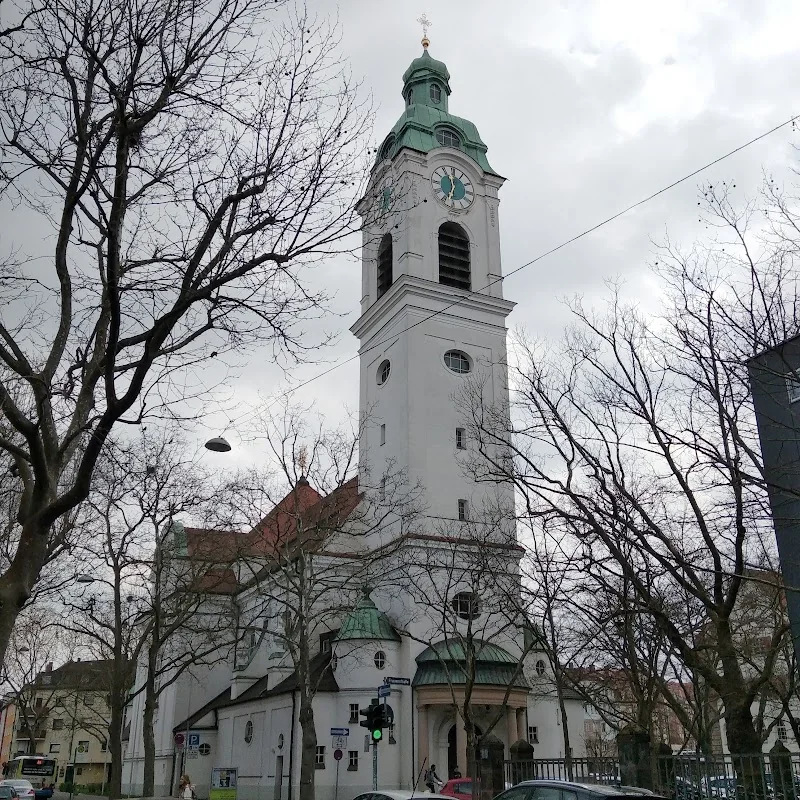
Fürth
Kaiserstraße 113, 90763 Fürth, Deutschland
Catholic Parish St. Heinrich | Fürth & Directions
The search patterns around this address clearly show what visitors pay attention to first: reviews, photos, the location in Fürth, and the connection to Bamberg or the names St. Heinrich and Kunigunde. For this reason, St. Heinrich in Fürth is a typical place with added value: not an anonymous event location, but a well-established Catholic community in the southern city, whose parish area encompasses the entire southern city of Fürth and shapes the religious and social center of the district together with the Ecumenical Center Gartenstadt. Anyone looking to orient themselves here is not just searching for a church, but for a reliable point of contact with clear opening hours, a clean contact structure, regular worship services, and an active community life. The website itself makes the character of the house clear: St. Heinrich is not just a building, but a parish with history, liturgy, music, groups, pastoral care, and meeting spaces. This is important for seekers, as the place integrates very well into everyday life: from a short visit to the parish office to Sunday services, from coffee after mass to children's church or choir. ([st-heinrich-fuerth.de](https://st-heinrich-fuerth.de/unsere-gemeinde/))
Reviews, Photos, and the First Impression of St. Heinrich in Fürth
Those searching for reviews usually want to know within seconds whether a place appears well-kept, trustworthy, and pleasant. St. Heinrich in Fürth meets this expectation in a quiet, factual manner: the parish presents itself not as an over-staged event location, but as a living community body with clear structure, good accessibility, and a visibly maintained self-understanding. The website shows images of the church and the associated buildings, and the navigation points explicitly lead to image areas and a photo chronicle, so seekers do not have to search long for photos. The visual impression is not merely decorative but substantive: the homepage indicates that the images aim to convey a small impression of St. Heinrich Church and the associated buildings, and it also highlights the cross sculpture hanging above the main altar. This is particularly valuable for a first impression, as it gives the place a clear atmosphere: dignified, well-kept, historically grown, and simultaneously used vibrantly. Therefore, those searching for images, atmosphere, or the charm of the house find not only exterior views here but also hints at the inner identity of the parish. The community activities in the areas of music, children, seniors, and encounters also contribute to this impression, as a church always appears particularly authentic when it is not only open on Sundays but remains active throughout the week. ([st-heinrich-fuerth.de](https://st-heinrich-fuerth.de/unsere-gemeinde/))
Address, Opening Hours, and Directions to Kaiserstraße 113
For practical visitor information, St. Heinrich in Fürth is very clearly set up. The Catholic parish office is located at Kaiserstraße 113, 90763 Fürth, and is thus situated in an area that is easily accessible from the southern city. The official contact details also mention Pastor Norbert Geyer, the general phone number, and an email address for the pastoral care area Fürth-City. The opening hours of the parish office are also clear: Mondays, Tuesdays, and Fridays from 09:00 to 12:00 and Thursdays from 14:00 to 17:00. This transparency is a real plus for people looking for opening hours, as it allows for direct planning. Additionally, the website points to a central parish office in the premises of the Christ the King parish office, which is accessible during extended hours. For the journey itself, the parish provides specific public transport routes: coming from Nuremberg by subway to Jakobinenstraße and then walking about 15 minutes via Jakobinen-, Ritter-, and Kaiserstraße; alternatively by bus 173 or 174 to Stresemannplatz or from the main train station with line 177 also to Stresemannplatz. A dedicated parking lot is not described on the official page; therefore, those arriving by car should plan their journey more as an urban city center or southern city approach and additionally inform themselves about the current parking situation in advance. This is where the practical benefit of the page lies: it provides reliable basic data and makes the location easy to plan. ([st-heinrich-fuerth.de](https://st-heinrich-fuerth.de/kontakt/))
Worship Services, Confession, and Children's Church at St. Heinrich
The heart of the parish is, of course, the liturgical life, and here St. Heinrich shows an impressive regularity. On Sundays, there is a Eucharistic celebration or Word of God service at 09:00, on Tuesdays at 09:00 a Eucharistic celebration, on Thursdays at 19:00 a Eucharistic celebration, which is usually celebrated bi-weekly, on Fridays at 17:00 a Eucharistic celebration outside of Lent, and during Lent at 18:00 a Stations of the Cross devotion or evening prayer. On Saturdays, there is an opportunity for confession at 17:00 and at 18:00 a Eucharistic celebration or Word of God service in alternation. Additionally, rosary prayers are offered on Tuesdays at 09:45 and Fridays at 16:15. For families, the children's church is particularly interesting, which takes place on Sundays at 09:00 in the parish center, although irregularly and depending on the current worship schedule. There is also a very lively environment with choir rehearsals, senior dance, Bible study group, Sunday coffee, and One World sales. Therefore, anyone looking for not just a church but an active parish will find a dense network of appointments and points of connection here. This is also important from an SEO perspective, as many search queries for a location do not aim at a single event but at the everyday life of a community: When is mass? Is there confession? Are there offers for children? Is the church also open on weekdays? St. Heinrich answers all these questions with a clear, recurring rhythm that makes the place relevant far beyond Sunday visits. ([st-heinrich-fuerth.de](https://st-heinrich-fuerth.de/gottesdienste/regelmaessige))
Church Building, Bamberg, and the History of St. Heinrich and Kunigunde
The history of St. Heinrich in Fürth is closely linked to the growth of the city and the development of Catholic life in the late 19th and early 20th centuries. The official chronicle describes how the Catholic population of Fürth grew significantly due to industrialization and immigration: around 1800 there were 407 Catholics, around 1890 already about 11,000, and around the turn of the century, this number continued to grow. The existing city parish church Our Lady could no longer accommodate this development, which is why the idea of a second Catholic church became increasingly urgent. Initial plans were initiated in 1899 at the Kolpinghaus, in 1902 the Nuremberg church builder Josef Schmitz presented designs for a neo-Romanesque church, and after further renovation and cost decisions, the Munich architect Hans Schurr was finally commissioned to present a church with neo-baroque forms. The foundation stone was laid on November 15, 1908, construction progressed quickly, and on October 23, 1910, St. Heinrich Church was solemnly consecrated. The connection to Bamberg is not coincidental: the chronicle refers to the 900th anniversary celebration of the Diocese of the Holy Emperor Heinrich and thus to the historical and spiritual closeness to the Archdiocese of Bamberg. This also explains the keyword connection to St. Heinrich and Kunigunde, as Heinrich II and Kunigunde are the great patron saints of the Archdiocese of Bamberg. For seekers, this classification is valuable because it explains the name not just as a label but as part of a deep regional faith history. The church thus stands not only in Fürth but in a Bamberg tradition that connects architecture, patronage, and ecclesiastical identity. ([st-heinrich-fuerth.de](https://st-heinrich-fuerth.de/service1/geschichte/kirchenbau))
Parish Center, Group Rooms, and Lived Community Life
A crucial part of the current attractiveness of St. Heinrich lies in the parish center. The property at the corner of Sonnen- and Kaiserstraße was deliberately chosen so that the church, parish house, and parish center could be brought together in one place. According to the chronicle, the former Kolpinghaus was too far from the actual center of the parish for many activities and was also in need of renovation. The new parish center was planned and implemented between 1978 and 1982, with land purchase, architect competition, groundbreaking, laying of the foundation stone, topping-out ceremony, and inauguration by Domkapitular Johannes Krauser in December 1982. Today, the house is an open place of encounter, and the website describes very specifically what the rooms are used for: a separate youth wing for youth work, a nicely designed senior club room for seniors, a music room for choir and schola, rooms for associations and groups, as well as the Heinrichsklause as a meeting point after mass. Particularly interesting for users with booking or event interests is the rental: the parish center at Sonnenstraße 21 can be used for private events, meetings, and conferences by associations, excluding the youth area; however, a Christian basic attitude and contact with the parish are prerequisites. It fits that the parish also operates two kindergartens, a regular kindergarten St. Heinrich and an integrative Montessori daycare St. Heinrich. This creates a picture that goes far beyond the classic parish office: St. Heinrich is a church infrastructure for the entire district, where faith, education, encounter, and everyday life intertwine. Those looking for a location that offers not only spaces but also a real social framework will find it here. ([st-heinrich-fuerth.de](https://st-heinrich-fuerth.de/service1/geschichte/pfarrzentrum/?utm_source=openai))
Stations of the Cross, Organ, and Special Furnishings
St. Heinrich also has a lot to offer in terms of content and art. Among the most significant furnishings are the 14 Stations of the Cross, which were created in the first half of the 19th century and were originally donated by King Ludwig I. for the Catholic parish church Our Lady. After they were no longer needed there, they came to St. Heinrich in 1928. This makes them not only art-historically interesting but also liturgically significant, as the Stations of the Cross here are not merely decoration but a lived tradition of devotion. Another focus is the organ: the current Eisenbarth organ was built in the church in 1965, consecrated on September 11, 1965, and has been renovated and expanded over the years. It has 46 registers on three manuals and pedal, mechanical action, and electric registration, as well as around 3300 pipes. The website explicitly emphasizes that this instrument is actively used liturgically and concertantly and is the centerpiece of a concert series that attracts many well-known musicians as part of the Fürth Church Music Days. The regional cantor Andreas König and the various ensembles of the parish, including the choir of St. Heinrich and Cantate-Schola, ensure the musical everyday life. Therefore, anyone thinking of a location not just in terms of spaces but also atmosphere will find in St. Heinrich an impressive combination of historical imagery, acoustic depth, and active church music. This mixture makes the place interesting for people who expect more than just a simple address when searching for terms like photos, organ, history, or special features. ([st-heinrich-fuerth.de](https://st-heinrich-fuerth.de/glauben/kreuzweg-01-00/?utm_source=openai))
Southern City, Ecumenism, and Why St. Heinrich is More Than a Church
St. Heinrich is strongly anchored in the district. The parish explicitly sees itself as part of the southern city of Fürth and simultaneously works in the pastoral care area Fürth-City, after the previous structure with St. Nikolaus was transferred to the new larger layout. This integration is important because it explains why St. Heinrich should not be viewed in isolation: the community is networked with other church locations and maintains an ecumenical and social perspective that extends far beyond the church walls. The Ecumenical Center Gartenstadt is a good example of this. It was established after the withdrawal of American troops from the Kalb Housing Area and today offers shared spaces for worship services and hall events, but also for children, youth, families, seniors, associations, and groups. At the same time, groups, circles, and volunteer work shape the parish: parish council, church administration, youth groups, choir work, senior offers, and many other formats. When searching for photos or reviews, this social foundation is often what makes a place credible in everyday life. St. Heinrich does not appear as a mere monument but as a functioning community with real depth of use: worship on Sunday, encounters during the week, music, education, family work, and space for personal concerns. This creates the image of a church that is not only a religious home but also a place of stability in the neighborhood. For visitors coming from Fürth itself or the wider Bamberg area, this is a strong argument, as history, present, and practical usability connect very harmoniously here. ([st-heinrich-fuerth.de](https://st-heinrich-fuerth.de/unsere-gemeinde/))
Sources:
- Catholic Parish St. Heinrich Fürth - Homepage
- Catholic Parish Office St. Heinrich Fürth - Contact and Opening Hours
- St. Heinrich Fürth - Regular Worship Services
- St. Heinrich Fürth - Church Building and History
- St. Heinrich Fürth - Parish Center and Community Life
- St. Heinrich Fürth - City Map and Directions
- St. Heinrich Fürth - Organ and Church Music
Mehr anzeigenWeniger anzeigen
Catholic Parish St. Heinrich | Fürth & Directions
The search patterns around this address clearly show what visitors pay attention to first: reviews, photos, the location in Fürth, and the connection to Bamberg or the names St. Heinrich and Kunigunde. For this reason, St. Heinrich in Fürth is a typical place with added value: not an anonymous event location, but a well-established Catholic community in the southern city, whose parish area encompasses the entire southern city of Fürth and shapes the religious and social center of the district together with the Ecumenical Center Gartenstadt. Anyone looking to orient themselves here is not just searching for a church, but for a reliable point of contact with clear opening hours, a clean contact structure, regular worship services, and an active community life. The website itself makes the character of the house clear: St. Heinrich is not just a building, but a parish with history, liturgy, music, groups, pastoral care, and meeting spaces. This is important for seekers, as the place integrates very well into everyday life: from a short visit to the parish office to Sunday services, from coffee after mass to children's church or choir. ([st-heinrich-fuerth.de](https://st-heinrich-fuerth.de/unsere-gemeinde/))
Reviews, Photos, and the First Impression of St. Heinrich in Fürth
Those searching for reviews usually want to know within seconds whether a place appears well-kept, trustworthy, and pleasant. St. Heinrich in Fürth meets this expectation in a quiet, factual manner: the parish presents itself not as an over-staged event location, but as a living community body with clear structure, good accessibility, and a visibly maintained self-understanding. The website shows images of the church and the associated buildings, and the navigation points explicitly lead to image areas and a photo chronicle, so seekers do not have to search long for photos. The visual impression is not merely decorative but substantive: the homepage indicates that the images aim to convey a small impression of St. Heinrich Church and the associated buildings, and it also highlights the cross sculpture hanging above the main altar. This is particularly valuable for a first impression, as it gives the place a clear atmosphere: dignified, well-kept, historically grown, and simultaneously used vibrantly. Therefore, those searching for images, atmosphere, or the charm of the house find not only exterior views here but also hints at the inner identity of the parish. The community activities in the areas of music, children, seniors, and encounters also contribute to this impression, as a church always appears particularly authentic when it is not only open on Sundays but remains active throughout the week. ([st-heinrich-fuerth.de](https://st-heinrich-fuerth.de/unsere-gemeinde/))
Address, Opening Hours, and Directions to Kaiserstraße 113
For practical visitor information, St. Heinrich in Fürth is very clearly set up. The Catholic parish office is located at Kaiserstraße 113, 90763 Fürth, and is thus situated in an area that is easily accessible from the southern city. The official contact details also mention Pastor Norbert Geyer, the general phone number, and an email address for the pastoral care area Fürth-City. The opening hours of the parish office are also clear: Mondays, Tuesdays, and Fridays from 09:00 to 12:00 and Thursdays from 14:00 to 17:00. This transparency is a real plus for people looking for opening hours, as it allows for direct planning. Additionally, the website points to a central parish office in the premises of the Christ the King parish office, which is accessible during extended hours. For the journey itself, the parish provides specific public transport routes: coming from Nuremberg by subway to Jakobinenstraße and then walking about 15 minutes via Jakobinen-, Ritter-, and Kaiserstraße; alternatively by bus 173 or 174 to Stresemannplatz or from the main train station with line 177 also to Stresemannplatz. A dedicated parking lot is not described on the official page; therefore, those arriving by car should plan their journey more as an urban city center or southern city approach and additionally inform themselves about the current parking situation in advance. This is where the practical benefit of the page lies: it provides reliable basic data and makes the location easy to plan. ([st-heinrich-fuerth.de](https://st-heinrich-fuerth.de/kontakt/))
Worship Services, Confession, and Children's Church at St. Heinrich
The heart of the parish is, of course, the liturgical life, and here St. Heinrich shows an impressive regularity. On Sundays, there is a Eucharistic celebration or Word of God service at 09:00, on Tuesdays at 09:00 a Eucharistic celebration, on Thursdays at 19:00 a Eucharistic celebration, which is usually celebrated bi-weekly, on Fridays at 17:00 a Eucharistic celebration outside of Lent, and during Lent at 18:00 a Stations of the Cross devotion or evening prayer. On Saturdays, there is an opportunity for confession at 17:00 and at 18:00 a Eucharistic celebration or Word of God service in alternation. Additionally, rosary prayers are offered on Tuesdays at 09:45 and Fridays at 16:15. For families, the children's church is particularly interesting, which takes place on Sundays at 09:00 in the parish center, although irregularly and depending on the current worship schedule. There is also a very lively environment with choir rehearsals, senior dance, Bible study group, Sunday coffee, and One World sales. Therefore, anyone looking for not just a church but an active parish will find a dense network of appointments and points of connection here. This is also important from an SEO perspective, as many search queries for a location do not aim at a single event but at the everyday life of a community: When is mass? Is there confession? Are there offers for children? Is the church also open on weekdays? St. Heinrich answers all these questions with a clear, recurring rhythm that makes the place relevant far beyond Sunday visits. ([st-heinrich-fuerth.de](https://st-heinrich-fuerth.de/gottesdienste/regelmaessige))
Church Building, Bamberg, and the History of St. Heinrich and Kunigunde
The history of St. Heinrich in Fürth is closely linked to the growth of the city and the development of Catholic life in the late 19th and early 20th centuries. The official chronicle describes how the Catholic population of Fürth grew significantly due to industrialization and immigration: around 1800 there were 407 Catholics, around 1890 already about 11,000, and around the turn of the century, this number continued to grow. The existing city parish church Our Lady could no longer accommodate this development, which is why the idea of a second Catholic church became increasingly urgent. Initial plans were initiated in 1899 at the Kolpinghaus, in 1902 the Nuremberg church builder Josef Schmitz presented designs for a neo-Romanesque church, and after further renovation and cost decisions, the Munich architect Hans Schurr was finally commissioned to present a church with neo-baroque forms. The foundation stone was laid on November 15, 1908, construction progressed quickly, and on October 23, 1910, St. Heinrich Church was solemnly consecrated. The connection to Bamberg is not coincidental: the chronicle refers to the 900th anniversary celebration of the Diocese of the Holy Emperor Heinrich and thus to the historical and spiritual closeness to the Archdiocese of Bamberg. This also explains the keyword connection to St. Heinrich and Kunigunde, as Heinrich II and Kunigunde are the great patron saints of the Archdiocese of Bamberg. For seekers, this classification is valuable because it explains the name not just as a label but as part of a deep regional faith history. The church thus stands not only in Fürth but in a Bamberg tradition that connects architecture, patronage, and ecclesiastical identity. ([st-heinrich-fuerth.de](https://st-heinrich-fuerth.de/service1/geschichte/kirchenbau))
Parish Center, Group Rooms, and Lived Community Life
A crucial part of the current attractiveness of St. Heinrich lies in the parish center. The property at the corner of Sonnen- and Kaiserstraße was deliberately chosen so that the church, parish house, and parish center could be brought together in one place. According to the chronicle, the former Kolpinghaus was too far from the actual center of the parish for many activities and was also in need of renovation. The new parish center was planned and implemented between 1978 and 1982, with land purchase, architect competition, groundbreaking, laying of the foundation stone, topping-out ceremony, and inauguration by Domkapitular Johannes Krauser in December 1982. Today, the house is an open place of encounter, and the website describes very specifically what the rooms are used for: a separate youth wing for youth work, a nicely designed senior club room for seniors, a music room for choir and schola, rooms for associations and groups, as well as the Heinrichsklause as a meeting point after mass. Particularly interesting for users with booking or event interests is the rental: the parish center at Sonnenstraße 21 can be used for private events, meetings, and conferences by associations, excluding the youth area; however, a Christian basic attitude and contact with the parish are prerequisites. It fits that the parish also operates two kindergartens, a regular kindergarten St. Heinrich and an integrative Montessori daycare St. Heinrich. This creates a picture that goes far beyond the classic parish office: St. Heinrich is a church infrastructure for the entire district, where faith, education, encounter, and everyday life intertwine. Those looking for a location that offers not only spaces but also a real social framework will find it here. ([st-heinrich-fuerth.de](https://st-heinrich-fuerth.de/service1/geschichte/pfarrzentrum/?utm_source=openai))
Stations of the Cross, Organ, and Special Furnishings
St. Heinrich also has a lot to offer in terms of content and art. Among the most significant furnishings are the 14 Stations of the Cross, which were created in the first half of the 19th century and were originally donated by King Ludwig I. for the Catholic parish church Our Lady. After they were no longer needed there, they came to St. Heinrich in 1928. This makes them not only art-historically interesting but also liturgically significant, as the Stations of the Cross here are not merely decoration but a lived tradition of devotion. Another focus is the organ: the current Eisenbarth organ was built in the church in 1965, consecrated on September 11, 1965, and has been renovated and expanded over the years. It has 46 registers on three manuals and pedal, mechanical action, and electric registration, as well as around 3300 pipes. The website explicitly emphasizes that this instrument is actively used liturgically and concertantly and is the centerpiece of a concert series that attracts many well-known musicians as part of the Fürth Church Music Days. The regional cantor Andreas König and the various ensembles of the parish, including the choir of St. Heinrich and Cantate-Schola, ensure the musical everyday life. Therefore, anyone thinking of a location not just in terms of spaces but also atmosphere will find in St. Heinrich an impressive combination of historical imagery, acoustic depth, and active church music. This mixture makes the place interesting for people who expect more than just a simple address when searching for terms like photos, organ, history, or special features. ([st-heinrich-fuerth.de](https://st-heinrich-fuerth.de/glauben/kreuzweg-01-00/?utm_source=openai))
Southern City, Ecumenism, and Why St. Heinrich is More Than a Church
St. Heinrich is strongly anchored in the district. The parish explicitly sees itself as part of the southern city of Fürth and simultaneously works in the pastoral care area Fürth-City, after the previous structure with St. Nikolaus was transferred to the new larger layout. This integration is important because it explains why St. Heinrich should not be viewed in isolation: the community is networked with other church locations and maintains an ecumenical and social perspective that extends far beyond the church walls. The Ecumenical Center Gartenstadt is a good example of this. It was established after the withdrawal of American troops from the Kalb Housing Area and today offers shared spaces for worship services and hall events, but also for children, youth, families, seniors, associations, and groups. At the same time, groups, circles, and volunteer work shape the parish: parish council, church administration, youth groups, choir work, senior offers, and many other formats. When searching for photos or reviews, this social foundation is often what makes a place credible in everyday life. St. Heinrich does not appear as a mere monument but as a functioning community with real depth of use: worship on Sunday, encounters during the week, music, education, family work, and space for personal concerns. This creates the image of a church that is not only a religious home but also a place of stability in the neighborhood. For visitors coming from Fürth itself or the wider Bamberg area, this is a strong argument, as history, present, and practical usability connect very harmoniously here. ([st-heinrich-fuerth.de](https://st-heinrich-fuerth.de/unsere-gemeinde/))
Sources:
- Catholic Parish St. Heinrich Fürth - Homepage
- Catholic Parish Office St. Heinrich Fürth - Contact and Opening Hours
- St. Heinrich Fürth - Regular Worship Services
- St. Heinrich Fürth - Church Building and History
- St. Heinrich Fürth - Parish Center and Community Life
- St. Heinrich Fürth - City Map and Directions
- St. Heinrich Fürth - Organ and Church Music
Catholic Parish St. Heinrich | Fürth & Directions
The search patterns around this address clearly show what visitors pay attention to first: reviews, photos, the location in Fürth, and the connection to Bamberg or the names St. Heinrich and Kunigunde. For this reason, St. Heinrich in Fürth is a typical place with added value: not an anonymous event location, but a well-established Catholic community in the southern city, whose parish area encompasses the entire southern city of Fürth and shapes the religious and social center of the district together with the Ecumenical Center Gartenstadt. Anyone looking to orient themselves here is not just searching for a church, but for a reliable point of contact with clear opening hours, a clean contact structure, regular worship services, and an active community life. The website itself makes the character of the house clear: St. Heinrich is not just a building, but a parish with history, liturgy, music, groups, pastoral care, and meeting spaces. This is important for seekers, as the place integrates very well into everyday life: from a short visit to the parish office to Sunday services, from coffee after mass to children's church or choir. ([st-heinrich-fuerth.de](https://st-heinrich-fuerth.de/unsere-gemeinde/))
Reviews, Photos, and the First Impression of St. Heinrich in Fürth
Those searching for reviews usually want to know within seconds whether a place appears well-kept, trustworthy, and pleasant. St. Heinrich in Fürth meets this expectation in a quiet, factual manner: the parish presents itself not as an over-staged event location, but as a living community body with clear structure, good accessibility, and a visibly maintained self-understanding. The website shows images of the church and the associated buildings, and the navigation points explicitly lead to image areas and a photo chronicle, so seekers do not have to search long for photos. The visual impression is not merely decorative but substantive: the homepage indicates that the images aim to convey a small impression of St. Heinrich Church and the associated buildings, and it also highlights the cross sculpture hanging above the main altar. This is particularly valuable for a first impression, as it gives the place a clear atmosphere: dignified, well-kept, historically grown, and simultaneously used vibrantly. Therefore, those searching for images, atmosphere, or the charm of the house find not only exterior views here but also hints at the inner identity of the parish. The community activities in the areas of music, children, seniors, and encounters also contribute to this impression, as a church always appears particularly authentic when it is not only open on Sundays but remains active throughout the week. ([st-heinrich-fuerth.de](https://st-heinrich-fuerth.de/unsere-gemeinde/))
Address, Opening Hours, and Directions to Kaiserstraße 113
For practical visitor information, St. Heinrich in Fürth is very clearly set up. The Catholic parish office is located at Kaiserstraße 113, 90763 Fürth, and is thus situated in an area that is easily accessible from the southern city. The official contact details also mention Pastor Norbert Geyer, the general phone number, and an email address for the pastoral care area Fürth-City. The opening hours of the parish office are also clear: Mondays, Tuesdays, and Fridays from 09:00 to 12:00 and Thursdays from 14:00 to 17:00. This transparency is a real plus for people looking for opening hours, as it allows for direct planning. Additionally, the website points to a central parish office in the premises of the Christ the King parish office, which is accessible during extended hours. For the journey itself, the parish provides specific public transport routes: coming from Nuremberg by subway to Jakobinenstraße and then walking about 15 minutes via Jakobinen-, Ritter-, and Kaiserstraße; alternatively by bus 173 or 174 to Stresemannplatz or from the main train station with line 177 also to Stresemannplatz. A dedicated parking lot is not described on the official page; therefore, those arriving by car should plan their journey more as an urban city center or southern city approach and additionally inform themselves about the current parking situation in advance. This is where the practical benefit of the page lies: it provides reliable basic data and makes the location easy to plan. ([st-heinrich-fuerth.de](https://st-heinrich-fuerth.de/kontakt/))
Worship Services, Confession, and Children's Church at St. Heinrich
The heart of the parish is, of course, the liturgical life, and here St. Heinrich shows an impressive regularity. On Sundays, there is a Eucharistic celebration or Word of God service at 09:00, on Tuesdays at 09:00 a Eucharistic celebration, on Thursdays at 19:00 a Eucharistic celebration, which is usually celebrated bi-weekly, on Fridays at 17:00 a Eucharistic celebration outside of Lent, and during Lent at 18:00 a Stations of the Cross devotion or evening prayer. On Saturdays, there is an opportunity for confession at 17:00 and at 18:00 a Eucharistic celebration or Word of God service in alternation. Additionally, rosary prayers are offered on Tuesdays at 09:45 and Fridays at 16:15. For families, the children's church is particularly interesting, which takes place on Sundays at 09:00 in the parish center, although irregularly and depending on the current worship schedule. There is also a very lively environment with choir rehearsals, senior dance, Bible study group, Sunday coffee, and One World sales. Therefore, anyone looking for not just a church but an active parish will find a dense network of appointments and points of connection here. This is also important from an SEO perspective, as many search queries for a location do not aim at a single event but at the everyday life of a community: When is mass? Is there confession? Are there offers for children? Is the church also open on weekdays? St. Heinrich answers all these questions with a clear, recurring rhythm that makes the place relevant far beyond Sunday visits. ([st-heinrich-fuerth.de](https://st-heinrich-fuerth.de/gottesdienste/regelmaessige))
Church Building, Bamberg, and the History of St. Heinrich and Kunigunde
The history of St. Heinrich in Fürth is closely linked to the growth of the city and the development of Catholic life in the late 19th and early 20th centuries. The official chronicle describes how the Catholic population of Fürth grew significantly due to industrialization and immigration: around 1800 there were 407 Catholics, around 1890 already about 11,000, and around the turn of the century, this number continued to grow. The existing city parish church Our Lady could no longer accommodate this development, which is why the idea of a second Catholic church became increasingly urgent. Initial plans were initiated in 1899 at the Kolpinghaus, in 1902 the Nuremberg church builder Josef Schmitz presented designs for a neo-Romanesque church, and after further renovation and cost decisions, the Munich architect Hans Schurr was finally commissioned to present a church with neo-baroque forms. The foundation stone was laid on November 15, 1908, construction progressed quickly, and on October 23, 1910, St. Heinrich Church was solemnly consecrated. The connection to Bamberg is not coincidental: the chronicle refers to the 900th anniversary celebration of the Diocese of the Holy Emperor Heinrich and thus to the historical and spiritual closeness to the Archdiocese of Bamberg. This also explains the keyword connection to St. Heinrich and Kunigunde, as Heinrich II and Kunigunde are the great patron saints of the Archdiocese of Bamberg. For seekers, this classification is valuable because it explains the name not just as a label but as part of a deep regional faith history. The church thus stands not only in Fürth but in a Bamberg tradition that connects architecture, patronage, and ecclesiastical identity. ([st-heinrich-fuerth.de](https://st-heinrich-fuerth.de/service1/geschichte/kirchenbau))
Parish Center, Group Rooms, and Lived Community Life
A crucial part of the current attractiveness of St. Heinrich lies in the parish center. The property at the corner of Sonnen- and Kaiserstraße was deliberately chosen so that the church, parish house, and parish center could be brought together in one place. According to the chronicle, the former Kolpinghaus was too far from the actual center of the parish for many activities and was also in need of renovation. The new parish center was planned and implemented between 1978 and 1982, with land purchase, architect competition, groundbreaking, laying of the foundation stone, topping-out ceremony, and inauguration by Domkapitular Johannes Krauser in December 1982. Today, the house is an open place of encounter, and the website describes very specifically what the rooms are used for: a separate youth wing for youth work, a nicely designed senior club room for seniors, a music room for choir and schola, rooms for associations and groups, as well as the Heinrichsklause as a meeting point after mass. Particularly interesting for users with booking or event interests is the rental: the parish center at Sonnenstraße 21 can be used for private events, meetings, and conferences by associations, excluding the youth area; however, a Christian basic attitude and contact with the parish are prerequisites. It fits that the parish also operates two kindergartens, a regular kindergarten St. Heinrich and an integrative Montessori daycare St. Heinrich. This creates a picture that goes far beyond the classic parish office: St. Heinrich is a church infrastructure for the entire district, where faith, education, encounter, and everyday life intertwine. Those looking for a location that offers not only spaces but also a real social framework will find it here. ([st-heinrich-fuerth.de](https://st-heinrich-fuerth.de/service1/geschichte/pfarrzentrum/?utm_source=openai))
Stations of the Cross, Organ, and Special Furnishings
St. Heinrich also has a lot to offer in terms of content and art. Among the most significant furnishings are the 14 Stations of the Cross, which were created in the first half of the 19th century and were originally donated by King Ludwig I. for the Catholic parish church Our Lady. After they were no longer needed there, they came to St. Heinrich in 1928. This makes them not only art-historically interesting but also liturgically significant, as the Stations of the Cross here are not merely decoration but a lived tradition of devotion. Another focus is the organ: the current Eisenbarth organ was built in the church in 1965, consecrated on September 11, 1965, and has been renovated and expanded over the years. It has 46 registers on three manuals and pedal, mechanical action, and electric registration, as well as around 3300 pipes. The website explicitly emphasizes that this instrument is actively used liturgically and concertantly and is the centerpiece of a concert series that attracts many well-known musicians as part of the Fürth Church Music Days. The regional cantor Andreas König and the various ensembles of the parish, including the choir of St. Heinrich and Cantate-Schola, ensure the musical everyday life. Therefore, anyone thinking of a location not just in terms of spaces but also atmosphere will find in St. Heinrich an impressive combination of historical imagery, acoustic depth, and active church music. This mixture makes the place interesting for people who expect more than just a simple address when searching for terms like photos, organ, history, or special features. ([st-heinrich-fuerth.de](https://st-heinrich-fuerth.de/glauben/kreuzweg-01-00/?utm_source=openai))
Southern City, Ecumenism, and Why St. Heinrich is More Than a Church
St. Heinrich is strongly anchored in the district. The parish explicitly sees itself as part of the southern city of Fürth and simultaneously works in the pastoral care area Fürth-City, after the previous structure with St. Nikolaus was transferred to the new larger layout. This integration is important because it explains why St. Heinrich should not be viewed in isolation: the community is networked with other church locations and maintains an ecumenical and social perspective that extends far beyond the church walls. The Ecumenical Center Gartenstadt is a good example of this. It was established after the withdrawal of American troops from the Kalb Housing Area and today offers shared spaces for worship services and hall events, but also for children, youth, families, seniors, associations, and groups. At the same time, groups, circles, and volunteer work shape the parish: parish council, church administration, youth groups, choir work, senior offers, and many other formats. When searching for photos or reviews, this social foundation is often what makes a place credible in everyday life. St. Heinrich does not appear as a mere monument but as a functioning community with real depth of use: worship on Sunday, encounters during the week, music, education, family work, and space for personal concerns. This creates the image of a church that is not only a religious home but also a place of stability in the neighborhood. For visitors coming from Fürth itself or the wider Bamberg area, this is a strong argument, as history, present, and practical usability connect very harmoniously here. ([st-heinrich-fuerth.de](https://st-heinrich-fuerth.de/unsere-gemeinde/))
Sources:
- Catholic Parish St. Heinrich Fürth - Homepage
- Catholic Parish Office St. Heinrich Fürth - Contact and Opening Hours
- St. Heinrich Fürth - Regular Worship Services
- St. Heinrich Fürth - Church Building and History
- St. Heinrich Fürth - Parish Center and Community Life
- St. Heinrich Fürth - City Map and Directions
- St. Heinrich Fürth - Organ and Church Music
Upcoming Events
No events found
Frequently Asked Questions
Reviews
Manuela Molnár
16. September 2021
I held a meeting here with a larger homeowners' association. Everything was perfect from the reservation to the meeting! A lot of trust in people you don't know. I even had the option to pay the room rental in cash or via bank transfer. Very good hygiene concept. Disinfectant for wiping down the tables was ready and provided free of charge. Thank you very much for the trust shown.
L. T.
17. March 2020
I have a lot of connections with St. Heinrich, everything from pastoral care to family support, you always get help there, no matter what it's about. Great. The services are also nice with singing and lovely conversations. It's always a place of reflection for me.
Thomas Wülk
13. January 2019
The best parish I know. Sensationally open and empathetic Pastor Norbert Geyer, perfect organization for all celebrations, a meeting place for old and young, services at different times, great festivities spread throughout the church year, various choirs, good organist, highly recommendable!!!
DP BL
25. December 2017
The Catholic Church of St. Heinrich was built in 1910 and is located in the southern part of Fürth! This church has a neo-baroque architectural style and forms a clear contrast to the neo-Gothic Protestant Church of St. Paul! Particularly worth seeing are the Stations of the Cross images, the main and side altars, the cross above the people's altar, and the pulpit!!! More information can be found at the parish house, Kaiserstrasse 113, 90763 Fürth.
Tom
19. April 2021
Catholic Church St. Heinrich Fürth, not wheelchair accessible ramp 27% incline, doors 90 cm, inductive hearing system available, (-) wheelchair accessible restroom in the parish center,