
Fürth
Burg 17, 90403 Nürnberg, Deutschland
Kaiserburg Nürnberg | Opening Hours & Admission
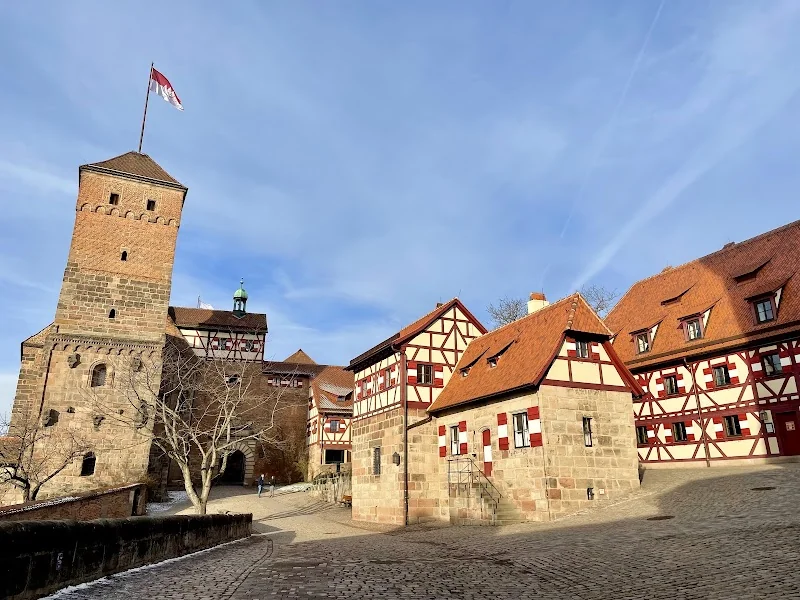
The Kaiserburg Nürnberg towers over the old town on a sandstone ridge and is one of the most significant castle complexes in Germany. As a former imperial palace, it encapsulates fascinating history, impressive architecture, and stunning views over Nuremberg in a compact space. Visitors experience the main highlights of the site in the Palas with its double chapel, in the Kaiserburg Museum, on the Sinwell Tower, and at the Deep Well – from a medieval power center to today’s urban landmark. Practical information such as seasonal opening hours, admission prices, and public transport access is clearly regulated; tickets can be purchased on-site at the cash desk in the outer courtyard. For culture enthusiasts, the Knights' Hall also offers a special stage for atmospheric concert formats by candlelight. Those needing a break can find a managed refreshment stop at the Burg Café Beer directly in the courtyard; in the historic Kaiser stables, the culture|youth hostel combines modern accommodation with conference rooms. This guide summarizes everything you need for a successful visit – from the best visiting times to accessible entrances and tips for concerts and families.
Opening Hours of Kaiserburg Nürnberg
The visiting hours of Kaiserburg are based on the season and are easy to remember: In the warm season, from April to September inclusive, the castle is open daily from 9 AM to 6 PM. In the cooler season, from October to March inclusive, the opening hours are daily from 10 AM to 4 PM. Important for daily planning is the last admission: it occurs about 60 minutes before closing, allowing for a relaxed tour through the Palas, museum, and outdoor areas. The complex is only closed on a few days of the year – specifically on January 1 (New Year's Day), on Shrove Tuesday, and on December 24, 25, and 31. Those planning a visit around the holidays should mark these days in their calendar.
The area includes seasonally accessible garden areas, which are particularly suitable for a breather with a panoramic view. The castle garden usually opens between April and October at the earliest from 8 AM and remains accessible until dusk (latest by 8 PM). In the winter months, the castle garden is closed. An additional botanical highlight is the Maria Sibylla Merian Garden; it is open from April to September on Sundays and Mondays from 2 PM to 6 PM, in October on the same weekdays from 2 PM to 4 PM, and otherwise closed (November to early April). Thus, the warm season is particularly suitable for enjoying the combination of exhibitions, tower ascent, and garden visit.
Good to know: The exhibition in the Palas and the Kaiserburg Museum are accessible without a guided tour, allowing for flexible visiting times. The Deep Well is shown as part of a demonstration for safety and educational reasons; the demonstrations are included in the ticket. Those wishing to avoid crowds should choose the early morning hours or later afternoons outside of holidays. Even during high demand, such as around the Christkindlesmarkt, access remains manageable with the mentioned time slots as long as the last admission is kept in mind.
Admission and Tickets: Museum, Sinwell Tower, and Deep Well
For an overview, the so-called total ticket 'Kaiserburg' is recommended. It includes the Palas with the double chapel and permanent exhibition, the Kaiserburg Museum in the Kemenate, the demonstration at the Deep Well, and the ascent to the Sinwell Tower. In 2025, the total ticket costs €9 (reduced €8). Alternatively, partial tickets are available: Palas with double chapel and Kaiserburg Museum €7 (reduced €6) and Deep Well plus Sinwell Tower €4 (reduced €3). The castle garden and the Maria Sibylla Merian Garden are freely accessible. Those wishing to combine their castle visit with another Franconian highlight can opt for the combination ticket 'Kaiserburg + Cadolzburg' for €14 (reduced €12). Children and young people under 18 enjoy free admission – a good option for families wanting to combine museum and outdoor areas without stress.
Tickets are sold exclusively on-site at the cash desk in the outer courtyard; online pre-ordering is currently not possible. Payment can be made conveniently in cash or by card (EC and common credit cards). This on-site solution has advantages: one remains flexible regarding weather, mood, and visiting time. Those wanting to experience the exhibition in the Palas more intensively can use the audio guide. It is available in several languages (including German, English, French, Italian, Spanish, Russian, Czech) and also offers a version for students from middle school. The rental fee is €2 per person. It becomes particularly vivid at the Deep Well: The shaft extends about 47 meters into the rock; a demonstration explains its history and function, partially supported by a camera ride that visually makes the view into the depth experienceable.
The Sinwell Tower rewards visitors with an impressive panoramic view of the city after 113 steps. Those with children should plan for the steps in advance; the tower is not suitable for strollers. Good to know: The order of the stations can be arranged flexibly, such as visiting the museum and Palas first, then the tower and well – or vice versa, depending on crowds and weather. Groups can individually book additional offers from the Art and Cultural Education Center of the Museums in Nuremberg (KPZ). This way, the visit can be condensed into a compact journey through time that connects armor and weapons, astronomical instruments, courtly representation, and everyday culture.
Access and Parking at Kaiserburg Nürnberg
Kaiserburg is centrally located above the Nuremberg old town and is easily accessible by public transport. In the immediate vicinity, there are three important stops of the Nuremberg local transport: the subway station 'Lorenzkirche', the bus stop 'Burgstraße', and the tram stop 'Tiergärtnertor'. From there, it is only a few minutes on foot to the outer courtyard. The local transport company provides the timetable information and fares; for travel from the region, the train with connections to public transport is recommended. Those who shy away from the ascent to the castle can choose a walking path with a moderate incline or plan short breaks at viewpoints – the paths are signposted.
For driving, there is a clear rule: There are no visitor parking spaces directly at Kaiserburg. Guests are asked to use the signposted parking garages in the city center and to plan the short walk to the castle. This saves search traffic on the castle hill and protects the historic ensemble. An exception is made for two designated disabled parking spaces in the outer courtyard; they are located between the castle café and museum cash desk. Those who rely on barrier-free paths also benefit from step-free access to central areas such as the cash and information building, the inner courtyard, and parts of the Kaiserburg Museum (ground floor). For the Palas, the Knights' Hall and the wedding room are accessible via a lift; however, the double chapel and the upper floor are only accessible via stairs.
The Sinwell Tower is a historic observation tower, whose platform is only accessible via stairs (113 steps); wheelchair users and people with walking aids should consider this when planning. At the Deep Well, a camera ride on a screen provides insights into the approximately 47-meter-deep shaft bottom, even if the immediate view from a wheelchair into the shaft is not possible. For people with hearing impairments, there is an inductive hearing system in the cash area as well as audio guides with induction technology; for people with visual impairments, tactile information is available at the forecourt. Those arriving by coach can use the designated access and drop-off points near the castle and follow the signs to the cash desk in the courtyard. Overall, public transport is recommended for individual visitors – it is stress-free, sustainable, and preserves the sensitive traffic situation around the castle.
Knights' Hall and Concerts: Candlelight Experiences in the Castle
The historic Knights' Hall in the Palas is now a special stage for concerts and representative events. The Bavarian Palace Administration indicates a maximum occupancy of up to 300 people for standing receptions and about 250 seats in row seating (without a podium). The room is used, among other things, for concert series that atmospherically incorporate the impressive hall architecture and acoustics. This includes the popular candlelight formats, which interpret well-known classical and pop programs by candlelight with string quartet or piano. These concerts usually last about 60 minutes without a break; admission begins about 30 minutes before the concert starts, late admission is usually not possible, and seating is chosen within the zone selected at the time of ticket purchase according to the principle of 'free seating' upon arrival.
For organizers, the Knights' Hall is a high-quality event space with historic ambiance. It is usually rented for corporate events, concerts, banquets, and standing receptions; private rentals are not planned. The inner courtyard can also be used – in combination with the Knights' Hall – and offers space for larger standing receptions as an open-air area. In addition to the monument preservation conditions, organizational requirements apply that ensure safety, fire protection, and the protection of the original interior substance. Those wishing to promote concerts as part of a public event must adhere to a regular approval and rental scheme; for accessible events with public advance sales, separate rates may apply.
As a visitor experience, the candle concerts add an emotional note to the classic castle discovery. An evening stroll through the courtyard, followed by music in the historic hall, makes the spaces feel different than during the day – the visual depth of the room, the wooden ceilings, the walls, and the view back into the courtyard. Those wishing to combine the concert and castle visit should plan the museum, tower, and well during the day and return in the evening for the concert. It should be noted that concert tickets are sold independently through the respective providers and are not available at the museum cash desk; for museum exhibitions and viewpoints, the daily or combination ticket for the Kaiserburg still applies.
History and Interior: Palas, Double Chapel, Sinwell Tower, and Deep Well
The Kaiserburg is a core location of medieval imperial history. It appears in written sources in 1105; between about 1050 and 1571, all Roman-German emperors resided at least temporarily in Nuremberg. The Palas with its representative rooms – including the Knights' Hall – was a place for embassies, audiences, and court days. A special architectural ensemble is formed by the double chapel from the Romanesque period, which makes the hierarchical spatial thinking of the time visible. The neighboring Sinwell Tower is a distinctive round tower that offers one of the best views of the city and surrounding area after 113 steps. In the center of the outer bailey lies the Deep Well, whose shaft was driven about 47 meters into the rock and ensured the castle's autonomous water supply. The demonstration at the well vividly explains the functioning and significance of this facility during times of siege.
The Kaiserburg Museum in the Kemenate is a branch of the German National Museum. The permanent exhibition connects objects of weapon history – from swords to armor to riding equipment – with testimonies of courtly and urban culture. An independent thematic perspective is dedicated to the research history and the scientific use of the castle in the early modern period: The Nuremberg astronomer Georg Christoph Eimmart established an observatory at the castle from 1678, whose instruments – including an impressive armillary sphere from 1680 – exemplarily make the scientific curiosity of the time visible. Since 2013, the museum has been architecturally integrated into a circular route that connects the interior spaces managed by the Palace Administration with the weapon collection; thus, the castle complex can be experienced without architectural barriers between the individual stations, as far as historical stairs allow.
For orientation, a simple plan helps: Outer courtyard with cash desk and castle café, inner courtyard as the center of the interior spaces, Palas with double chapel and Knights' Hall on one side, Kemenate with Kaiserburg Museum on the other side; the Sinwell Tower rises as a viewpoint, the Deep Well lies centrally in the outer bailey. Additionally, the castle garden and the Maria Sibylla Merian Garden open seasonally. Those wanting to delve deeper can use the multilingual audio guide; it provides background on architecture, usage history, and notable details such as the late Gothic additions or representative sculptures. With this knowledge in mind, the view from the tower over the city – from the church towers to the city wall – becomes a journey through time spanning almost a millennium.
Dining, Restaurant, and Youth Hostel: Burg Café Beer and Kaiser Stables
Directly in the courtyard, the Bavarian Palace Administration operates a leased restaurant: the Burg Café Beer at the address 'Auf der Burg 13'. It is a practical stop for coffee, cake, and light meals – ideal for recharging energy before the tower ascent or winding down the castle visit. The opening hours are seasonal: Usually from April to September from 10 AM to 6 PM and from October to March from 10 AM to 5 PM. For barrier-free visits, there is a step-free access and a disabled-friendly toilet available. Those traveling with family or in a group will find an uncomplicated break here between the museum, well demonstration, and tower. The café is only a few steps away from the cash desk, making it easy to bridge waiting times – for example, until the next well demonstration.
A second notable offering is the culture|youth hostel Nuremberg in the historic Kaiser stables. The late medieval building has been developed into a modern house with rooms, bistro, nine seminar rooms, and the Eppeleinsaal. The Eppeleinsaal is suitable for conferences and symposia and accommodates up to 199 people; thus, it complements the event offerings of the castle with a flexible, modern conference space. Due to its location above the old town, short distances to the most important sights are guaranteed. For school classes, family programs, or project-related stays, the youth hostel offers tailored packages – from a medieval quiz through the old town to a combined visit to Kaiserburg and Cadolzburg. This way, the educational and experiential character of the castle area can be combined with comfortable overnight accommodations.
For those seeking Franconian cuisine, there is a wide range of inns and restaurants in the immediate vicinity of the castle; for the immediate area of Kaiserburg, the Burg Café Beer remains the official stop. Practical tip: During peak times around holidays or large events, a short planning of breaks is advisable – for example, an early lunch stop at the café before the tower ascent or a coffee break between the museum and well demonstration. In any case, the combination of castle visit, a short refreshment, and a possible evening concert in the Knights' Hall rounds off the experience into a coherent day at Nuremberg's landmark.
Sources:
- Bavarian Palace Administration – Kaiserburg Nürnberg: Opening Hours and Tours
- Bavarian Palace Administration – Kaiserburg Nürnberg: Admission Prices / Tickets
- Bavarian Palace Administration – Kaiserburg Nürnberg: Access & Parking
- Bavarian Palace Administration – Event Rooms: Knights' Hall (Capacities, Use)
- Congress and Tourism Center Nuremberg – Kaiserburg (Overview, 113 Steps, 47 m Well)
- German National Museum – Kaiserburg Museum (Branch, Contents, Opening Hours)
- Fever – Candlelight: Romantic Classics (Location: Knights' Hall of Kaiserburg Nürnberg)
- Bavarian Palace Administration – Kaiserburg Nürnberg: Restaurant Burg Café Beer
Mehr anzeigenWeniger anzeigen
Kaiserburg Nürnberg | Opening Hours & Admission
The Kaiserburg Nürnberg towers over the old town on a sandstone ridge and is one of the most significant castle complexes in Germany. As a former imperial palace, it encapsulates fascinating history, impressive architecture, and stunning views over Nuremberg in a compact space. Visitors experience the main highlights of the site in the Palas with its double chapel, in the Kaiserburg Museum, on the Sinwell Tower, and at the Deep Well – from a medieval power center to today’s urban landmark. Practical information such as seasonal opening hours, admission prices, and public transport access is clearly regulated; tickets can be purchased on-site at the cash desk in the outer courtyard. For culture enthusiasts, the Knights' Hall also offers a special stage for atmospheric concert formats by candlelight. Those needing a break can find a managed refreshment stop at the Burg Café Beer directly in the courtyard; in the historic Kaiser stables, the culture|youth hostel combines modern accommodation with conference rooms. This guide summarizes everything you need for a successful visit – from the best visiting times to accessible entrances and tips for concerts and families.
Opening Hours of Kaiserburg Nürnberg
The visiting hours of Kaiserburg are based on the season and are easy to remember: In the warm season, from April to September inclusive, the castle is open daily from 9 AM to 6 PM. In the cooler season, from October to March inclusive, the opening hours are daily from 10 AM to 4 PM. Important for daily planning is the last admission: it occurs about 60 minutes before closing, allowing for a relaxed tour through the Palas, museum, and outdoor areas. The complex is only closed on a few days of the year – specifically on January 1 (New Year's Day), on Shrove Tuesday, and on December 24, 25, and 31. Those planning a visit around the holidays should mark these days in their calendar.
The area includes seasonally accessible garden areas, which are particularly suitable for a breather with a panoramic view. The castle garden usually opens between April and October at the earliest from 8 AM and remains accessible until dusk (latest by 8 PM). In the winter months, the castle garden is closed. An additional botanical highlight is the Maria Sibylla Merian Garden; it is open from April to September on Sundays and Mondays from 2 PM to 6 PM, in October on the same weekdays from 2 PM to 4 PM, and otherwise closed (November to early April). Thus, the warm season is particularly suitable for enjoying the combination of exhibitions, tower ascent, and garden visit.
Good to know: The exhibition in the Palas and the Kaiserburg Museum are accessible without a guided tour, allowing for flexible visiting times. The Deep Well is shown as part of a demonstration for safety and educational reasons; the demonstrations are included in the ticket. Those wishing to avoid crowds should choose the early morning hours or later afternoons outside of holidays. Even during high demand, such as around the Christkindlesmarkt, access remains manageable with the mentioned time slots as long as the last admission is kept in mind.
Admission and Tickets: Museum, Sinwell Tower, and Deep Well
For an overview, the so-called total ticket 'Kaiserburg' is recommended. It includes the Palas with the double chapel and permanent exhibition, the Kaiserburg Museum in the Kemenate, the demonstration at the Deep Well, and the ascent to the Sinwell Tower. In 2025, the total ticket costs €9 (reduced €8). Alternatively, partial tickets are available: Palas with double chapel and Kaiserburg Museum €7 (reduced €6) and Deep Well plus Sinwell Tower €4 (reduced €3). The castle garden and the Maria Sibylla Merian Garden are freely accessible. Those wishing to combine their castle visit with another Franconian highlight can opt for the combination ticket 'Kaiserburg + Cadolzburg' for €14 (reduced €12). Children and young people under 18 enjoy free admission – a good option for families wanting to combine museum and outdoor areas without stress.
Tickets are sold exclusively on-site at the cash desk in the outer courtyard; online pre-ordering is currently not possible. Payment can be made conveniently in cash or by card (EC and common credit cards). This on-site solution has advantages: one remains flexible regarding weather, mood, and visiting time. Those wanting to experience the exhibition in the Palas more intensively can use the audio guide. It is available in several languages (including German, English, French, Italian, Spanish, Russian, Czech) and also offers a version for students from middle school. The rental fee is €2 per person. It becomes particularly vivid at the Deep Well: The shaft extends about 47 meters into the rock; a demonstration explains its history and function, partially supported by a camera ride that visually makes the view into the depth experienceable.
The Sinwell Tower rewards visitors with an impressive panoramic view of the city after 113 steps. Those with children should plan for the steps in advance; the tower is not suitable for strollers. Good to know: The order of the stations can be arranged flexibly, such as visiting the museum and Palas first, then the tower and well – or vice versa, depending on crowds and weather. Groups can individually book additional offers from the Art and Cultural Education Center of the Museums in Nuremberg (KPZ). This way, the visit can be condensed into a compact journey through time that connects armor and weapons, astronomical instruments, courtly representation, and everyday culture.
Access and Parking at Kaiserburg Nürnberg
Kaiserburg is centrally located above the Nuremberg old town and is easily accessible by public transport. In the immediate vicinity, there are three important stops of the Nuremberg local transport: the subway station 'Lorenzkirche', the bus stop 'Burgstraße', and the tram stop 'Tiergärtnertor'. From there, it is only a few minutes on foot to the outer courtyard. The local transport company provides the timetable information and fares; for travel from the region, the train with connections to public transport is recommended. Those who shy away from the ascent to the castle can choose a walking path with a moderate incline or plan short breaks at viewpoints – the paths are signposted.
For driving, there is a clear rule: There are no visitor parking spaces directly at Kaiserburg. Guests are asked to use the signposted parking garages in the city center and to plan the short walk to the castle. This saves search traffic on the castle hill and protects the historic ensemble. An exception is made for two designated disabled parking spaces in the outer courtyard; they are located between the castle café and museum cash desk. Those who rely on barrier-free paths also benefit from step-free access to central areas such as the cash and information building, the inner courtyard, and parts of the Kaiserburg Museum (ground floor). For the Palas, the Knights' Hall and the wedding room are accessible via a lift; however, the double chapel and the upper floor are only accessible via stairs.
The Sinwell Tower is a historic observation tower, whose platform is only accessible via stairs (113 steps); wheelchair users and people with walking aids should consider this when planning. At the Deep Well, a camera ride on a screen provides insights into the approximately 47-meter-deep shaft bottom, even if the immediate view from a wheelchair into the shaft is not possible. For people with hearing impairments, there is an inductive hearing system in the cash area as well as audio guides with induction technology; for people with visual impairments, tactile information is available at the forecourt. Those arriving by coach can use the designated access and drop-off points near the castle and follow the signs to the cash desk in the courtyard. Overall, public transport is recommended for individual visitors – it is stress-free, sustainable, and preserves the sensitive traffic situation around the castle.
Knights' Hall and Concerts: Candlelight Experiences in the Castle
The historic Knights' Hall in the Palas is now a special stage for concerts and representative events. The Bavarian Palace Administration indicates a maximum occupancy of up to 300 people for standing receptions and about 250 seats in row seating (without a podium). The room is used, among other things, for concert series that atmospherically incorporate the impressive hall architecture and acoustics. This includes the popular candlelight formats, which interpret well-known classical and pop programs by candlelight with string quartet or piano. These concerts usually last about 60 minutes without a break; admission begins about 30 minutes before the concert starts, late admission is usually not possible, and seating is chosen within the zone selected at the time of ticket purchase according to the principle of 'free seating' upon arrival.
For organizers, the Knights' Hall is a high-quality event space with historic ambiance. It is usually rented for corporate events, concerts, banquets, and standing receptions; private rentals are not planned. The inner courtyard can also be used – in combination with the Knights' Hall – and offers space for larger standing receptions as an open-air area. In addition to the monument preservation conditions, organizational requirements apply that ensure safety, fire protection, and the protection of the original interior substance. Those wishing to promote concerts as part of a public event must adhere to a regular approval and rental scheme; for accessible events with public advance sales, separate rates may apply.
As a visitor experience, the candle concerts add an emotional note to the classic castle discovery. An evening stroll through the courtyard, followed by music in the historic hall, makes the spaces feel different than during the day – the visual depth of the room, the wooden ceilings, the walls, and the view back into the courtyard. Those wishing to combine the concert and castle visit should plan the museum, tower, and well during the day and return in the evening for the concert. It should be noted that concert tickets are sold independently through the respective providers and are not available at the museum cash desk; for museum exhibitions and viewpoints, the daily or combination ticket for the Kaiserburg still applies.
History and Interior: Palas, Double Chapel, Sinwell Tower, and Deep Well
The Kaiserburg is a core location of medieval imperial history. It appears in written sources in 1105; between about 1050 and 1571, all Roman-German emperors resided at least temporarily in Nuremberg. The Palas with its representative rooms – including the Knights' Hall – was a place for embassies, audiences, and court days. A special architectural ensemble is formed by the double chapel from the Romanesque period, which makes the hierarchical spatial thinking of the time visible. The neighboring Sinwell Tower is a distinctive round tower that offers one of the best views of the city and surrounding area after 113 steps. In the center of the outer bailey lies the Deep Well, whose shaft was driven about 47 meters into the rock and ensured the castle's autonomous water supply. The demonstration at the well vividly explains the functioning and significance of this facility during times of siege.
The Kaiserburg Museum in the Kemenate is a branch of the German National Museum. The permanent exhibition connects objects of weapon history – from swords to armor to riding equipment – with testimonies of courtly and urban culture. An independent thematic perspective is dedicated to the research history and the scientific use of the castle in the early modern period: The Nuremberg astronomer Georg Christoph Eimmart established an observatory at the castle from 1678, whose instruments – including an impressive armillary sphere from 1680 – exemplarily make the scientific curiosity of the time visible. Since 2013, the museum has been architecturally integrated into a circular route that connects the interior spaces managed by the Palace Administration with the weapon collection; thus, the castle complex can be experienced without architectural barriers between the individual stations, as far as historical stairs allow.
For orientation, a simple plan helps: Outer courtyard with cash desk and castle café, inner courtyard as the center of the interior spaces, Palas with double chapel and Knights' Hall on one side, Kemenate with Kaiserburg Museum on the other side; the Sinwell Tower rises as a viewpoint, the Deep Well lies centrally in the outer bailey. Additionally, the castle garden and the Maria Sibylla Merian Garden open seasonally. Those wanting to delve deeper can use the multilingual audio guide; it provides background on architecture, usage history, and notable details such as the late Gothic additions or representative sculptures. With this knowledge in mind, the view from the tower over the city – from the church towers to the city wall – becomes a journey through time spanning almost a millennium.
Dining, Restaurant, and Youth Hostel: Burg Café Beer and Kaiser Stables
Directly in the courtyard, the Bavarian Palace Administration operates a leased restaurant: the Burg Café Beer at the address 'Auf der Burg 13'. It is a practical stop for coffee, cake, and light meals – ideal for recharging energy before the tower ascent or winding down the castle visit. The opening hours are seasonal: Usually from April to September from 10 AM to 6 PM and from October to March from 10 AM to 5 PM. For barrier-free visits, there is a step-free access and a disabled-friendly toilet available. Those traveling with family or in a group will find an uncomplicated break here between the museum, well demonstration, and tower. The café is only a few steps away from the cash desk, making it easy to bridge waiting times – for example, until the next well demonstration.
A second notable offering is the culture|youth hostel Nuremberg in the historic Kaiser stables. The late medieval building has been developed into a modern house with rooms, bistro, nine seminar rooms, and the Eppeleinsaal. The Eppeleinsaal is suitable for conferences and symposia and accommodates up to 199 people; thus, it complements the event offerings of the castle with a flexible, modern conference space. Due to its location above the old town, short distances to the most important sights are guaranteed. For school classes, family programs, or project-related stays, the youth hostel offers tailored packages – from a medieval quiz through the old town to a combined visit to Kaiserburg and Cadolzburg. This way, the educational and experiential character of the castle area can be combined with comfortable overnight accommodations.
For those seeking Franconian cuisine, there is a wide range of inns and restaurants in the immediate vicinity of the castle; for the immediate area of Kaiserburg, the Burg Café Beer remains the official stop. Practical tip: During peak times around holidays or large events, a short planning of breaks is advisable – for example, an early lunch stop at the café before the tower ascent or a coffee break between the museum and well demonstration. In any case, the combination of castle visit, a short refreshment, and a possible evening concert in the Knights' Hall rounds off the experience into a coherent day at Nuremberg's landmark.
Sources:
- Bavarian Palace Administration – Kaiserburg Nürnberg: Opening Hours and Tours
- Bavarian Palace Administration – Kaiserburg Nürnberg: Admission Prices / Tickets
- Bavarian Palace Administration – Kaiserburg Nürnberg: Access & Parking
- Bavarian Palace Administration – Event Rooms: Knights' Hall (Capacities, Use)
- Congress and Tourism Center Nuremberg – Kaiserburg (Overview, 113 Steps, 47 m Well)
- German National Museum – Kaiserburg Museum (Branch, Contents, Opening Hours)
- Fever – Candlelight: Romantic Classics (Location: Knights' Hall of Kaiserburg Nürnberg)
- Bavarian Palace Administration – Kaiserburg Nürnberg: Restaurant Burg Café Beer
Kaiserburg Nürnberg | Opening Hours & Admission
The Kaiserburg Nürnberg towers over the old town on a sandstone ridge and is one of the most significant castle complexes in Germany. As a former imperial palace, it encapsulates fascinating history, impressive architecture, and stunning views over Nuremberg in a compact space. Visitors experience the main highlights of the site in the Palas with its double chapel, in the Kaiserburg Museum, on the Sinwell Tower, and at the Deep Well – from a medieval power center to today’s urban landmark. Practical information such as seasonal opening hours, admission prices, and public transport access is clearly regulated; tickets can be purchased on-site at the cash desk in the outer courtyard. For culture enthusiasts, the Knights' Hall also offers a special stage for atmospheric concert formats by candlelight. Those needing a break can find a managed refreshment stop at the Burg Café Beer directly in the courtyard; in the historic Kaiser stables, the culture|youth hostel combines modern accommodation with conference rooms. This guide summarizes everything you need for a successful visit – from the best visiting times to accessible entrances and tips for concerts and families.
Opening Hours of Kaiserburg Nürnberg
The visiting hours of Kaiserburg are based on the season and are easy to remember: In the warm season, from April to September inclusive, the castle is open daily from 9 AM to 6 PM. In the cooler season, from October to March inclusive, the opening hours are daily from 10 AM to 4 PM. Important for daily planning is the last admission: it occurs about 60 minutes before closing, allowing for a relaxed tour through the Palas, museum, and outdoor areas. The complex is only closed on a few days of the year – specifically on January 1 (New Year's Day), on Shrove Tuesday, and on December 24, 25, and 31. Those planning a visit around the holidays should mark these days in their calendar.
The area includes seasonally accessible garden areas, which are particularly suitable for a breather with a panoramic view. The castle garden usually opens between April and October at the earliest from 8 AM and remains accessible until dusk (latest by 8 PM). In the winter months, the castle garden is closed. An additional botanical highlight is the Maria Sibylla Merian Garden; it is open from April to September on Sundays and Mondays from 2 PM to 6 PM, in October on the same weekdays from 2 PM to 4 PM, and otherwise closed (November to early April). Thus, the warm season is particularly suitable for enjoying the combination of exhibitions, tower ascent, and garden visit.
Good to know: The exhibition in the Palas and the Kaiserburg Museum are accessible without a guided tour, allowing for flexible visiting times. The Deep Well is shown as part of a demonstration for safety and educational reasons; the demonstrations are included in the ticket. Those wishing to avoid crowds should choose the early morning hours or later afternoons outside of holidays. Even during high demand, such as around the Christkindlesmarkt, access remains manageable with the mentioned time slots as long as the last admission is kept in mind.
Admission and Tickets: Museum, Sinwell Tower, and Deep Well
For an overview, the so-called total ticket 'Kaiserburg' is recommended. It includes the Palas with the double chapel and permanent exhibition, the Kaiserburg Museum in the Kemenate, the demonstration at the Deep Well, and the ascent to the Sinwell Tower. In 2025, the total ticket costs €9 (reduced €8). Alternatively, partial tickets are available: Palas with double chapel and Kaiserburg Museum €7 (reduced €6) and Deep Well plus Sinwell Tower €4 (reduced €3). The castle garden and the Maria Sibylla Merian Garden are freely accessible. Those wishing to combine their castle visit with another Franconian highlight can opt for the combination ticket 'Kaiserburg + Cadolzburg' for €14 (reduced €12). Children and young people under 18 enjoy free admission – a good option for families wanting to combine museum and outdoor areas without stress.
Tickets are sold exclusively on-site at the cash desk in the outer courtyard; online pre-ordering is currently not possible. Payment can be made conveniently in cash or by card (EC and common credit cards). This on-site solution has advantages: one remains flexible regarding weather, mood, and visiting time. Those wanting to experience the exhibition in the Palas more intensively can use the audio guide. It is available in several languages (including German, English, French, Italian, Spanish, Russian, Czech) and also offers a version for students from middle school. The rental fee is €2 per person. It becomes particularly vivid at the Deep Well: The shaft extends about 47 meters into the rock; a demonstration explains its history and function, partially supported by a camera ride that visually makes the view into the depth experienceable.
The Sinwell Tower rewards visitors with an impressive panoramic view of the city after 113 steps. Those with children should plan for the steps in advance; the tower is not suitable for strollers. Good to know: The order of the stations can be arranged flexibly, such as visiting the museum and Palas first, then the tower and well – or vice versa, depending on crowds and weather. Groups can individually book additional offers from the Art and Cultural Education Center of the Museums in Nuremberg (KPZ). This way, the visit can be condensed into a compact journey through time that connects armor and weapons, astronomical instruments, courtly representation, and everyday culture.
Access and Parking at Kaiserburg Nürnberg
Kaiserburg is centrally located above the Nuremberg old town and is easily accessible by public transport. In the immediate vicinity, there are three important stops of the Nuremberg local transport: the subway station 'Lorenzkirche', the bus stop 'Burgstraße', and the tram stop 'Tiergärtnertor'. From there, it is only a few minutes on foot to the outer courtyard. The local transport company provides the timetable information and fares; for travel from the region, the train with connections to public transport is recommended. Those who shy away from the ascent to the castle can choose a walking path with a moderate incline or plan short breaks at viewpoints – the paths are signposted.
For driving, there is a clear rule: There are no visitor parking spaces directly at Kaiserburg. Guests are asked to use the signposted parking garages in the city center and to plan the short walk to the castle. This saves search traffic on the castle hill and protects the historic ensemble. An exception is made for two designated disabled parking spaces in the outer courtyard; they are located between the castle café and museum cash desk. Those who rely on barrier-free paths also benefit from step-free access to central areas such as the cash and information building, the inner courtyard, and parts of the Kaiserburg Museum (ground floor). For the Palas, the Knights' Hall and the wedding room are accessible via a lift; however, the double chapel and the upper floor are only accessible via stairs.
The Sinwell Tower is a historic observation tower, whose platform is only accessible via stairs (113 steps); wheelchair users and people with walking aids should consider this when planning. At the Deep Well, a camera ride on a screen provides insights into the approximately 47-meter-deep shaft bottom, even if the immediate view from a wheelchair into the shaft is not possible. For people with hearing impairments, there is an inductive hearing system in the cash area as well as audio guides with induction technology; for people with visual impairments, tactile information is available at the forecourt. Those arriving by coach can use the designated access and drop-off points near the castle and follow the signs to the cash desk in the courtyard. Overall, public transport is recommended for individual visitors – it is stress-free, sustainable, and preserves the sensitive traffic situation around the castle.
Knights' Hall and Concerts: Candlelight Experiences in the Castle
The historic Knights' Hall in the Palas is now a special stage for concerts and representative events. The Bavarian Palace Administration indicates a maximum occupancy of up to 300 people for standing receptions and about 250 seats in row seating (without a podium). The room is used, among other things, for concert series that atmospherically incorporate the impressive hall architecture and acoustics. This includes the popular candlelight formats, which interpret well-known classical and pop programs by candlelight with string quartet or piano. These concerts usually last about 60 minutes without a break; admission begins about 30 minutes before the concert starts, late admission is usually not possible, and seating is chosen within the zone selected at the time of ticket purchase according to the principle of 'free seating' upon arrival.
For organizers, the Knights' Hall is a high-quality event space with historic ambiance. It is usually rented for corporate events, concerts, banquets, and standing receptions; private rentals are not planned. The inner courtyard can also be used – in combination with the Knights' Hall – and offers space for larger standing receptions as an open-air area. In addition to the monument preservation conditions, organizational requirements apply that ensure safety, fire protection, and the protection of the original interior substance. Those wishing to promote concerts as part of a public event must adhere to a regular approval and rental scheme; for accessible events with public advance sales, separate rates may apply.
As a visitor experience, the candle concerts add an emotional note to the classic castle discovery. An evening stroll through the courtyard, followed by music in the historic hall, makes the spaces feel different than during the day – the visual depth of the room, the wooden ceilings, the walls, and the view back into the courtyard. Those wishing to combine the concert and castle visit should plan the museum, tower, and well during the day and return in the evening for the concert. It should be noted that concert tickets are sold independently through the respective providers and are not available at the museum cash desk; for museum exhibitions and viewpoints, the daily or combination ticket for the Kaiserburg still applies.
History and Interior: Palas, Double Chapel, Sinwell Tower, and Deep Well
The Kaiserburg is a core location of medieval imperial history. It appears in written sources in 1105; between about 1050 and 1571, all Roman-German emperors resided at least temporarily in Nuremberg. The Palas with its representative rooms – including the Knights' Hall – was a place for embassies, audiences, and court days. A special architectural ensemble is formed by the double chapel from the Romanesque period, which makes the hierarchical spatial thinking of the time visible. The neighboring Sinwell Tower is a distinctive round tower that offers one of the best views of the city and surrounding area after 113 steps. In the center of the outer bailey lies the Deep Well, whose shaft was driven about 47 meters into the rock and ensured the castle's autonomous water supply. The demonstration at the well vividly explains the functioning and significance of this facility during times of siege.
The Kaiserburg Museum in the Kemenate is a branch of the German National Museum. The permanent exhibition connects objects of weapon history – from swords to armor to riding equipment – with testimonies of courtly and urban culture. An independent thematic perspective is dedicated to the research history and the scientific use of the castle in the early modern period: The Nuremberg astronomer Georg Christoph Eimmart established an observatory at the castle from 1678, whose instruments – including an impressive armillary sphere from 1680 – exemplarily make the scientific curiosity of the time visible. Since 2013, the museum has been architecturally integrated into a circular route that connects the interior spaces managed by the Palace Administration with the weapon collection; thus, the castle complex can be experienced without architectural barriers between the individual stations, as far as historical stairs allow.
For orientation, a simple plan helps: Outer courtyard with cash desk and castle café, inner courtyard as the center of the interior spaces, Palas with double chapel and Knights' Hall on one side, Kemenate with Kaiserburg Museum on the other side; the Sinwell Tower rises as a viewpoint, the Deep Well lies centrally in the outer bailey. Additionally, the castle garden and the Maria Sibylla Merian Garden open seasonally. Those wanting to delve deeper can use the multilingual audio guide; it provides background on architecture, usage history, and notable details such as the late Gothic additions or representative sculptures. With this knowledge in mind, the view from the tower over the city – from the church towers to the city wall – becomes a journey through time spanning almost a millennium.
Dining, Restaurant, and Youth Hostel: Burg Café Beer and Kaiser Stables
Directly in the courtyard, the Bavarian Palace Administration operates a leased restaurant: the Burg Café Beer at the address 'Auf der Burg 13'. It is a practical stop for coffee, cake, and light meals – ideal for recharging energy before the tower ascent or winding down the castle visit. The opening hours are seasonal: Usually from April to September from 10 AM to 6 PM and from October to March from 10 AM to 5 PM. For barrier-free visits, there is a step-free access and a disabled-friendly toilet available. Those traveling with family or in a group will find an uncomplicated break here between the museum, well demonstration, and tower. The café is only a few steps away from the cash desk, making it easy to bridge waiting times – for example, until the next well demonstration.
A second notable offering is the culture|youth hostel Nuremberg in the historic Kaiser stables. The late medieval building has been developed into a modern house with rooms, bistro, nine seminar rooms, and the Eppeleinsaal. The Eppeleinsaal is suitable for conferences and symposia and accommodates up to 199 people; thus, it complements the event offerings of the castle with a flexible, modern conference space. Due to its location above the old town, short distances to the most important sights are guaranteed. For school classes, family programs, or project-related stays, the youth hostel offers tailored packages – from a medieval quiz through the old town to a combined visit to Kaiserburg and Cadolzburg. This way, the educational and experiential character of the castle area can be combined with comfortable overnight accommodations.
For those seeking Franconian cuisine, there is a wide range of inns and restaurants in the immediate vicinity of the castle; for the immediate area of Kaiserburg, the Burg Café Beer remains the official stop. Practical tip: During peak times around holidays or large events, a short planning of breaks is advisable – for example, an early lunch stop at the café before the tower ascent or a coffee break between the museum and well demonstration. In any case, the combination of castle visit, a short refreshment, and a possible evening concert in the Knights' Hall rounds off the experience into a coherent day at Nuremberg's landmark.
Sources:
- Bavarian Palace Administration – Kaiserburg Nürnberg: Opening Hours and Tours
- Bavarian Palace Administration – Kaiserburg Nürnberg: Admission Prices / Tickets
- Bavarian Palace Administration – Kaiserburg Nürnberg: Access & Parking
- Bavarian Palace Administration – Event Rooms: Knights' Hall (Capacities, Use)
- Congress and Tourism Center Nuremberg – Kaiserburg (Overview, 113 Steps, 47 m Well)
- German National Museum – Kaiserburg Museum (Branch, Contents, Opening Hours)
- Fever – Candlelight: Romantic Classics (Location: Knights' Hall of Kaiserburg Nürnberg)
- Bavarian Palace Administration – Kaiserburg Nürnberg: Restaurant Burg Café Beer
Upcoming Events
No events found
Frequently Asked Questions
Reviews
Markus M.
1. November 2025
Absolutely worth seeing! I've rarely seen such a great site that is so well preserved. However, if you're arriving by car, you need some luck to find a parking spot, as most are for residents only, but we find that totally okay.
Julia Schnülle
1. December 2025
Beautiful view over Nuremberg, especially at night when the city is lit up below you, it's a really nice sight. The Christmas market makes the walk to the castle feel shorter since you can grab a drink along the way😉 The climb to the castle is a bit tiring as it goes quite steeply uphill. There’s a very steep path and a slightly easier one, so you can choose based on your mood and fitness level. There’s a small café at the castle if you’re there during the day.
B. N.
15. December 2025
You can really experience history here. A guided tour of the castle is highly recommended, and for kids, the Deep Well is a must. The view from the castle, and even better from the Sinwell Tower, is simply breathtaking.
Awattar
26. November 2025
A day in the heart of history: My visit to Nuremberg Castle! Today I visited a true power place of European history: the majestic Nuremberg Castle. Its silhouette dominates the old town from afar and bears witness to the former power and significance of the Holy Roman Empire of the German Nation. For centuries, the castle was one of the most important imperial residences – emperors like Charles IV often held diets here! The atmosphere up here is simply unique. You walk over ancient cobblestones, gaze at massive fortifications, and feel transported back to the Middle Ages. For me, it was almost magical. A definite highlight was climbing the Sinwell Tower. The effort is immediately rewarded: from the top, you have a breathtaking 360-degree panoramic view of the city, which spreads out like a model train set below you – from the red roofs to St. Lorenz Church. A perfect spot for photos! Equally fascinating is the tour to the Deep Well. It's hard to believe that this well was dug over 50 meters into the sandstone rock to secure the castle's water supply. I was deeply impressed by the engineering skills of that time. The double chapel with its two levels, one for the emperor and one for the court, is also an architectural masterpiece that you must see. Although parts of the castle were heavily damaged in World War II, it has been carefully restored and stands today as a shining monument. For anyone who loves history and wants to enjoy an unforgettable view, I can only highly recommend a visit to Nuremberg Castle. This day was definitely a complete success!
N i C
5. November 2025
Nuremberg Castle is the city's landmark and a must-see for sightseeing. It is one of the most significant castles in Germany and offers a breathtaking view over Nuremberg – especially beautiful at sunset. The historic site shapes the cityscape and is just a few minutes' walk from the main market and the famous Christkindlesmarkt. If you like, you can also join a guided tour – even included with the Nuremberg Card. A worthwhile visit for history enthusiasts and anyone wanting to experience Nuremberg from above.