
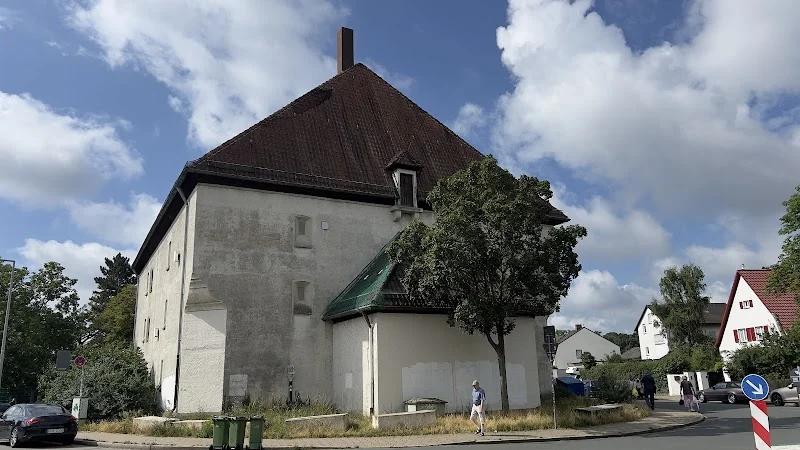
Kronacher Str., Fürth
Kronacher Str., 90765 Fürth, Germany
Fanbunker Fürth | Photos & Kronacher Straße
The Fanbunker Fürth is today much more than an unusual meeting point for football fans. The building at Kronacher Straße 22 is located right next to the Sportpark Ronhof and connects city history, war memories, post-war use, the Cold War, and fan culture in a very special way. This very mix makes the place so searchable: Those who search for photos, for Kronacher Straße, or for the Fanbunker itself almost always mean the same place, where a former air raid shelter became a strong identity meeting point for the supporters of SpVgg Greuther Fürth. The Sportfreunde Ronhof officially opened the Fanbunker in July 2021; the city of Fürth still lists the Kronacher Bunker in its leadership program as a historical site, where part of the interior has been deliberately preserved in the state of the Cold War. The bunker is thus both a memorial and a vibrant club home. This tension between past and present continues to shape the appeal of the building today. ([sportfreunde-ronhof.de](https://sportfreunde-ronhof.de/fanbunker/))
Fanbunker Fürth Photos: This is how the bunker looks today
The photos of the Fanbunker clearly show why the place has such a strong visual impact. In the image series of NN, it can be seen how fans have designed the old, cool bunker areas in white and green, without covering the historical atmosphere of the building. This creates the special appeal: The rooms do not feel like any random pub or a classic fan club room, but like a place where history has remained visible. The photos reveal narrow corridors, thick walls, early construction traces, and at the same time lovingly placed fan elements. These include details on the walls that remind of the club's history, the unique visual language of the renovation period, and the connection between history and sociability. The images make it clear that the Fanbunker should not be a smoothly renovated new building, but a place with edges, materiality, and memory. This gives it photographic strength and explains why search queries like fanbunker fürth fotos fit particularly well with the object. ([nn.de](https://www.nn.de/sport/exklusiver-einblick-so-sieht-es-im-neuen-further-fanbunker-aus-1.11195098))
Especially impressive are the photos that document the renovation itself. The walls show not only decoration but also traces of the former state of use, such as preserved markings, technical remnants, and deliberately visible breaks between old and new. In the image series of NN, it is also noticeable that historical finds and memorabilia have been integrated into the interior, such as green wooden benches from the old main stand of Ronhof, a recreated scoreboard, and small quotes from fan history. The outside is also interesting in pictures because the massive bunker architecture remains visible alongside later interventions. Therefore, the place functions in photography on two levels: on the one hand, as an impressive monument of a war-related protective structure, and on the other hand, as a detailed meeting point for the Fürth fan scene. Those who search for photos are not only looking for motifs here but for a whole narrative in images. ([nn.de](https://www.nn.de/sport/exklusiver-einblick-so-sieht-es-im-neuen-further-fanbunker-aus-1.11195098))
Kronacher Straße 22 and the location at Sportpark Ronhof
The exact location is one of the most important search terms related to the Fanbunker. The place is located at Kronacher Straße 22 in 90765 Fürth, directly at the transition to Laubenweg and only a very short distance from Sportpark Ronhof. The NN describes the bunker as being about 200 meters from the stadium, thus in immediate proximity to the football everyday life of SpVgg Greuther Fürth. The city of Fürth also specifies this exact address on its event page. For visitors and fans, this is practical because it makes the place immediately locatable: Those moving around the Ronhof area will quickly encounter the building. For the search intent fanbunker fürth kronacher straße fürth, this location is central, as it answers the simple but often asked question of where this place is actually located and how closely it is connected to the stadium. The proximity to Ronhof is not a coincidence but part of the concept: The former bunker has been deliberately embedded into the fan world. ([nn.de](https://www.nn.de/sport/exklusiver-einblick-so-sieht-es-im-neuen-further-fanbunker-aus-1.11195098))
This location makes the Fanbunker a typical Fürth place with several layers. It is visible, historically charged, and has emerged from the everyday life of the football scene. The city of Fürth refers to the place in its tour series as Kronacher Bunker and links it with the historical narrative of the building. The Sportfreunde Ronhof themselves describe their Fanbunker as a new home for the Kleeblatt fans, thus as a place where fan history becomes spatially tangible. This is also important from an SEO perspective: Those searching for Kronacher Straße or Laubenweg are often not just looking for an address but for a mix of directions, orientation, stadium proximity, and local context. That is why the terms Kronacher Straße, Laubenweg, Ronhof, and Fürth are so closely connected and should always appear together in a good description. ([sportfreunde-ronhof.de](https://sportfreunde-ronhof.de/fanbunker/))
History of the Kronacher Bunker: From Air Raid Shelter to Landmark
The history of the building dates back to World War II. FürthWiki describes the Kronacher Bunker as a massive reinforced concrete high bunker located at Kronacher Straße 22, which was supposed to provide shelter for 901 people. The bunker was built during the war by the Fürth architectural firm Peringer and Rogler; construction began in February 1941, the concrete work was completed in September 1941, and the building could be provisionally used in that month. The outer form was also deliberately chosen: The building received a design reminiscent of a church with a stair tower and hipped roof to appear less conspicuous from the air. The monument text also mentions French prisoners of war as the people who had to construct the three-story air raid shelter in 1941. The two-meter-thick reinforced concrete walls and the strong, closed construction show how seriously the protective function was intended. From today's perspective, this original function is still architecturally discernible. ([fuerthwiki.de](https://www.fuerthwiki.de/wiki/index.php/Kronacher_Bunker))
After the war, the use changed several times. According to FürthWiki and the city's management, the bunker initially served as an emergency shelter for refugees and those bombed out; during this phase, windows were blown into the wall surfaces to allow daylight into the building. Later, between 1968 and 1971, the bunker was again reinforced as a protective structure during the Cold War and condensed to accommodate 901 people. The monument award 2022 also states that the bunker was released from civil protection obligations in 2007 and then stood empty for a long time. This sequence of air protection, post-war emergency shelter, Cold War, and vacancy makes the place historically particularly dense. It is not just an old building but a structure that carries several political and social epochs within it. That is why the term landmark fits well here: The bunker does not stand for glory but for memory, resilience, and renovation history. ([fuerthwiki.de](https://www.fuerthwiki.de/wiki/index.php/Kronacher_Bunker))
Conversion to Fanbunker: How the Bunker Became a Meeting Point
The transformation into the Fanbunker began for a very practical reason. The Sportfreunde Ronhof were looking for a new meeting point after their former pub and the lovingly furnished museum in sight of the stadium were no longer available. According to Nordbayern, the Sportfreunde purchased the bunker from the city on a long-term lease and turned it into a project that later became officially known as the Fanbunker. The club's website mentions the opening on July 7, 2021, and describes that numerous supporters, neighbors, and involved companies were invited. The renovation took about a year and a half, as reported by the NN. Thus, a long-empty special building became a new place for fans, conversations, and memories. The interesting thing is that the bunker was not simply modernized but allowed to visibly retain its past. This makes the story credible and unique: The place should not lose its origin but translate it into a new use. ([nordbayern.de](https://www.nordbayern.de/fuerth/geplanter-treffpunkt-ein-bunker-fur-die-kleeblatt-fans-1.9625366))
The monument award documents very clearly how much work is behind this new use. In numerous working hours, about 130 tons of rubble were removed from the structure; some walls were allowed to be removed to enlarge the rooms, but the original floor plan remained recognizable. The preserved bunker equipment was also integrated into the usage concept. The NN additionally describes that the former sleeping and storage rooms were designed with great attention to detail, such as a room reminiscent of an Irish pub, complete with wood paneling and a dartboard. At the same time, the principle still applies in the bunker that cooking is not allowed, but food can only be reheated. These details show that the Fanbunker is not just any club home but a consciously preserved and simultaneously functional mix of monument and social space. The new use respects the past without remaining in a museum. This is precisely where the strength of the project lies. ([sportfreunde-ronhof.de](https://sportfreunde-ronhof.de/wp-content/uploads/2023/03/Denkmalpraemierung_2022_Fanbunker.pdf))
Guided Tours, Rooms, and Important Visitor Information
Those who want to experience the Fanbunker not only in photos but on-site will find an official guided tour offer in Fürth. The city of Fürth includes the Kronacher Bunker in its event series as a place for the tour When the Bunker Could Speak. It is explicitly stated that a high bunker from World War II is located directly next to the current Sportpark Ronhof, and its history will be explained during a guided tour. The tour connects several chapters: shelter from bombs, living space for refugees from the eastern regions, use during the Cold War, and finally the repurposing as an atomic shelter. The city also points out that part of the bunker has deliberately remained in its original state from the Cold War and is open to the public for tours. For those searching for bunker tour fürth, history, or practical visiting options, this is the most important information: The place is not only privately used but also accessible as a historical learning site. ([fuerth.de](https://www.fuerth.de/kultur-freizeit/veranstaltungen-termine/veranstaltungskalender/veranstaltungsdetails/stadtfuehrung-wenn-der-bunker-reden-koennte-1800-15-10-2026-393393/))
Content-wise, the Fanbunker is so strong because it appeals to several target groups. Football fans see it as a meeting point with white-green identity, history enthusiasts recognize a rarely preserved high bunker with clearly discernible renovation phases, and city visitors experience a place that becomes understandable through tours and photos. According to Nordbayern and club sources, the bunker is now a place of sociability, remembrance, and proximity to the stadium. At the same time, the historical weight remains visible, such as through the thick walls, the preserved markings, the technical remnants, and the conscious decision not to smooth the character of the building. That is why the Fanbunker also works so well in an SEO sense: The search queries capture different motives, but they all land at the same place. Whether photos, address, history, tour, or fan home - the Fanbunker Fürth is a small but very dense piece of city and club culture. ([nn.de](https://www.nn.de/sport/exklusiver-einblick-so-sieht-es-im-neuen-further-fanbunker-aus-1.11195098))
Sources:
Mehr anzeigenWeniger anzeigen
Fanbunker Fürth | Photos & Kronacher Straße
The Fanbunker Fürth is today much more than an unusual meeting point for football fans. The building at Kronacher Straße 22 is located right next to the Sportpark Ronhof and connects city history, war memories, post-war use, the Cold War, and fan culture in a very special way. This very mix makes the place so searchable: Those who search for photos, for Kronacher Straße, or for the Fanbunker itself almost always mean the same place, where a former air raid shelter became a strong identity meeting point for the supporters of SpVgg Greuther Fürth. The Sportfreunde Ronhof officially opened the Fanbunker in July 2021; the city of Fürth still lists the Kronacher Bunker in its leadership program as a historical site, where part of the interior has been deliberately preserved in the state of the Cold War. The bunker is thus both a memorial and a vibrant club home. This tension between past and present continues to shape the appeal of the building today. ([sportfreunde-ronhof.de](https://sportfreunde-ronhof.de/fanbunker/))
Fanbunker Fürth Photos: This is how the bunker looks today
The photos of the Fanbunker clearly show why the place has such a strong visual impact. In the image series of NN, it can be seen how fans have designed the old, cool bunker areas in white and green, without covering the historical atmosphere of the building. This creates the special appeal: The rooms do not feel like any random pub or a classic fan club room, but like a place where history has remained visible. The photos reveal narrow corridors, thick walls, early construction traces, and at the same time lovingly placed fan elements. These include details on the walls that remind of the club's history, the unique visual language of the renovation period, and the connection between history and sociability. The images make it clear that the Fanbunker should not be a smoothly renovated new building, but a place with edges, materiality, and memory. This gives it photographic strength and explains why search queries like fanbunker fürth fotos fit particularly well with the object. ([nn.de](https://www.nn.de/sport/exklusiver-einblick-so-sieht-es-im-neuen-further-fanbunker-aus-1.11195098))
Especially impressive are the photos that document the renovation itself. The walls show not only decoration but also traces of the former state of use, such as preserved markings, technical remnants, and deliberately visible breaks between old and new. In the image series of NN, it is also noticeable that historical finds and memorabilia have been integrated into the interior, such as green wooden benches from the old main stand of Ronhof, a recreated scoreboard, and small quotes from fan history. The outside is also interesting in pictures because the massive bunker architecture remains visible alongside later interventions. Therefore, the place functions in photography on two levels: on the one hand, as an impressive monument of a war-related protective structure, and on the other hand, as a detailed meeting point for the Fürth fan scene. Those who search for photos are not only looking for motifs here but for a whole narrative in images. ([nn.de](https://www.nn.de/sport/exklusiver-einblick-so-sieht-es-im-neuen-further-fanbunker-aus-1.11195098))
Kronacher Straße 22 and the location at Sportpark Ronhof
The exact location is one of the most important search terms related to the Fanbunker. The place is located at Kronacher Straße 22 in 90765 Fürth, directly at the transition to Laubenweg and only a very short distance from Sportpark Ronhof. The NN describes the bunker as being about 200 meters from the stadium, thus in immediate proximity to the football everyday life of SpVgg Greuther Fürth. The city of Fürth also specifies this exact address on its event page. For visitors and fans, this is practical because it makes the place immediately locatable: Those moving around the Ronhof area will quickly encounter the building. For the search intent fanbunker fürth kronacher straße fürth, this location is central, as it answers the simple but often asked question of where this place is actually located and how closely it is connected to the stadium. The proximity to Ronhof is not a coincidence but part of the concept: The former bunker has been deliberately embedded into the fan world. ([nn.de](https://www.nn.de/sport/exklusiver-einblick-so-sieht-es-im-neuen-further-fanbunker-aus-1.11195098))
This location makes the Fanbunker a typical Fürth place with several layers. It is visible, historically charged, and has emerged from the everyday life of the football scene. The city of Fürth refers to the place in its tour series as Kronacher Bunker and links it with the historical narrative of the building. The Sportfreunde Ronhof themselves describe their Fanbunker as a new home for the Kleeblatt fans, thus as a place where fan history becomes spatially tangible. This is also important from an SEO perspective: Those searching for Kronacher Straße or Laubenweg are often not just looking for an address but for a mix of directions, orientation, stadium proximity, and local context. That is why the terms Kronacher Straße, Laubenweg, Ronhof, and Fürth are so closely connected and should always appear together in a good description. ([sportfreunde-ronhof.de](https://sportfreunde-ronhof.de/fanbunker/))
History of the Kronacher Bunker: From Air Raid Shelter to Landmark
The history of the building dates back to World War II. FürthWiki describes the Kronacher Bunker as a massive reinforced concrete high bunker located at Kronacher Straße 22, which was supposed to provide shelter for 901 people. The bunker was built during the war by the Fürth architectural firm Peringer and Rogler; construction began in February 1941, the concrete work was completed in September 1941, and the building could be provisionally used in that month. The outer form was also deliberately chosen: The building received a design reminiscent of a church with a stair tower and hipped roof to appear less conspicuous from the air. The monument text also mentions French prisoners of war as the people who had to construct the three-story air raid shelter in 1941. The two-meter-thick reinforced concrete walls and the strong, closed construction show how seriously the protective function was intended. From today's perspective, this original function is still architecturally discernible. ([fuerthwiki.de](https://www.fuerthwiki.de/wiki/index.php/Kronacher_Bunker))
After the war, the use changed several times. According to FürthWiki and the city's management, the bunker initially served as an emergency shelter for refugees and those bombed out; during this phase, windows were blown into the wall surfaces to allow daylight into the building. Later, between 1968 and 1971, the bunker was again reinforced as a protective structure during the Cold War and condensed to accommodate 901 people. The monument award 2022 also states that the bunker was released from civil protection obligations in 2007 and then stood empty for a long time. This sequence of air protection, post-war emergency shelter, Cold War, and vacancy makes the place historically particularly dense. It is not just an old building but a structure that carries several political and social epochs within it. That is why the term landmark fits well here: The bunker does not stand for glory but for memory, resilience, and renovation history. ([fuerthwiki.de](https://www.fuerthwiki.de/wiki/index.php/Kronacher_Bunker))
Conversion to Fanbunker: How the Bunker Became a Meeting Point
The transformation into the Fanbunker began for a very practical reason. The Sportfreunde Ronhof were looking for a new meeting point after their former pub and the lovingly furnished museum in sight of the stadium were no longer available. According to Nordbayern, the Sportfreunde purchased the bunker from the city on a long-term lease and turned it into a project that later became officially known as the Fanbunker. The club's website mentions the opening on July 7, 2021, and describes that numerous supporters, neighbors, and involved companies were invited. The renovation took about a year and a half, as reported by the NN. Thus, a long-empty special building became a new place for fans, conversations, and memories. The interesting thing is that the bunker was not simply modernized but allowed to visibly retain its past. This makes the story credible and unique: The place should not lose its origin but translate it into a new use. ([nordbayern.de](https://www.nordbayern.de/fuerth/geplanter-treffpunkt-ein-bunker-fur-die-kleeblatt-fans-1.9625366))
The monument award documents very clearly how much work is behind this new use. In numerous working hours, about 130 tons of rubble were removed from the structure; some walls were allowed to be removed to enlarge the rooms, but the original floor plan remained recognizable. The preserved bunker equipment was also integrated into the usage concept. The NN additionally describes that the former sleeping and storage rooms were designed with great attention to detail, such as a room reminiscent of an Irish pub, complete with wood paneling and a dartboard. At the same time, the principle still applies in the bunker that cooking is not allowed, but food can only be reheated. These details show that the Fanbunker is not just any club home but a consciously preserved and simultaneously functional mix of monument and social space. The new use respects the past without remaining in a museum. This is precisely where the strength of the project lies. ([sportfreunde-ronhof.de](https://sportfreunde-ronhof.de/wp-content/uploads/2023/03/Denkmalpraemierung_2022_Fanbunker.pdf))
Guided Tours, Rooms, and Important Visitor Information
Those who want to experience the Fanbunker not only in photos but on-site will find an official guided tour offer in Fürth. The city of Fürth includes the Kronacher Bunker in its event series as a place for the tour When the Bunker Could Speak. It is explicitly stated that a high bunker from World War II is located directly next to the current Sportpark Ronhof, and its history will be explained during a guided tour. The tour connects several chapters: shelter from bombs, living space for refugees from the eastern regions, use during the Cold War, and finally the repurposing as an atomic shelter. The city also points out that part of the bunker has deliberately remained in its original state from the Cold War and is open to the public for tours. For those searching for bunker tour fürth, history, or practical visiting options, this is the most important information: The place is not only privately used but also accessible as a historical learning site. ([fuerth.de](https://www.fuerth.de/kultur-freizeit/veranstaltungen-termine/veranstaltungskalender/veranstaltungsdetails/stadtfuehrung-wenn-der-bunker-reden-koennte-1800-15-10-2026-393393/))
Content-wise, the Fanbunker is so strong because it appeals to several target groups. Football fans see it as a meeting point with white-green identity, history enthusiasts recognize a rarely preserved high bunker with clearly discernible renovation phases, and city visitors experience a place that becomes understandable through tours and photos. According to Nordbayern and club sources, the bunker is now a place of sociability, remembrance, and proximity to the stadium. At the same time, the historical weight remains visible, such as through the thick walls, the preserved markings, the technical remnants, and the conscious decision not to smooth the character of the building. That is why the Fanbunker also works so well in an SEO sense: The search queries capture different motives, but they all land at the same place. Whether photos, address, history, tour, or fan home - the Fanbunker Fürth is a small but very dense piece of city and club culture. ([nn.de](https://www.nn.de/sport/exklusiver-einblick-so-sieht-es-im-neuen-further-fanbunker-aus-1.11195098))
Sources:
Fanbunker Fürth | Photos & Kronacher Straße
The Fanbunker Fürth is today much more than an unusual meeting point for football fans. The building at Kronacher Straße 22 is located right next to the Sportpark Ronhof and connects city history, war memories, post-war use, the Cold War, and fan culture in a very special way. This very mix makes the place so searchable: Those who search for photos, for Kronacher Straße, or for the Fanbunker itself almost always mean the same place, where a former air raid shelter became a strong identity meeting point for the supporters of SpVgg Greuther Fürth. The Sportfreunde Ronhof officially opened the Fanbunker in July 2021; the city of Fürth still lists the Kronacher Bunker in its leadership program as a historical site, where part of the interior has been deliberately preserved in the state of the Cold War. The bunker is thus both a memorial and a vibrant club home. This tension between past and present continues to shape the appeal of the building today. ([sportfreunde-ronhof.de](https://sportfreunde-ronhof.de/fanbunker/))
Fanbunker Fürth Photos: This is how the bunker looks today
The photos of the Fanbunker clearly show why the place has such a strong visual impact. In the image series of NN, it can be seen how fans have designed the old, cool bunker areas in white and green, without covering the historical atmosphere of the building. This creates the special appeal: The rooms do not feel like any random pub or a classic fan club room, but like a place where history has remained visible. The photos reveal narrow corridors, thick walls, early construction traces, and at the same time lovingly placed fan elements. These include details on the walls that remind of the club's history, the unique visual language of the renovation period, and the connection between history and sociability. The images make it clear that the Fanbunker should not be a smoothly renovated new building, but a place with edges, materiality, and memory. This gives it photographic strength and explains why search queries like fanbunker fürth fotos fit particularly well with the object. ([nn.de](https://www.nn.de/sport/exklusiver-einblick-so-sieht-es-im-neuen-further-fanbunker-aus-1.11195098))
Especially impressive are the photos that document the renovation itself. The walls show not only decoration but also traces of the former state of use, such as preserved markings, technical remnants, and deliberately visible breaks between old and new. In the image series of NN, it is also noticeable that historical finds and memorabilia have been integrated into the interior, such as green wooden benches from the old main stand of Ronhof, a recreated scoreboard, and small quotes from fan history. The outside is also interesting in pictures because the massive bunker architecture remains visible alongside later interventions. Therefore, the place functions in photography on two levels: on the one hand, as an impressive monument of a war-related protective structure, and on the other hand, as a detailed meeting point for the Fürth fan scene. Those who search for photos are not only looking for motifs here but for a whole narrative in images. ([nn.de](https://www.nn.de/sport/exklusiver-einblick-so-sieht-es-im-neuen-further-fanbunker-aus-1.11195098))
Kronacher Straße 22 and the location at Sportpark Ronhof
The exact location is one of the most important search terms related to the Fanbunker. The place is located at Kronacher Straße 22 in 90765 Fürth, directly at the transition to Laubenweg and only a very short distance from Sportpark Ronhof. The NN describes the bunker as being about 200 meters from the stadium, thus in immediate proximity to the football everyday life of SpVgg Greuther Fürth. The city of Fürth also specifies this exact address on its event page. For visitors and fans, this is practical because it makes the place immediately locatable: Those moving around the Ronhof area will quickly encounter the building. For the search intent fanbunker fürth kronacher straße fürth, this location is central, as it answers the simple but often asked question of where this place is actually located and how closely it is connected to the stadium. The proximity to Ronhof is not a coincidence but part of the concept: The former bunker has been deliberately embedded into the fan world. ([nn.de](https://www.nn.de/sport/exklusiver-einblick-so-sieht-es-im-neuen-further-fanbunker-aus-1.11195098))
This location makes the Fanbunker a typical Fürth place with several layers. It is visible, historically charged, and has emerged from the everyday life of the football scene. The city of Fürth refers to the place in its tour series as Kronacher Bunker and links it with the historical narrative of the building. The Sportfreunde Ronhof themselves describe their Fanbunker as a new home for the Kleeblatt fans, thus as a place where fan history becomes spatially tangible. This is also important from an SEO perspective: Those searching for Kronacher Straße or Laubenweg are often not just looking for an address but for a mix of directions, orientation, stadium proximity, and local context. That is why the terms Kronacher Straße, Laubenweg, Ronhof, and Fürth are so closely connected and should always appear together in a good description. ([sportfreunde-ronhof.de](https://sportfreunde-ronhof.de/fanbunker/))
History of the Kronacher Bunker: From Air Raid Shelter to Landmark
The history of the building dates back to World War II. FürthWiki describes the Kronacher Bunker as a massive reinforced concrete high bunker located at Kronacher Straße 22, which was supposed to provide shelter for 901 people. The bunker was built during the war by the Fürth architectural firm Peringer and Rogler; construction began in February 1941, the concrete work was completed in September 1941, and the building could be provisionally used in that month. The outer form was also deliberately chosen: The building received a design reminiscent of a church with a stair tower and hipped roof to appear less conspicuous from the air. The monument text also mentions French prisoners of war as the people who had to construct the three-story air raid shelter in 1941. The two-meter-thick reinforced concrete walls and the strong, closed construction show how seriously the protective function was intended. From today's perspective, this original function is still architecturally discernible. ([fuerthwiki.de](https://www.fuerthwiki.de/wiki/index.php/Kronacher_Bunker))
After the war, the use changed several times. According to FürthWiki and the city's management, the bunker initially served as an emergency shelter for refugees and those bombed out; during this phase, windows were blown into the wall surfaces to allow daylight into the building. Later, between 1968 and 1971, the bunker was again reinforced as a protective structure during the Cold War and condensed to accommodate 901 people. The monument award 2022 also states that the bunker was released from civil protection obligations in 2007 and then stood empty for a long time. This sequence of air protection, post-war emergency shelter, Cold War, and vacancy makes the place historically particularly dense. It is not just an old building but a structure that carries several political and social epochs within it. That is why the term landmark fits well here: The bunker does not stand for glory but for memory, resilience, and renovation history. ([fuerthwiki.de](https://www.fuerthwiki.de/wiki/index.php/Kronacher_Bunker))
Conversion to Fanbunker: How the Bunker Became a Meeting Point
The transformation into the Fanbunker began for a very practical reason. The Sportfreunde Ronhof were looking for a new meeting point after their former pub and the lovingly furnished museum in sight of the stadium were no longer available. According to Nordbayern, the Sportfreunde purchased the bunker from the city on a long-term lease and turned it into a project that later became officially known as the Fanbunker. The club's website mentions the opening on July 7, 2021, and describes that numerous supporters, neighbors, and involved companies were invited. The renovation took about a year and a half, as reported by the NN. Thus, a long-empty special building became a new place for fans, conversations, and memories. The interesting thing is that the bunker was not simply modernized but allowed to visibly retain its past. This makes the story credible and unique: The place should not lose its origin but translate it into a new use. ([nordbayern.de](https://www.nordbayern.de/fuerth/geplanter-treffpunkt-ein-bunker-fur-die-kleeblatt-fans-1.9625366))
The monument award documents very clearly how much work is behind this new use. In numerous working hours, about 130 tons of rubble were removed from the structure; some walls were allowed to be removed to enlarge the rooms, but the original floor plan remained recognizable. The preserved bunker equipment was also integrated into the usage concept. The NN additionally describes that the former sleeping and storage rooms were designed with great attention to detail, such as a room reminiscent of an Irish pub, complete with wood paneling and a dartboard. At the same time, the principle still applies in the bunker that cooking is not allowed, but food can only be reheated. These details show that the Fanbunker is not just any club home but a consciously preserved and simultaneously functional mix of monument and social space. The new use respects the past without remaining in a museum. This is precisely where the strength of the project lies. ([sportfreunde-ronhof.de](https://sportfreunde-ronhof.de/wp-content/uploads/2023/03/Denkmalpraemierung_2022_Fanbunker.pdf))
Guided Tours, Rooms, and Important Visitor Information
Those who want to experience the Fanbunker not only in photos but on-site will find an official guided tour offer in Fürth. The city of Fürth includes the Kronacher Bunker in its event series as a place for the tour When the Bunker Could Speak. It is explicitly stated that a high bunker from World War II is located directly next to the current Sportpark Ronhof, and its history will be explained during a guided tour. The tour connects several chapters: shelter from bombs, living space for refugees from the eastern regions, use during the Cold War, and finally the repurposing as an atomic shelter. The city also points out that part of the bunker has deliberately remained in its original state from the Cold War and is open to the public for tours. For those searching for bunker tour fürth, history, or practical visiting options, this is the most important information: The place is not only privately used but also accessible as a historical learning site. ([fuerth.de](https://www.fuerth.de/kultur-freizeit/veranstaltungen-termine/veranstaltungskalender/veranstaltungsdetails/stadtfuehrung-wenn-der-bunker-reden-koennte-1800-15-10-2026-393393/))
Content-wise, the Fanbunker is so strong because it appeals to several target groups. Football fans see it as a meeting point with white-green identity, history enthusiasts recognize a rarely preserved high bunker with clearly discernible renovation phases, and city visitors experience a place that becomes understandable through tours and photos. According to Nordbayern and club sources, the bunker is now a place of sociability, remembrance, and proximity to the stadium. At the same time, the historical weight remains visible, such as through the thick walls, the preserved markings, the technical remnants, and the conscious decision not to smooth the character of the building. That is why the Fanbunker also works so well in an SEO sense: The search queries capture different motives, but they all land at the same place. Whether photos, address, history, tour, or fan home - the Fanbunker Fürth is a small but very dense piece of city and club culture. ([nn.de](https://www.nn.de/sport/exklusiver-einblick-so-sieht-es-im-neuen-further-fanbunker-aus-1.11195098))
Sources:
Upcoming Events
No events found
Frequently Asked Questions
Reviews
Torsten Michalk
25. January 2023
Great fans. Fine bar. Top museum. But: For members only.
Dirk Süßmann
28. February 2026
Here, a white-green soul meets like-minded people and beer in a unique atmosphere.
Danny R
22. December 2025
Fantastic place and great people.
Matthias Witte
18. October 2023
A truly special place, unlike any other. Created and maintained with so much love and passion. I was delighted to have the opportunity to see it.
F k
28. January 2024
Fantastic place. Everything was built by themselves and is non-commercial. Great community there. It's amazing that places like this still exist! 👍