
Fürth
Dr.-Martin-Luther-Platz 2, 90763 Fürth, Deutschland
Evang.-Luth. Parish Office St. Paul | Services & History
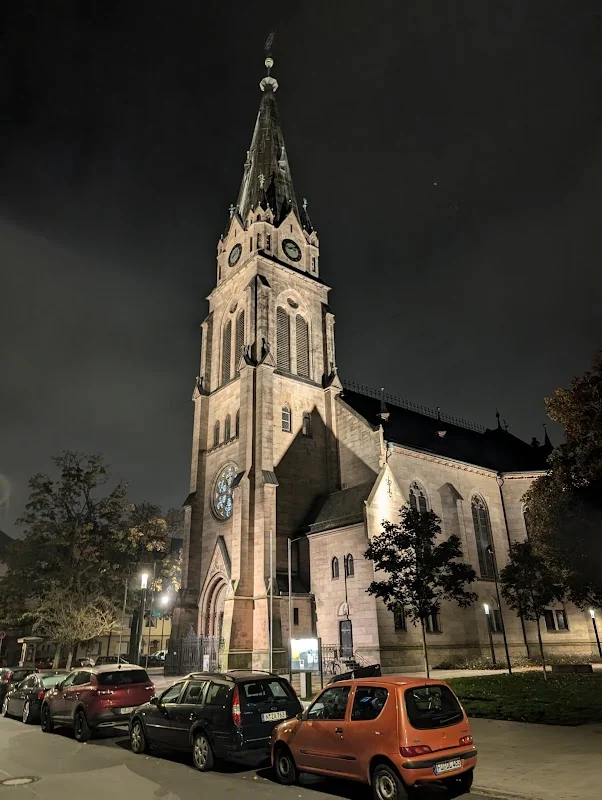
Evang.-Luth. Parish Office St. Paul in the Fürth South City is much more than an administrative address. Here, church work, community life, church music, and a distinctive cityscape come together to create a place with high recognizability and great influence. The church was consecrated in 1900, remains the center of the community to this day, and shapes Dr. Martin Luther Square as one of the most important Protestant landmarks in Fürth. Those who visit St. Paul experience a space that tells stories of history, acoustics, urban development, and vibrant present simultaneously. Particularly striking are the 70-meter high tower, its great significance for services and official acts, and its strong role as a venue for music and encounters. Additionally, there is a community center that is accessible and open for various church and cultural uses. St. Paul thus connects tradition and everyday life in a way that is still visible and audible in Fürth today. ([sankt-paul.de](https://sankt-paul.de/geschichte?utm_source=openai))
Address, Office Hours, and Contact for the Parish Office
Those looking for the Parish Office St. Paul will find it at a clearly named and central address: Dr. Martin Luther Square 2 in 90763 Fürth. The community also publishes direct contact details on its website, so interested parties do not have to search long. The phone can be reached at 0911-7 66 32-0, the fax at 0911-7 66 32-15, and the email address is pfarramt.stpaul.fue@elkb.de. Particularly practical are the fixed office hours, which usually allow for reliable personal accessibility. From Monday to Thursday, the parish office is open in the morning from 9:00 to 12:00, and additionally on Tuesday to Thursday in the afternoon from 14:00 to 17:00. The office is closed on Fridays. This makes the point of contact for pastoral care, organization, inquiries, and community topics well-structured and easy to plan for everyday life. So, anyone searching for the term Parish Office St. Paul Fürth will not only receive a name but also a real contact point with fixed times and clear responsibilities. ([sankt-paul.de](https://www.sankt-paul.de/anschrift?utm_source=openai))
The contact details are especially important for people who need a baptism, wedding, funeral, a pastoral inquiry, or general information about the community. The parish office is also the first address for organizational questions regarding appointments, room usage, or community life. The website also points to a contact form in case a message needs to be sent outside of office hours. This is helpful for seekers because the place becomes visible not only as a church building but also as a functioning parish office with administrative tasks. At the same time, the official communication shows that St. Paul is closely connected to local community life in Fürth and does not merely represent a formal administrative seat. Therefore, those searching for the location under the search term Parish Office St. Paul Fürth or Evang.-Luth. Parish Office St. Paul will find a place where traditional parish work and open community structures come together. ([sankt-paul.de](https://www.sankt-paul.de/anschrift?utm_source=openai))
Services and Spiritual Life at St. Paul
The spiritual profile of St. Paul is particularly evident in the variety of service forms. The website announces recurring formats such as midday prayer in the Paul Church, Taizé prayer, praise service, and church with children. This makes it clear that the community addresses a wide range of target groups and spiritual approaches. Those seeking peace and a brief interruption in their daily routine will find the midday prayer. Those who love meditative, sung forms will be drawn to the Taizé prayer. Those who appreciate a musically influenced end to the week can attend the praise service. And families with children will find their own formats that make faith accessible and communal for children. This diversity is no coincidence but an expression of a community that does not set liturgical tradition and contemporary forms against each other but connects them. ([sankt-paul.de](https://www.sankt-paul.de/gottesdienste?utm_source=openai))
Even beyond the pure Sunday services, St. Paul is vibrantly organized. The community offers groups and circles for different life phases and interests, including offerings for older people, house circles, creative groups, addiction help, and other formats of togetherness. Particularly noteworthy is that the website expressly describes the community center as barrier-free and points out the presence of an elevator. This is not only practical for a church community but also a signal for accessibility and participation. Additionally, St. Paul understands itself as a place of encounter in the Fürth South City, where faith, neighborhood, and communal life come together. Therefore, those searching for St. Paul Fürth services will find not only individual dates but also a religious and social network that extends throughout the week and addresses different people. ([sankt-paul.de](https://www.sankt-paul.de/aktive-kirche-unsere-gruppen?utm_source=openai))
Community Center, Rentals, and Capacity
St. Paul is not only a church but also a versatile event venue. The official rental page describes the church space as a special place for concerts, readings, guest performances, and productions. With space for around 700 to 800 visitors, the room is one of the largest church spaces in Fürth. Additionally, there are good sanitary facilities, a cloakroom, and the very important good acoustics for events. The community also emphasizes that the event venue is reachable within five minutes on foot from the Fürth main train station or the subway. This combination of room size, sound quality, and accessibility makes St. Paul attractive for a wide range of uses. The historical significance as a concert church also fits in with this, as church and cultural formats have found a suitable framework here for many years. ([sankt-paul.de](https://www.sankt-paul.de/anschrift/vermietungen?utm_source=openai))
The community center complements the church space with additional flexibly usable areas. Mentioned are a community hall with chairs for about 180 people or with tables for about 120 people, a community room for about 40 people, and a group room for about 20 people. This is a very useful space offering for smaller meetings, working groups, celebrations, or church groups. The official presentation also shows that the community center is barrier-free accessible and has an elevator. This is a significant advantage for older people, families with strollers, or guests with mobility restrictions. Therefore, those searching for rentals St. Paul Fürth will find not only a church address but also a differentiated space concept that ranges from large gatherings to small working groups. This combination of a historic church and a functional community center is particularly valuable for events in the district. ([sankt-paul.de](https://www.sankt-paul.de/anschrift/vermietungen?utm_source=openai))
History, Architecture, and District
The history of St. Paul is closely linked to the development of Fürth's South City. According to the official presentation, St. Paul Church was consecrated on September 17, 1900, making it a pioneer of a new district that developed gradually. In early images, the church stands alone in the open field, later the surroundings grew into a vibrant South City. The community emphasizes that the church has been a place for services and official acts for the growing population from the very beginning. In its heyday, more than 20,000 parish members may have gathered here, underscoring the significance of this Protestant center at the time. The building is also impressive architecturally: the church measures 37 meters in length, 17 meters in width and height, and its tower reaches 70 meters. Thus, it still has the tallest church tower in Fürth. ([sankt-paul.de](https://sankt-paul.de/geschichte?utm_source=openai))
Architecturally, the church was built in a historicist style and was inspired by Gothic models. The tourist presentation of the city points out that St. Paul has been considered the center of the community since its consecration and has undergone extensive renovations multiple times over the years, including in 1948, 1969, 1986/87, and 1999. This shows how much the community values the preservation and maintenance of the building. At the same time, there is much to suggest that St. Paul is not only a monument but also a vibrant part of the city. The church stands in the context of the South City for identity, orientation, and continuity. Particularly interesting is the historical magnitude: in the early planning stages, an even larger church was envisioned, but ultimately a building with about 1000 seats was chosen. Thus, St. Paul combines urban restraint with monumental presence. ([sankt-paul.de](https://sankt-paul.de/geschichte?utm_source=openai))
The significance for the district goes beyond the building itself. The Fürth deanery describes St. Paul as the starting point for many impulses, such as the Fürth Church Music Days, and names the community as the mother church for the Dambach Redeemer Church. This is a strong sign of how important St. Paul is for the Protestant landscape of the city. Additionally, the church continues to shape the image of the surroundings and has a clear urban reference point with Dr. Martin Luther Square. Therefore, those researching the location should not only search for the history of St. Paul Fürth or the Church of St. Paul Fürth but also consider the connection between the church, South City, and community structure. This triad makes the place relevant for visitors as well as for community members and organizers. ([fuerth-evangelisch.de](https://www.fuerth-evangelisch.de/fuerth-st-paul))
Organs, Bells, and Church Music
A special treasure of St. Paul is its church music. The official history describes Paul Church as the home of the largest organ in the Fürth deanery. The original instrument from the company Strebel in Nuremberg was installed during the consecration in 1900 but is now only partially present. After various war-related losses and renovations, the current main organ was created in 1963/64 by E. F. Walcker and Cie. from Ludwigsburg. It has 54 registers on three manuals and pedal and over 4000 pipes. In May 1964, it was consecrated as a mechanical slider organ. For the space, this is more than just equipment: the organ shapes the acoustic identity of the church and makes it a destination for concert visitors, organists, and choirs. ([sankt-paul.de](https://sankt-paul.de/geschichte?utm_source=openai))
The main organ is complemented by a choir organ, which was built in 1972 at the initiative of committed church council members and entrepreneurs. It also comes from Walcker and has two manuals and 13 registers. The special feature is that both organs can be played from one console, which opens up an extraordinary sound space during concerts. The community also mentions that the church music days have their roots in St. Paul and that the church has already served as a stage for the Windsbacher Knabenchor, Enrico Paruta, and many other musical formats due to its acoustics. This makes St. Paul particularly relevant for the keyword church music St. Paul Fürth. Those interested in organs will find here not only an instrument but a whole musical tradition with a high reputation and long development. ([sankt-paul.de](https://sankt-paul.de/geschichte?utm_source=openai))
The church's sound landscape also includes the bells and the choir windows. The history of the bells dates back to 1899 when the chime first rang. During World War II, three bells had to be surrendered and melted down; later, new bells were added. The choir windows were created in 1957 by Adolf V. Saile as stained glass and were donated by the patron Gustav Schickedanz. This makes it visible that St. Paul is not only a place of hearing but also of seeing. Music, light, and architecture intertwine. For seekers researching organ St. Paul Fürth or history St. Paul Fürth, this connection of technical equipment, art, and community profile is crucial. The place thus does not appear museum-like but vibrant, as it continues to be used for services, concerts, and special church music events. ([sankt-paul.de](https://sankt-paul.de/geschichte?utm_source=openai))
Access, Location, and Barrier-Free Use
St. Paul is located very centrally in the Fürth South City and is therefore easily accessible. The official rental page explicitly highlights that the Fürth main train station and the subway are only about five minutes away on foot. For visitors, this is a strong plus, as traveling by public transport becomes particularly convenient. The tourist presentation also refers to the location in the South City and the high recognizability of the church in the cityscape. Therefore, those visiting the location for the first time will find not a remote special place but a well-connected urban destination with a short distance to important traffic hubs. This is a significant practical advantage for events, services, and encounters. ([sankt-paul.de](https://www.sankt-paul.de/anschrift/vermietungen?utm_source=openai))
For people with mobility restrictions, it is also important that the community center is described as barrier-free and has an elevator. This is helpful in everyday life for groups, senior circles, families, and organizers and makes many offerings of the community more accessible. The official pages also make it clear that life at St. Paul is strongly oriented toward neighborhood, social networking, and participation. The community is networked with kindergartens, after-school care, diaconal services, and district initiatives and sees itself as part of a vibrant urban environment. This fits well with a location that enables encounters not only on Sundays but also during the week. Therefore, those searching for access St. Paul Fürth, barrier-free community center, or Church St. Paul Fürth will receive a clear picture: short distances, good accessibility, and a consciously open, practical infrastructure. ([sankt-paul.de](https://www.sankt-paul.de/aktive-kirche-unsere-gruppen?utm_source=openai))
In summary, Evang.-Luth. Parish Office St. Paul is a place where historical significance, musical quality, and communal presence come together in a small space. The church offers impressive architecture, the church space is suitable for large celebrations and concerts, the community center complements the use with flexible rooms, and the location in the South City makes the visit easy to plan. Those searching for a Protestant location with character, substance, and strong local anchoring will find in St. Paul a place that goes far beyond a mere address. This is precisely the special strength of this Fürth community: it is a spiritual center, a cultural space, and a neighborhood place at the same time. ([sankt-paul.de](https://www.sankt-paul.de/anschrift/vermietungen?utm_source=openai))
Sources:
- St. Paul in Fürth - History ([sankt-paul.de](https://sankt-paul.de/geschichte?utm_source=openai))
- St. Paul in Fürth - Address ([sankt-paul.de](https://www.sankt-paul.de/anschrift?utm_source=openai))
- St. Paul in Fürth - Rentals ([sankt-paul.de](https://www.sankt-paul.de/anschrift/vermietungen?utm_source=openai))
- St. Paul in Fürth - Services ([sankt-paul.de](https://www.sankt-paul.de/gottesdienste?utm_source=openai))
- St. Paul in Fürth - Church Music ([sankt-paul.de](https://sankt-paul.de/aktive-kirche-unsere-gruppen/kirchenmusik?utm_source=openai))
- Evang.-Luth. Deanery Fürth - Fürth St. Paul ([fuerth-evangelisch.de](https://www.fuerth-evangelisch.de/fuerth-st-paul))
- Tourism Fürth - Church St. Paul ([tourismus-fuerth.de](https://www.tourismus-fuerth.de/poi/kirche-st-paul))
Show moreShow less
Evang.-Luth. Parish Office St. Paul | Services & History
Evang.-Luth. Parish Office St. Paul in the Fürth South City is much more than an administrative address. Here, church work, community life, church music, and a distinctive cityscape come together to create a place with high recognizability and great influence. The church was consecrated in 1900, remains the center of the community to this day, and shapes Dr. Martin Luther Square as one of the most important Protestant landmarks in Fürth. Those who visit St. Paul experience a space that tells stories of history, acoustics, urban development, and vibrant present simultaneously. Particularly striking are the 70-meter high tower, its great significance for services and official acts, and its strong role as a venue for music and encounters. Additionally, there is a community center that is accessible and open for various church and cultural uses. St. Paul thus connects tradition and everyday life in a way that is still visible and audible in Fürth today. ([sankt-paul.de](https://sankt-paul.de/geschichte?utm_source=openai))
Address, Office Hours, and Contact for the Parish Office
Those looking for the Parish Office St. Paul will find it at a clearly named and central address: Dr. Martin Luther Square 2 in 90763 Fürth. The community also publishes direct contact details on its website, so interested parties do not have to search long. The phone can be reached at 0911-7 66 32-0, the fax at 0911-7 66 32-15, and the email address is pfarramt.stpaul.fue@elkb.de. Particularly practical are the fixed office hours, which usually allow for reliable personal accessibility. From Monday to Thursday, the parish office is open in the morning from 9:00 to 12:00, and additionally on Tuesday to Thursday in the afternoon from 14:00 to 17:00. The office is closed on Fridays. This makes the point of contact for pastoral care, organization, inquiries, and community topics well-structured and easy to plan for everyday life. So, anyone searching for the term Parish Office St. Paul Fürth will not only receive a name but also a real contact point with fixed times and clear responsibilities. ([sankt-paul.de](https://www.sankt-paul.de/anschrift?utm_source=openai))
The contact details are especially important for people who need a baptism, wedding, funeral, a pastoral inquiry, or general information about the community. The parish office is also the first address for organizational questions regarding appointments, room usage, or community life. The website also points to a contact form in case a message needs to be sent outside of office hours. This is helpful for seekers because the place becomes visible not only as a church building but also as a functioning parish office with administrative tasks. At the same time, the official communication shows that St. Paul is closely connected to local community life in Fürth and does not merely represent a formal administrative seat. Therefore, those searching for the location under the search term Parish Office St. Paul Fürth or Evang.-Luth. Parish Office St. Paul will find a place where traditional parish work and open community structures come together. ([sankt-paul.de](https://www.sankt-paul.de/anschrift?utm_source=openai))
Services and Spiritual Life at St. Paul
The spiritual profile of St. Paul is particularly evident in the variety of service forms. The website announces recurring formats such as midday prayer in the Paul Church, Taizé prayer, praise service, and church with children. This makes it clear that the community addresses a wide range of target groups and spiritual approaches. Those seeking peace and a brief interruption in their daily routine will find the midday prayer. Those who love meditative, sung forms will be drawn to the Taizé prayer. Those who appreciate a musically influenced end to the week can attend the praise service. And families with children will find their own formats that make faith accessible and communal for children. This diversity is no coincidence but an expression of a community that does not set liturgical tradition and contemporary forms against each other but connects them. ([sankt-paul.de](https://www.sankt-paul.de/gottesdienste?utm_source=openai))
Even beyond the pure Sunday services, St. Paul is vibrantly organized. The community offers groups and circles for different life phases and interests, including offerings for older people, house circles, creative groups, addiction help, and other formats of togetherness. Particularly noteworthy is that the website expressly describes the community center as barrier-free and points out the presence of an elevator. This is not only practical for a church community but also a signal for accessibility and participation. Additionally, St. Paul understands itself as a place of encounter in the Fürth South City, where faith, neighborhood, and communal life come together. Therefore, those searching for St. Paul Fürth services will find not only individual dates but also a religious and social network that extends throughout the week and addresses different people. ([sankt-paul.de](https://www.sankt-paul.de/aktive-kirche-unsere-gruppen?utm_source=openai))
Community Center, Rentals, and Capacity
St. Paul is not only a church but also a versatile event venue. The official rental page describes the church space as a special place for concerts, readings, guest performances, and productions. With space for around 700 to 800 visitors, the room is one of the largest church spaces in Fürth. Additionally, there are good sanitary facilities, a cloakroom, and the very important good acoustics for events. The community also emphasizes that the event venue is reachable within five minutes on foot from the Fürth main train station or the subway. This combination of room size, sound quality, and accessibility makes St. Paul attractive for a wide range of uses. The historical significance as a concert church also fits in with this, as church and cultural formats have found a suitable framework here for many years. ([sankt-paul.de](https://www.sankt-paul.de/anschrift/vermietungen?utm_source=openai))
The community center complements the church space with additional flexibly usable areas. Mentioned are a community hall with chairs for about 180 people or with tables for about 120 people, a community room for about 40 people, and a group room for about 20 people. This is a very useful space offering for smaller meetings, working groups, celebrations, or church groups. The official presentation also shows that the community center is barrier-free accessible and has an elevator. This is a significant advantage for older people, families with strollers, or guests with mobility restrictions. Therefore, those searching for rentals St. Paul Fürth will find not only a church address but also a differentiated space concept that ranges from large gatherings to small working groups. This combination of a historic church and a functional community center is particularly valuable for events in the district. ([sankt-paul.de](https://www.sankt-paul.de/anschrift/vermietungen?utm_source=openai))
History, Architecture, and District
The history of St. Paul is closely linked to the development of Fürth's South City. According to the official presentation, St. Paul Church was consecrated on September 17, 1900, making it a pioneer of a new district that developed gradually. In early images, the church stands alone in the open field, later the surroundings grew into a vibrant South City. The community emphasizes that the church has been a place for services and official acts for the growing population from the very beginning. In its heyday, more than 20,000 parish members may have gathered here, underscoring the significance of this Protestant center at the time. The building is also impressive architecturally: the church measures 37 meters in length, 17 meters in width and height, and its tower reaches 70 meters. Thus, it still has the tallest church tower in Fürth. ([sankt-paul.de](https://sankt-paul.de/geschichte?utm_source=openai))
Architecturally, the church was built in a historicist style and was inspired by Gothic models. The tourist presentation of the city points out that St. Paul has been considered the center of the community since its consecration and has undergone extensive renovations multiple times over the years, including in 1948, 1969, 1986/87, and 1999. This shows how much the community values the preservation and maintenance of the building. At the same time, there is much to suggest that St. Paul is not only a monument but also a vibrant part of the city. The church stands in the context of the South City for identity, orientation, and continuity. Particularly interesting is the historical magnitude: in the early planning stages, an even larger church was envisioned, but ultimately a building with about 1000 seats was chosen. Thus, St. Paul combines urban restraint with monumental presence. ([sankt-paul.de](https://sankt-paul.de/geschichte?utm_source=openai))
The significance for the district goes beyond the building itself. The Fürth deanery describes St. Paul as the starting point for many impulses, such as the Fürth Church Music Days, and names the community as the mother church for the Dambach Redeemer Church. This is a strong sign of how important St. Paul is for the Protestant landscape of the city. Additionally, the church continues to shape the image of the surroundings and has a clear urban reference point with Dr. Martin Luther Square. Therefore, those researching the location should not only search for the history of St. Paul Fürth or the Church of St. Paul Fürth but also consider the connection between the church, South City, and community structure. This triad makes the place relevant for visitors as well as for community members and organizers. ([fuerth-evangelisch.de](https://www.fuerth-evangelisch.de/fuerth-st-paul))
Organs, Bells, and Church Music
A special treasure of St. Paul is its church music. The official history describes Paul Church as the home of the largest organ in the Fürth deanery. The original instrument from the company Strebel in Nuremberg was installed during the consecration in 1900 but is now only partially present. After various war-related losses and renovations, the current main organ was created in 1963/64 by E. F. Walcker and Cie. from Ludwigsburg. It has 54 registers on three manuals and pedal and over 4000 pipes. In May 1964, it was consecrated as a mechanical slider organ. For the space, this is more than just equipment: the organ shapes the acoustic identity of the church and makes it a destination for concert visitors, organists, and choirs. ([sankt-paul.de](https://sankt-paul.de/geschichte?utm_source=openai))
The main organ is complemented by a choir organ, which was built in 1972 at the initiative of committed church council members and entrepreneurs. It also comes from Walcker and has two manuals and 13 registers. The special feature is that both organs can be played from one console, which opens up an extraordinary sound space during concerts. The community also mentions that the church music days have their roots in St. Paul and that the church has already served as a stage for the Windsbacher Knabenchor, Enrico Paruta, and many other musical formats due to its acoustics. This makes St. Paul particularly relevant for the keyword church music St. Paul Fürth. Those interested in organs will find here not only an instrument but a whole musical tradition with a high reputation and long development. ([sankt-paul.de](https://sankt-paul.de/geschichte?utm_source=openai))
The church's sound landscape also includes the bells and the choir windows. The history of the bells dates back to 1899 when the chime first rang. During World War II, three bells had to be surrendered and melted down; later, new bells were added. The choir windows were created in 1957 by Adolf V. Saile as stained glass and were donated by the patron Gustav Schickedanz. This makes it visible that St. Paul is not only a place of hearing but also of seeing. Music, light, and architecture intertwine. For seekers researching organ St. Paul Fürth or history St. Paul Fürth, this connection of technical equipment, art, and community profile is crucial. The place thus does not appear museum-like but vibrant, as it continues to be used for services, concerts, and special church music events. ([sankt-paul.de](https://sankt-paul.de/geschichte?utm_source=openai))
Access, Location, and Barrier-Free Use
St. Paul is located very centrally in the Fürth South City and is therefore easily accessible. The official rental page explicitly highlights that the Fürth main train station and the subway are only about five minutes away on foot. For visitors, this is a strong plus, as traveling by public transport becomes particularly convenient. The tourist presentation also refers to the location in the South City and the high recognizability of the church in the cityscape. Therefore, those visiting the location for the first time will find not a remote special place but a well-connected urban destination with a short distance to important traffic hubs. This is a significant practical advantage for events, services, and encounters. ([sankt-paul.de](https://www.sankt-paul.de/anschrift/vermietungen?utm_source=openai))
For people with mobility restrictions, it is also important that the community center is described as barrier-free and has an elevator. This is helpful in everyday life for groups, senior circles, families, and organizers and makes many offerings of the community more accessible. The official pages also make it clear that life at St. Paul is strongly oriented toward neighborhood, social networking, and participation. The community is networked with kindergartens, after-school care, diaconal services, and district initiatives and sees itself as part of a vibrant urban environment. This fits well with a location that enables encounters not only on Sundays but also during the week. Therefore, those searching for access St. Paul Fürth, barrier-free community center, or Church St. Paul Fürth will receive a clear picture: short distances, good accessibility, and a consciously open, practical infrastructure. ([sankt-paul.de](https://www.sankt-paul.de/aktive-kirche-unsere-gruppen?utm_source=openai))
In summary, Evang.-Luth. Parish Office St. Paul is a place where historical significance, musical quality, and communal presence come together in a small space. The church offers impressive architecture, the church space is suitable for large celebrations and concerts, the community center complements the use with flexible rooms, and the location in the South City makes the visit easy to plan. Those searching for a Protestant location with character, substance, and strong local anchoring will find in St. Paul a place that goes far beyond a mere address. This is precisely the special strength of this Fürth community: it is a spiritual center, a cultural space, and a neighborhood place at the same time. ([sankt-paul.de](https://www.sankt-paul.de/anschrift/vermietungen?utm_source=openai))
Sources:
- St. Paul in Fürth - History ([sankt-paul.de](https://sankt-paul.de/geschichte?utm_source=openai))
- St. Paul in Fürth - Address ([sankt-paul.de](https://www.sankt-paul.de/anschrift?utm_source=openai))
- St. Paul in Fürth - Rentals ([sankt-paul.de](https://www.sankt-paul.de/anschrift/vermietungen?utm_source=openai))
- St. Paul in Fürth - Services ([sankt-paul.de](https://www.sankt-paul.de/gottesdienste?utm_source=openai))
- St. Paul in Fürth - Church Music ([sankt-paul.de](https://sankt-paul.de/aktive-kirche-unsere-gruppen/kirchenmusik?utm_source=openai))
- Evang.-Luth. Deanery Fürth - Fürth St. Paul ([fuerth-evangelisch.de](https://www.fuerth-evangelisch.de/fuerth-st-paul))
- Tourism Fürth - Church St. Paul ([tourismus-fuerth.de](https://www.tourismus-fuerth.de/poi/kirche-st-paul))
Evang.-Luth. Parish Office St. Paul | Services & History
Evang.-Luth. Parish Office St. Paul in the Fürth South City is much more than an administrative address. Here, church work, community life, church music, and a distinctive cityscape come together to create a place with high recognizability and great influence. The church was consecrated in 1900, remains the center of the community to this day, and shapes Dr. Martin Luther Square as one of the most important Protestant landmarks in Fürth. Those who visit St. Paul experience a space that tells stories of history, acoustics, urban development, and vibrant present simultaneously. Particularly striking are the 70-meter high tower, its great significance for services and official acts, and its strong role as a venue for music and encounters. Additionally, there is a community center that is accessible and open for various church and cultural uses. St. Paul thus connects tradition and everyday life in a way that is still visible and audible in Fürth today. ([sankt-paul.de](https://sankt-paul.de/geschichte?utm_source=openai))
Address, Office Hours, and Contact for the Parish Office
Those looking for the Parish Office St. Paul will find it at a clearly named and central address: Dr. Martin Luther Square 2 in 90763 Fürth. The community also publishes direct contact details on its website, so interested parties do not have to search long. The phone can be reached at 0911-7 66 32-0, the fax at 0911-7 66 32-15, and the email address is pfarramt.stpaul.fue@elkb.de. Particularly practical are the fixed office hours, which usually allow for reliable personal accessibility. From Monday to Thursday, the parish office is open in the morning from 9:00 to 12:00, and additionally on Tuesday to Thursday in the afternoon from 14:00 to 17:00. The office is closed on Fridays. This makes the point of contact for pastoral care, organization, inquiries, and community topics well-structured and easy to plan for everyday life. So, anyone searching for the term Parish Office St. Paul Fürth will not only receive a name but also a real contact point with fixed times and clear responsibilities. ([sankt-paul.de](https://www.sankt-paul.de/anschrift?utm_source=openai))
The contact details are especially important for people who need a baptism, wedding, funeral, a pastoral inquiry, or general information about the community. The parish office is also the first address for organizational questions regarding appointments, room usage, or community life. The website also points to a contact form in case a message needs to be sent outside of office hours. This is helpful for seekers because the place becomes visible not only as a church building but also as a functioning parish office with administrative tasks. At the same time, the official communication shows that St. Paul is closely connected to local community life in Fürth and does not merely represent a formal administrative seat. Therefore, those searching for the location under the search term Parish Office St. Paul Fürth or Evang.-Luth. Parish Office St. Paul will find a place where traditional parish work and open community structures come together. ([sankt-paul.de](https://www.sankt-paul.de/anschrift?utm_source=openai))
Services and Spiritual Life at St. Paul
The spiritual profile of St. Paul is particularly evident in the variety of service forms. The website announces recurring formats such as midday prayer in the Paul Church, Taizé prayer, praise service, and church with children. This makes it clear that the community addresses a wide range of target groups and spiritual approaches. Those seeking peace and a brief interruption in their daily routine will find the midday prayer. Those who love meditative, sung forms will be drawn to the Taizé prayer. Those who appreciate a musically influenced end to the week can attend the praise service. And families with children will find their own formats that make faith accessible and communal for children. This diversity is no coincidence but an expression of a community that does not set liturgical tradition and contemporary forms against each other but connects them. ([sankt-paul.de](https://www.sankt-paul.de/gottesdienste?utm_source=openai))
Even beyond the pure Sunday services, St. Paul is vibrantly organized. The community offers groups and circles for different life phases and interests, including offerings for older people, house circles, creative groups, addiction help, and other formats of togetherness. Particularly noteworthy is that the website expressly describes the community center as barrier-free and points out the presence of an elevator. This is not only practical for a church community but also a signal for accessibility and participation. Additionally, St. Paul understands itself as a place of encounter in the Fürth South City, where faith, neighborhood, and communal life come together. Therefore, those searching for St. Paul Fürth services will find not only individual dates but also a religious and social network that extends throughout the week and addresses different people. ([sankt-paul.de](https://www.sankt-paul.de/aktive-kirche-unsere-gruppen?utm_source=openai))
Community Center, Rentals, and Capacity
St. Paul is not only a church but also a versatile event venue. The official rental page describes the church space as a special place for concerts, readings, guest performances, and productions. With space for around 700 to 800 visitors, the room is one of the largest church spaces in Fürth. Additionally, there are good sanitary facilities, a cloakroom, and the very important good acoustics for events. The community also emphasizes that the event venue is reachable within five minutes on foot from the Fürth main train station or the subway. This combination of room size, sound quality, and accessibility makes St. Paul attractive for a wide range of uses. The historical significance as a concert church also fits in with this, as church and cultural formats have found a suitable framework here for many years. ([sankt-paul.de](https://www.sankt-paul.de/anschrift/vermietungen?utm_source=openai))
The community center complements the church space with additional flexibly usable areas. Mentioned are a community hall with chairs for about 180 people or with tables for about 120 people, a community room for about 40 people, and a group room for about 20 people. This is a very useful space offering for smaller meetings, working groups, celebrations, or church groups. The official presentation also shows that the community center is barrier-free accessible and has an elevator. This is a significant advantage for older people, families with strollers, or guests with mobility restrictions. Therefore, those searching for rentals St. Paul Fürth will find not only a church address but also a differentiated space concept that ranges from large gatherings to small working groups. This combination of a historic church and a functional community center is particularly valuable for events in the district. ([sankt-paul.de](https://www.sankt-paul.de/anschrift/vermietungen?utm_source=openai))
History, Architecture, and District
The history of St. Paul is closely linked to the development of Fürth's South City. According to the official presentation, St. Paul Church was consecrated on September 17, 1900, making it a pioneer of a new district that developed gradually. In early images, the church stands alone in the open field, later the surroundings grew into a vibrant South City. The community emphasizes that the church has been a place for services and official acts for the growing population from the very beginning. In its heyday, more than 20,000 parish members may have gathered here, underscoring the significance of this Protestant center at the time. The building is also impressive architecturally: the church measures 37 meters in length, 17 meters in width and height, and its tower reaches 70 meters. Thus, it still has the tallest church tower in Fürth. ([sankt-paul.de](https://sankt-paul.de/geschichte?utm_source=openai))
Architecturally, the church was built in a historicist style and was inspired by Gothic models. The tourist presentation of the city points out that St. Paul has been considered the center of the community since its consecration and has undergone extensive renovations multiple times over the years, including in 1948, 1969, 1986/87, and 1999. This shows how much the community values the preservation and maintenance of the building. At the same time, there is much to suggest that St. Paul is not only a monument but also a vibrant part of the city. The church stands in the context of the South City for identity, orientation, and continuity. Particularly interesting is the historical magnitude: in the early planning stages, an even larger church was envisioned, but ultimately a building with about 1000 seats was chosen. Thus, St. Paul combines urban restraint with monumental presence. ([sankt-paul.de](https://sankt-paul.de/geschichte?utm_source=openai))
The significance for the district goes beyond the building itself. The Fürth deanery describes St. Paul as the starting point for many impulses, such as the Fürth Church Music Days, and names the community as the mother church for the Dambach Redeemer Church. This is a strong sign of how important St. Paul is for the Protestant landscape of the city. Additionally, the church continues to shape the image of the surroundings and has a clear urban reference point with Dr. Martin Luther Square. Therefore, those researching the location should not only search for the history of St. Paul Fürth or the Church of St. Paul Fürth but also consider the connection between the church, South City, and community structure. This triad makes the place relevant for visitors as well as for community members and organizers. ([fuerth-evangelisch.de](https://www.fuerth-evangelisch.de/fuerth-st-paul))
Organs, Bells, and Church Music
A special treasure of St. Paul is its church music. The official history describes Paul Church as the home of the largest organ in the Fürth deanery. The original instrument from the company Strebel in Nuremberg was installed during the consecration in 1900 but is now only partially present. After various war-related losses and renovations, the current main organ was created in 1963/64 by E. F. Walcker and Cie. from Ludwigsburg. It has 54 registers on three manuals and pedal and over 4000 pipes. In May 1964, it was consecrated as a mechanical slider organ. For the space, this is more than just equipment: the organ shapes the acoustic identity of the church and makes it a destination for concert visitors, organists, and choirs. ([sankt-paul.de](https://sankt-paul.de/geschichte?utm_source=openai))
The main organ is complemented by a choir organ, which was built in 1972 at the initiative of committed church council members and entrepreneurs. It also comes from Walcker and has two manuals and 13 registers. The special feature is that both organs can be played from one console, which opens up an extraordinary sound space during concerts. The community also mentions that the church music days have their roots in St. Paul and that the church has already served as a stage for the Windsbacher Knabenchor, Enrico Paruta, and many other musical formats due to its acoustics. This makes St. Paul particularly relevant for the keyword church music St. Paul Fürth. Those interested in organs will find here not only an instrument but a whole musical tradition with a high reputation and long development. ([sankt-paul.de](https://sankt-paul.de/geschichte?utm_source=openai))
The church's sound landscape also includes the bells and the choir windows. The history of the bells dates back to 1899 when the chime first rang. During World War II, three bells had to be surrendered and melted down; later, new bells were added. The choir windows were created in 1957 by Adolf V. Saile as stained glass and were donated by the patron Gustav Schickedanz. This makes it visible that St. Paul is not only a place of hearing but also of seeing. Music, light, and architecture intertwine. For seekers researching organ St. Paul Fürth or history St. Paul Fürth, this connection of technical equipment, art, and community profile is crucial. The place thus does not appear museum-like but vibrant, as it continues to be used for services, concerts, and special church music events. ([sankt-paul.de](https://sankt-paul.de/geschichte?utm_source=openai))
Access, Location, and Barrier-Free Use
St. Paul is located very centrally in the Fürth South City and is therefore easily accessible. The official rental page explicitly highlights that the Fürth main train station and the subway are only about five minutes away on foot. For visitors, this is a strong plus, as traveling by public transport becomes particularly convenient. The tourist presentation also refers to the location in the South City and the high recognizability of the church in the cityscape. Therefore, those visiting the location for the first time will find not a remote special place but a well-connected urban destination with a short distance to important traffic hubs. This is a significant practical advantage for events, services, and encounters. ([sankt-paul.de](https://www.sankt-paul.de/anschrift/vermietungen?utm_source=openai))
For people with mobility restrictions, it is also important that the community center is described as barrier-free and has an elevator. This is helpful in everyday life for groups, senior circles, families, and organizers and makes many offerings of the community more accessible. The official pages also make it clear that life at St. Paul is strongly oriented toward neighborhood, social networking, and participation. The community is networked with kindergartens, after-school care, diaconal services, and district initiatives and sees itself as part of a vibrant urban environment. This fits well with a location that enables encounters not only on Sundays but also during the week. Therefore, those searching for access St. Paul Fürth, barrier-free community center, or Church St. Paul Fürth will receive a clear picture: short distances, good accessibility, and a consciously open, practical infrastructure. ([sankt-paul.de](https://www.sankt-paul.de/aktive-kirche-unsere-gruppen?utm_source=openai))
In summary, Evang.-Luth. Parish Office St. Paul is a place where historical significance, musical quality, and communal presence come together in a small space. The church offers impressive architecture, the church space is suitable for large celebrations and concerts, the community center complements the use with flexible rooms, and the location in the South City makes the visit easy to plan. Those searching for a Protestant location with character, substance, and strong local anchoring will find in St. Paul a place that goes far beyond a mere address. This is precisely the special strength of this Fürth community: it is a spiritual center, a cultural space, and a neighborhood place at the same time. ([sankt-paul.de](https://www.sankt-paul.de/anschrift/vermietungen?utm_source=openai))
Sources:
- St. Paul in Fürth - History ([sankt-paul.de](https://sankt-paul.de/geschichte?utm_source=openai))
- St. Paul in Fürth - Address ([sankt-paul.de](https://www.sankt-paul.de/anschrift?utm_source=openai))
- St. Paul in Fürth - Rentals ([sankt-paul.de](https://www.sankt-paul.de/anschrift/vermietungen?utm_source=openai))
- St. Paul in Fürth - Services ([sankt-paul.de](https://www.sankt-paul.de/gottesdienste?utm_source=openai))
- St. Paul in Fürth - Church Music ([sankt-paul.de](https://sankt-paul.de/aktive-kirche-unsere-gruppen/kirchenmusik?utm_source=openai))
- Evang.-Luth. Deanery Fürth - Fürth St. Paul ([fuerth-evangelisch.de](https://www.fuerth-evangelisch.de/fuerth-st-paul))
- Tourism Fürth - Church St. Paul ([tourismus-fuerth.de](https://www.tourismus-fuerth.de/poi/kirche-st-paul))
Frequently Asked Questions
Reviews
No reviews found