
Fürth
Augustinerhof 4, 90403 Nürnberg, Deutschland
German Museum Nuremberg | Tickets & Opening Hours
The German Museum Nuremberg – The Future Museum shows in the middle of the old town at Augustinerhof how research and technology could shape our everyday lives in the coming decades. In five large thematic areas, visitors experience prototypes, models, and interactive stations from fields such as robotics, mobility, medicine, climate, and space travel on about 2900 square meters. The house is a branch of the German Museum and is just a few steps away from the main market. Those planning a visit benefit from the central location, clear public transport connections, and transparent ticket regulations with time slots. Thanks to regular special exhibitions – for example, on the topic of the future of nutrition – and a growing program of immersive XR experiences, a return visit remains attractive. This page consolidates the most important information from official sources: current opening hours, ticket prices and booking, directions and parking, as well as highlights of the exhibitions, so you can prepare your visit specifically and have more time for discoveries on-site.
Opening Hours and Visit Planning
For a smooth start, it is worth checking the current daily opening hours. Since January 7, 2025, the Future Museum is open from Tuesday to Friday from 9:00 AM to 5:00 PM and on weekends and public holidays from 10:00 AM to 6:00 PM; the house is generally closed on Mondays. Special regulations apply around the turn of the year: It is closed on Christmas Eve, the first Christmas day, and New Year's Eve; the museum is also paused on New Year's Day. The second Christmas day is open, and other open or closed holidays will be communicated by the house in advance. This structure facilitates planning, especially for families, groups, and educational institutions that prefer fixed time slots. Due to high demand – especially on Saturdays, Sundays, and during holiday periods – the museum recommends purchasing online tickets with fixed time slots. Entry is based on slots; if a quota is exhausted, no additional sales are offered for that specific time slot. Those who are flexible with their schedule often find the most relaxed visiting times on weekday mornings. For members of the German Museum and holders of the Nuremberg Card, there is a separate on-site quota; a separate advance reservation is not necessary for these groups. Regardless, it is advisable to arrive a few minutes before the booked slot to plan for wardrobe and orientation and to start the tour without haste. The house is accessible; elevators connect the levels, and nearby parking options offer designated spaces for people with disabilities. Those needing assistance can reach the visitor service by phone on weekdays in the morning; they can help with questions about tickets, group registrations, and accessibility.
Tickets, Prices, and Booking
The Future Museum manages access through time slots and recommends online purchase to ensure travel and visit fit together ideally. The ticket prices are clearly transparent: Adults pay €10.50, the family ticket costs €22.00 and is valid for up to two adults with their own children up to 17 years. Reduced admission of €6.50 is available for children and teenagers aged 6 to 17, students, apprentices, and people with severe disabilities; registered companions of severely disabled visitors are free. Children up to and including 5 years generally receive free admission. For adult groups of 15 or more, the price is €8.50 per person; one companion – such as a tour guide – is free for every 15 people. School classes, apprentice, and student groups benefit from significantly reduced rates: €2.00 per person from Tuesday to Friday, €6.50 on weekends and public holidays; here, too, companions are free depending on group size. For regular visitors, there is an annual pass specifically for the Future Museum, which allows year-round access and is especially worthwhile for local families, technology enthusiasts, and educational partners. Holders of the Nuremberg Card have free admission; additionally, the ticket office holds a quota available on-site for these cards. Since demand is high on weekends, early purchase of time slots in the online ticket shop is recommended. Those traveling with a mixed group of full-paying guests, reduced tickets, and free quotas should pay attention to the appropriate tariff selection when booking and clarify any questions with the visitor service in advance to ensure entry for everyone together. By the way: For children under twelve years, it is recommended to visit the museum only when accompanied by adults; this ensures that the interactive stations are used sensibly and safely. Those wishing to visit the house multiple times can plan special exhibitions and XR offerings well through the annual pass or in combination with other Nuremberg cultural offerings.
Directions and Parking at Augustinerhof
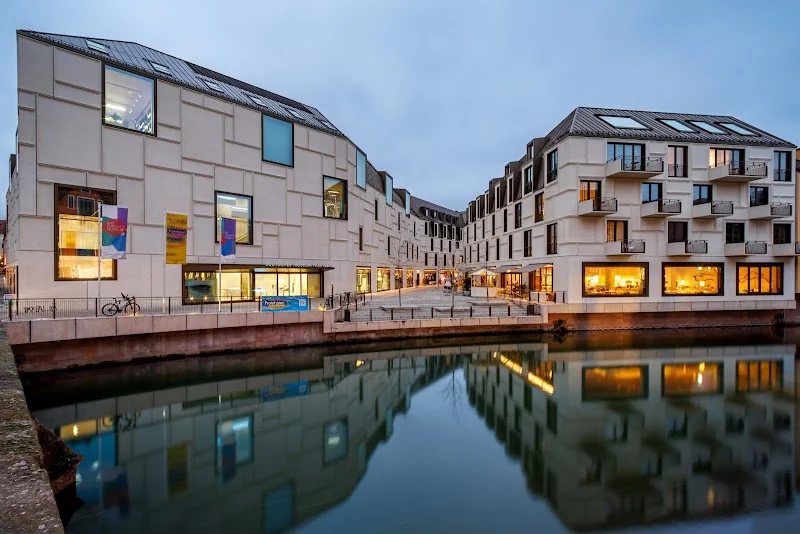
The location in the historic center makes it easy to reach by public transport. From the subway junction Lorenzkirche on line U1, it is about a ten-minute walk; tram line 4 stops at Hallertor, and bus line 36 serves the main market – both stops are within a short walking distance. Those coming from the surrounding area can use the connections of the transport association and conveniently change depending on the time of day. The museum is located directly in the Augustinerhof district, just a few steps from the Pegnitz riverbank and the main market, making it easy to find. For drivers: The house generally advises against direct access, as the old town is traffic-sensitive and parking options are limited. If arriving by car is necessary, parking garages are available nearby – the Augustinerhof underground garage on Augustinerstraße and the parking garage at the main market on Augustinerstraße 4. Both garages are only a few minutes' walk from the entrance. Accessible entrances and elevators are available for people with mobility impairments; designated parking spaces and verified accessibility are confirmed by the initiative Travel for All. Those carrying strollers, walking aids, or other equipment benefit from the level access to the floors. Tip for families: It is best to plan the route so that you first head to the entrance area with the ticket office and elevator to get oriented. Groups and school classes should coordinate their arrival and departure times in advance with the visitor service, especially if buses or several smaller groups arrive simultaneously. For everyone: The combination of public transport and a short walk saves time and makes the visit in the center more manageable – especially since many other attractions, cafés, and resting spots are located nearby.
Exhibitions and Highlights: Overview of Five Thematic Areas
The permanent exhibition is divided into five thematic fields, ranging from personal living environments to outer space, considering technical, social, and ethical questions. Work and everyday life focuses on the interplay of automation, robotics, artificial intelligence, and big data with daily life. Here, visitors can experiment with where machines can provide meaningful support, what tasks they can take over – and where limits, risks, and responsibilities lie. Body and mind illuminate medical and technological progress: from robotics in care to exoskeletons and implants to new diagnostic and therapeutic procedures. System City looks at the urban future with connected, intelligent infrastructure, new mobility concepts, and questions of quality of life and participation in megacities. System Earth links climate data, models, and visualizations with technological approaches to protect our planet; a special photo motif is the approximately three-meter-high globe onto which current climate data is projected. Space and time finally unfold the big questions of space travel: Which missions expand our horizons, which technologies enable new steps, and how do satellites influence everyday life? In addition to the permanent themes, prototypes and experimental setups present the interface between research, development, and vision. Among the often-cited highlights are a hyperloop object and PopUp Next, an experimental concept between electric car and flying taxi. These pieces illustrate the closeness between science and science fiction – and encourage discussion of opportunities and limits. Additionally, there are formats such as laboratories, workshops, and dialogue series that profile the house as a place of debate. Special exhibitions set thematic accents, recently with Reimagining Food, an exhibition on new food systems, running from July 9, 2025, to March 1, 2026. This keeps the course dynamic: Regularly changing content, lectures, and actions allow returning visitors to gain new perspectives.
Space and Time, XR, and Special Action Days
The area of space and time is the natural home for many of the immersive offerings that the Future Museum has firmly established since 2025. With Future Museum EXTENDED, the house has integrated virtual reality and augmented reality experiences permanently into the program. At the start on March 13, 2025, the VR Moonwalk replaced an earlier VR time travel experience and has since offered a guided, visually impressive excursion to the moon. The format is aimed at visitors from about 12 years old and is thematically connected to the exhibits on space travel: From the first missions to visions of future resource extraction on asteroids or a lunar base, the area illustrates how rapidly technologies are developing. Action days such as the nationwide Day of Space Travel 2025 complemented the program with curated tours through space and time, which were included in the regular admission price and provided insights into backgrounds, curation decisions, and technical details. Such formats exemplify how the museum combines knowledge acquisition and experience: First, the exhibition offers understandable models and data; then, an immersive station deepens the impression and makes complex content tangible through seeing, hearing, and interaction. For planners, this means: Plan time for the XR offerings, as slots are limited and demand peaks can occur throughout the day. Those who want to experience the full spectrum can combine space and time with system earth – for example, by viewing the seemingly floating globe onto which climate data is projected after the VR experience – and then explore prototypes from mobility. This creates a suitable dramaturgy between wonder, discussion, and contextualization. The XR line is regularly expanded; it is worthwhile to briefly check the program before the visit to see which new virtual experiences are available.
Photos, Impressions, and On-Site Service
Many visitors share photos of the particularly photogenic stations: These include the large-format climate globe in system earth, the exhibits on space travel in the area of space and time, and the prototypes for new mobility. The clear path guidance and level access allow exhibits to be discovered from different perspectives; elevators connect the levels, and mobile seating options provide support if needed. The barrier-free accessibility has been tested and documented; it includes, among other things, level access, elevators with sufficient space, orientation aids, and barrier-free sanitary facilities. For blind and visually impaired individuals, tactile overview plans and additional aids are available, and central content is bilingual. Those who prefer a quiet visit can take advantage of the morning hours on weekdays; those who enjoy the special atmosphere of a full house can choose weekends or action days. For families, the interactive stations are particularly attractive because they combine experimentation and learning; school groups benefit from reduced rates and tailored programs. The museum communicates program highlights such as special exhibitions, XR expansions, and festival focuses on its website, making it easy to combine the visit with other Nuremberg experiences. In the immediate vicinity, there are historic alleys, squares, and cafés – the main market is just around the corner, and the Pegnitz riverbank offers short breaks between two thematic areas. Those coming from the surrounding area can combine their visit with a city walk; the short distances keep the day's planning flexible. Contacting the house is straightforward: Visitor service at Augustinerhof 4, 90403 Nuremberg, reachable by phone at 0911 21548 880 or by email. For spontaneous questions on-site, the direct route to the ticket and information zone on the ground floor is recommended, where the team assists with orientation and ticket inquiries. Overall, the clearer the preparation, the more time remains to experience the content in depth – from the robotic arm to visualizations to the visions of space travel.
History, Sponsorship, and Context
The Future Museum is a branch of the German Museum and was opened on September 18, 2021. With its location in the Nuremberg old town, the house sends a clear signal: Future technologies and societal debates do not take place on the periphery, but in the heart of the city. The exhibition area of about 2900 square meters is spread over three levels. In the curation philosophy, the latest scientific findings and technology trends are consistently mirrored with cultural images and motifs from science fiction. This creates friction points that invite visitors to take a stance. The house sees itself as a place of dialogue: It not only exhibits technology but also questions its impact on work, health, environment, city, and space research. On the management side, the Future Museum is integrated into the network of the German Museum. In external communication and program information, the house acts as a platform that is continuously expanded – visible, for example, in the inclusion of XR offerings or in collaborations with urban actors. A look at the permanent themes shows that it is not about predictions in the sense of fixed forecasts, but about exploring possibilities, opportunities, and risks. The position at the intersection of science, culture, and society also explains the diversity of the audience: families, school classes, technology fans, travelers, and culture enthusiasts all find access. With the combination of permanent exhibitions, special exhibitions such as Reimagining Food, and the expansion of digital experiences, the house ensures long-term relevance and invites return visits.
Sources:
- German Museum Nuremberg – Opening Hours
- German Museum Nuremberg – Admission and tickets
- German Museum Nuremberg – Directions and Location Map
- German Museum Nuremberg – Exhibition Areas
- German Museum Nuremberg – Future Museum EXTENDED
- German Museum Nuremberg – Special Exhibition Reimagining Food 2025–2026
- German Museum Nuremberg – Opening September 18, 2021
- Tourism Nuremberg – German Museum Nuremberg
Mehr anzeigenWeniger anzeigen
German Museum Nuremberg | Tickets & Opening Hours
The German Museum Nuremberg – The Future Museum shows in the middle of the old town at Augustinerhof how research and technology could shape our everyday lives in the coming decades. In five large thematic areas, visitors experience prototypes, models, and interactive stations from fields such as robotics, mobility, medicine, climate, and space travel on about 2900 square meters. The house is a branch of the German Museum and is just a few steps away from the main market. Those planning a visit benefit from the central location, clear public transport connections, and transparent ticket regulations with time slots. Thanks to regular special exhibitions – for example, on the topic of the future of nutrition – and a growing program of immersive XR experiences, a return visit remains attractive. This page consolidates the most important information from official sources: current opening hours, ticket prices and booking, directions and parking, as well as highlights of the exhibitions, so you can prepare your visit specifically and have more time for discoveries on-site.
Opening Hours and Visit Planning
For a smooth start, it is worth checking the current daily opening hours. Since January 7, 2025, the Future Museum is open from Tuesday to Friday from 9:00 AM to 5:00 PM and on weekends and public holidays from 10:00 AM to 6:00 PM; the house is generally closed on Mondays. Special regulations apply around the turn of the year: It is closed on Christmas Eve, the first Christmas day, and New Year's Eve; the museum is also paused on New Year's Day. The second Christmas day is open, and other open or closed holidays will be communicated by the house in advance. This structure facilitates planning, especially for families, groups, and educational institutions that prefer fixed time slots. Due to high demand – especially on Saturdays, Sundays, and during holiday periods – the museum recommends purchasing online tickets with fixed time slots. Entry is based on slots; if a quota is exhausted, no additional sales are offered for that specific time slot. Those who are flexible with their schedule often find the most relaxed visiting times on weekday mornings. For members of the German Museum and holders of the Nuremberg Card, there is a separate on-site quota; a separate advance reservation is not necessary for these groups. Regardless, it is advisable to arrive a few minutes before the booked slot to plan for wardrobe and orientation and to start the tour without haste. The house is accessible; elevators connect the levels, and nearby parking options offer designated spaces for people with disabilities. Those needing assistance can reach the visitor service by phone on weekdays in the morning; they can help with questions about tickets, group registrations, and accessibility.
Tickets, Prices, and Booking
The Future Museum manages access through time slots and recommends online purchase to ensure travel and visit fit together ideally. The ticket prices are clearly transparent: Adults pay €10.50, the family ticket costs €22.00 and is valid for up to two adults with their own children up to 17 years. Reduced admission of €6.50 is available for children and teenagers aged 6 to 17, students, apprentices, and people with severe disabilities; registered companions of severely disabled visitors are free. Children up to and including 5 years generally receive free admission. For adult groups of 15 or more, the price is €8.50 per person; one companion – such as a tour guide – is free for every 15 people. School classes, apprentice, and student groups benefit from significantly reduced rates: €2.00 per person from Tuesday to Friday, €6.50 on weekends and public holidays; here, too, companions are free depending on group size. For regular visitors, there is an annual pass specifically for the Future Museum, which allows year-round access and is especially worthwhile for local families, technology enthusiasts, and educational partners. Holders of the Nuremberg Card have free admission; additionally, the ticket office holds a quota available on-site for these cards. Since demand is high on weekends, early purchase of time slots in the online ticket shop is recommended. Those traveling with a mixed group of full-paying guests, reduced tickets, and free quotas should pay attention to the appropriate tariff selection when booking and clarify any questions with the visitor service in advance to ensure entry for everyone together. By the way: For children under twelve years, it is recommended to visit the museum only when accompanied by adults; this ensures that the interactive stations are used sensibly and safely. Those wishing to visit the house multiple times can plan special exhibitions and XR offerings well through the annual pass or in combination with other Nuremberg cultural offerings.
Directions and Parking at Augustinerhof
The location in the historic center makes it easy to reach by public transport. From the subway junction Lorenzkirche on line U1, it is about a ten-minute walk; tram line 4 stops at Hallertor, and bus line 36 serves the main market – both stops are within a short walking distance. Those coming from the surrounding area can use the connections of the transport association and conveniently change depending on the time of day. The museum is located directly in the Augustinerhof district, just a few steps from the Pegnitz riverbank and the main market, making it easy to find. For drivers: The house generally advises against direct access, as the old town is traffic-sensitive and parking options are limited. If arriving by car is necessary, parking garages are available nearby – the Augustinerhof underground garage on Augustinerstraße and the parking garage at the main market on Augustinerstraße 4. Both garages are only a few minutes' walk from the entrance. Accessible entrances and elevators are available for people with mobility impairments; designated parking spaces and verified accessibility are confirmed by the initiative Travel for All. Those carrying strollers, walking aids, or other equipment benefit from the level access to the floors. Tip for families: It is best to plan the route so that you first head to the entrance area with the ticket office and elevator to get oriented. Groups and school classes should coordinate their arrival and departure times in advance with the visitor service, especially if buses or several smaller groups arrive simultaneously. For everyone: The combination of public transport and a short walk saves time and makes the visit in the center more manageable – especially since many other attractions, cafés, and resting spots are located nearby.
Exhibitions and Highlights: Overview of Five Thematic Areas
The permanent exhibition is divided into five thematic fields, ranging from personal living environments to outer space, considering technical, social, and ethical questions. Work and everyday life focuses on the interplay of automation, robotics, artificial intelligence, and big data with daily life. Here, visitors can experiment with where machines can provide meaningful support, what tasks they can take over – and where limits, risks, and responsibilities lie. Body and mind illuminate medical and technological progress: from robotics in care to exoskeletons and implants to new diagnostic and therapeutic procedures. System City looks at the urban future with connected, intelligent infrastructure, new mobility concepts, and questions of quality of life and participation in megacities. System Earth links climate data, models, and visualizations with technological approaches to protect our planet; a special photo motif is the approximately three-meter-high globe onto which current climate data is projected. Space and time finally unfold the big questions of space travel: Which missions expand our horizons, which technologies enable new steps, and how do satellites influence everyday life? In addition to the permanent themes, prototypes and experimental setups present the interface between research, development, and vision. Among the often-cited highlights are a hyperloop object and PopUp Next, an experimental concept between electric car and flying taxi. These pieces illustrate the closeness between science and science fiction – and encourage discussion of opportunities and limits. Additionally, there are formats such as laboratories, workshops, and dialogue series that profile the house as a place of debate. Special exhibitions set thematic accents, recently with Reimagining Food, an exhibition on new food systems, running from July 9, 2025, to March 1, 2026. This keeps the course dynamic: Regularly changing content, lectures, and actions allow returning visitors to gain new perspectives.
Space and Time, XR, and Special Action Days
The area of space and time is the natural home for many of the immersive offerings that the Future Museum has firmly established since 2025. With Future Museum EXTENDED, the house has integrated virtual reality and augmented reality experiences permanently into the program. At the start on March 13, 2025, the VR Moonwalk replaced an earlier VR time travel experience and has since offered a guided, visually impressive excursion to the moon. The format is aimed at visitors from about 12 years old and is thematically connected to the exhibits on space travel: From the first missions to visions of future resource extraction on asteroids or a lunar base, the area illustrates how rapidly technologies are developing. Action days such as the nationwide Day of Space Travel 2025 complemented the program with curated tours through space and time, which were included in the regular admission price and provided insights into backgrounds, curation decisions, and technical details. Such formats exemplify how the museum combines knowledge acquisition and experience: First, the exhibition offers understandable models and data; then, an immersive station deepens the impression and makes complex content tangible through seeing, hearing, and interaction. For planners, this means: Plan time for the XR offerings, as slots are limited and demand peaks can occur throughout the day. Those who want to experience the full spectrum can combine space and time with system earth – for example, by viewing the seemingly floating globe onto which climate data is projected after the VR experience – and then explore prototypes from mobility. This creates a suitable dramaturgy between wonder, discussion, and contextualization. The XR line is regularly expanded; it is worthwhile to briefly check the program before the visit to see which new virtual experiences are available.
Photos, Impressions, and On-Site Service
Many visitors share photos of the particularly photogenic stations: These include the large-format climate globe in system earth, the exhibits on space travel in the area of space and time, and the prototypes for new mobility. The clear path guidance and level access allow exhibits to be discovered from different perspectives; elevators connect the levels, and mobile seating options provide support if needed. The barrier-free accessibility has been tested and documented; it includes, among other things, level access, elevators with sufficient space, orientation aids, and barrier-free sanitary facilities. For blind and visually impaired individuals, tactile overview plans and additional aids are available, and central content is bilingual. Those who prefer a quiet visit can take advantage of the morning hours on weekdays; those who enjoy the special atmosphere of a full house can choose weekends or action days. For families, the interactive stations are particularly attractive because they combine experimentation and learning; school groups benefit from reduced rates and tailored programs. The museum communicates program highlights such as special exhibitions, XR expansions, and festival focuses on its website, making it easy to combine the visit with other Nuremberg experiences. In the immediate vicinity, there are historic alleys, squares, and cafés – the main market is just around the corner, and the Pegnitz riverbank offers short breaks between two thematic areas. Those coming from the surrounding area can combine their visit with a city walk; the short distances keep the day's planning flexible. Contacting the house is straightforward: Visitor service at Augustinerhof 4, 90403 Nuremberg, reachable by phone at 0911 21548 880 or by email. For spontaneous questions on-site, the direct route to the ticket and information zone on the ground floor is recommended, where the team assists with orientation and ticket inquiries. Overall, the clearer the preparation, the more time remains to experience the content in depth – from the robotic arm to visualizations to the visions of space travel.
History, Sponsorship, and Context
The Future Museum is a branch of the German Museum and was opened on September 18, 2021. With its location in the Nuremberg old town, the house sends a clear signal: Future technologies and societal debates do not take place on the periphery, but in the heart of the city. The exhibition area of about 2900 square meters is spread over three levels. In the curation philosophy, the latest scientific findings and technology trends are consistently mirrored with cultural images and motifs from science fiction. This creates friction points that invite visitors to take a stance. The house sees itself as a place of dialogue: It not only exhibits technology but also questions its impact on work, health, environment, city, and space research. On the management side, the Future Museum is integrated into the network of the German Museum. In external communication and program information, the house acts as a platform that is continuously expanded – visible, for example, in the inclusion of XR offerings or in collaborations with urban actors. A look at the permanent themes shows that it is not about predictions in the sense of fixed forecasts, but about exploring possibilities, opportunities, and risks. The position at the intersection of science, culture, and society also explains the diversity of the audience: families, school classes, technology fans, travelers, and culture enthusiasts all find access. With the combination of permanent exhibitions, special exhibitions such as Reimagining Food, and the expansion of digital experiences, the house ensures long-term relevance and invites return visits.
Sources:
- German Museum Nuremberg – Opening Hours
- German Museum Nuremberg – Admission and tickets
- German Museum Nuremberg – Directions and Location Map
- German Museum Nuremberg – Exhibition Areas
- German Museum Nuremberg – Future Museum EXTENDED
- German Museum Nuremberg – Special Exhibition Reimagining Food 2025–2026
- German Museum Nuremberg – Opening September 18, 2021
- Tourism Nuremberg – German Museum Nuremberg
German Museum Nuremberg | Tickets & Opening Hours
The German Museum Nuremberg – The Future Museum shows in the middle of the old town at Augustinerhof how research and technology could shape our everyday lives in the coming decades. In five large thematic areas, visitors experience prototypes, models, and interactive stations from fields such as robotics, mobility, medicine, climate, and space travel on about 2900 square meters. The house is a branch of the German Museum and is just a few steps away from the main market. Those planning a visit benefit from the central location, clear public transport connections, and transparent ticket regulations with time slots. Thanks to regular special exhibitions – for example, on the topic of the future of nutrition – and a growing program of immersive XR experiences, a return visit remains attractive. This page consolidates the most important information from official sources: current opening hours, ticket prices and booking, directions and parking, as well as highlights of the exhibitions, so you can prepare your visit specifically and have more time for discoveries on-site.
Opening Hours and Visit Planning
For a smooth start, it is worth checking the current daily opening hours. Since January 7, 2025, the Future Museum is open from Tuesday to Friday from 9:00 AM to 5:00 PM and on weekends and public holidays from 10:00 AM to 6:00 PM; the house is generally closed on Mondays. Special regulations apply around the turn of the year: It is closed on Christmas Eve, the first Christmas day, and New Year's Eve; the museum is also paused on New Year's Day. The second Christmas day is open, and other open or closed holidays will be communicated by the house in advance. This structure facilitates planning, especially for families, groups, and educational institutions that prefer fixed time slots. Due to high demand – especially on Saturdays, Sundays, and during holiday periods – the museum recommends purchasing online tickets with fixed time slots. Entry is based on slots; if a quota is exhausted, no additional sales are offered for that specific time slot. Those who are flexible with their schedule often find the most relaxed visiting times on weekday mornings. For members of the German Museum and holders of the Nuremberg Card, there is a separate on-site quota; a separate advance reservation is not necessary for these groups. Regardless, it is advisable to arrive a few minutes before the booked slot to plan for wardrobe and orientation and to start the tour without haste. The house is accessible; elevators connect the levels, and nearby parking options offer designated spaces for people with disabilities. Those needing assistance can reach the visitor service by phone on weekdays in the morning; they can help with questions about tickets, group registrations, and accessibility.
Tickets, Prices, and Booking
The Future Museum manages access through time slots and recommends online purchase to ensure travel and visit fit together ideally. The ticket prices are clearly transparent: Adults pay €10.50, the family ticket costs €22.00 and is valid for up to two adults with their own children up to 17 years. Reduced admission of €6.50 is available for children and teenagers aged 6 to 17, students, apprentices, and people with severe disabilities; registered companions of severely disabled visitors are free. Children up to and including 5 years generally receive free admission. For adult groups of 15 or more, the price is €8.50 per person; one companion – such as a tour guide – is free for every 15 people. School classes, apprentice, and student groups benefit from significantly reduced rates: €2.00 per person from Tuesday to Friday, €6.50 on weekends and public holidays; here, too, companions are free depending on group size. For regular visitors, there is an annual pass specifically for the Future Museum, which allows year-round access and is especially worthwhile for local families, technology enthusiasts, and educational partners. Holders of the Nuremberg Card have free admission; additionally, the ticket office holds a quota available on-site for these cards. Since demand is high on weekends, early purchase of time slots in the online ticket shop is recommended. Those traveling with a mixed group of full-paying guests, reduced tickets, and free quotas should pay attention to the appropriate tariff selection when booking and clarify any questions with the visitor service in advance to ensure entry for everyone together. By the way: For children under twelve years, it is recommended to visit the museum only when accompanied by adults; this ensures that the interactive stations are used sensibly and safely. Those wishing to visit the house multiple times can plan special exhibitions and XR offerings well through the annual pass or in combination with other Nuremberg cultural offerings.
Directions and Parking at Augustinerhof
The location in the historic center makes it easy to reach by public transport. From the subway junction Lorenzkirche on line U1, it is about a ten-minute walk; tram line 4 stops at Hallertor, and bus line 36 serves the main market – both stops are within a short walking distance. Those coming from the surrounding area can use the connections of the transport association and conveniently change depending on the time of day. The museum is located directly in the Augustinerhof district, just a few steps from the Pegnitz riverbank and the main market, making it easy to find. For drivers: The house generally advises against direct access, as the old town is traffic-sensitive and parking options are limited. If arriving by car is necessary, parking garages are available nearby – the Augustinerhof underground garage on Augustinerstraße and the parking garage at the main market on Augustinerstraße 4. Both garages are only a few minutes' walk from the entrance. Accessible entrances and elevators are available for people with mobility impairments; designated parking spaces and verified accessibility are confirmed by the initiative Travel for All. Those carrying strollers, walking aids, or other equipment benefit from the level access to the floors. Tip for families: It is best to plan the route so that you first head to the entrance area with the ticket office and elevator to get oriented. Groups and school classes should coordinate their arrival and departure times in advance with the visitor service, especially if buses or several smaller groups arrive simultaneously. For everyone: The combination of public transport and a short walk saves time and makes the visit in the center more manageable – especially since many other attractions, cafés, and resting spots are located nearby.
Exhibitions and Highlights: Overview of Five Thematic Areas
The permanent exhibition is divided into five thematic fields, ranging from personal living environments to outer space, considering technical, social, and ethical questions. Work and everyday life focuses on the interplay of automation, robotics, artificial intelligence, and big data with daily life. Here, visitors can experiment with where machines can provide meaningful support, what tasks they can take over – and where limits, risks, and responsibilities lie. Body and mind illuminate medical and technological progress: from robotics in care to exoskeletons and implants to new diagnostic and therapeutic procedures. System City looks at the urban future with connected, intelligent infrastructure, new mobility concepts, and questions of quality of life and participation in megacities. System Earth links climate data, models, and visualizations with technological approaches to protect our planet; a special photo motif is the approximately three-meter-high globe onto which current climate data is projected. Space and time finally unfold the big questions of space travel: Which missions expand our horizons, which technologies enable new steps, and how do satellites influence everyday life? In addition to the permanent themes, prototypes and experimental setups present the interface between research, development, and vision. Among the often-cited highlights are a hyperloop object and PopUp Next, an experimental concept between electric car and flying taxi. These pieces illustrate the closeness between science and science fiction – and encourage discussion of opportunities and limits. Additionally, there are formats such as laboratories, workshops, and dialogue series that profile the house as a place of debate. Special exhibitions set thematic accents, recently with Reimagining Food, an exhibition on new food systems, running from July 9, 2025, to March 1, 2026. This keeps the course dynamic: Regularly changing content, lectures, and actions allow returning visitors to gain new perspectives.
Space and Time, XR, and Special Action Days
The area of space and time is the natural home for many of the immersive offerings that the Future Museum has firmly established since 2025. With Future Museum EXTENDED, the house has integrated virtual reality and augmented reality experiences permanently into the program. At the start on March 13, 2025, the VR Moonwalk replaced an earlier VR time travel experience and has since offered a guided, visually impressive excursion to the moon. The format is aimed at visitors from about 12 years old and is thematically connected to the exhibits on space travel: From the first missions to visions of future resource extraction on asteroids or a lunar base, the area illustrates how rapidly technologies are developing. Action days such as the nationwide Day of Space Travel 2025 complemented the program with curated tours through space and time, which were included in the regular admission price and provided insights into backgrounds, curation decisions, and technical details. Such formats exemplify how the museum combines knowledge acquisition and experience: First, the exhibition offers understandable models and data; then, an immersive station deepens the impression and makes complex content tangible through seeing, hearing, and interaction. For planners, this means: Plan time for the XR offerings, as slots are limited and demand peaks can occur throughout the day. Those who want to experience the full spectrum can combine space and time with system earth – for example, by viewing the seemingly floating globe onto which climate data is projected after the VR experience – and then explore prototypes from mobility. This creates a suitable dramaturgy between wonder, discussion, and contextualization. The XR line is regularly expanded; it is worthwhile to briefly check the program before the visit to see which new virtual experiences are available.
Photos, Impressions, and On-Site Service
Many visitors share photos of the particularly photogenic stations: These include the large-format climate globe in system earth, the exhibits on space travel in the area of space and time, and the prototypes for new mobility. The clear path guidance and level access allow exhibits to be discovered from different perspectives; elevators connect the levels, and mobile seating options provide support if needed. The barrier-free accessibility has been tested and documented; it includes, among other things, level access, elevators with sufficient space, orientation aids, and barrier-free sanitary facilities. For blind and visually impaired individuals, tactile overview plans and additional aids are available, and central content is bilingual. Those who prefer a quiet visit can take advantage of the morning hours on weekdays; those who enjoy the special atmosphere of a full house can choose weekends or action days. For families, the interactive stations are particularly attractive because they combine experimentation and learning; school groups benefit from reduced rates and tailored programs. The museum communicates program highlights such as special exhibitions, XR expansions, and festival focuses on its website, making it easy to combine the visit with other Nuremberg experiences. In the immediate vicinity, there are historic alleys, squares, and cafés – the main market is just around the corner, and the Pegnitz riverbank offers short breaks between two thematic areas. Those coming from the surrounding area can combine their visit with a city walk; the short distances keep the day's planning flexible. Contacting the house is straightforward: Visitor service at Augustinerhof 4, 90403 Nuremberg, reachable by phone at 0911 21548 880 or by email. For spontaneous questions on-site, the direct route to the ticket and information zone on the ground floor is recommended, where the team assists with orientation and ticket inquiries. Overall, the clearer the preparation, the more time remains to experience the content in depth – from the robotic arm to visualizations to the visions of space travel.
History, Sponsorship, and Context
The Future Museum is a branch of the German Museum and was opened on September 18, 2021. With its location in the Nuremberg old town, the house sends a clear signal: Future technologies and societal debates do not take place on the periphery, but in the heart of the city. The exhibition area of about 2900 square meters is spread over three levels. In the curation philosophy, the latest scientific findings and technology trends are consistently mirrored with cultural images and motifs from science fiction. This creates friction points that invite visitors to take a stance. The house sees itself as a place of dialogue: It not only exhibits technology but also questions its impact on work, health, environment, city, and space research. On the management side, the Future Museum is integrated into the network of the German Museum. In external communication and program information, the house acts as a platform that is continuously expanded – visible, for example, in the inclusion of XR offerings or in collaborations with urban actors. A look at the permanent themes shows that it is not about predictions in the sense of fixed forecasts, but about exploring possibilities, opportunities, and risks. The position at the intersection of science, culture, and society also explains the diversity of the audience: families, school classes, technology fans, travelers, and culture enthusiasts all find access. With the combination of permanent exhibitions, special exhibitions such as Reimagining Food, and the expansion of digital experiences, the house ensures long-term relevance and invites return visits.
Sources:
- German Museum Nuremberg – Opening Hours
- German Museum Nuremberg – Admission and tickets
- German Museum Nuremberg – Directions and Location Map
- German Museum Nuremberg – Exhibition Areas
- German Museum Nuremberg – Future Museum EXTENDED
- German Museum Nuremberg – Special Exhibition Reimagining Food 2025–2026
- German Museum Nuremberg – Opening September 18, 2021
- Tourism Nuremberg – German Museum Nuremberg
Upcoming Events
No events found
Frequently Asked Questions
Reviews
N i C
5. November 2025
Great, modern museum in the heart of Nuremberg that is especially family-friendly. Across three floors, there are numerous interactive stations and experiments that make the future tangible. Kids can try everything while adults discover the latest developments. Conveniently, there are free lockers for bags and clothes, an area for eating and drinking, and admission is included with the Nuremberg Card. An absolutely recommendable place for an educational and exciting family outing.
Di Pe
28. July 2025
Very interesting. The museum has 3 floors. There is an elevator. You can experience a lot and be hands-on. I think it's not really suitable for kids under 10. Explanations are available in German and English. Staff were also available everywhere for questions.
Julian Häffner
5. October 2025
Really a great museum and absolutely recommendable. I was there primarily to visit a special exhibition on "The Future of Nutrition" and was pleasantly surprised. I spent an hour in the special exhibition alone and another hour for the rest of the top floor ("Space and All"). Along with lots of detailed info and beautiful models, there are also many interactive stations. If you want to enjoy everything in detail, you can easily spend 5 hours or more there without getting bored. The only downside - which isn't too bad - is the Virtual Reality moon tour. For what the technology can do, not enough was made of it. You just stand in a poorly rendered lunar landscape and can read 10 additional info panels there. They could have done more with that. But that doesn't change the 5 stars.
S A
23. September 2025
The museum realistically shows what the future holds. This museum not only provides entertainment but also informs us about how we will live and work. The museum also offers a lot to try out. In my opinion, the explanations could be more detailed. I was most interested in the replica of a quantum computer. It is currently still very error-prone but offers huge potential for our future. The museum is divided into three floors. I visited the museum on a weekday. At that time, it was not overcrowded. I will visit the museum again in two or three years to perhaps see more trends that we might not know about yet.
Emy ChipChap
30. July 2025
Great, technical and modern museum that offers a lot of interesting information on currently socially important topics like AI, space travel, and climate change. It's also interactive and suitable for all age groups. It's also inclusive, as it has an elevator and braille. We were very excited, a definite recommendation.