
Fürth
Gustavstraße 38, 90762 Fürth, Deutschland
Historic Ensemble Gustavstraße | Old Town & History
The historic ensemble Gustavstraße is located in the heart of Fürth's historical core and represents exactly the image for which the city is known: The Town Hall, Gustavstraße, its alleys, and the Green Market form a compact, walkable district with half-timbered houses, sandstone, and a vibrant gastronomy. The city of Fürth describes the old town as a protected ensemble and highlights Gustavstraße as a well-known pub street, featuring small shops and recurring events. The Tourist Information also points to historical buildings, the character as a monument site, and the many establishments that invite visitors to stop by today. Therefore, those who visit Gustavstraße do not experience a single event hall, but a developed urban space with history, everyday life, and celebration culture in close quarters. This is precisely where the charm lies: The street is not just a backdrop but the living center of an entire old town district that feels different from daytime visits to evening strolls. For those searching for old town, history, events, access, or parking, this place is equally a cultural address and practical orientation in the heart of Fürth. ([tourismus-fuerth.de](https://www.tourismus-fuerth.de/poi/gustavstrasse-100036884/))
Why Gustavstraße is the Heart of Fürth's Old Town
Historically, Gustavstraße is much more than a pretty alley with establishments: It was for a long time the old main street of the place and thus part of the central axis along which medieval Fürth developed. The historical description of the ensemble shows that the market town grouped around a twice-bent thoroughfare axis, to which Gustavstraße belonged as a former farmer's alley. This axis was functionally connected to the marketplace because the farmers coming to the market parked their carts here and stopped at the inns. This early everyday function explains why Gustavstraße still radiates so much urban energy today: It was never just a thoroughfare but always also a place to stay, a trading place, and a social meeting point. For this reason, the area around the marketplace, Gustavstraße, and the church square has been so formative for Fürth's identity. The city and monument preservation later reorganized the historical area; as early as 1990, the Bavarian State Office for Monument Preservation proposed to include the previously separately considered ensembles of Gustavstraße/Church Square/Marketplace and Königstraße/Schindelgasse into the broader ensemble of Old Town Fürth. Today, this explains the urban planning image: not isolated individual monuments, but a coherent old town logic with short paths, tight spaces, and clear historical depth effect. Therefore, those walking through Gustavstraße are not moving in just any nightlife area but on a street that has emerged from the market and traffic life of an old town core and continues to visibly retain this role to the present day. ([fuerthwiki.de](https://www.fuerthwiki.de/wiki/index.php/Ensemble_Altstadt_F%C3%BCrth))
From Farmer's Alley to Monument-Protected Urban Axis
The historical transformation of Gustavstraße is particularly exciting for visitors because it becomes visible along a single street. The current name was established in 1827 when the former farmer's alley was named after King Gustav Adolf; the street thus still recalls the traditions associated with Fürth surrounding the Swedish king. The Tourist Information points out that historians suspect his stay was more likely in the neighboring rectory, but the naming of the street preserves this historical reference. This makes it clear how strongly tradition, city topography, and memory intertwine in Fürth. This applies not only to the street itself but to the entire old town structure: The market town grew along the old thoroughfare axis, and later expansions also adhered to this logic. The historical description also mentions the large urban planning context of the old town, in which the marketplace and Gustavstraße as focal areas still show the typical image of a Franconian small town of the 18th and 19th centuries. Additionally, the history of the Michaelis Fair connects Gustavstraße with the public life of the city. The festival spread over centuries from the church square through Gustavstraße to the entire city center; in 1901, even market stalls were moved to König- and Gustavstraße before the magistrate withdrew its decision after resistance. This connection of everyday street, market axis, festival route, and monument space makes Gustavstraße so unique. It is not a museum relic but a lively place where the history of the city continues to work in its spatial structure and remains visible in the urban landscape to this day. ([fuerthwiki.de](https://www.fuerthwiki.de/wiki/index.php/Ensemble_Altstadt_F%C3%BCrth))
Half-Timbering, Sandstone, and the Unique Image of Fürth
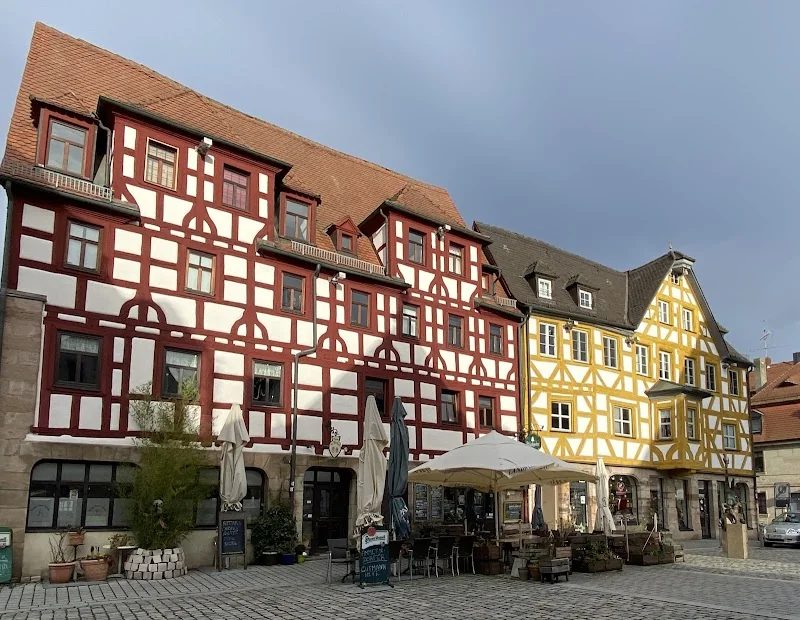
The unique face of Gustavstraße arises from the mix of building forms, materials, and proportions that are typical of Fürth's old town. The city of Fürth explicitly describes the historical core as characterized by the Town Hall, Gustavstraße, and its alleys, as well as the Green Market; half-timbered houses and sandstone buildings dominate the image. The Tourist Information also emphasizes that in Gustavstraße, alongside many later altered facades, traditional half-timbering can still be discovered. A striking example is the baroque sandstone building of the inn Grüner Baum, which is among the prominent historical houses of the street. It is associated with the tradition that King Gustav Adolf of Sweden is said to have stayed there in 1632, although historians consider the neighboring rectory more likely. This mix of secured building history and vibrant narrative tradition shapes the charm of the district. Additionally, the characteristic diversity of facades in Fürth, where historical layers remain visible, adds to this. The Tourist Information highlights striking colorful slate on many buildings that partially cover the originally present half-timbering, as it was once considered peasant and unfashionable. This creates an urban image that appears cohesive and colorful at first glance, but upon closer inspection reveals many epochs and transformations. The old town does not present itself here as a rigid reconstruction but as a grown urban landscape with house forms from different centuries, with gables, sandstone, slate, and narrow parcels. For visitors, this means: Even a short walk through Gustavstraße tells of social change, old crafts, bourgeois representation, and the effort to preserve the character of the ensemble without losing the vibrant liveliness of the street. ([tourismus-fuerth.de](https://www.tourismus-fuerth.de/poi/gustavstrasse-100036884/))
Gastronomy, Grafflmarkt, and Lively Old Town Moments
Today, Gustavstraße is primarily known as Fürth's most famous pub street, and therein lies one of its strongest SEO and experience factors. The city of Fürth speaks of the pub street around Gustavstraße, of quaint little shops, and of the old town as a place where not only culinary delights are offered. The Tourist Information adds that numerous establishments invite for cozy stops and that the street is also a historical building and monument site. This combination of gastronomy, history, and urban everyday life makes the street space particularly attractive for visitors who want not only to see but also to stay. Additionally, regular events further enhance the character of the district. Particularly important is the Grafflmarkt, which the city describes as a flea market for everyone in Fürth's beautiful old town. According to the city website, it takes place on several streets and squares, including Gustavstraße, Waagplatz, Waagstraße, Church Square, Königstraße, Geleitsgasse, Löwenplatz, the parking lots on Lilienstraße, and the marketplace or Green Market. The old town page also mentions the Grafflmarkt as one of the popular highlights that take place twice a year. Also closely associated with Gustavstraße is the Michaelis Fair, whose festival area has spread over the centuries from the church square through Gustavstraße to the city center. For the current experience of the street, city tours are also important: The tour Secrets around Gustavstraße starts at the Green Market at the corner of Gustavstraße and reveals more than 20 small and large secrets at 13 stations; the series Fürther Highlights also leads from there into hidden areas of the old town. This creates a district that invites strolling during the day, dining in the evening, and discovering on market days. This complexity explains why Gustavstraße is not perceived merely as a nightlife address but as a vibrant cultural space where trade, enjoyment, memory, and urban history directly intertwine. ([fuerth.de](https://www.fuerth.de/kultur-freizeit/freizeit/shoppen-und-gastro/))
Access, Parking, and the Best Way Through the Old Town
Gustavstraße is so centrally located that travel planning can be meaningfully combined in several ways. The Tourist Information explicitly provides connections for Google Maps, OpenStreetMap, and Deutsche Bahn on the object page, which shows that the street is well integrated for walking in the city center as well as for arriving by public transport. For visitors arriving by car, it is especially important that the old town of Fürth is organized as an inner-city area with resident parking zones. The city's handbook on resident parking only lists parking garages with the possibility of renting parking spaces for the old town, thus clarifying that the parking situation in this historical core is tight and regulated. Additionally, special caution applies during major events such as the Grafflmarkt: The city specifies concrete closures there, such as on Gustavstraße and adjacent areas, and emphasizes that the general traffic and parking rules continue to apply. The city's service regarding parking fees also shows that public parking space in Fürth is regulated and usually associated with clear time and fee rules. Practically, this means: Those who want to visit Gustavstraße should not simply hope for a spontaneous parking space but plan their visit consciously. Especially on popular market days or during church fairs, it is worth checking travel arrangements in advance and then walking through the old town. The walk pays off, as the street unfolds its charm especially in connection with the rest of the old town district. A short stroll can be well combined with the Green Market, the marketplace, the Town Hall, and the adjacent alleys. Thus, a trip becomes a small city exploration, where one experiences the structure of the Fürth old town ensemble not only from the perspective of traffic but also from the viewpoint of a developed urban space. ([tourismus-fuerth.de](https://www.tourismus-fuerth.de/poi/gustavstrasse-100036884/))
Old Town Walk, Tours, and Why a Visit is Always Worthwhile
Those who really want to understand the historic ensemble Gustavstraße should not just pass through it but experience it as part of a larger old town walk. The city's offerings show that the area is consciously used as a starting point for tours. On tours like The Old Town and its Courtyards or Fürther Highlights, the walk begins at the marketplace or Green Market in front of the Jester Fountain and leads to hidden oases, elaborately renovated courtyards, and the architectural traces of old Fürth. This look behind the facades is crucial because it removes Gustavstraße from the role of a gastronomic promenade and places it in its historical context. The district then becomes readable as a grown urban space: as a street of farmers, innkeepers, market people, visitors, and today's old town guests. For practical exploration, this also means that Gustavstraße is not a classic hall with fixed capacity, seating arrangement, or stage logic, but an open urban space. This makes the visit flexible: One can stop briefly, deliberately dine, take part in the old town tours, or end the evening in the pub street. This is particularly important for content and SEO purposes, as the search intentions surrounding Gustavstraße can be very diverse: Some search for history and half-timbering, others for Grafflmarkt, parking, access, or simply a good place to eat. The strength of this place lies in bringing all these interests together in one spot. Between Town Hall, marketplace, church square, and the alleys of the old town, a picture of Fürth emerges that is historically, practically, and atmospherically convincing at the same time. Once there, one quickly understands why Gustavstraße is not just an address but a core experience of the city. ([fuerth.de](https://www.fuerth.de/kultur-freizeit/veranstaltungen-termine/veranstaltungskalender/veranstaltungsdetails/stadtfuehrung-die-altstadt-und-ihre-hoefe-1100-15-02-2026-393073/?utm_source=openai))
Sources:
Mehr anzeigenWeniger anzeigen
Historic Ensemble Gustavstraße | Old Town & History
The historic ensemble Gustavstraße is located in the heart of Fürth's historical core and represents exactly the image for which the city is known: The Town Hall, Gustavstraße, its alleys, and the Green Market form a compact, walkable district with half-timbered houses, sandstone, and a vibrant gastronomy. The city of Fürth describes the old town as a protected ensemble and highlights Gustavstraße as a well-known pub street, featuring small shops and recurring events. The Tourist Information also points to historical buildings, the character as a monument site, and the many establishments that invite visitors to stop by today. Therefore, those who visit Gustavstraße do not experience a single event hall, but a developed urban space with history, everyday life, and celebration culture in close quarters. This is precisely where the charm lies: The street is not just a backdrop but the living center of an entire old town district that feels different from daytime visits to evening strolls. For those searching for old town, history, events, access, or parking, this place is equally a cultural address and practical orientation in the heart of Fürth. ([tourismus-fuerth.de](https://www.tourismus-fuerth.de/poi/gustavstrasse-100036884/))
Why Gustavstraße is the Heart of Fürth's Old Town
Historically, Gustavstraße is much more than a pretty alley with establishments: It was for a long time the old main street of the place and thus part of the central axis along which medieval Fürth developed. The historical description of the ensemble shows that the market town grouped around a twice-bent thoroughfare axis, to which Gustavstraße belonged as a former farmer's alley. This axis was functionally connected to the marketplace because the farmers coming to the market parked their carts here and stopped at the inns. This early everyday function explains why Gustavstraße still radiates so much urban energy today: It was never just a thoroughfare but always also a place to stay, a trading place, and a social meeting point. For this reason, the area around the marketplace, Gustavstraße, and the church square has been so formative for Fürth's identity. The city and monument preservation later reorganized the historical area; as early as 1990, the Bavarian State Office for Monument Preservation proposed to include the previously separately considered ensembles of Gustavstraße/Church Square/Marketplace and Königstraße/Schindelgasse into the broader ensemble of Old Town Fürth. Today, this explains the urban planning image: not isolated individual monuments, but a coherent old town logic with short paths, tight spaces, and clear historical depth effect. Therefore, those walking through Gustavstraße are not moving in just any nightlife area but on a street that has emerged from the market and traffic life of an old town core and continues to visibly retain this role to the present day. ([fuerthwiki.de](https://www.fuerthwiki.de/wiki/index.php/Ensemble_Altstadt_F%C3%BCrth))
From Farmer's Alley to Monument-Protected Urban Axis
The historical transformation of Gustavstraße is particularly exciting for visitors because it becomes visible along a single street. The current name was established in 1827 when the former farmer's alley was named after King Gustav Adolf; the street thus still recalls the traditions associated with Fürth surrounding the Swedish king. The Tourist Information points out that historians suspect his stay was more likely in the neighboring rectory, but the naming of the street preserves this historical reference. This makes it clear how strongly tradition, city topography, and memory intertwine in Fürth. This applies not only to the street itself but to the entire old town structure: The market town grew along the old thoroughfare axis, and later expansions also adhered to this logic. The historical description also mentions the large urban planning context of the old town, in which the marketplace and Gustavstraße as focal areas still show the typical image of a Franconian small town of the 18th and 19th centuries. Additionally, the history of the Michaelis Fair connects Gustavstraße with the public life of the city. The festival spread over centuries from the church square through Gustavstraße to the entire city center; in 1901, even market stalls were moved to König- and Gustavstraße before the magistrate withdrew its decision after resistance. This connection of everyday street, market axis, festival route, and monument space makes Gustavstraße so unique. It is not a museum relic but a lively place where the history of the city continues to work in its spatial structure and remains visible in the urban landscape to this day. ([fuerthwiki.de](https://www.fuerthwiki.de/wiki/index.php/Ensemble_Altstadt_F%C3%BCrth))
Half-Timbering, Sandstone, and the Unique Image of Fürth
The unique face of Gustavstraße arises from the mix of building forms, materials, and proportions that are typical of Fürth's old town. The city of Fürth explicitly describes the historical core as characterized by the Town Hall, Gustavstraße, and its alleys, as well as the Green Market; half-timbered houses and sandstone buildings dominate the image. The Tourist Information also emphasizes that in Gustavstraße, alongside many later altered facades, traditional half-timbering can still be discovered. A striking example is the baroque sandstone building of the inn Grüner Baum, which is among the prominent historical houses of the street. It is associated with the tradition that King Gustav Adolf of Sweden is said to have stayed there in 1632, although historians consider the neighboring rectory more likely. This mix of secured building history and vibrant narrative tradition shapes the charm of the district. Additionally, the characteristic diversity of facades in Fürth, where historical layers remain visible, adds to this. The Tourist Information highlights striking colorful slate on many buildings that partially cover the originally present half-timbering, as it was once considered peasant and unfashionable. This creates an urban image that appears cohesive and colorful at first glance, but upon closer inspection reveals many epochs and transformations. The old town does not present itself here as a rigid reconstruction but as a grown urban landscape with house forms from different centuries, with gables, sandstone, slate, and narrow parcels. For visitors, this means: Even a short walk through Gustavstraße tells of social change, old crafts, bourgeois representation, and the effort to preserve the character of the ensemble without losing the vibrant liveliness of the street. ([tourismus-fuerth.de](https://www.tourismus-fuerth.de/poi/gustavstrasse-100036884/))
Gastronomy, Grafflmarkt, and Lively Old Town Moments
Today, Gustavstraße is primarily known as Fürth's most famous pub street, and therein lies one of its strongest SEO and experience factors. The city of Fürth speaks of the pub street around Gustavstraße, of quaint little shops, and of the old town as a place where not only culinary delights are offered. The Tourist Information adds that numerous establishments invite for cozy stops and that the street is also a historical building and monument site. This combination of gastronomy, history, and urban everyday life makes the street space particularly attractive for visitors who want not only to see but also to stay. Additionally, regular events further enhance the character of the district. Particularly important is the Grafflmarkt, which the city describes as a flea market for everyone in Fürth's beautiful old town. According to the city website, it takes place on several streets and squares, including Gustavstraße, Waagplatz, Waagstraße, Church Square, Königstraße, Geleitsgasse, Löwenplatz, the parking lots on Lilienstraße, and the marketplace or Green Market. The old town page also mentions the Grafflmarkt as one of the popular highlights that take place twice a year. Also closely associated with Gustavstraße is the Michaelis Fair, whose festival area has spread over the centuries from the church square through Gustavstraße to the city center. For the current experience of the street, city tours are also important: The tour Secrets around Gustavstraße starts at the Green Market at the corner of Gustavstraße and reveals more than 20 small and large secrets at 13 stations; the series Fürther Highlights also leads from there into hidden areas of the old town. This creates a district that invites strolling during the day, dining in the evening, and discovering on market days. This complexity explains why Gustavstraße is not perceived merely as a nightlife address but as a vibrant cultural space where trade, enjoyment, memory, and urban history directly intertwine. ([fuerth.de](https://www.fuerth.de/kultur-freizeit/freizeit/shoppen-und-gastro/))
Access, Parking, and the Best Way Through the Old Town
Gustavstraße is so centrally located that travel planning can be meaningfully combined in several ways. The Tourist Information explicitly provides connections for Google Maps, OpenStreetMap, and Deutsche Bahn on the object page, which shows that the street is well integrated for walking in the city center as well as for arriving by public transport. For visitors arriving by car, it is especially important that the old town of Fürth is organized as an inner-city area with resident parking zones. The city's handbook on resident parking only lists parking garages with the possibility of renting parking spaces for the old town, thus clarifying that the parking situation in this historical core is tight and regulated. Additionally, special caution applies during major events such as the Grafflmarkt: The city specifies concrete closures there, such as on Gustavstraße and adjacent areas, and emphasizes that the general traffic and parking rules continue to apply. The city's service regarding parking fees also shows that public parking space in Fürth is regulated and usually associated with clear time and fee rules. Practically, this means: Those who want to visit Gustavstraße should not simply hope for a spontaneous parking space but plan their visit consciously. Especially on popular market days or during church fairs, it is worth checking travel arrangements in advance and then walking through the old town. The walk pays off, as the street unfolds its charm especially in connection with the rest of the old town district. A short stroll can be well combined with the Green Market, the marketplace, the Town Hall, and the adjacent alleys. Thus, a trip becomes a small city exploration, where one experiences the structure of the Fürth old town ensemble not only from the perspective of traffic but also from the viewpoint of a developed urban space. ([tourismus-fuerth.de](https://www.tourismus-fuerth.de/poi/gustavstrasse-100036884/))
Old Town Walk, Tours, and Why a Visit is Always Worthwhile
Those who really want to understand the historic ensemble Gustavstraße should not just pass through it but experience it as part of a larger old town walk. The city's offerings show that the area is consciously used as a starting point for tours. On tours like The Old Town and its Courtyards or Fürther Highlights, the walk begins at the marketplace or Green Market in front of the Jester Fountain and leads to hidden oases, elaborately renovated courtyards, and the architectural traces of old Fürth. This look behind the facades is crucial because it removes Gustavstraße from the role of a gastronomic promenade and places it in its historical context. The district then becomes readable as a grown urban space: as a street of farmers, innkeepers, market people, visitors, and today's old town guests. For practical exploration, this also means that Gustavstraße is not a classic hall with fixed capacity, seating arrangement, or stage logic, but an open urban space. This makes the visit flexible: One can stop briefly, deliberately dine, take part in the old town tours, or end the evening in the pub street. This is particularly important for content and SEO purposes, as the search intentions surrounding Gustavstraße can be very diverse: Some search for history and half-timbering, others for Grafflmarkt, parking, access, or simply a good place to eat. The strength of this place lies in bringing all these interests together in one spot. Between Town Hall, marketplace, church square, and the alleys of the old town, a picture of Fürth emerges that is historically, practically, and atmospherically convincing at the same time. Once there, one quickly understands why Gustavstraße is not just an address but a core experience of the city. ([fuerth.de](https://www.fuerth.de/kultur-freizeit/veranstaltungen-termine/veranstaltungskalender/veranstaltungsdetails/stadtfuehrung-die-altstadt-und-ihre-hoefe-1100-15-02-2026-393073/?utm_source=openai))
Sources:
Historic Ensemble Gustavstraße | Old Town & History
The historic ensemble Gustavstraße is located in the heart of Fürth's historical core and represents exactly the image for which the city is known: The Town Hall, Gustavstraße, its alleys, and the Green Market form a compact, walkable district with half-timbered houses, sandstone, and a vibrant gastronomy. The city of Fürth describes the old town as a protected ensemble and highlights Gustavstraße as a well-known pub street, featuring small shops and recurring events. The Tourist Information also points to historical buildings, the character as a monument site, and the many establishments that invite visitors to stop by today. Therefore, those who visit Gustavstraße do not experience a single event hall, but a developed urban space with history, everyday life, and celebration culture in close quarters. This is precisely where the charm lies: The street is not just a backdrop but the living center of an entire old town district that feels different from daytime visits to evening strolls. For those searching for old town, history, events, access, or parking, this place is equally a cultural address and practical orientation in the heart of Fürth. ([tourismus-fuerth.de](https://www.tourismus-fuerth.de/poi/gustavstrasse-100036884/))
Why Gustavstraße is the Heart of Fürth's Old Town
Historically, Gustavstraße is much more than a pretty alley with establishments: It was for a long time the old main street of the place and thus part of the central axis along which medieval Fürth developed. The historical description of the ensemble shows that the market town grouped around a twice-bent thoroughfare axis, to which Gustavstraße belonged as a former farmer's alley. This axis was functionally connected to the marketplace because the farmers coming to the market parked their carts here and stopped at the inns. This early everyday function explains why Gustavstraße still radiates so much urban energy today: It was never just a thoroughfare but always also a place to stay, a trading place, and a social meeting point. For this reason, the area around the marketplace, Gustavstraße, and the church square has been so formative for Fürth's identity. The city and monument preservation later reorganized the historical area; as early as 1990, the Bavarian State Office for Monument Preservation proposed to include the previously separately considered ensembles of Gustavstraße/Church Square/Marketplace and Königstraße/Schindelgasse into the broader ensemble of Old Town Fürth. Today, this explains the urban planning image: not isolated individual monuments, but a coherent old town logic with short paths, tight spaces, and clear historical depth effect. Therefore, those walking through Gustavstraße are not moving in just any nightlife area but on a street that has emerged from the market and traffic life of an old town core and continues to visibly retain this role to the present day. ([fuerthwiki.de](https://www.fuerthwiki.de/wiki/index.php/Ensemble_Altstadt_F%C3%BCrth))
From Farmer's Alley to Monument-Protected Urban Axis
The historical transformation of Gustavstraße is particularly exciting for visitors because it becomes visible along a single street. The current name was established in 1827 when the former farmer's alley was named after King Gustav Adolf; the street thus still recalls the traditions associated with Fürth surrounding the Swedish king. The Tourist Information points out that historians suspect his stay was more likely in the neighboring rectory, but the naming of the street preserves this historical reference. This makes it clear how strongly tradition, city topography, and memory intertwine in Fürth. This applies not only to the street itself but to the entire old town structure: The market town grew along the old thoroughfare axis, and later expansions also adhered to this logic. The historical description also mentions the large urban planning context of the old town, in which the marketplace and Gustavstraße as focal areas still show the typical image of a Franconian small town of the 18th and 19th centuries. Additionally, the history of the Michaelis Fair connects Gustavstraße with the public life of the city. The festival spread over centuries from the church square through Gustavstraße to the entire city center; in 1901, even market stalls were moved to König- and Gustavstraße before the magistrate withdrew its decision after resistance. This connection of everyday street, market axis, festival route, and monument space makes Gustavstraße so unique. It is not a museum relic but a lively place where the history of the city continues to work in its spatial structure and remains visible in the urban landscape to this day. ([fuerthwiki.de](https://www.fuerthwiki.de/wiki/index.php/Ensemble_Altstadt_F%C3%BCrth))
Half-Timbering, Sandstone, and the Unique Image of Fürth
The unique face of Gustavstraße arises from the mix of building forms, materials, and proportions that are typical of Fürth's old town. The city of Fürth explicitly describes the historical core as characterized by the Town Hall, Gustavstraße, and its alleys, as well as the Green Market; half-timbered houses and sandstone buildings dominate the image. The Tourist Information also emphasizes that in Gustavstraße, alongside many later altered facades, traditional half-timbering can still be discovered. A striking example is the baroque sandstone building of the inn Grüner Baum, which is among the prominent historical houses of the street. It is associated with the tradition that King Gustav Adolf of Sweden is said to have stayed there in 1632, although historians consider the neighboring rectory more likely. This mix of secured building history and vibrant narrative tradition shapes the charm of the district. Additionally, the characteristic diversity of facades in Fürth, where historical layers remain visible, adds to this. The Tourist Information highlights striking colorful slate on many buildings that partially cover the originally present half-timbering, as it was once considered peasant and unfashionable. This creates an urban image that appears cohesive and colorful at first glance, but upon closer inspection reveals many epochs and transformations. The old town does not present itself here as a rigid reconstruction but as a grown urban landscape with house forms from different centuries, with gables, sandstone, slate, and narrow parcels. For visitors, this means: Even a short walk through Gustavstraße tells of social change, old crafts, bourgeois representation, and the effort to preserve the character of the ensemble without losing the vibrant liveliness of the street. ([tourismus-fuerth.de](https://www.tourismus-fuerth.de/poi/gustavstrasse-100036884/))
Gastronomy, Grafflmarkt, and Lively Old Town Moments
Today, Gustavstraße is primarily known as Fürth's most famous pub street, and therein lies one of its strongest SEO and experience factors. The city of Fürth speaks of the pub street around Gustavstraße, of quaint little shops, and of the old town as a place where not only culinary delights are offered. The Tourist Information adds that numerous establishments invite for cozy stops and that the street is also a historical building and monument site. This combination of gastronomy, history, and urban everyday life makes the street space particularly attractive for visitors who want not only to see but also to stay. Additionally, regular events further enhance the character of the district. Particularly important is the Grafflmarkt, which the city describes as a flea market for everyone in Fürth's beautiful old town. According to the city website, it takes place on several streets and squares, including Gustavstraße, Waagplatz, Waagstraße, Church Square, Königstraße, Geleitsgasse, Löwenplatz, the parking lots on Lilienstraße, and the marketplace or Green Market. The old town page also mentions the Grafflmarkt as one of the popular highlights that take place twice a year. Also closely associated with Gustavstraße is the Michaelis Fair, whose festival area has spread over the centuries from the church square through Gustavstraße to the city center. For the current experience of the street, city tours are also important: The tour Secrets around Gustavstraße starts at the Green Market at the corner of Gustavstraße and reveals more than 20 small and large secrets at 13 stations; the series Fürther Highlights also leads from there into hidden areas of the old town. This creates a district that invites strolling during the day, dining in the evening, and discovering on market days. This complexity explains why Gustavstraße is not perceived merely as a nightlife address but as a vibrant cultural space where trade, enjoyment, memory, and urban history directly intertwine. ([fuerth.de](https://www.fuerth.de/kultur-freizeit/freizeit/shoppen-und-gastro/))
Access, Parking, and the Best Way Through the Old Town
Gustavstraße is so centrally located that travel planning can be meaningfully combined in several ways. The Tourist Information explicitly provides connections for Google Maps, OpenStreetMap, and Deutsche Bahn on the object page, which shows that the street is well integrated for walking in the city center as well as for arriving by public transport. For visitors arriving by car, it is especially important that the old town of Fürth is organized as an inner-city area with resident parking zones. The city's handbook on resident parking only lists parking garages with the possibility of renting parking spaces for the old town, thus clarifying that the parking situation in this historical core is tight and regulated. Additionally, special caution applies during major events such as the Grafflmarkt: The city specifies concrete closures there, such as on Gustavstraße and adjacent areas, and emphasizes that the general traffic and parking rules continue to apply. The city's service regarding parking fees also shows that public parking space in Fürth is regulated and usually associated with clear time and fee rules. Practically, this means: Those who want to visit Gustavstraße should not simply hope for a spontaneous parking space but plan their visit consciously. Especially on popular market days or during church fairs, it is worth checking travel arrangements in advance and then walking through the old town. The walk pays off, as the street unfolds its charm especially in connection with the rest of the old town district. A short stroll can be well combined with the Green Market, the marketplace, the Town Hall, and the adjacent alleys. Thus, a trip becomes a small city exploration, where one experiences the structure of the Fürth old town ensemble not only from the perspective of traffic but also from the viewpoint of a developed urban space. ([tourismus-fuerth.de](https://www.tourismus-fuerth.de/poi/gustavstrasse-100036884/))
Old Town Walk, Tours, and Why a Visit is Always Worthwhile
Those who really want to understand the historic ensemble Gustavstraße should not just pass through it but experience it as part of a larger old town walk. The city's offerings show that the area is consciously used as a starting point for tours. On tours like The Old Town and its Courtyards or Fürther Highlights, the walk begins at the marketplace or Green Market in front of the Jester Fountain and leads to hidden oases, elaborately renovated courtyards, and the architectural traces of old Fürth. This look behind the facades is crucial because it removes Gustavstraße from the role of a gastronomic promenade and places it in its historical context. The district then becomes readable as a grown urban space: as a street of farmers, innkeepers, market people, visitors, and today's old town guests. For practical exploration, this also means that Gustavstraße is not a classic hall with fixed capacity, seating arrangement, or stage logic, but an open urban space. This makes the visit flexible: One can stop briefly, deliberately dine, take part in the old town tours, or end the evening in the pub street. This is particularly important for content and SEO purposes, as the search intentions surrounding Gustavstraße can be very diverse: Some search for history and half-timbering, others for Grafflmarkt, parking, access, or simply a good place to eat. The strength of this place lies in bringing all these interests together in one spot. Between Town Hall, marketplace, church square, and the alleys of the old town, a picture of Fürth emerges that is historically, practically, and atmospherically convincing at the same time. Once there, one quickly understands why Gustavstraße is not just an address but a core experience of the city. ([fuerth.de](https://www.fuerth.de/kultur-freizeit/veranstaltungen-termine/veranstaltungskalender/veranstaltungsdetails/stadtfuehrung-die-altstadt-und-ihre-hoefe-1100-15-02-2026-393073/?utm_source=openai))
Sources:
Upcoming Events
No events found
Frequently Asked Questions
Reviews
No reviews found