
Yilian Cañizares
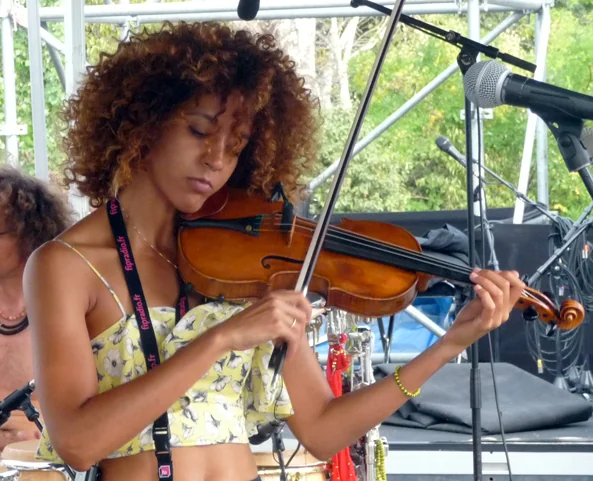
Image from Wikipedia
Image from Wikipedia
Yilian Cañizares – Violinist, Singer, Composer
Between Havana and Lausanne: A Sound World of Jazz, Classical and Afro-Cuban Spirituality
Born in 1983 in Havana and based in Switzerland since 2000, Yilian Cañizares is one of the most distinctive voices in contemporary jazz. Her music career combines classical virtuosity, improvisational freedom, and the pulsating rhythms of Afro-Cuban tradition. With a striking stage presence, a versatile voice, and a unique tone on the violin, she creates soundscapes where composition and improvisation seamlessly intertwine, transcending the boundaries between genre, culture, and history.
As a Cuban-Swiss artist, Cañizares connects her biographical experiences with a global perspective on music history and the present. Awards, international festival performances, and collaborations with influential musicians document her artistic development. Her discography – from Ochumare and Invocación to Aguas and Erzulie and up to Habana-Bahía – showcases a body of work that reveals a new facet of her musical cosmos with each album.
Childhood, Education, and Artistic Development
Being influenced early on by the rigor of the Russian violin school in Havana, Cañizares learned technical precision and stylistic discipline, which continue to form the foundation of her playing today. In 1997, a scholarship led her to Caracas to study at the Academia Latinoamericana de Violín; in 2000, she moved to the conservatory in Fribourg. In Switzerland, her horizons expanded to include jazz, improvisation, and singing – a turning point in her artistic development that shaped her later signature sound.
In Lausanne, she founded the ensemble Ochumare – Yoruba for "rainbow." The group name became a program: rich sound mixtures, a sense of melody, and a curious openness to musical traditions. In 2008, she won the Montreux Jazz Festival competition with Ochumare – an early milestone that paved the way for international invitations and brought her stage presence into focus within the jazz scene.
Breakthrough and International Attention
With her debut album Ochumare (2013), Cañizares marked the beginning of a discography that consistently moves between jazz, world music, and contemporary chamber music. The follow-up work Invocación (2015) solidified her reputation as a bridge builder between Afro-Cuban heritage and modern sound language. International media praised the originality of her production and the finely nuanced arrangement of her pieces.
In the following years, she gained recognition from expert juries and music press, including nominations at the Songlines Music Awards (2021) and receiving the Swiss Music Prize (2021). These milestones not only demonstrate her authority and reach but also the consistency of her artistic signature – a signature in which improvisation never becomes mere play, but rather a meaningful narrative.
Collaborations, Stage Presence, and Artistic Signature
Collaborations with musical personalities such as Omar Sosa, Chucho Valdés, Ibrahim Maalouf, Youn Sun Nah, Diego El Cigala, or Richard Bona showcase Cañizares’ ability to bring together stylistic worlds. Her violin playing oscillates between melodic lines and percussive articulation, while her voice grounds the melody and translates the lyrics – often inspired by Afro-Cuban spirituality – into a poetic present-day language.
On stage, she captivates with a narrative arc: quiet, chamber-music intimacy organically transitions into collective grooves; call-and-response moments evoke ritual forms without tipping into the folkloric. This stage presence – characterized by rhythmic elegance, clear phrasing, and dramatic sensitivity – makes her concerts immersive listening experiences.
Discography: Milestones, Projects, and Reception
The discography outlines a consistent artistic development. Following Ochumare (2013) and Invocación (2015), there are Aguas (2018), a sensitive duo album with Omar Sosa, as well as Erzulie (2019), which explores the Haitian deity of love and freedom, deepening Cañizares’ connection to Afro-diasporic symbolic worlds. In 2023, Habana-Bahía was released – recorded in Salvador de Bahia – a sonic bridge between Cuba and Brazil, characterized by tambor textures, choral passages, and shimmering string colors.
Influenced by the pandemic years, she formed the Resilience Trio, revitalizing her compositions in a compact, interactive band format. In 2025, she announced Vitamina Y – a project designed as an energy ration and spiritual nourishment. Early 2026 will see the release of the EP Nuevo Ciclo, marking a departure into a new phase of work: focused songs, pointed production, and clear groove accents. This sequence of works shows how consistently Cañizares sharpens her own sound identity while entering into stylistic coalitions.
Style, Genre, and Production: A Synthesis of Tradition and Present
At the center stands the violin as a melodic-harmonic entity, which Cañizares intertwines with vocal lines and percussive patterns. Her compositions connect clave structures and syncopated patterns with modal harmonic and chamber music arrangements. The sound contextualizes Afro-Cuban rhythms – Bata echoes, Rumba gestures, Candomblé colors – in dialogue with jazz harmony, contemporary classical music, and global pop aesthetics.
In production, she favors transparent, breathing sound images. The instruments are given space; the spaces remain instruments: reverb and resonance are used as dramatic means, not merely as effects. Thus, songs organically build up – from singable intro phrases through polyrhythmic layers to codal conclusions that vary and reframe thematic material.
Cultural Influence, Identity, and Mediation
Cañizares’ work unfolds cultural value beyond the concert hall. As an artist with Cuban roots and Swiss influences, she acts as a mediator between sound traditions. Her projects honor the Afro-diasporic narratives of the Caribbean just as much as the urban modernity of European music cities. In doing so, she links memory culture, spirituality, and contemporary art into a modern world-jazz aesthetic.
Moreover, she is committed to education, equality, and ecological issues. Performances as part of international initiatives, as well as teaching and masterclasses at renowned institutions, show how strongly she connects artistic practice with social responsibility. This combination of expertise, authority, and trustworthiness makes her a credible voice in the global music discourse.
Current Projects 2024–2026: Releases, Tours, Awards
In 2024, Cañizares will be named one of the 100 shaping personalities of Romandie – a sign of her cultural influence in Switzerland. In 2025, she will go on her first US tour, appearing at programs associated with the Montreux Jazz Festival Miami, where the mix of Resilience Trio intensity and Vitamina Y material reshapes her live dynamics. At the same time, she will release a pre-single "Vamos a Florecer," which poetically encapsulates her credo of musical renewal – to grow, heal, and move on.
On January 13, 2026, the EP Nuevo Ciclo will be released – a condensed glimpse into the next phase of work, which is defined by song structure, groove design, and production aesthetics. Additionally, the studio album Vitamina Y is scheduled for 2026, announced as a “vitamin for the soul” and further contemplating the narrative connection between Afro-Cuban heritage, jazz vitality, and classical form culture.
Placement in Music History: Afro-Cuban Jazz in the 21st Century
Cañizares positions herself alongside catalysts who expand the role of the violin in jazz and make the Afro-diasporic tradition audible. She references the history of Latin and Afro-Cuban jazz without falling into the reproduction of historical idioms. Instead, she employs the violin as a singing voice, intertwining it with percussion, bass, and piano to create a chamber-groove collective. This balance of structure and freedom makes her music accessible to both jazz audiences and world music fans alike.
Her albums are more than collections of sound: they are curated dramaturgies that work with motifs from Orishas mythology, urban realities of life, and poetic observations of everyday life. Thus, her discography opens up a musically and culturally dense resonance space – expanding the canon of Afro-Cuban-influenced jazz productions with a female, self-determined perspective.
Voices of the Fans
The reactions from fans clearly show: Yilian Cañizares captivates people worldwide. On Instagram, a listener exclaims, “Your violin tells stories that go straight to the heart.” A YouTube comment sums it up: “This music is both healing and energizing.” On Facebook, one remarks: “Every concert feels like a journey through memory, hope, and the future.”
Conclusion
Yilian Cañizares embodies a concept of jazz that takes the 21st century seriously: open, multifaceted, global. Her artistic development illustrates how experience and expertise shape a distinctive musical signature. As a violinist, singer, and composer, she masters the vocabulary of composition, arrangement, and production – translating it into a stage where spirituality and the present amplify each other. Anyone wishing to understand contemporary world jazz should experience Yilian Cañizares live: where sound becomes a lived narrative and music touches directly.
Official Channels of Yilian Cañizares:
- Instagram: https://www.instagram.com/yiliancanizares
- Facebook: https://www.facebook.com/yiliancanizares/
- YouTube: https://www.youtube.com/@YilianCanizares
- Spotify: https://open.spotify.com/intl-fr/artist/51kjU9cCnLDzokU3agspnv
- TikTok: https://www.tiktok.com/@yiliancanizares
Sources:
- Yilian Cañizares – Official Website (Biography)
- IMN International Music Network – Artist Profile & Press Quotes
- Apple Music – Nuevo Ciclo (EP), January 13, 2026
- Bandcamp – Habana-Bahía (Album Page)
- Sounds & Books – Review “Habana-Bahía” (06.10.2023)
- Afropop Worldwide – “Invoking the Orishas”
- Wikipedia (DE) – Yilian Cañizares
- Wikipedia (EN) – Yilian Cañizares
- Wikipedia (ES) – Yilian Cañizares
- Swiss Music Prize 2021 – Magazine (PDF)
- Oh! Jazz – Article “Yilian Cañizares and the African Ancestry of Jazz”
- Wikipedia: Image and Text Source