
Kinderchor
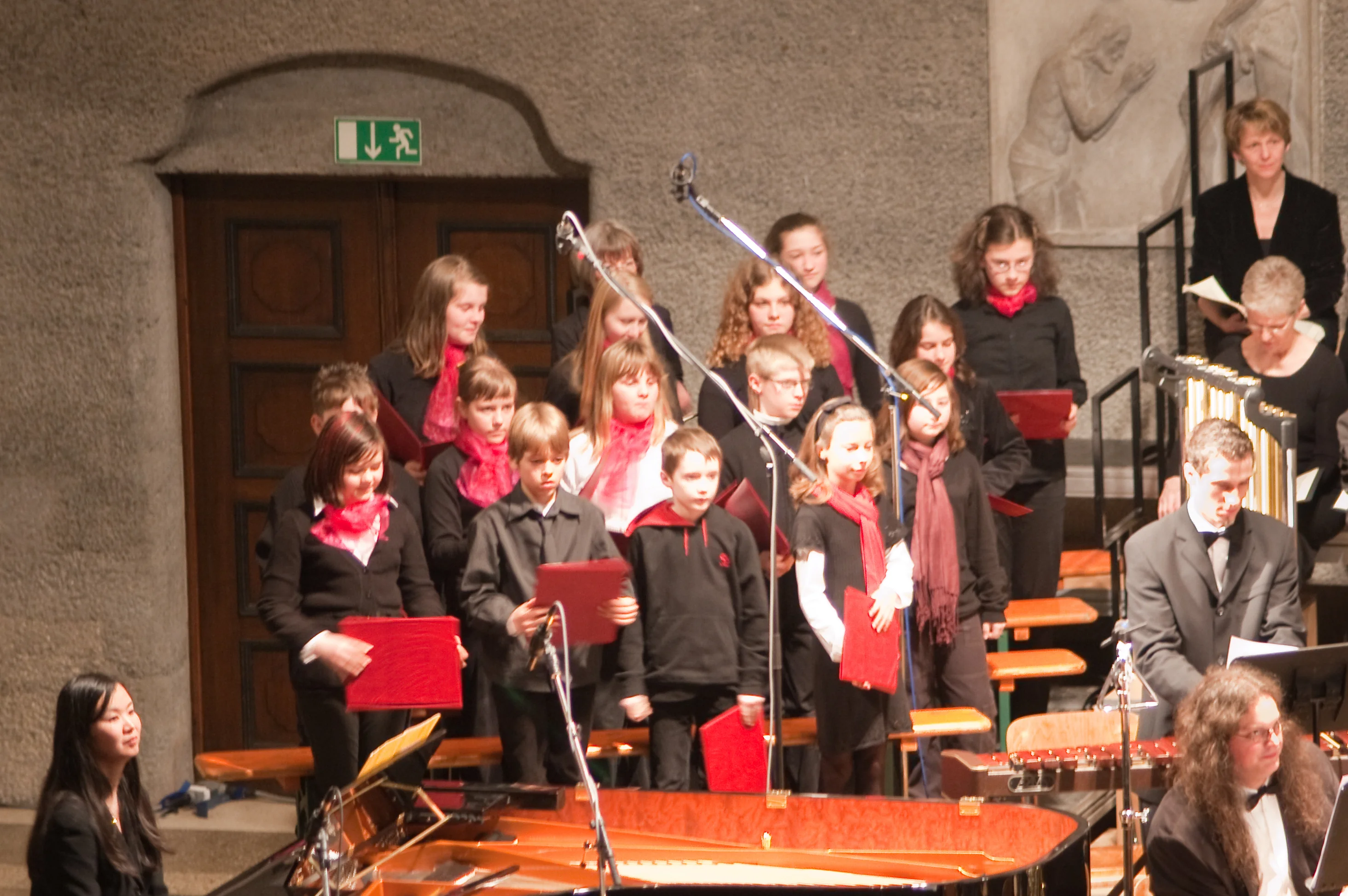
Image from Wikipedia
Image from Wikipedia
Children's Choir: The Art of Young Voices Between Pedagogy, Sound Culture, and Stage Magic
An Ensemble with Its Own Soul
A children's choir is much more than just a collection of young voices: it is a musical community where boys and girls sing together, often in unison and with multiple voice parts represented. Compared to women's choirs, a children's choir has a lighter sound volume, yet possesses a unique immediacy that has fascinated audiences in choral music for generations. The term also refers to works that are specifically performed by children's voices. ([de.wikipedia.org](https://de.wikipedia.org/wiki/Kinderchor?utm_source=openai))
This dual role is precisely where the cultural strength of the children's choir lies: as a pedagogical format, as an artistic ensemble, and as a carrier of repertoire that ranges from folk songs to sacred music to opera roles and musical plays. Children's choirs shape musical socialization from an early age, promote listening, breathing, articulation, and communal music-making, and create spaces where the voice is not only trained but is experienced as an expression of personality. ([de.wikipedia.org](https://de.wikipedia.org/wiki/Kinderchor?utm_source=openai))
Biography of a Collective: How Children's Choir Work Develops
The history of the children's choir is not the biography of a single star, but that of a collective. Its roots extend into church choral communities, broadcasting institutions, music schools, and educational models in which singing with children was systematically developed. In Germany, the MDR Children's Choir, the Bielefeld Children's Choir, the Wetzlar Children's Choir, and the Brettheim Children's Choir are among the names that have shaped this tradition over decades. ([de.wikipedia.org](https://de.wikipedia.org/wiki/MDR-Kinderchor?utm_source=openai))
This clearly demonstrates that children's choir work is also an art of organization. It encompasses age-appropriate vocal training, the support of voice changes, the integration of movement and play, and the careful selection of repertoire. The goal remains the same: children should get to know their singing voices, acquire fundamental musical and rhythmic skills, and find a social home in a choral community. ([de.wikipedia.org](https://de.wikipedia.org/wiki/Kinderchor?utm_source=openai))
Career Path in the Ensemble: From Rehearsal Room to the Big Stage
A professionally managed children's choir often develops over years, sometimes even generations. The MDR Children's Choir in Leipzig, for example, has been around since 1948, is the only children's choir under the sponsorship of ARD, and works with a staggered rehearsal and performance organization that introduces children from the age of three to singing. The structure with preparatory and youth choirs alongside the concert choir shows how consistently a children's choir can be established as a musical institution. ([de.wikipedia.org](https://de.wikipedia.org/wiki/MDR-Kinderchor?utm_source=openai))
Other formations exemplify regional roots and artistic continuity. The Brettheim Children's Choir was founded in 1983 and has been active since 2014 under the direction of Johannes and Miriam Hammer; its repertoire ranges from individual songs to larger musical plays and musicals specifically designed for children. The Wetzlar Children's Choir, on the other hand, shaped Christian children's music in Germany for decades before evolving into the Sunshine Kids. ([de.wikipedia.org](https://de.wikipedia.org/wiki/Brettheimer_Kinderchor?utm_source=openai))
Repertoire and Discography: Between Song, Musical, and Broadcast Production
The discography of children's choirs is often closely linked to their respective commissions. Broadcasting choirs such as the Südfunk Children's Choir recorded a wide repertoire of folk and children's songs weekly, which even received dedicated airing slots in the SDR program. Such recordings made children's voices a defining sound of the post-war era and created a media presence that extended far beyond the rehearsal room. ([de.wikipedia.org](https://de.wikipedia.org/wiki/S%C3%BCdfunk-Kinderchor?utm_source=openai))
In other configurations, albums, musicals, and musical plays take center stage. The Brettheim Children's Choir became known through publications from the Liebenzeller Mission Publishing House and in co-production with the Gospel Broadcasting Publishing House; in this context, not only individual songs but also larger dramatic forms played a central role. Children's choir work unfolds its full musical dramaturgy here: multi-part structures, narrative arcs, clear articulation, and a production tailored to the characteristics of young voices. ([de.wikipedia.org](https://de.wikipedia.org/wiki/Brettheimer_Kinderchor?utm_source=openai))
Musical Development: Sound, Technique, and Pedagogical Precision
The sound of a children's choir thrives on transparency, agility, and a special brightness in the soprano register. Unlike adult choral formations, the focus is less on volume and more on the uniformity of tone color. Working with children therefore demands precise vocal training that combines singing technique and playful communication, ensuring that intonation, breath control, and articulation are developed simultaneously. ([de.wikipedia.org](https://de.wikipedia.org/wiki/Kinderchor?utm_source=openai))
Consequently, the training of children's choir leaders includes not only basic choral knowledge but also methods of children's vocal training, approaches to multi-part singing, relative solmization, rhythm language, theatrical elements, and instrumental accompaniment. The musical process is thus not merely the reproduction of songs but a complex interplay of pedagogy, arrangement, repertoire knowledge, and social leadership. ([de.wikipedia.org](https://de.wikipedia.org/wiki/Kinderchor?utm_source=openai))
Cultural Influence: Between Church, Broadcasting, Opera, and Music Education
Children's choirs are present in many cultural spaces. In church communities, they take on roles in the church year, design family services, and connect sacred music with the everyday lives of children. In opera houses, children's choirs are also a regular part of performance practice, appearing in works like Hänsel und Gretel, Carmen, Tosca, or Boris Godunov. In this way, the children's choir becomes a mediator between musical tradition and vibrant contemporary culture. ([de.wikipedia.org](https://de.wikipedia.org/wiki/Kinderchor?utm_source=openai))
Musically, the children's choir also has significant importance. The Wikipedia source mentions 18,790 children's and youth choirs in Germany as of 2002, indicating the breadth of this choral landscape. At the same time, recent literature emphasizes that the work with children has evolved between 1996 and 2021, and today's children's choir practice places greater emphasis on consistency, change, and personality development. ([de.wikipedia.org](https://de.wikipedia.org/wiki/Kinderchor?utm_source=openai))
Current Relevance and Musical Presence
The term children's choir remains vibrant today because it persists in various forms: as an ensemble in broadcasting, churches, schools, music theaters, and project work. The MDR Children's Choir demonstrates, with its age stratification and professional structure, how institutionally anchored this art form continues to be. At the same time, contemporary choral projects prove that children's choir work remains present in current productions, concerts, and educational formats. ([de.wikipedia.org](https://de.wikipedia.org/wiki/MDR-Kinderchor?utm_source=openai))
Especially exciting is its adaptability to today's listening habits. Children's choirs can preserve traditional repertoire while also incorporating modern arrangements, theatrical formats, and media production techniques. Thus, they remain not only a place of musical education but also a laboratory for cultural transmission, ensemble spirit, and artistic discipline. ([de.wikipedia.org](https://de.wikipedia.org/wiki/Kinderchor?utm_source=openai))
Conclusion: Why the Children's Choir Continues to Fascinate
The children's choir is one of the most fascinating aspects of choral culture: it combines education and emotion, discipline and playfulness, tradition and modernity. Its special strength lies in the authenticity of young voices, the communal energy, and the ability to imbue even familiar songs with new immediacy. Those who experience children's choir work encounter not just music but also social learning and artistic development in its purest form. ([de.wikipedia.org](https://de.wikipedia.org/wiki/Kinderchor?utm_source=openai))
For this reason, the children's choir remains an experience that should be felt live: in concert halls, churches, music theaters, or during a public performance. There unfolds that blend of clarity of sound, movement, and collective presence that makes children's choirs so distinctive. Anyone who has experienced this energy once understands immediately why the children's choir is one of the most enduringly valuable forms of musical culture. ([de.wikipedia.org](https://de.wikipedia.org/wiki/Kinderchor?utm_source=openai))
Official Channels of Children's Choir:
- Instagram: no official profile found
- Facebook: no official profile found
- YouTube: no official profile found
- Spotify: no official profile found
- TikTok: no official profile found
Sources:
Upcoming Events
Children's Musical of the Children's Choir
Family Day of the Diocesan Committee