
Hannah Arendt
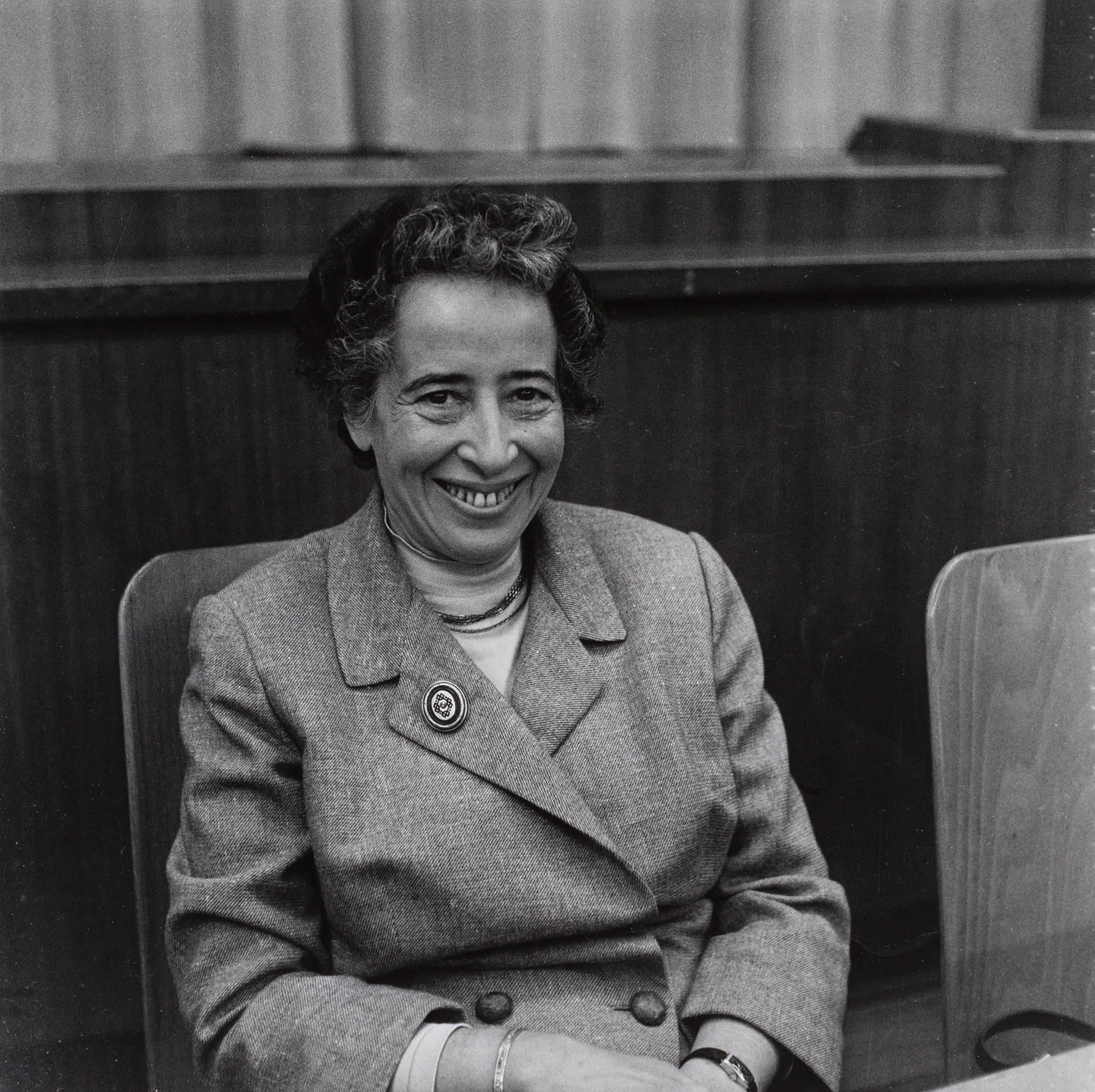
Image from Wikipedia
Image from Wikipedia
Hannah Arendt: The Intellectual Who Redefined 20th Century Thought
A Biography of Persecution, Exile, and Philosophical Radicalism
Hannah Arendt, born on October 14, 1906, in Linden near Hannover and died on December 4, 1975, in New York City, is regarded as one of the most influential political thinkers of the 20th century. Her Jewish heritage, experiences of persecution and exile, as well as her resolute opposition to totalitarian rule, profoundly shaped her thinking and public voice. After fleeing Germany in 1933, she initially worked in Paris, later moving to the United States, where she established herself as an author, journalist, and academic. ([plato.stanford.edu](https://plato.stanford.edu/entries/arendt/?utm_source=openai))
Arendt's life path is inseparably linked to the political catastrophes of the 20th century. She studied philosophy in Marburg, Freiburg, and Heidelberg, completing her doctorate in 1929 under Karl Jaspers. The rupture caused by National Socialism transformed the academically trained thinker into an exiled observer of modernity, who approached political order, freedom, and responsibility not as abstract concepts, but as questions of existential experience. ([encyclopedia.com](https://www.encyclopedia.com/women/encyclopedias-almanacs-transcripts-and-maps/arendt-hannah-1906-1975?utm_source=openai))
Early Years and Intellectual Formation
From her early years, Arendt combined philosophical curiosity with historical awareness. Her education in the German intellectual tradition, her proximity to Jaspers, and her engagement with Martin Heidegger created a tension from which her later political theory emerged. Her thinking was never purely systematic; it developed from reading, experience, and the analysis of specific historical disruptions. This blend of precision and restlessness gives her texts an extraordinary tension to this day. ([plato.stanford.edu](https://plato.stanford.edu/entries/arendt/?utm_source=openai))
Arendt understood Jewish identity not as a mere label of origin, but as a matter of action and self-assertion. This attitude made her a thinker who did not settle for adaptation or ideological self-soothing. Her biography illustrates how closely intellectual authority and personal vulnerability were connected in her life. ([encyclopedia.com](https://www.encyclopedia.com/women/encyclopedias-almanacs-transcripts-and-maps/arendt-hannah-1906-1975?utm_source=openai))
Exile, Journalism, and Academic Rise
After her emigration in 1933, Arendt initially lived in Paris before arriving in the United States in 1941. There she developed into one of the defining voices of political theory in a new language and under new institutional conditions. She taught at the New School for Social Research, where she remained closely associated until her death, and held positions at various American universities, including Princeton, Berkeley, and Chicago. ([plato.stanford.edu](https://plato.stanford.edu/entries/arendt/?utm_source=openai))
Her journalism further sharpened the tone of her work. Arendt wrote not in the style of academic insulation, but with a rare blend of analytical clarity and public responsibility. It was precisely this that established her authority: she did not merely reflect on politics; she visibly engaged with it, even where it provoked contradiction and hostility. ([plato.stanford.edu](https://plato.stanford.edu/entries/arendt/?utm_source=openai))
Major Works: Totalitarianism, Freedom, and Public Action
With The Origins of Totalitarianism and the German version Elemente und Ursprünge totaler Herrschaft, Arendt became internationally renowned. The work examined antisemitism, imperialism, and totalitarianism as historical and political formations, establishing her as a prominent analyst of totalitarian rule in the 20th century. The study remains a key text for understanding modern dictatorships and the conditions under which freedom is destroyed. ([britannica.com](https://www.britannica.com/topic/Origins-of-Totalitarianism?utm_source=openai))
The Human Condition emphasized a different aspect, placing the vita activa at its center. Arendt analyzed labor, work, and action as fundamental forms of human engagement with the world, stressing that political life must become visible in the public sphere. The work is considered one of her most original contributions because it roots the idea of freedom not in privacy, but in the interactions between people. ([plato.stanford.edu](https://plato.stanford.edu/entries/arendt/?utm_source=openai))
Eichmann in Jerusalem and Controversy as a Part of Thinking
With Eichmann in Jerusalem, Arendt sparked one of the most consequential debates in post-war history. Her report on the Eichmann trial coined the phrase “the banality of evil,” making it clear that monstrous crimes arise not only from diabolical wickedness, but also from thoughtlessness, bureaucracy, and obedience. The text provoked intense reactions but simultaneously elevated Arendt to a figure of global historical significance. ([newyorker.com](https://www.newyorker.com/magazine/1963/03/16/eichmann-in-jerusalem-v?utm_source=openai))
The controversy surrounding the book is central to its historical impact. Arendt maintained that political judgment must not be replaced by moral simplification, but must confront the ambivalence of historical situations. This integrity explains why her works continue to be intensively read today in philosophy, political science, history, and memory culture. ([plato.stanford.edu](https://plato.stanford.edu/entries/arendt/?utm_source=openai))
Thinking Style, Language, and Political Attitude
Arendt's thought revolves around plurality, judgment, and the ability to adopt another's perspective. She was skeptical of purely representative democracies and preferred forms of direct political participation, such as council systems and direct democracy. This attitude reflects her trust in concrete political practice over mere institutional rhetoric. ([socpol.uvvg.ro](https://socpol.uvvg.ro/social-media-world-alienation-and-post-truth-reflections-on-hannah-arendts-political-thought/?utm_source=openai))
Noteworthy is also her style: Arendt wrote with a clarity that did not smooth over philosophical complexity but rather made it visible. She worked with historical documents, biographies, and literary texts, analyzing them closely and juxtaposing them with her own ideas. This creates an intellectual arrangement in her texts that is simultaneously rigorous, fluid, and literary. ([klassik-stiftung.de](https://www.klassik-stiftung.de/ihr-besuch/ausstellung/hannah-arendt-die-biografie/?utm_source=openai))
Impact, Reception, and Cultural Influence
Arendt is among those thinkers whose relevance is made evident with each political crisis. Her concepts of totalitarianism, public space, and political judgment are frequently invoked in current debates about democracy, polarization, and digital public spheres. The fact that recent academic texts explicitly connect Arendt to social media, post-truth, and algorithmic decision-making demonstrates the enduring reach of her thought. ([blog.apaonline.org](https://blog.apaonline.org/2025/04/07/putting-the-social-in-social-media-hannah-arendt-political-judgment-and-online-polarization/?utm_source=openai))
The academic infrastructure surrounding her work is also noteworthy. The Arendt Research Center is working on a critical collected edition of her writings, and the Klassik Stiftung Weimar dedicated an exhibition to her, contextualizing her life and work anew. This institutional presence underscores Arendt's status as a canonical author of political thought. ([arendt-research-center.de](https://www.arendt-research-center.de/en/projekt/General-Information/index.html?utm_source=openai))
Bibliography Instead of Discography: Arendt's Literary Legacy
Since Hannah Arendt was not a musician, there is no discography, no hit singles, and no charts in the traditional sense. Her real catalog consists of books, essays, lectures, and journalistic texts that form a coherent body of thought over decades. Key titles include The Origins of Totalitarianism, The Human Condition, Between Past and Future, On Revolution, and Eichmann in Jerusalem. ([britannica.com](https://www.britannica.com/topic/Origins-of-Totalitarianism?utm_source=openai))
Together, these works form an intellectual repertoire of extraordinary density. Those who read Arendt do not encounter a linear doctrine but a movement of thought that continuously balances freedom, violence, judgment, and responsibility against one another. This is precisely where her lasting fascination lies: she provides no simple answers but sharpens the awareness of the conditions under which politics remains possible. ([plato.stanford.edu](https://plato.stanford.edu/entries/arendt/?utm_source=openai))
Conclusion: Why Hannah Arendt Remains Electrifying Today
Hannah Arendt remains exciting because she defended thinking against complacency. Her biography intertwines persecution, exile, academic authority, and journalistic fearlessness into a work that questions political freedom, plurality, and responsibility in an ongoing manner. Reading her texts offers not merely theory but an intellectual presence in a state of heightened awareness. ([plato.stanford.edu](https://plato.stanford.edu/entries/arendt/?utm_source=openai))
Especially today, encountering Arendt serves as a vibrant engagement with the public sphere, language, and the courage to judge. Her work invites a proactive approach to political reality rather than passive consumption, encouraging active thinking and participation. Those who delve deeper into her thought will discover an author whose intellectual presence extends into the present day. ([link.springer.com](https://link.springer.com/article/10.1007/s10676-024-09759-5?utm_source=openai))
Official Channels of Hannah Arendt:
- Instagram: no official profile found
- Facebook: no official profile found
- YouTube: no official profile found
- Spotify: no official profile found
- TikTok: no official profile found
Sources:
- Stanford Encyclopedia of Philosophy – Hannah Arendt
- Britannica – Origins of Totalitarianism
- Arendt Research Center – General Information
- Klassik Stiftung Weimar – Hannah Arendt: The Biography
- National Library of Israel – Arendt’s Eichmann in Jerusalem
- Library of Congress – Hannah Arendt papers
- DIE ZEIT – Hannah Arendt: The Secret of Hannah Arendt
- WELT – Hannah Arendt Biography on the 50th Anniversary of Her Death
- Wikipedia: Image and text source
Upcoming Events
Living Without Railing – a Dialogue
An evening for clever minds: Hannah Arendt in dialogue, full of impulses on freedom, judgment, and responsibility. 28.04.2025 online, 40 €. #HannahArendt
Movie Night - Hannah Arendt - Thinking is Dangerous
An evening for all who take thinking seriously: experience Hannah Arendt at the Kolbermoor Town Hall. Documentary film, contemporary history, and strong impulses on 28.04.2026. #Kolbermoor #Culture
Hannah Arendt: Dialog Stage Extra on Truth and Lies in Politics
A smart evening in Potsdam: Hannah Arendt, political truth, and vibrant discourse at the Zimmer Stage. 14.10.2026, from €5. #HannahArendt #Potsdam
Arendt
An intelligent theater evening in Aalen: Arendt brings Hannah Arendt's thinking to the stage. 11/20/2026, 8:00 PM, tickets starting from 19 euros. #TheaterAalen #Aalen
Arendt
Hannah Arendt live on stage: A captivating theater evening in the Old Town Hall Aalen with history, suspense, and great atmosphere. #TheaterAalen
Arendt
An evening full of thoughts, history, and stage magic: Arendt at the Old Town Hall Aalen touches with depth and presence. 27.11.2026, from €19. #TheaterAalen