
Erich Mühsam
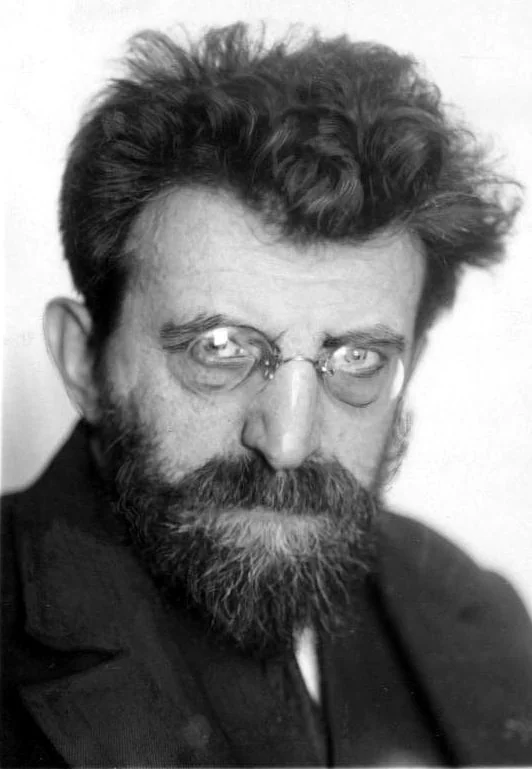
Image from Wikipedia
Image from Wikipedia
Erich Mühsam – Poet, Anarchist, and Uncompromising Chronicler of Resistance
A Life Between Literature, Revolt, and Political Persecution
Erich Mühsam is one of the sharpest and most rebellious voices of the German-speaking modern era. Born on April 6, 1878, in Berlin, and murdered in the Oranienburg concentration camp in 1934, he combined literary productivity with radical political engagement. As a writer, journalist, antimilitarist, and anarchist, he shaped the debates of his time with a stance that conceives art and resistance as inseparable. (deutsche-biographie.de)
His name still stands for intellectual steadfastness, for the insistence on individual freedom, and for a language that not only describes social injustice but also condemns it. Mühsam was early forced out of the bourgeois educational path, completed an apprenticeship as a pharmacist, and quickly found his way as a freelance writer in Berlin to a literary anarchism that fought against authority, militarism, and oppression. This fundamental attitude shaped both his work and his biography. (hls-dhs-dss.ch)
Early Years and the Formation of a Rebellious Mindset
The formative years of Mühsam already indicated the direction of his later life: In 1896, he was expelled from high school for "socialist activities," after which he chose the path of a self-educated intellectual. In 1901, he settled as a freelance writer in Berlin, and between 1904 and 1908, he traveled extensively through Europe, including connections to Monte Verità in Ascona. From these experiences emerged a thinking that melded artistic sensitivity, social outrage, and political utopia. (hls-dhs-dss.ch)
His views connected anarchist theorists like Proudhon, Bakunin, Kropotkin, and Landauer with elements of individualism. The German Biography describes this stance as "emotional anarchism," supported by a critique of authority and solidarity with the socially disadvantaged. It is precisely in this that Mühsam's historical significance lies: He was not a theorist in the narrow sense, but a literary warrior whose texts translate political energy into language. (deutsche-biographie.de)
Munich, Anti-War Activism, and Political Escalation
From 1909 to 1924, Mühsam lived in Munich, where his profile as a radical journalist and antimilitarist sharpened further. During World War I, he acted as an anti-war opponent and often entrusted his criticism of the times to diaries and poems due to limited public publishing opportunities. It was during this phase that his writing shifted from condemnation to a propagandistic focus against the war. (hls-dhs-dss.ch)
Sources indicate that several of his plays were premiered during his lifetime. This underscores that Mühsam not only drew attention as a political journalist but also as a playwright. His texts navigated between satire, agitation, and literary tension, thus finding an independent tone within the cultural climate of the Weimar Republic. (hls-dhs-dss.ch)
Munich Soviet Republic and the Consequences of Engagement
In 1919, Erich Mühsam was significantly involved in the proclamation of the Munich Soviet Republic. For this political engagement, he was sentenced to 15 years of fortress imprisonment, from which he was released after five years through an amnesty. This decisive moment illustrates the consequences of his actions: Mühsam was not an observer of history but an active disruptor of it. (chotzen.de)
During the Weimar Republic, he was actively involved in the Red Aid for the release of political prisoners. Later, he found his political home in the "Anarchist Association." His career reveals how closely intertwined his political commitment, journalistic work, and cultural intervention were. (chotzen.de)
Works, Language, and Literary Power
Mühsam's oeuvre ranges from poems to diaries and theater texts, as well as political writings. The poems created during the war stand out, described in the German Biography as a turning point from desperate accusation to the advocacy of armed resistance. His battle songs draw on the stylistic elements of pre-March poetry and give political content a powerful, vivid language. (deutsche-biographie.de)
The Erich Mühsam Society documents the ongoing editorial and historical engagement with his work. There, texts, first publications from his estate, rare publications, as well as materials for conferences and research are released. This demonstrates how Mühsam's literary oeuvre is still read today as a literary and political document. (erich-muehsam.de)
It is important to clarify: Erich Mühsam does not have a discography in the musical sense. His work belongs to literature, political journalism, and theater. Nevertheless, his language has a notable closeness to song-like quality, to an agitational rhythm and public speaking, which is why he is often perceived in cultural-historical contexts as a voice of political sound poetics. (deutsche-biographie.de)
Cultural Influence and Historical Reception
Mühsam's influence stems from the connection of aesthetic attitude and political radicality. He embodied a culture of contradiction that did not settle for moral outrage but actively pushed for social change. The fact that his poems and political writings were destroyed in the book burnings of 1933 marks the regime's attempt to eradicate exactly this resistant voice. (dajab.de)
His arrest following the Reichstag fire, the imprisonment in various camps and prisons, and his murder by the SS guard in Oranienburg stand as exemplary for the persecution of opposition intellectuals under National Socialism. Mühsam's end of life condenses the tragedy of a biography in which literary independence and political courage were met with extreme violence. (chotzen.de)
It is precisely for this reason that Erich Mühsam remains relevant: as an author whose texts speak of solidarity, freedom, and resistance, and as a historical figure that makes the vulnerability of democratic and cultural spaces visible. Anyone engaging with German literature, the history of anarchism, or the political culture of the 20th century cannot overlook Mühsam. His work continues to serve as a reminder that language can embody a stance. (deutsche-biographie.de)
Conclusion: Why Erich Mühsam Remains Fascinating to This Day
Erich Mühsam unites literary productivity, political consistency, and personal stubbornness with a rare intensity. His biography not only tells of persecution and loss but also of intellectual independence, linguistic sharpness, and cultural resilience. It is precisely in this that his enduring tension lies: Mühsam remains an author who does not decorate but challenges. Anyone wishing to understand German literary history in its most radical form should read him and take his historical presence seriously. (deutsche-biographie.de)
There is no longer a live experience in the narrow sense for Erich Mühsam, but his texts continue to have an enormous impact in readings, archives, and editorial new editions today. Those who engage with him encounter a witness of the century whose voice still rings out remarkably clear. (erich-muehsam.de)
Official Channels of Erich Mühsam:
- Instagram: no official profile found
- Facebook: no official profile found
- YouTube: no official profile found
- Spotify: no official profile found
- TikTok: no official profile found
Sources:
Upcoming Events
THE POET*ESS CASE - today Erich Mühsam