
Emily Dickinson
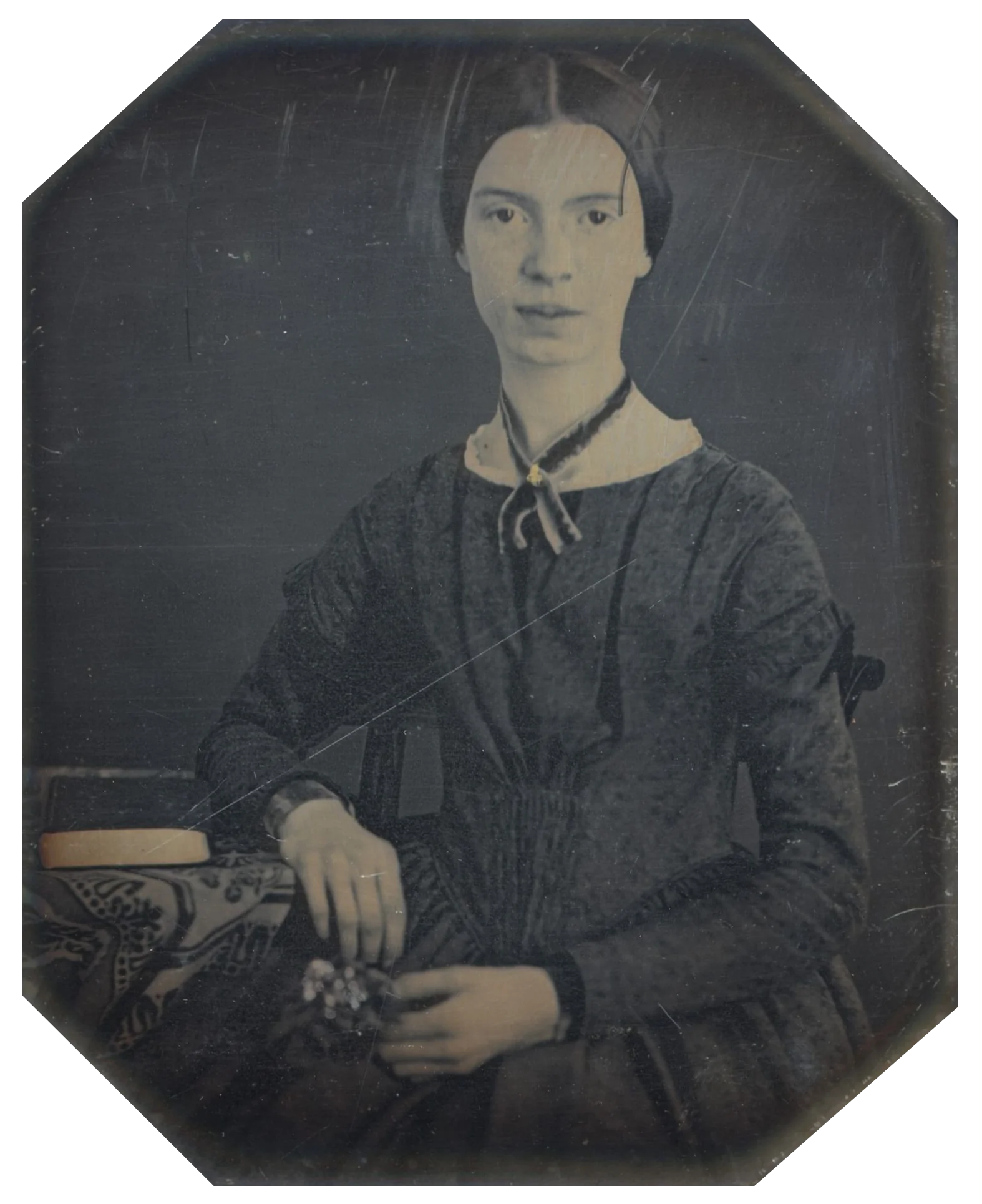
Image from Wikipedia
Image from Wikipedia
Emily Dickinson: The Quiet Revolution of American Poetry
A Poetess Who Shaped an Entire World from Silence
Emily Dickinson is one of the defining voices of American literature. Born on December 10, 1830, in Amherst, Massachusetts, she developed a poetic language of extraordinary condensation, radical independence, and formal precision. Her poems were published gradually only after her death in 1886, yet her work feels so modern that it seems to have fallen into literary history from the future. ([britannica.com](https://www.britannica.com/biography/Emily-Dickinson?utm_source=openai))
The fascination with Dickinson lies in the tension between retreat and radicality. She largely lived in the private space of her family home in Amherst, yet she wrote poetry that dissected concepts such as time, death, faith, nature, and consciousness with a linguistic boldness that was only fully appreciated by later generations. This precisely is where her cultural significance stems from: as an author who did not perform loudly, but transformed entire readings with formal intensity and intellectual independence. ([emilydickinsonmuseum.org](https://www.emilydickinsonmuseum.org/the-museum/?utm_source=openai))
Biography: Amherst, Education, and the Origin of a Distinctive Voice
The Emily Dickinson Museum describes her childhood and youth as shaped by family, education, reading, gardening, and religious tensions. Dickinson grew up in Amherst, attended a remarkable educational institution for girls of her time, and developed an early, intense relationship with language, observation, and inner contemplation. These early years laid the foundation for a poetic voice that could transform the mundane into existential insights. ([emilydickinsonmuseum.org](https://www.emilydickinsonmuseum.org/emily-dickinson/biography/?utm_source=openai))
The musealization of her birthplace underscores how closely her work is connected to its environment. The Homestead, her birthplace, and The Evergreens, her brother Austin's house, together form the historical center of her posthumous life in Amherst. There, not only did her poetry emerge, but also a model of life in concentration, where writing, observing, and retreating became an artistic method. ([emilydickinsonmuseum.org](https://www.emilydickinsonmuseum.org/the-museum/?utm_source=openai))
The Years of Writing: Poetic Condensation Instead of Public Career
In the so-called years of writing, Dickinson began systematically organizing her poems into manuscript volumes. Britannica reports that from 1858 onwards, she created clean copies and stitched 40 small booklets together, collectively containing about 800 poems. This practice demonstrates an extraordinary form of authorship: not a publication strategy aimed at visibility, but a concentrated, almost archival self-organization of her work. ([britannica.com](https://www.britannica.com/biography/Emily-Dickinson/Mature-career?utm_source=openai))
Only a very small portion of her work was published during her lifetime in print. Britannica states that only ten of her nearly 1,800 poems were published while she was alive, and even these often without her full control. This very discrepancy between productive output and public invisibility later made Dickinson a key figure in modern literary history: an author whose influence did not arise from the workings of the literary market but from the aftermath of her language. ([britannica.com](https://www.britannica.com/biography/Emily-Dickinson?utm_source=openai))
Posthumous Publication and Literary Rediscovery
After Dickinson's death on May 15, 1886, in Amherst, her work was made accessible to the public through the efforts of relatives and confidants. The Emily Dickinson Museum emphasizes that her life story and the history of her posthumous publication are closely linked to the two historical houses. This belated discovery fundamentally changed the perception of her oeuvre and made it evident how far her language was ahead of its time. ([emilydickinsonmuseum.org](https://www.emilydickinsonmuseum.org/the-museum/?utm_source=openai))
The early reception was marked by amazement at the formal distinctiveness of her texts. The Poetry Foundation points out that readers and critics noticed the “strangeness” of the newly published Dickinson poems, that is, the striking otherness that is now read as a strength. From this initially perplexing effect, her authority as a voice of linguistic condensation, ellipsis, and open meaning developed. ([poetryfoundation.org](https://www.poetryfoundation.org/poets/emily-dickinson/?utm_source=openai))
Works and Poetic Discography: Central Texts, Motifs, and Editions
For a poet like Emily Dickinson, her work cannot be described in a classical discography, but rather through a canonization of her key texts and editions. Among her most famous poems are “This is my letter to the World,” “Because I could not stop for Death,” and “I felt a Funeral, in my Brain”; they exemplify her engagement with communication, mortality, and states of consciousness. The Museum and the Poetry Foundation classify these texts as the core of her oeuvre, which appears exceptionally cohesive in themes, form, and intellectual movement. ([emilydickinsonmuseum.org](https://www.emilydickinsonmuseum.org/emily-dickinson/biography/?utm_source=openai))
Her manuscripts, the so-called fascicles, are of central importance to Dickinson scholarship. They not only show poems but also a compositional thinking where sequence, repetition, and variation become part of the artistic arrangement. In this sense, Dickinson appears as a master of the poetic album: each piece is autonomous, yet part of a larger inner architecture. ([britannica.com](https://www.britannica.com/biography/Emily-Dickinson/Mature-career?utm_source=openai))
Style: Sparseness, Break, Sound, and Precise Perception
Dickinson's style is characterized by extreme condensation. Her verses work with concise images, surprising dashes, internal contrasts, and a syntax that does not simply convey meaning but reveals it. This technical distinctiveness makes her poetry feel so modern today: it creates resonant spaces where language does not close but opens. ([britannica.com](https://www.britannica.com/biography/Emily-Dickinson/Mature-career?utm_source=openai))
Thematically as well, her work exhibits rare breadth. Religion appears not as dogma but as an experience of doubt and transcendence; nature not as an idyllic backdrop but as a space of insight; death not as a mere ending but as an ongoing relationship of consciousness to its own transience. The Emily Dickinson Museum emphasizes her grappling with religion, illness, and death as central biographical and poetic themes. ([emilydickinsonmuseum.org](https://www.emilydickinsonmuseum.org/emily-dickinson/biography/?utm_source=openai))
Cultural Influence: Why Emily Dickinson Remains Relevant Today
Emily Dickinson is among the most influential voices in American literature because she redefined the possibilities of poetic expression. Her language resonates in later poetry, in modern short forms, in experimental writing styles, and in any reading that derives power from condensation. The Emily Dickinson Museum explicitly sees itself as a place that amplifies and reinterprets her “revolutionary poetic voice.” ([emilydickinsonmuseum.org](https://www.emilydickinsonmuseum.org/?utm_source=openai))
Even in the 21st century, her presence remains vibrant. The museum regularly hosts readings, discussions, and programs that translate Dickinson's work into new contemporary contexts. This ongoing reception shows that her poetry does not function as a closed historical archive but as a living resonance space for readers seeking linguistic precision and intellectual independence. ([emilydickinsonmuseum.org](https://www.emilydickinsonmuseum.org/?utm_source=openai))
Current Projects and Publications: The Ongoing Afterlife of a Canon
Emily Dickinson herself cannot present any new albums, tours, or current publications as she died in 1886. However, her work continues to be the subject of new editions, research projects, and museum publications in 2024 and 2025 that extend her significance. Particularly, the ongoing activities of the Emily Dickinson Museum demonstrate that the engagement with her life and writing is by no means complete. ([emilydickinsonmuseum.org](https://www.emilydickinsonmuseum.org/?utm_source=openai))
Recent indications from the museum context further confirm that Dickinson's legacy remains present in exhibitions, programs, and scholarly contexts. The current relevance lies less in new works than in new perspectives on the existing work: edition, research, mediation, and cultural memory keep the author in motion. ([emilydickinsonmuseum.org](https://www.emilydickinsonmuseum.org/?utm_source=openai))
Conclusion: The Quiet Greatness of a Radical Voice
Emily Dickinson fascinates because she created a universal language from the private realm. Her artistic development, formal radicality, and lasting influence make her one of the most important authors in literary history. Those who read her poems encounter not a loud pose but an intellectual and emotional intensity that still feels surprisingly fresh today. ([britannica.com](https://www.britannica.com/biography/Emily-Dickinson?utm_source=openai))
Herein lies the invitation to every audience: Emily Dickinson does not want to be consumed but to be read, heard, and read again. Her verses unfold their power in closeness, in precise observation, in slow reverberation. Those who engage with her experience one of the most impressive poetic presences in world literature. ([poetryfoundation.org](https://www.poetryfoundation.org/articles/70063/forever-is-composed-of-nows-?utm_source=openai))
Official Channels of Emily Dickinson:
- Instagram: No official profile found
- Facebook: No official profile found
- YouTube: No official profile found
- Spotify: No official profile found
- TikTok: No official profile found