
Arnold Schönberg
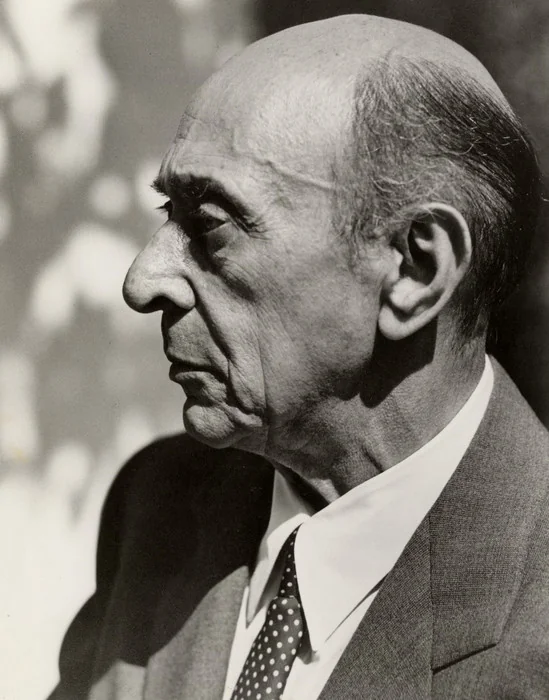
Image from Wikipedia
Image from Wikipedia
Arnold Schönberg: The Radical Architect of Modern Music
A Composer Who Redefined the Language of Sound in the 20th Century
Arnold Schönberg is one of the most influential figures in music history. Born on September 13, 1874, in Vienna and died on July 13, 1951, in Brentwood near Los Angeles, he combined artistic curiosity with intellectual rigor as a composer, music theorist, teacher, painter, poet, and inventor. His musical career progressed from late romantic tonality through free atonality to the twelve-tone technique, which he developed into one of the most influential compositional methods of the modern era. ([de.wikipedia.org](https://de.wikipedia.org/wiki/Arnold_Sch%C3%B6nberg?utm_source=openai))
Schönberg worked alternately in Berlin and Vienna starting in 1901, emigrated to the USA in 1933, and became a U.S. citizen in 1941. After his emigration, he wrote his name as Arnold Schoenberg. His biography is not only the story of a composer but also that of an artistic upheaval that continues to shape the world of music today. ([de.wikipedia.org](https://de.wikipedia.org/wiki/Arnold_Sch%C3%B6nberg?utm_source=openai))
Vienna, Berlin, and the Early Path to His Own Language
The early years in Vienna laid the foundation for Schönberg's artistic development. He initially worked in various positions before fully dedicating himself to music, and he quickly connected with an environment that recognized his ambitions. In Berlin, he took on roles in the musical everyday life and moved within a milieu shaped by cabaret, theater, operetta, and artistic experimentation. This phase sharpened his perception of form, instrumentation, and dramatic effect. ([lernhelfer.de](https://www.lernhelfer.de/schuelerlexikon/musik/artikel/arnold-schoenberg?utm_source=openai))
The first preserved works show a composer still deeply rooted in the traditions of the late 19th century. At the same time, Schönberg already indicated in his early compositions that he understood musical boundaries not as endpoints but as starting points. In this tension between heritage and departure developed that unmistakable tone that established his later significance as a pioneer of New Music. ([schoenbergmusic.com](https://www.schoenbergmusic.com/biography?utm_source=openai))
The Break with Tonality and the Birth of Modernity
Between 1904 and 1911, Schönberg gradually distanced himself from major-minor tonality. This step marks one of the most consequential breaks in music history, as it shattered the traditional hierarchy of tones and necessitated new principles of form. From this radical reorientation emerged free atonality, which manifested in works of high psychological tension and dense expressiveness. ([de.wikipedia.org](https://de.wikipedia.org/wiki/Arnold_Sch%C3%B6nberg?utm_source=openai))
Schönberg's aesthetic impulse was not aimed at provocation for its own sake but at a consistent evolution of musical language. Composition became for him a field of thought where motifs, harmony, counterpoint, and form had to be reorganized. This attitude made him a central figure of the Second Viennese School and a point of reference for generations of composers. ([deutschegrammophon.com](https://www.deutschegrammophon.com/de/komponist-innen/arnold-schoenberg/biografie?utm_source=openai))
The Twelve-Tone Technique as a Compositional System
Around 1920, Schönberg formulated the twelve-tone technique, parallel and independently from other approaches of the time. In this method, the twelve semitones of the chromatic scale are organized in a fixed order, which serves as the basis for melody, harmony, and motivic work. This compositional technique was later developed into serial music and influenced numerous movements of New Music. ([de.wikipedia.org](https://de.wikipedia.org/wiki/Arnold_Sch%C3%B6nberg?utm_source=openai))
A key work from this phase is the Piano Suite Op. 25, in which Schönberg composed the Prelude, the first piece in his twelve-tone technique, in July 1921 at Villa Josef in Traunkirchen. The work exemplifies his ability to combine strict structure with expressive power. Here, it becomes clear that Schönberg understood the method not as an abstract rule but as a productive ordering system for artistic freedom. ([de.wikipedia.org](https://de.wikipedia.org/wiki/Arnold_Sch%C3%B6nberg?utm_source=openai))
Teacher, Theorist, and Mentor to a Whole Generation
Schönberg's influence extends far beyond his own oeuvre. As a composition teacher, he shaped the constellation with Alban Berg and Anton Webern that is known in music history as the Second Viennese School. His teaching at the Prussian Academy of Arts in Berlin and his work as a theorist made him an authority of modernity whose ideas continue to live on in analysis, composition, and music aesthetics. ([deutschegrammophon.com](https://www.deutschegrammophon.com/de/komponist-innen/arnold-schoenberg/biografie?utm_source=openai))
His significance as an educator lay not only in imparting technique but in shaping an analytical awareness. Schönberg demanded compositional discipline, formal clarity, and the ability to think in musical contexts from his students. As a result, he became a formative figure of musical modernity, whose impact extends into present-day universities, conservatories, and composition classes. ([deutschegrammophon.com](https://www.deutschegrammophon.com/de/komponist-innen/arnold-schoenberg/biografie?utm_source=openai))
Works, Discography, and Presence on Recordings
Among Schönberg's central works are the late romantic Verklärte Nacht, the freely atonal piano pieces Op. 11 and Op. 19, the Suite for Piano Op. 25, Pierrot lunaire, as well as the unfinished but monumentally significant Moses and Aron. These works mark the key stations of his musical development and form the repertoire through which his reputation as a revolutionary of composition was solidified. ([schoenberg.at](https://schoenberg.at/de/neuigkeiten/verlag-henle-zu-schoenbergs-150-geburtstag?utm_source=openai))
The discography of Schönberg is closely linked to the reception of New Music. Recordings of his central orchestral, chamber, and vocal works were produced in growing numbers throughout the 20th century as performers, conductors, and labels increasingly engaged with his music. A historical finding from the press describes how the recording industry approached his music, making important interpretations comparable. This shows that Schönberg's work only became recognizable as a repertoire of significance through the medium of recording. ([zeit.de](https://www.zeit.de/1969/38/die-neue-schallplatten?utm_source=openai))
Cultural Influence and Critical Reception
Schönberg, together with Igor Stravinsky, is regarded as one of the most influential composers of the early 20th century after Claude Debussy. His name represents the transition from late romanticism to musical modernity, the break with the familiar, and the opening of new tonal modes of thought. From this perspective, his cultural influence is comparable to few other composers. ([britannica.com](https://www.britannica.com/biography/Arnold-Schoenberg?utm_source=openai))
The reception of his music remained controversial for a long time. Many listeners initially found atonality to be a challenge, while the music press and the professional community increasingly recognized the intellectual and aesthetic significance of his works. Today, Schönberg stands for an artistic rigor that does not aim for immediate appeal but for structural depth, compositional logic, and expression without conventional ties. ([nmz.de](https://www.nmz.de/kritik/rezensionen/cd/mueheloser-schoenberg?utm_source=openai))
His influence reaches into the analysis of modern compositional techniques, into serial music, into academic teaching, and into the repertoire-building of concert activities. Even outside the realm of so-called serious music, Schönberg's name remains synonymous with radicalism, innovation, and artistic independence. He embodies the idea that musical progress arises from precise thinking, strict form, and bold imagination. ([deutschegrammophon.com](https://www.deutschegrammophon.com/de/komponist-innen/arnold-schoenberg/biografie?utm_source=openai))
Current Projects and Publications in Historical Context
Since Arnold Schönberg died in 1951, there are no current artistic projects in the today's sense. Nevertheless, his work remains alive in editions, new recordings, scholarly publications, and anniversary releases. G. Henle Verlag and other institutions continuously keep his oeuvre in the spotlight, and around his 150th birthday, publications and program formats were realized that emphasized his importance for the present once again. ([schoenberg.at](https://schoenberg.at/de/neuigkeiten/verlag-henle-zu-schoenbergs-150-geburtstag?utm_source=openai))
Conclusion: Why Arnold Schönberg Continues to Fascinate
Arnold Schönberg fascinates because he not only questioned musical rules but reinvented them. His career combines composition, theory, teaching, and cultural innovation into a work of extraordinary density. Those who listen to Schönberg encounter not just a historical figure, but a way of thinking that alters the act of listening itself. His music challenges, rewards with intellectual depth, and opens up the view on modernity in its most radical form. ([deutschegrammophon.com](https://www.deutschegrammophon.com/de/komponist-innen/arnold-schoenberg/biografie?utm_source=openai))
Anyone wishing to understand the development of 20th-century music cannot overlook Schönberg. His works belong on stage, in concert halls, and in any serious engagement with musical innovation. Particularly live, the tension between structure and expression unfolds most impressively. Arnold Schönberg remains a must-see for all who want not only to enjoy music but to experience it in all its cultural significance. ([deutschegrammophon.com](https://www.deutschegrammophon.com/de/komponist-innen/arnold-schoenberg/biografie?utm_source=openai))
Official Channels of Arnold Schönberg:
- Instagram: No official profile found
- Facebook: No official profile found
- YouTube: No official profile found
- Spotify: No official profile found
- TikTok: No official profile found
Sources:
- Britannica – Arnold Schoenberg: Biography, Compositions, & Facts
- Deutsche Grammophon – Arnold Schoenberg Biography
- schoenberg.at – G. Henle Verlag on Arnold Schönberg's 150th Birthday
- Wikipedia – Arnold Schönberg
- NDR – Press Release on the Concert Season 2024/25 and Schönberg Reference
- Neue Musikzeitung – Review: Müheloser Schönberg
Upcoming Events
From the Treasure Chest: Schönberg's Liebeslied