
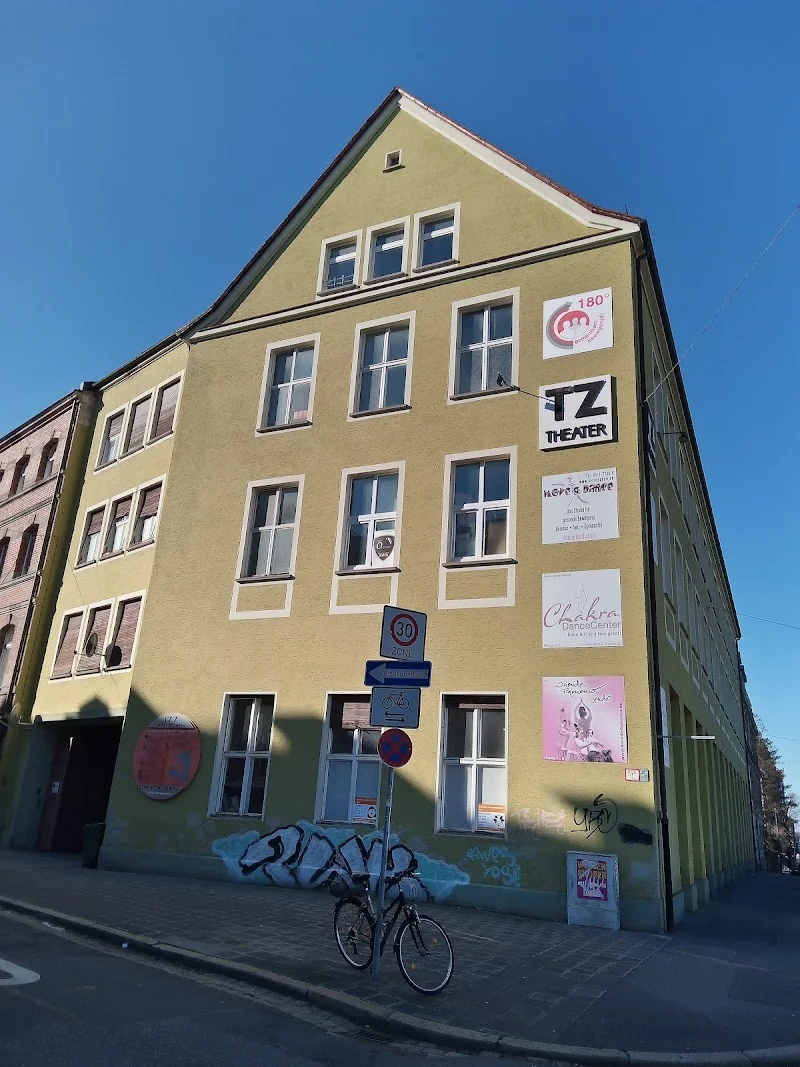
Kaiserstraße 177, Fürth
Kaiserstraße 177, 90763 Fürth, Germany
Dance Center of the Nuremberg Region e.V. | Fürth & Rehearsals
The Dance Center of the Nuremberg Region e.V. is a special place for everyone who wants not only to see contemporary dance but also to develop, try out, and think further together. Unlike a classic event location, the Dance Center functions as an artistic home for the independent dance scene in the Nuremberg metropolitan region. Since 1997, it has been located in the studios of KUNSTfabrik in Fürth and sees itself as a space for research, discourse, exchange, and networking. Those searching for Dance Center Fürth, Dance Center Nuremberg, or Dance Center Nuremberg will find here not an interchangeable showroom, but a working environment with a clear artistic identity, professional conditions, and a strong connection to the regional scene. The facility is supported by the cities of Nuremberg, Fürth, and Erlangen, as well as by the Free State of Bavaria, providing a reliable structure for independent choreographers, ensembles, and guest artists. From this combination of funding, space, and network, new productions emerge every year that premiere in the region and often travel nationally or internationally afterward. At the same time, the Dance Center is also open to the dance-interested public, for example, through showings, public formats, and workshops. ([tanzzentrale.de](https://tanzzentrale.de/))
Dance Center Fürth: Independent Scene, Rehearsals and Training
At its core, the Dance Center is a production site for the independent dance scene. The official self-presentation describes it as an artistic home for dance creators in the Nuremberg metropolitan region and as a contact point for anyone interested in dance, movement, and exchange. Particularly important is the structure of the so-called Producing Artists. The Dance Center creates professional rehearsal conditions for these choreographers and artists so that new works can be developed, tested, and shown in a regional premiere in peace. According to the official website, about 10 to 15 productions are created annually, which often take regional and international paths after the premiere. This makes the location much more than just a rehearsal space: it is a place where ideas become stage works, where aesthetics are sharpened, and where contemporary dance receives concrete working opportunities in the independent scene. This combination of production site, meeting space, and artistic network is particularly relevant for search queries like dance center nuremberg, dance center fürth, or dance center, as it clearly demonstrates the practical utility of the facility. ([tanzzentrale.de](https://tanzzentrale.de/))
The profile also includes regular professional training and workshops. On the history page, the Dance Center describes that professional training for dancers and dance educators takes place three times a week and is taught by members of the Dance Center as well as by international guest teachers in blocks. In addition, there are workshops that complement the program and bring new impulses into the scene. This is where many search intentions arise that lead towards dance workshops fürth, training dance center, or dance studio fürth. For visitors, this means a lively mix of practicing, learning, observing, and participating. Internal communication for the independent scene is also supported: In the service area, there is a bulletin board where job offers, auditions, project inquiries, and funding notices can be published. This makes the Dance Center a practical hub where artistic production and scene information come together directly. So, for those looking not just for a course room but for a truly active dance community, this is the right place. ([tanzzentrale.de](https://tanzzentrale.de/geschichte-en))
Facilities with Large Hall and Ballet Room
The facilities are one of the most important reasons why the Dance Center is in such high demand. Officially, two differently sized studios are available: the Large Hall with 180 square meters and the Ballet Room with about 70 square meters. According to the website, the Large Hall offers sufficient space for expansive movements and group work, while the Ballet Room is suitable for solo work and small groups. Particularly useful for professional use are the mirror wall and ballet bars in the smaller hall. Both halls are equipped with a simple sprung floor, which is an important quality feature for dance rehearsals, body work, and repeated stress. This is precisely why the Dance Center fits so well into search queries like rehearsal room fürth, large hall dance center, or ballet room fürth, as it aligns closely with the actual offerings on site. The studios are also located in a former factory building within the KUNSTfabrik, which distinguishes the place architecturally and atmospherically from plain standard rooms. Here, industrial structure meets artistic practice, and this connection makes the space particularly interesting for contemporary dancers. ([tanzzentrale.de](https://tanzzentrale.de/raeumlichkeiten))
The rooms are also prepared for events with a performance character. In the Large Hall, the stage technology has recently been upgraded, according to the official description, so that lighting and sound not only enable rehearsals under nearly theater-like conditions but also public showings and other formats with a presentation character. This is important for choreographers who want to present their work to an audience in a protected environment without having to perform in a large venue. Workshops, residencies, and smaller events can also be realized in the rooms. The website explicitly states that the facilities can be rented for rehearsal purposes or for workshops and events. This covers several user groups: Producing Artists, guest artists, independent groups, instructors, and curated public events. So, for those looking for a location that not only offers space but also functional dance infrastructure, there is a very clear answer here. The mix of size, equipment, and adaptability is one of the most important location advantages of the Dance Center. ([tanzzentrale.de](https://tanzzentrale.de/raeumlichkeiten))
Access, Address, and Accessibility in Fürth
The address is clear and particularly important for search queries like access dance center fürth or jakobinenstraße dance center: Kaiserstr. 177, 90763 Fürth, in the KUNSTfabrik fürth, Staircase B, 2nd floor. The official directions recommend taking the U1 to the Jakobinenstraße stop. There, you should take the exit in the direction of Nuremberg, use the eastern staircase, then walk right under the bridge and turn left at the first traffic light; the Dance Center is at the next corner. This is a practical, clear set of directions for anyone traveling by public transport. Additionally, the Dance Center publishes contact details such as the email address info@tanzzentrale.de and a phone number, making it possible to directly inquire about rehearsals, events, or rentals. For a location in the dance sector, this combination of a central address, detailed directions, and direct contact options is particularly helpful. It not only makes everyday life easier for guest artists but also for the audience and potential renters. ([tanzzentrale.de](https://tanzzentrale.de/service-en))
However, it is also important to have an open view of the limitations on site. The studios are located on the 2nd floor of a former factory building, and the building officially has only a freight elevator, which is not permitted for people. Therefore, the Dance Center is unfortunately not accessible for wheelchair users and people with mobility impairments. This information is part of serious visitor communication and is crucial when planning workshops, rehearsals, or events. Anyone planning a visit should therefore check access in advance and possibly contact the office directly. At the same time, the transparent communication of the house shows that the Dance Center clearly names its spatial conditions and is open to feedback. This is especially important for cultural venues that are aware of their social responsibility. For people searching for dance center fürth, access dance center, or rehearsal rooms fürth, this information is as relevant as the actual studio sizes. Because a good place convinces not only through content but also through reliable usability. ([tanzzentrale.de](https://tanzzentrale.de/service-en))
History of the Dance Center since 1997
The history of the Dance Center begins in 1997 when it was founded by a group of regional choreographers and dancers. From the beginning, it has been located in studios of the KUNSTfabrik complex in Fürth, centrally at the corner of Kaiserstraße/Karolinenstraße. The English history page also explains that the former factory space was originally converted into dance studios by Jutta Czurda and her company CZ Tanztheater. When the company dissolved, these spaces became the nearby home for the Dance Center because they were already ideally suited for dance production. This historical origin explains why the location still does not feel like an arbitrary event venue but like a developed workspace with artistic memory. The word rhizome, which the Dance Center itself uses in the About section, fits this very well: it stands for interconnections, horizontal connections, and a network without rigid hierarchy. So, for those searching for dance center nuremberg or dance center of the nuremberg region e.v., they encounter an institution that has emerged from the independent scene and continues to shape it today. ([tanzzentrale.de](https://tanzzentrale.de/geschichte-en))
Over the years, the Dance Center has significantly expanded its profile. The website now describes it as a place for research, discourse, exchange, and networking. It supports freelance choreographers with professional working conditions and is thus a central player in regional dance production. The history page also mentions that the Dance Center has been involved in several regional dance festivals, including Transformance CityXchange 2015, tanz.tausch 2018, and the Nuremberg contribution to the Dance Platform Germany 2020. Since 2019, it has also been the home of the format Raw and Polished, an open stage that takes place three times a year. Additionally, public recognition has come: in 2024, the Dance Center received one of the Fürth cultural awards, endowed with 4,000 euros. These points show that a local production site has become a recognized cultural venue over the years. The development from 1997 to today is therefore not only a historical background but also part of the brand identity of the location. It also explains why the Dance Center is equally present in the city of Fürth and the Nuremberg region. ([tanzzentrale.de](https://tanzzentrale.de/geschichte-en))
Networks, Collaborations, and Public Formats
Another important aspect of the Dance Center is its networking beyond its own address. The website describes various collaborations and projects with which the institution strengthens the independent dance scene. This is particularly visible in formats like for exchange+, a network of southern German dance initiatives and artist associations, which was structurally manifested for the first time in 2022 as a collaboration between Tanztendenz Munich and the Dance Center and has since grown further. According to the homepage, the network is now in its fourth round and currently includes six alliance partners in two federal states. Also fitting is STUDIO ROUND, an exchange and presentation format initiated by TanzNetzDresden, which collaborates in a Nuremberg edition with partners from Frankfurt Rhein-Main, Freiburg, and Dresden. These formats are particularly relevant for search intentions like creative scene nuremberg, workshops for dance creators, or cultural place fürth, as they show that the Dance Center does not operate in isolation but as part of a larger network of production and presentation venues. So, for those interested in contemporary dance, this place offers not only a space but also an artistic ecosystem. ([tanzzentrale.de](https://tanzzentrale.de/))
The public dimension of this networking is also important. The homepage announces current premieres and guest works that show that the Dance Center not only produces internally but also makes its work visible. Formats like showings, open evenings, and exchange evenings create opportunities for the audience, artists, and the scene to come into contact with each other. This is crucial for independent dance venues because their relevance is not only derived from rehearsal spaces but also from the dialogue with the public. Additionally, the service area includes a newsletter, press downloads, and logos for funded projects, which also supports the work organizationally. The Dance Center is thus a place where cultural production, communication, and network maintenance converge. For search terms like events fürth, dance center calendar, or current events dance center, it is important that the program is continuously updated and the platform shows a mix of in-house productions, collaborations, and guest formats. This very mix makes the place lively and explains why it is so well anchored in the regional dance landscape. ([tanzzentrale.de](https://tanzzentrale.de/))
Membership, Producing Artists, and Creative Residencies
The Dance Center is not only a space for productions but also an association with clear membership models. According to the official membership page, there are supporting members, active members, and Producing Artists. Supporting members support the goals of the association ideologically or materially and pay at least 30 euros per year. Active members pay at least 40 euros per year but receive discounted participation in training and workshops as well as the opportunity to rent rooms at a fair price for rehearsals or teaching. Producing Artists are dancers and choreographers who are supported by the cities of Nuremberg, Fürth, and Erlangen and regularly develop and perform new productions in the metropolitan region; the annual fee here is 100 euros. Applications and admissions are decided by the board. This structure is relevant for search queries like membership dance center or producing artists nuremberg, as it clearly explains how access to the working community functions. The association thus connects openness for supporters and a professional logic for the artistic core group. ([tanzzentrale.de](https://tanzzentrale.de/mitgliedschaft?utm_source=openai))
Especially exciting are the Creative Residencies. This artist-in-residence program has existed since 2008 and invites national and international dance and performance artists to work in the Dance Center under professional conditions. It is not only about quiet rehearsals but also about exchange with the regional scene and collaborations with independent dancers from Nuremberg and the surrounding area. At the end of a residency, there is often a showing, a panel discussion, or another low-threshold format in which the audience gains insight into the working process. For the independent scene, this is an important building block because new perspectives come to Fürth and at the same time regional artists grow into international contexts. The Dance Center thus creates a connection between local production, public mediation, and artistic development. Together with regular training, workshops, and network projects, a very closed profile emerges: those seeking space for contemporary dance, artistic residencies, and professional work will find a place with a clear signature here. This is what makes the Dance Center in the Nuremberg region so unique. ([tanzzentrale.de](https://tanzzentrale.de/creative-residencies?utm_source=openai))
In summary, the Dance Center of the Nuremberg Region e.V. is a place where practice, scene, and public meaningfully connect. It offers not only square meters but also a content concept: rehearsals, training, workshops, showings, residencies, membership, and networking work belong together here. The location is therefore particularly interesting for artists looking for a real workplace, as well as for culture-interested visitors who want to experience contemporary dance in an authentic environment. Those visiting the address in Fürth encounter not just a studio but a developed institution of the independent scene. This is precisely why the Dance Center is so relevant in search queries around dance center fürth, dance center nuremberg, rehearsal room fürth, and creative residencies dance center: it fulfills these search intentions not superficially but with a clear, long-standing offering. ([tanzzentrale.de](https://tanzzentrale.de/))
Sources:
- Dance Center of the Nuremberg Region e.V. – Homepage
- Dance Center of the Nuremberg Region e.V. – Background and Basics
- Dance Center of the Nuremberg Region e.V. – Facilities
- Dance Center of the Nuremberg Region e.V. – Service
- Dance Center of the Nuremberg Region e.V. – Membership
- Dance Center of the Nuremberg Region e.V. – Creative Residencies
Mehr anzeigenWeniger anzeigen
Dance Center of the Nuremberg Region e.V. | Fürth & Rehearsals
The Dance Center of the Nuremberg Region e.V. is a special place for everyone who wants not only to see contemporary dance but also to develop, try out, and think further together. Unlike a classic event location, the Dance Center functions as an artistic home for the independent dance scene in the Nuremberg metropolitan region. Since 1997, it has been located in the studios of KUNSTfabrik in Fürth and sees itself as a space for research, discourse, exchange, and networking. Those searching for Dance Center Fürth, Dance Center Nuremberg, or Dance Center Nuremberg will find here not an interchangeable showroom, but a working environment with a clear artistic identity, professional conditions, and a strong connection to the regional scene. The facility is supported by the cities of Nuremberg, Fürth, and Erlangen, as well as by the Free State of Bavaria, providing a reliable structure for independent choreographers, ensembles, and guest artists. From this combination of funding, space, and network, new productions emerge every year that premiere in the region and often travel nationally or internationally afterward. At the same time, the Dance Center is also open to the dance-interested public, for example, through showings, public formats, and workshops. ([tanzzentrale.de](https://tanzzentrale.de/))
Dance Center Fürth: Independent Scene, Rehearsals and Training
At its core, the Dance Center is a production site for the independent dance scene. The official self-presentation describes it as an artistic home for dance creators in the Nuremberg metropolitan region and as a contact point for anyone interested in dance, movement, and exchange. Particularly important is the structure of the so-called Producing Artists. The Dance Center creates professional rehearsal conditions for these choreographers and artists so that new works can be developed, tested, and shown in a regional premiere in peace. According to the official website, about 10 to 15 productions are created annually, which often take regional and international paths after the premiere. This makes the location much more than just a rehearsal space: it is a place where ideas become stage works, where aesthetics are sharpened, and where contemporary dance receives concrete working opportunities in the independent scene. This combination of production site, meeting space, and artistic network is particularly relevant for search queries like dance center nuremberg, dance center fürth, or dance center, as it clearly demonstrates the practical utility of the facility. ([tanzzentrale.de](https://tanzzentrale.de/))
The profile also includes regular professional training and workshops. On the history page, the Dance Center describes that professional training for dancers and dance educators takes place three times a week and is taught by members of the Dance Center as well as by international guest teachers in blocks. In addition, there are workshops that complement the program and bring new impulses into the scene. This is where many search intentions arise that lead towards dance workshops fürth, training dance center, or dance studio fürth. For visitors, this means a lively mix of practicing, learning, observing, and participating. Internal communication for the independent scene is also supported: In the service area, there is a bulletin board where job offers, auditions, project inquiries, and funding notices can be published. This makes the Dance Center a practical hub where artistic production and scene information come together directly. So, for those looking not just for a course room but for a truly active dance community, this is the right place. ([tanzzentrale.de](https://tanzzentrale.de/geschichte-en))
Facilities with Large Hall and Ballet Room
The facilities are one of the most important reasons why the Dance Center is in such high demand. Officially, two differently sized studios are available: the Large Hall with 180 square meters and the Ballet Room with about 70 square meters. According to the website, the Large Hall offers sufficient space for expansive movements and group work, while the Ballet Room is suitable for solo work and small groups. Particularly useful for professional use are the mirror wall and ballet bars in the smaller hall. Both halls are equipped with a simple sprung floor, which is an important quality feature for dance rehearsals, body work, and repeated stress. This is precisely why the Dance Center fits so well into search queries like rehearsal room fürth, large hall dance center, or ballet room fürth, as it aligns closely with the actual offerings on site. The studios are also located in a former factory building within the KUNSTfabrik, which distinguishes the place architecturally and atmospherically from plain standard rooms. Here, industrial structure meets artistic practice, and this connection makes the space particularly interesting for contemporary dancers. ([tanzzentrale.de](https://tanzzentrale.de/raeumlichkeiten))
The rooms are also prepared for events with a performance character. In the Large Hall, the stage technology has recently been upgraded, according to the official description, so that lighting and sound not only enable rehearsals under nearly theater-like conditions but also public showings and other formats with a presentation character. This is important for choreographers who want to present their work to an audience in a protected environment without having to perform in a large venue. Workshops, residencies, and smaller events can also be realized in the rooms. The website explicitly states that the facilities can be rented for rehearsal purposes or for workshops and events. This covers several user groups: Producing Artists, guest artists, independent groups, instructors, and curated public events. So, for those looking for a location that not only offers space but also functional dance infrastructure, there is a very clear answer here. The mix of size, equipment, and adaptability is one of the most important location advantages of the Dance Center. ([tanzzentrale.de](https://tanzzentrale.de/raeumlichkeiten))
Access, Address, and Accessibility in Fürth
The address is clear and particularly important for search queries like access dance center fürth or jakobinenstraße dance center: Kaiserstr. 177, 90763 Fürth, in the KUNSTfabrik fürth, Staircase B, 2nd floor. The official directions recommend taking the U1 to the Jakobinenstraße stop. There, you should take the exit in the direction of Nuremberg, use the eastern staircase, then walk right under the bridge and turn left at the first traffic light; the Dance Center is at the next corner. This is a practical, clear set of directions for anyone traveling by public transport. Additionally, the Dance Center publishes contact details such as the email address info@tanzzentrale.de and a phone number, making it possible to directly inquire about rehearsals, events, or rentals. For a location in the dance sector, this combination of a central address, detailed directions, and direct contact options is particularly helpful. It not only makes everyday life easier for guest artists but also for the audience and potential renters. ([tanzzentrale.de](https://tanzzentrale.de/service-en))
However, it is also important to have an open view of the limitations on site. The studios are located on the 2nd floor of a former factory building, and the building officially has only a freight elevator, which is not permitted for people. Therefore, the Dance Center is unfortunately not accessible for wheelchair users and people with mobility impairments. This information is part of serious visitor communication and is crucial when planning workshops, rehearsals, or events. Anyone planning a visit should therefore check access in advance and possibly contact the office directly. At the same time, the transparent communication of the house shows that the Dance Center clearly names its spatial conditions and is open to feedback. This is especially important for cultural venues that are aware of their social responsibility. For people searching for dance center fürth, access dance center, or rehearsal rooms fürth, this information is as relevant as the actual studio sizes. Because a good place convinces not only through content but also through reliable usability. ([tanzzentrale.de](https://tanzzentrale.de/service-en))
History of the Dance Center since 1997
The history of the Dance Center begins in 1997 when it was founded by a group of regional choreographers and dancers. From the beginning, it has been located in studios of the KUNSTfabrik complex in Fürth, centrally at the corner of Kaiserstraße/Karolinenstraße. The English history page also explains that the former factory space was originally converted into dance studios by Jutta Czurda and her company CZ Tanztheater. When the company dissolved, these spaces became the nearby home for the Dance Center because they were already ideally suited for dance production. This historical origin explains why the location still does not feel like an arbitrary event venue but like a developed workspace with artistic memory. The word rhizome, which the Dance Center itself uses in the About section, fits this very well: it stands for interconnections, horizontal connections, and a network without rigid hierarchy. So, for those searching for dance center nuremberg or dance center of the nuremberg region e.v., they encounter an institution that has emerged from the independent scene and continues to shape it today. ([tanzzentrale.de](https://tanzzentrale.de/geschichte-en))
Over the years, the Dance Center has significantly expanded its profile. The website now describes it as a place for research, discourse, exchange, and networking. It supports freelance choreographers with professional working conditions and is thus a central player in regional dance production. The history page also mentions that the Dance Center has been involved in several regional dance festivals, including Transformance CityXchange 2015, tanz.tausch 2018, and the Nuremberg contribution to the Dance Platform Germany 2020. Since 2019, it has also been the home of the format Raw and Polished, an open stage that takes place three times a year. Additionally, public recognition has come: in 2024, the Dance Center received one of the Fürth cultural awards, endowed with 4,000 euros. These points show that a local production site has become a recognized cultural venue over the years. The development from 1997 to today is therefore not only a historical background but also part of the brand identity of the location. It also explains why the Dance Center is equally present in the city of Fürth and the Nuremberg region. ([tanzzentrale.de](https://tanzzentrale.de/geschichte-en))
Networks, Collaborations, and Public Formats
Another important aspect of the Dance Center is its networking beyond its own address. The website describes various collaborations and projects with which the institution strengthens the independent dance scene. This is particularly visible in formats like for exchange+, a network of southern German dance initiatives and artist associations, which was structurally manifested for the first time in 2022 as a collaboration between Tanztendenz Munich and the Dance Center and has since grown further. According to the homepage, the network is now in its fourth round and currently includes six alliance partners in two federal states. Also fitting is STUDIO ROUND, an exchange and presentation format initiated by TanzNetzDresden, which collaborates in a Nuremberg edition with partners from Frankfurt Rhein-Main, Freiburg, and Dresden. These formats are particularly relevant for search intentions like creative scene nuremberg, workshops for dance creators, or cultural place fürth, as they show that the Dance Center does not operate in isolation but as part of a larger network of production and presentation venues. So, for those interested in contemporary dance, this place offers not only a space but also an artistic ecosystem. ([tanzzentrale.de](https://tanzzentrale.de/))
The public dimension of this networking is also important. The homepage announces current premieres and guest works that show that the Dance Center not only produces internally but also makes its work visible. Formats like showings, open evenings, and exchange evenings create opportunities for the audience, artists, and the scene to come into contact with each other. This is crucial for independent dance venues because their relevance is not only derived from rehearsal spaces but also from the dialogue with the public. Additionally, the service area includes a newsletter, press downloads, and logos for funded projects, which also supports the work organizationally. The Dance Center is thus a place where cultural production, communication, and network maintenance converge. For search terms like events fürth, dance center calendar, or current events dance center, it is important that the program is continuously updated and the platform shows a mix of in-house productions, collaborations, and guest formats. This very mix makes the place lively and explains why it is so well anchored in the regional dance landscape. ([tanzzentrale.de](https://tanzzentrale.de/))
Membership, Producing Artists, and Creative Residencies
The Dance Center is not only a space for productions but also an association with clear membership models. According to the official membership page, there are supporting members, active members, and Producing Artists. Supporting members support the goals of the association ideologically or materially and pay at least 30 euros per year. Active members pay at least 40 euros per year but receive discounted participation in training and workshops as well as the opportunity to rent rooms at a fair price for rehearsals or teaching. Producing Artists are dancers and choreographers who are supported by the cities of Nuremberg, Fürth, and Erlangen and regularly develop and perform new productions in the metropolitan region; the annual fee here is 100 euros. Applications and admissions are decided by the board. This structure is relevant for search queries like membership dance center or producing artists nuremberg, as it clearly explains how access to the working community functions. The association thus connects openness for supporters and a professional logic for the artistic core group. ([tanzzentrale.de](https://tanzzentrale.de/mitgliedschaft?utm_source=openai))
Especially exciting are the Creative Residencies. This artist-in-residence program has existed since 2008 and invites national and international dance and performance artists to work in the Dance Center under professional conditions. It is not only about quiet rehearsals but also about exchange with the regional scene and collaborations with independent dancers from Nuremberg and the surrounding area. At the end of a residency, there is often a showing, a panel discussion, or another low-threshold format in which the audience gains insight into the working process. For the independent scene, this is an important building block because new perspectives come to Fürth and at the same time regional artists grow into international contexts. The Dance Center thus creates a connection between local production, public mediation, and artistic development. Together with regular training, workshops, and network projects, a very closed profile emerges: those seeking space for contemporary dance, artistic residencies, and professional work will find a place with a clear signature here. This is what makes the Dance Center in the Nuremberg region so unique. ([tanzzentrale.de](https://tanzzentrale.de/creative-residencies?utm_source=openai))
In summary, the Dance Center of the Nuremberg Region e.V. is a place where practice, scene, and public meaningfully connect. It offers not only square meters but also a content concept: rehearsals, training, workshops, showings, residencies, membership, and networking work belong together here. The location is therefore particularly interesting for artists looking for a real workplace, as well as for culture-interested visitors who want to experience contemporary dance in an authentic environment. Those visiting the address in Fürth encounter not just a studio but a developed institution of the independent scene. This is precisely why the Dance Center is so relevant in search queries around dance center fürth, dance center nuremberg, rehearsal room fürth, and creative residencies dance center: it fulfills these search intentions not superficially but with a clear, long-standing offering. ([tanzzentrale.de](https://tanzzentrale.de/))
Sources:
- Dance Center of the Nuremberg Region e.V. – Homepage
- Dance Center of the Nuremberg Region e.V. – Background and Basics
- Dance Center of the Nuremberg Region e.V. – Facilities
- Dance Center of the Nuremberg Region e.V. – Service
- Dance Center of the Nuremberg Region e.V. – Membership
- Dance Center of the Nuremberg Region e.V. – Creative Residencies
Dance Center of the Nuremberg Region e.V. | Fürth & Rehearsals
The Dance Center of the Nuremberg Region e.V. is a special place for everyone who wants not only to see contemporary dance but also to develop, try out, and think further together. Unlike a classic event location, the Dance Center functions as an artistic home for the independent dance scene in the Nuremberg metropolitan region. Since 1997, it has been located in the studios of KUNSTfabrik in Fürth and sees itself as a space for research, discourse, exchange, and networking. Those searching for Dance Center Fürth, Dance Center Nuremberg, or Dance Center Nuremberg will find here not an interchangeable showroom, but a working environment with a clear artistic identity, professional conditions, and a strong connection to the regional scene. The facility is supported by the cities of Nuremberg, Fürth, and Erlangen, as well as by the Free State of Bavaria, providing a reliable structure for independent choreographers, ensembles, and guest artists. From this combination of funding, space, and network, new productions emerge every year that premiere in the region and often travel nationally or internationally afterward. At the same time, the Dance Center is also open to the dance-interested public, for example, through showings, public formats, and workshops. ([tanzzentrale.de](https://tanzzentrale.de/))
Dance Center Fürth: Independent Scene, Rehearsals and Training
At its core, the Dance Center is a production site for the independent dance scene. The official self-presentation describes it as an artistic home for dance creators in the Nuremberg metropolitan region and as a contact point for anyone interested in dance, movement, and exchange. Particularly important is the structure of the so-called Producing Artists. The Dance Center creates professional rehearsal conditions for these choreographers and artists so that new works can be developed, tested, and shown in a regional premiere in peace. According to the official website, about 10 to 15 productions are created annually, which often take regional and international paths after the premiere. This makes the location much more than just a rehearsal space: it is a place where ideas become stage works, where aesthetics are sharpened, and where contemporary dance receives concrete working opportunities in the independent scene. This combination of production site, meeting space, and artistic network is particularly relevant for search queries like dance center nuremberg, dance center fürth, or dance center, as it clearly demonstrates the practical utility of the facility. ([tanzzentrale.de](https://tanzzentrale.de/))
The profile also includes regular professional training and workshops. On the history page, the Dance Center describes that professional training for dancers and dance educators takes place three times a week and is taught by members of the Dance Center as well as by international guest teachers in blocks. In addition, there are workshops that complement the program and bring new impulses into the scene. This is where many search intentions arise that lead towards dance workshops fürth, training dance center, or dance studio fürth. For visitors, this means a lively mix of practicing, learning, observing, and participating. Internal communication for the independent scene is also supported: In the service area, there is a bulletin board where job offers, auditions, project inquiries, and funding notices can be published. This makes the Dance Center a practical hub where artistic production and scene information come together directly. So, for those looking not just for a course room but for a truly active dance community, this is the right place. ([tanzzentrale.de](https://tanzzentrale.de/geschichte-en))
Facilities with Large Hall and Ballet Room
The facilities are one of the most important reasons why the Dance Center is in such high demand. Officially, two differently sized studios are available: the Large Hall with 180 square meters and the Ballet Room with about 70 square meters. According to the website, the Large Hall offers sufficient space for expansive movements and group work, while the Ballet Room is suitable for solo work and small groups. Particularly useful for professional use are the mirror wall and ballet bars in the smaller hall. Both halls are equipped with a simple sprung floor, which is an important quality feature for dance rehearsals, body work, and repeated stress. This is precisely why the Dance Center fits so well into search queries like rehearsal room fürth, large hall dance center, or ballet room fürth, as it aligns closely with the actual offerings on site. The studios are also located in a former factory building within the KUNSTfabrik, which distinguishes the place architecturally and atmospherically from plain standard rooms. Here, industrial structure meets artistic practice, and this connection makes the space particularly interesting for contemporary dancers. ([tanzzentrale.de](https://tanzzentrale.de/raeumlichkeiten))
The rooms are also prepared for events with a performance character. In the Large Hall, the stage technology has recently been upgraded, according to the official description, so that lighting and sound not only enable rehearsals under nearly theater-like conditions but also public showings and other formats with a presentation character. This is important for choreographers who want to present their work to an audience in a protected environment without having to perform in a large venue. Workshops, residencies, and smaller events can also be realized in the rooms. The website explicitly states that the facilities can be rented for rehearsal purposes or for workshops and events. This covers several user groups: Producing Artists, guest artists, independent groups, instructors, and curated public events. So, for those looking for a location that not only offers space but also functional dance infrastructure, there is a very clear answer here. The mix of size, equipment, and adaptability is one of the most important location advantages of the Dance Center. ([tanzzentrale.de](https://tanzzentrale.de/raeumlichkeiten))
Access, Address, and Accessibility in Fürth
The address is clear and particularly important for search queries like access dance center fürth or jakobinenstraße dance center: Kaiserstr. 177, 90763 Fürth, in the KUNSTfabrik fürth, Staircase B, 2nd floor. The official directions recommend taking the U1 to the Jakobinenstraße stop. There, you should take the exit in the direction of Nuremberg, use the eastern staircase, then walk right under the bridge and turn left at the first traffic light; the Dance Center is at the next corner. This is a practical, clear set of directions for anyone traveling by public transport. Additionally, the Dance Center publishes contact details such as the email address info@tanzzentrale.de and a phone number, making it possible to directly inquire about rehearsals, events, or rentals. For a location in the dance sector, this combination of a central address, detailed directions, and direct contact options is particularly helpful. It not only makes everyday life easier for guest artists but also for the audience and potential renters. ([tanzzentrale.de](https://tanzzentrale.de/service-en))
However, it is also important to have an open view of the limitations on site. The studios are located on the 2nd floor of a former factory building, and the building officially has only a freight elevator, which is not permitted for people. Therefore, the Dance Center is unfortunately not accessible for wheelchair users and people with mobility impairments. This information is part of serious visitor communication and is crucial when planning workshops, rehearsals, or events. Anyone planning a visit should therefore check access in advance and possibly contact the office directly. At the same time, the transparent communication of the house shows that the Dance Center clearly names its spatial conditions and is open to feedback. This is especially important for cultural venues that are aware of their social responsibility. For people searching for dance center fürth, access dance center, or rehearsal rooms fürth, this information is as relevant as the actual studio sizes. Because a good place convinces not only through content but also through reliable usability. ([tanzzentrale.de](https://tanzzentrale.de/service-en))
History of the Dance Center since 1997
The history of the Dance Center begins in 1997 when it was founded by a group of regional choreographers and dancers. From the beginning, it has been located in studios of the KUNSTfabrik complex in Fürth, centrally at the corner of Kaiserstraße/Karolinenstraße. The English history page also explains that the former factory space was originally converted into dance studios by Jutta Czurda and her company CZ Tanztheater. When the company dissolved, these spaces became the nearby home for the Dance Center because they were already ideally suited for dance production. This historical origin explains why the location still does not feel like an arbitrary event venue but like a developed workspace with artistic memory. The word rhizome, which the Dance Center itself uses in the About section, fits this very well: it stands for interconnections, horizontal connections, and a network without rigid hierarchy. So, for those searching for dance center nuremberg or dance center of the nuremberg region e.v., they encounter an institution that has emerged from the independent scene and continues to shape it today. ([tanzzentrale.de](https://tanzzentrale.de/geschichte-en))
Over the years, the Dance Center has significantly expanded its profile. The website now describes it as a place for research, discourse, exchange, and networking. It supports freelance choreographers with professional working conditions and is thus a central player in regional dance production. The history page also mentions that the Dance Center has been involved in several regional dance festivals, including Transformance CityXchange 2015, tanz.tausch 2018, and the Nuremberg contribution to the Dance Platform Germany 2020. Since 2019, it has also been the home of the format Raw and Polished, an open stage that takes place three times a year. Additionally, public recognition has come: in 2024, the Dance Center received one of the Fürth cultural awards, endowed with 4,000 euros. These points show that a local production site has become a recognized cultural venue over the years. The development from 1997 to today is therefore not only a historical background but also part of the brand identity of the location. It also explains why the Dance Center is equally present in the city of Fürth and the Nuremberg region. ([tanzzentrale.de](https://tanzzentrale.de/geschichte-en))
Networks, Collaborations, and Public Formats
Another important aspect of the Dance Center is its networking beyond its own address. The website describes various collaborations and projects with which the institution strengthens the independent dance scene. This is particularly visible in formats like for exchange+, a network of southern German dance initiatives and artist associations, which was structurally manifested for the first time in 2022 as a collaboration between Tanztendenz Munich and the Dance Center and has since grown further. According to the homepage, the network is now in its fourth round and currently includes six alliance partners in two federal states. Also fitting is STUDIO ROUND, an exchange and presentation format initiated by TanzNetzDresden, which collaborates in a Nuremberg edition with partners from Frankfurt Rhein-Main, Freiburg, and Dresden. These formats are particularly relevant for search intentions like creative scene nuremberg, workshops for dance creators, or cultural place fürth, as they show that the Dance Center does not operate in isolation but as part of a larger network of production and presentation venues. So, for those interested in contemporary dance, this place offers not only a space but also an artistic ecosystem. ([tanzzentrale.de](https://tanzzentrale.de/))
The public dimension of this networking is also important. The homepage announces current premieres and guest works that show that the Dance Center not only produces internally but also makes its work visible. Formats like showings, open evenings, and exchange evenings create opportunities for the audience, artists, and the scene to come into contact with each other. This is crucial for independent dance venues because their relevance is not only derived from rehearsal spaces but also from the dialogue with the public. Additionally, the service area includes a newsletter, press downloads, and logos for funded projects, which also supports the work organizationally. The Dance Center is thus a place where cultural production, communication, and network maintenance converge. For search terms like events fürth, dance center calendar, or current events dance center, it is important that the program is continuously updated and the platform shows a mix of in-house productions, collaborations, and guest formats. This very mix makes the place lively and explains why it is so well anchored in the regional dance landscape. ([tanzzentrale.de](https://tanzzentrale.de/))
Membership, Producing Artists, and Creative Residencies
The Dance Center is not only a space for productions but also an association with clear membership models. According to the official membership page, there are supporting members, active members, and Producing Artists. Supporting members support the goals of the association ideologically or materially and pay at least 30 euros per year. Active members pay at least 40 euros per year but receive discounted participation in training and workshops as well as the opportunity to rent rooms at a fair price for rehearsals or teaching. Producing Artists are dancers and choreographers who are supported by the cities of Nuremberg, Fürth, and Erlangen and regularly develop and perform new productions in the metropolitan region; the annual fee here is 100 euros. Applications and admissions are decided by the board. This structure is relevant for search queries like membership dance center or producing artists nuremberg, as it clearly explains how access to the working community functions. The association thus connects openness for supporters and a professional logic for the artistic core group. ([tanzzentrale.de](https://tanzzentrale.de/mitgliedschaft?utm_source=openai))
Especially exciting are the Creative Residencies. This artist-in-residence program has existed since 2008 and invites national and international dance and performance artists to work in the Dance Center under professional conditions. It is not only about quiet rehearsals but also about exchange with the regional scene and collaborations with independent dancers from Nuremberg and the surrounding area. At the end of a residency, there is often a showing, a panel discussion, or another low-threshold format in which the audience gains insight into the working process. For the independent scene, this is an important building block because new perspectives come to Fürth and at the same time regional artists grow into international contexts. The Dance Center thus creates a connection between local production, public mediation, and artistic development. Together with regular training, workshops, and network projects, a very closed profile emerges: those seeking space for contemporary dance, artistic residencies, and professional work will find a place with a clear signature here. This is what makes the Dance Center in the Nuremberg region so unique. ([tanzzentrale.de](https://tanzzentrale.de/creative-residencies?utm_source=openai))
In summary, the Dance Center of the Nuremberg Region e.V. is a place where practice, scene, and public meaningfully connect. It offers not only square meters but also a content concept: rehearsals, training, workshops, showings, residencies, membership, and networking work belong together here. The location is therefore particularly interesting for artists looking for a real workplace, as well as for culture-interested visitors who want to experience contemporary dance in an authentic environment. Those visiting the address in Fürth encounter not just a studio but a developed institution of the independent scene. This is precisely why the Dance Center is so relevant in search queries around dance center fürth, dance center nuremberg, rehearsal room fürth, and creative residencies dance center: it fulfills these search intentions not superficially but with a clear, long-standing offering. ([tanzzentrale.de](https://tanzzentrale.de/))
Sources:
- Dance Center of the Nuremberg Region e.V. – Homepage
- Dance Center of the Nuremberg Region e.V. – Background and Basics
- Dance Center of the Nuremberg Region e.V. – Facilities
- Dance Center of the Nuremberg Region e.V. – Service
- Dance Center of the Nuremberg Region e.V. – Membership
- Dance Center of the Nuremberg Region e.V. – Creative Residencies
Upcoming Events
No events found
Frequently Asked Questions
Reviews
Isabelle Nelson
10. June 2021
Beautiful studios and artists working here
Sabine Schwandner
26. July 2020
Beautiful rooms, attended an Indian dance workshop, very good dance teacher
Robert Bro
23. February 2019
It's wonderful here, great facilities, great teachers.
pfanni nanni
18. July 2019
Super nice team, pleasant atmosphere
Sibylle Wenzel
4. June 2018
A place for experimentation and exchange