
Fürth
90766 Fürth, Deutschland
Seven Arch Bridge Fürth | Address & Images
The Seven Arch Bridge in Fürth is one of the most distinctive bridge structures in the city and for that reason, it is a destination that people often search for with various intentions: some want to quickly find the address, others want to locate the bridge on a map, and yet others seek images to see the striking silhouette in advance. All these inquiries lead to a place where railway history, the landscape of Rednitz, and leisure by the river remarkably overlap. The tourist information describes the Seven Arch Bridge as an impressive structure from the 19th century that spans the Rednitz and today is not only an important traffic route but also a popular photo motif and a symbol of the industrial development of Middle Franconia. FürthWiki adds precise technical data, a detailed history, and the classification as a railway bridge in the meadows of the Rednitz. Therefore, those who visit the bridge in Fürth do not experience just any transitional structure, but a distinctive place with strong recognizability, high historical density, and an environment suitable for walks, photos, and railway observation alike. ([tourismus-fuerth.de](https://www.tourismus-fuerth.de/poi/siebenbogenbruecke-100241280/))
Address, Map, and Directions to the Seven Arch Bridge Fürth
For orientation, the Seven Arch Bridge is very easy to grasp because the official tourist site lists it with the address Uferpromenade, 90766 Fürth. At the same time, the location is described as being about 600 meters west of the Fürth main train station. This is particularly convenient for visitors because the tourist information explicitly states that the Seven Arch Bridge is reachable on foot from the main train station. So, those arriving by train do not need to plan a complicated onward journey but can understand the route as a short city walk. On the same page, Google Maps, OpenStreetMap, and Deutsche Bahn are linked for route planning, which further facilitates the local orientation. FürthWiki provides the geographical location with 49.4713 and 10.9798 as well as the integration into the meadows and the Rednitz Valley. This creates a clear picture: The Seven Arch Bridge is located in an area that is urbanly accessible but also appears open enough to perceive the bridge in its entirety. Therefore, those searching for the address find not just a point on the map but a genuine access to a river and railway ensemble that unfolds very directly from the city center. ([tourismus-fuerth.de](https://www.tourismus-fuerth.de/poi/siebenbogenbruecke-100241280/))
Especially for the search intention maps, this location is particularly valuable because the bridge does not stand isolated but is embedded in a very readable environment. The Rednitz flows through the second arch, as seen from the train station, making the bridge immediately understandable in the urban landscape. The tourist classification as historical structures and green oases also shows that the Seven Arch Bridge is not only understood as a traffic object but as part of an open recreational area. Those orienting themselves on a map can thus recognize the connection between the promenade, river course, railway line, and the adjacent recreational areas more quickly. For visitors, this means: While the address is sufficient for navigation, it is only the combination of proximity to the train station, location by the Rednitz, and open sight that explains why the place is interesting for both a short visit and a longer walk. This interplay is typical for the Seven Arch Bridge and makes it a location that one should not only reach but consciously experience. ([tourismus-fuerth.de](https://www.tourismus-fuerth.de/poi/siebenbogenbruecke-100241280/))
Images, Photo Motifs, and Perspectives at the Rednitz
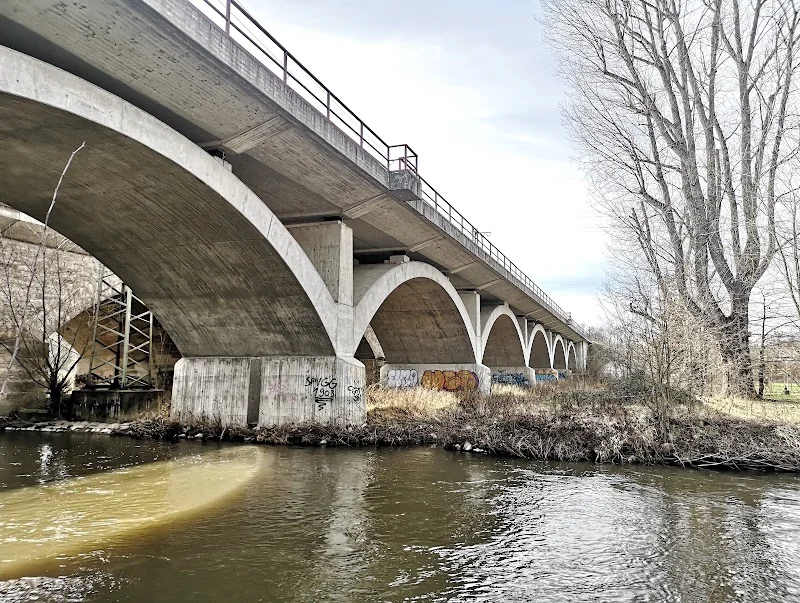
Those searching for images of the Seven Arch Bridge Fürth quickly encounter the core of its appeal: The bridge is a strong motif because its seven arches, the height above the valley floor, and its location over the Rednitz create a very clear silhouette. The tourist information explicitly names it a popular photo motif and points out that the unobstructed view and the heavily trafficked railway lines also make it interesting for railway fans. FürthWiki describes the same effect from the perspective of railway observation and mentions the lateral Fronmüller Bridge as a place where cameras are directed at interesting trains. From this information, it becomes clear that the appeal of the images lies not only in the structure itself but also in the scene around it: river, bridge, tracks, and the open view into the Rednitz Valley together form a striking image composition. Additionally, the Rednitz is channeled through the second arch, making the waterline visible in the image and particularly emphasizing the geometry of the arches. Therefore, those searching for photos do not receive a backdrop from a single viewpoint but a multifaceted ensemble that appears very different depending on the perspective. ([tourismus-fuerth.de](https://www.tourismus-fuerth.de/poi/siebenbogenbruecke-100241280/))
The images on FürthWiki also emphasize how present the bridge is in the local memory. There are not only current views but also historical recordings documented that make the transformation of the structure comprehensible. This provides an additional appeal for many visitors: The Seven Arch Bridge is not only a place to take a beautiful photo but also a motif from which one can read urban development over decades. Particularly interesting is the contrast between the massive historical arches and the open river landscape. The tourism site also mentions that around the bridge there is a barbecue and picnic area as well as a calisthenics park. This means for photographers that the location is not only technically and historically significant but also lively in everyday life. From an SEO perspective, this is important because those searching for images often look not only for an object but also for an atmospheric environment. This environment is precisely what the Seven Arch Bridge offers: a structure with recognizability, a distinct river landscape, and an urban open space that is both visually appealing and characterful. ([tourismus-fuerth.de](https://www.tourismus-fuerth.de/poi/siebenbogenbruecke-100241280/))
History and Construction of the Seven Arch Bridge
The history of the Seven Arch Bridge begins in 1862. FürthWiki describes that crossing the Rednitz Valley was a challenging endeavor at that time, and the start of construction generated so much interest that the police had to keep the construction site clear. On September 11, 1863, the keystone was set. The original structure initially served single-track traffic to Würzburg and was thus a central part of the early railway development in the region. As early as 1891, the bridge was widened for double-track traffic to Bamberg from February to September. Different materials were used in the process, including rust, Marktbreiter shell limestone, and Jurassic limestone. FürthWiki also notes that at that time, the bridge, including masonry, was 187.20 meters long and the arch span was 20.34 meters. The tourist information today summarizes the structure as 186.7 meters long with seven spans of 20.4 meters each. These values show how precisely the bridge was designed for its function as a high-capacity railway crossing. Early on, it was not merely an optical structure but a heavily frequented part of the rail network that actively supported the development of Fürth and its surroundings. ([tourismus-fuerth.de](https://www.tourismus-fuerth.de/poi/siebenbogenbruecke-100241280/))
In the subsequent years, the bridge was modified several times without losing its character. In 1899, a concrete structure was built on the south side for a fifth track, which has since accommodated the Rangaubahn to Cadolzburg. In 1925, the Fronmüller Bridge was added to create a flood-free crossing. During World War II, on April 17, 1945, the seventh pillar was blown up, but as early as June 1945, the Americans established a temporary crossing; two years later, the seventh arch was repaired. In the following decades, traffic continued to increase: FürthWiki cites more than 400 trains per day for 1953. Because the distance between the tracks was too small, the bridge was widened by 2.4 meters between May 1969 and November 1970. In the process, the masts for the overhead line were relocated into the Rednitz Valley, and the total construction, along with the attached Fronmüller Bridge, reached a width of 25.1 meters. Another significant change came with the expansion of the S-Bahn to Forchheim: between 2009 and 2010, a second bridge for two new tracks was built on the north side about ten meters away. Nordbayern describes this work as a bridge construction following the old model, with the new bridge designed for two tracks. Since calendar week 16 of 2022, regular S-Bahn traffic has been conducted over the structure. The Seven Arch Bridge is thus an example of how a historical structure can be adapted multiple times to new technical requirements without losing its defining impact on the urban landscape. ([fuerthwiki.de](https://www.fuerthwiki.de/wiki/index.php/Siebenbogenbr%C3%BCcke))
Leisure Around the Barbecue Area, Calisthenics Park, and Rednitz
Although the Seven Arch Bridge is a railway structure, it is today perceived not only as infrastructure but also as part of a recreational area. The tourist information assigns it not only to historical buildings and monuments but also to the green oases of the city. Directly around the bridge, it mentions a barbecue and picnic area as well as a calisthenics park. This is important for visitors because the bridge thus does not remain merely a transit object but transforms into a recreational area where one can linger, walk, take photos, or simply enjoy the view of the Rednitz. Additionally, the tourist information describes the Seven Arch Bridge as suitable for groups, families, individual guests, and children of all ages. This shows that the place is not only attractive for special interests like railway enthusiasts but also for regular city visits and walks. For those seeking practical information, it is also relevant that the visit is free of charge. So, if someone plans a short, low-threshold activity in Fürth, they find a place that combines historical significance with easy accessibility. This combination makes the location particularly exciting: a structure with industrial background, alongside recreational offerings, and an open river location that makes the visit worthwhile even without a large program. ([tourismus-fuerth.de](https://www.tourismus-fuerth.de/poi/siebenbogenbruecke-100241280/))
Practically important is also the handling of the waterway in immediate proximity. The city of Fürth points out on its information page about swimming, boating, and water sports that bathing is prohibited in the area of the Seven Arch Bridge up to the southern end of the wide entrance steps in front of the property Badstraße 8. The city cites the protection of residents and safety aspects due to obstacles in the water and a suddenly steeply sloping riverbed as reasons. This is relevant for visitors because while the Rednitz in the bridge area is a beautiful sight, it should not be understood as an unrestricted swimming area. At the same time, this broadens the practical view of the location: The Seven Arch Bridge is located at a river section that is both attractive and sensitive. Additionally, the city of Fürth operates a soccer field Seven Arch Bridge with two soccer goals and a goal wall. This emphasizes that the name of the bridge continues to live on in the city's recreational offerings. So, those searching for activities in the vicinity find not only historical architecture but also concrete urban offerings. For an SEO page, this mix is valuable because those searching for maps and images often also look for what can be done on-site. This is where the Seven Arch Bridge excels: it is a photo spot, a technical monument, a walking place, and at the same time part of a larger recreational area by the Rednitz. ([fuerth.de](https://www.fuerth.de/umwelt-abfall/umweltschutz/wasser-und-boden/baden-bootfahren-und-wassersport/))
Frequently Asked Questions About Visit, Use, and Classification
The most common practical question often does not concern history but the visit itself: Is the Seven Arch Bridge worth a short stop? The answer is a clear yes if one likes historical structures, river locations, or railway atmosphere. The tourist information states that the bridge is freely accessible and points out the walkability from the main train station. Thus, it is very well suited for a short city walk without much planning effort. Those arriving by train can quickly integrate the bridge into their daily schedule. The official classification as a historical structure, green oasis, and popular photo motif also shows that the location is not only intended for specialists. Families, groups, and individual guests can easily incorporate the bridge into a visit to Fürth because there is no entry barrier and the surroundings are easily readable. For search queries related to address, maps, and images, this mixture is crucial: quick orientation, clear location, and a visually strong motif. The tourist information and the historical data from FürthWiki complement each other well here, as they cover both the practical and content levels. ([tourismus-fuerth.de](https://www.tourismus-fuerth.de/poi/siebenbogenbruecke-100241280/))
Another frequently asked question concerns the character of the bridge: Is it a normal road bridge or a purely railway object? The sources are clear here. It is a railway bridge that carries the railway lines Nürnberg-Bamberg, Nürnberg-Würzburg, and the Rangaubahn over the Rednitz. FürthWiki also refers to it as one of the most distinctive bridges in Fürth and describes how strongly it visually shapes the Rednitz Valley. The tourist information highlights its industrial symbolic value and popularity among railway fans. So, if someone is looking for a place with technical history and simultaneously good photographic effect, they are exactly right here. Additionally, there is the historical transformation: from single-track origins through expansions in the 19th and 20th centuries to the new S-Bahn bridge on the north side. It is precisely these layers that make the Seven Arch Bridge interesting because one can read not only a point of the city but an entire development process from it. This is equally exciting for visitors as it is for content related to history, monuments, cityscapes, and leisure in green spaces. Therefore, those visiting the bridge in Fürth encounter not only a beautiful structure but also a real piece of infrastructure history that is still actively used and simultaneously retains significance as a photo motif and city location. ([tourismus-fuerth.de](https://www.tourismus-fuerth.de/poi/siebenbogenbruecke-100241280/))
Sources:
Mehr anzeigenWeniger anzeigen
Seven Arch Bridge Fürth | Address & Images
The Seven Arch Bridge in Fürth is one of the most distinctive bridge structures in the city and for that reason, it is a destination that people often search for with various intentions: some want to quickly find the address, others want to locate the bridge on a map, and yet others seek images to see the striking silhouette in advance. All these inquiries lead to a place where railway history, the landscape of Rednitz, and leisure by the river remarkably overlap. The tourist information describes the Seven Arch Bridge as an impressive structure from the 19th century that spans the Rednitz and today is not only an important traffic route but also a popular photo motif and a symbol of the industrial development of Middle Franconia. FürthWiki adds precise technical data, a detailed history, and the classification as a railway bridge in the meadows of the Rednitz. Therefore, those who visit the bridge in Fürth do not experience just any transitional structure, but a distinctive place with strong recognizability, high historical density, and an environment suitable for walks, photos, and railway observation alike. ([tourismus-fuerth.de](https://www.tourismus-fuerth.de/poi/siebenbogenbruecke-100241280/))
Address, Map, and Directions to the Seven Arch Bridge Fürth
For orientation, the Seven Arch Bridge is very easy to grasp because the official tourist site lists it with the address Uferpromenade, 90766 Fürth. At the same time, the location is described as being about 600 meters west of the Fürth main train station. This is particularly convenient for visitors because the tourist information explicitly states that the Seven Arch Bridge is reachable on foot from the main train station. So, those arriving by train do not need to plan a complicated onward journey but can understand the route as a short city walk. On the same page, Google Maps, OpenStreetMap, and Deutsche Bahn are linked for route planning, which further facilitates the local orientation. FürthWiki provides the geographical location with 49.4713 and 10.9798 as well as the integration into the meadows and the Rednitz Valley. This creates a clear picture: The Seven Arch Bridge is located in an area that is urbanly accessible but also appears open enough to perceive the bridge in its entirety. Therefore, those searching for the address find not just a point on the map but a genuine access to a river and railway ensemble that unfolds very directly from the city center. ([tourismus-fuerth.de](https://www.tourismus-fuerth.de/poi/siebenbogenbruecke-100241280/))
Especially for the search intention maps, this location is particularly valuable because the bridge does not stand isolated but is embedded in a very readable environment. The Rednitz flows through the second arch, as seen from the train station, making the bridge immediately understandable in the urban landscape. The tourist classification as historical structures and green oases also shows that the Seven Arch Bridge is not only understood as a traffic object but as part of an open recreational area. Those orienting themselves on a map can thus recognize the connection between the promenade, river course, railway line, and the adjacent recreational areas more quickly. For visitors, this means: While the address is sufficient for navigation, it is only the combination of proximity to the train station, location by the Rednitz, and open sight that explains why the place is interesting for both a short visit and a longer walk. This interplay is typical for the Seven Arch Bridge and makes it a location that one should not only reach but consciously experience. ([tourismus-fuerth.de](https://www.tourismus-fuerth.de/poi/siebenbogenbruecke-100241280/))
Images, Photo Motifs, and Perspectives at the Rednitz
Those searching for images of the Seven Arch Bridge Fürth quickly encounter the core of its appeal: The bridge is a strong motif because its seven arches, the height above the valley floor, and its location over the Rednitz create a very clear silhouette. The tourist information explicitly names it a popular photo motif and points out that the unobstructed view and the heavily trafficked railway lines also make it interesting for railway fans. FürthWiki describes the same effect from the perspective of railway observation and mentions the lateral Fronmüller Bridge as a place where cameras are directed at interesting trains. From this information, it becomes clear that the appeal of the images lies not only in the structure itself but also in the scene around it: river, bridge, tracks, and the open view into the Rednitz Valley together form a striking image composition. Additionally, the Rednitz is channeled through the second arch, making the waterline visible in the image and particularly emphasizing the geometry of the arches. Therefore, those searching for photos do not receive a backdrop from a single viewpoint but a multifaceted ensemble that appears very different depending on the perspective. ([tourismus-fuerth.de](https://www.tourismus-fuerth.de/poi/siebenbogenbruecke-100241280/))
The images on FürthWiki also emphasize how present the bridge is in the local memory. There are not only current views but also historical recordings documented that make the transformation of the structure comprehensible. This provides an additional appeal for many visitors: The Seven Arch Bridge is not only a place to take a beautiful photo but also a motif from which one can read urban development over decades. Particularly interesting is the contrast between the massive historical arches and the open river landscape. The tourism site also mentions that around the bridge there is a barbecue and picnic area as well as a calisthenics park. This means for photographers that the location is not only technically and historically significant but also lively in everyday life. From an SEO perspective, this is important because those searching for images often look not only for an object but also for an atmospheric environment. This environment is precisely what the Seven Arch Bridge offers: a structure with recognizability, a distinct river landscape, and an urban open space that is both visually appealing and characterful. ([tourismus-fuerth.de](https://www.tourismus-fuerth.de/poi/siebenbogenbruecke-100241280/))
History and Construction of the Seven Arch Bridge
The history of the Seven Arch Bridge begins in 1862. FürthWiki describes that crossing the Rednitz Valley was a challenging endeavor at that time, and the start of construction generated so much interest that the police had to keep the construction site clear. On September 11, 1863, the keystone was set. The original structure initially served single-track traffic to Würzburg and was thus a central part of the early railway development in the region. As early as 1891, the bridge was widened for double-track traffic to Bamberg from February to September. Different materials were used in the process, including rust, Marktbreiter shell limestone, and Jurassic limestone. FürthWiki also notes that at that time, the bridge, including masonry, was 187.20 meters long and the arch span was 20.34 meters. The tourist information today summarizes the structure as 186.7 meters long with seven spans of 20.4 meters each. These values show how precisely the bridge was designed for its function as a high-capacity railway crossing. Early on, it was not merely an optical structure but a heavily frequented part of the rail network that actively supported the development of Fürth and its surroundings. ([tourismus-fuerth.de](https://www.tourismus-fuerth.de/poi/siebenbogenbruecke-100241280/))
In the subsequent years, the bridge was modified several times without losing its character. In 1899, a concrete structure was built on the south side for a fifth track, which has since accommodated the Rangaubahn to Cadolzburg. In 1925, the Fronmüller Bridge was added to create a flood-free crossing. During World War II, on April 17, 1945, the seventh pillar was blown up, but as early as June 1945, the Americans established a temporary crossing; two years later, the seventh arch was repaired. In the following decades, traffic continued to increase: FürthWiki cites more than 400 trains per day for 1953. Because the distance between the tracks was too small, the bridge was widened by 2.4 meters between May 1969 and November 1970. In the process, the masts for the overhead line were relocated into the Rednitz Valley, and the total construction, along with the attached Fronmüller Bridge, reached a width of 25.1 meters. Another significant change came with the expansion of the S-Bahn to Forchheim: between 2009 and 2010, a second bridge for two new tracks was built on the north side about ten meters away. Nordbayern describes this work as a bridge construction following the old model, with the new bridge designed for two tracks. Since calendar week 16 of 2022, regular S-Bahn traffic has been conducted over the structure. The Seven Arch Bridge is thus an example of how a historical structure can be adapted multiple times to new technical requirements without losing its defining impact on the urban landscape. ([fuerthwiki.de](https://www.fuerthwiki.de/wiki/index.php/Siebenbogenbr%C3%BCcke))
Leisure Around the Barbecue Area, Calisthenics Park, and Rednitz
Although the Seven Arch Bridge is a railway structure, it is today perceived not only as infrastructure but also as part of a recreational area. The tourist information assigns it not only to historical buildings and monuments but also to the green oases of the city. Directly around the bridge, it mentions a barbecue and picnic area as well as a calisthenics park. This is important for visitors because the bridge thus does not remain merely a transit object but transforms into a recreational area where one can linger, walk, take photos, or simply enjoy the view of the Rednitz. Additionally, the tourist information describes the Seven Arch Bridge as suitable for groups, families, individual guests, and children of all ages. This shows that the place is not only attractive for special interests like railway enthusiasts but also for regular city visits and walks. For those seeking practical information, it is also relevant that the visit is free of charge. So, if someone plans a short, low-threshold activity in Fürth, they find a place that combines historical significance with easy accessibility. This combination makes the location particularly exciting: a structure with industrial background, alongside recreational offerings, and an open river location that makes the visit worthwhile even without a large program. ([tourismus-fuerth.de](https://www.tourismus-fuerth.de/poi/siebenbogenbruecke-100241280/))
Practically important is also the handling of the waterway in immediate proximity. The city of Fürth points out on its information page about swimming, boating, and water sports that bathing is prohibited in the area of the Seven Arch Bridge up to the southern end of the wide entrance steps in front of the property Badstraße 8. The city cites the protection of residents and safety aspects due to obstacles in the water and a suddenly steeply sloping riverbed as reasons. This is relevant for visitors because while the Rednitz in the bridge area is a beautiful sight, it should not be understood as an unrestricted swimming area. At the same time, this broadens the practical view of the location: The Seven Arch Bridge is located at a river section that is both attractive and sensitive. Additionally, the city of Fürth operates a soccer field Seven Arch Bridge with two soccer goals and a goal wall. This emphasizes that the name of the bridge continues to live on in the city's recreational offerings. So, those searching for activities in the vicinity find not only historical architecture but also concrete urban offerings. For an SEO page, this mix is valuable because those searching for maps and images often also look for what can be done on-site. This is where the Seven Arch Bridge excels: it is a photo spot, a technical monument, a walking place, and at the same time part of a larger recreational area by the Rednitz. ([fuerth.de](https://www.fuerth.de/umwelt-abfall/umweltschutz/wasser-und-boden/baden-bootfahren-und-wassersport/))
Frequently Asked Questions About Visit, Use, and Classification
The most common practical question often does not concern history but the visit itself: Is the Seven Arch Bridge worth a short stop? The answer is a clear yes if one likes historical structures, river locations, or railway atmosphere. The tourist information states that the bridge is freely accessible and points out the walkability from the main train station. Thus, it is very well suited for a short city walk without much planning effort. Those arriving by train can quickly integrate the bridge into their daily schedule. The official classification as a historical structure, green oasis, and popular photo motif also shows that the location is not only intended for specialists. Families, groups, and individual guests can easily incorporate the bridge into a visit to Fürth because there is no entry barrier and the surroundings are easily readable. For search queries related to address, maps, and images, this mixture is crucial: quick orientation, clear location, and a visually strong motif. The tourist information and the historical data from FürthWiki complement each other well here, as they cover both the practical and content levels. ([tourismus-fuerth.de](https://www.tourismus-fuerth.de/poi/siebenbogenbruecke-100241280/))
Another frequently asked question concerns the character of the bridge: Is it a normal road bridge or a purely railway object? The sources are clear here. It is a railway bridge that carries the railway lines Nürnberg-Bamberg, Nürnberg-Würzburg, and the Rangaubahn over the Rednitz. FürthWiki also refers to it as one of the most distinctive bridges in Fürth and describes how strongly it visually shapes the Rednitz Valley. The tourist information highlights its industrial symbolic value and popularity among railway fans. So, if someone is looking for a place with technical history and simultaneously good photographic effect, they are exactly right here. Additionally, there is the historical transformation: from single-track origins through expansions in the 19th and 20th centuries to the new S-Bahn bridge on the north side. It is precisely these layers that make the Seven Arch Bridge interesting because one can read not only a point of the city but an entire development process from it. This is equally exciting for visitors as it is for content related to history, monuments, cityscapes, and leisure in green spaces. Therefore, those visiting the bridge in Fürth encounter not only a beautiful structure but also a real piece of infrastructure history that is still actively used and simultaneously retains significance as a photo motif and city location. ([tourismus-fuerth.de](https://www.tourismus-fuerth.de/poi/siebenbogenbruecke-100241280/))
Sources:
Seven Arch Bridge Fürth | Address & Images
The Seven Arch Bridge in Fürth is one of the most distinctive bridge structures in the city and for that reason, it is a destination that people often search for with various intentions: some want to quickly find the address, others want to locate the bridge on a map, and yet others seek images to see the striking silhouette in advance. All these inquiries lead to a place where railway history, the landscape of Rednitz, and leisure by the river remarkably overlap. The tourist information describes the Seven Arch Bridge as an impressive structure from the 19th century that spans the Rednitz and today is not only an important traffic route but also a popular photo motif and a symbol of the industrial development of Middle Franconia. FürthWiki adds precise technical data, a detailed history, and the classification as a railway bridge in the meadows of the Rednitz. Therefore, those who visit the bridge in Fürth do not experience just any transitional structure, but a distinctive place with strong recognizability, high historical density, and an environment suitable for walks, photos, and railway observation alike. ([tourismus-fuerth.de](https://www.tourismus-fuerth.de/poi/siebenbogenbruecke-100241280/))
Address, Map, and Directions to the Seven Arch Bridge Fürth
For orientation, the Seven Arch Bridge is very easy to grasp because the official tourist site lists it with the address Uferpromenade, 90766 Fürth. At the same time, the location is described as being about 600 meters west of the Fürth main train station. This is particularly convenient for visitors because the tourist information explicitly states that the Seven Arch Bridge is reachable on foot from the main train station. So, those arriving by train do not need to plan a complicated onward journey but can understand the route as a short city walk. On the same page, Google Maps, OpenStreetMap, and Deutsche Bahn are linked for route planning, which further facilitates the local orientation. FürthWiki provides the geographical location with 49.4713 and 10.9798 as well as the integration into the meadows and the Rednitz Valley. This creates a clear picture: The Seven Arch Bridge is located in an area that is urbanly accessible but also appears open enough to perceive the bridge in its entirety. Therefore, those searching for the address find not just a point on the map but a genuine access to a river and railway ensemble that unfolds very directly from the city center. ([tourismus-fuerth.de](https://www.tourismus-fuerth.de/poi/siebenbogenbruecke-100241280/))
Especially for the search intention maps, this location is particularly valuable because the bridge does not stand isolated but is embedded in a very readable environment. The Rednitz flows through the second arch, as seen from the train station, making the bridge immediately understandable in the urban landscape. The tourist classification as historical structures and green oases also shows that the Seven Arch Bridge is not only understood as a traffic object but as part of an open recreational area. Those orienting themselves on a map can thus recognize the connection between the promenade, river course, railway line, and the adjacent recreational areas more quickly. For visitors, this means: While the address is sufficient for navigation, it is only the combination of proximity to the train station, location by the Rednitz, and open sight that explains why the place is interesting for both a short visit and a longer walk. This interplay is typical for the Seven Arch Bridge and makes it a location that one should not only reach but consciously experience. ([tourismus-fuerth.de](https://www.tourismus-fuerth.de/poi/siebenbogenbruecke-100241280/))
Images, Photo Motifs, and Perspectives at the Rednitz
Those searching for images of the Seven Arch Bridge Fürth quickly encounter the core of its appeal: The bridge is a strong motif because its seven arches, the height above the valley floor, and its location over the Rednitz create a very clear silhouette. The tourist information explicitly names it a popular photo motif and points out that the unobstructed view and the heavily trafficked railway lines also make it interesting for railway fans. FürthWiki describes the same effect from the perspective of railway observation and mentions the lateral Fronmüller Bridge as a place where cameras are directed at interesting trains. From this information, it becomes clear that the appeal of the images lies not only in the structure itself but also in the scene around it: river, bridge, tracks, and the open view into the Rednitz Valley together form a striking image composition. Additionally, the Rednitz is channeled through the second arch, making the waterline visible in the image and particularly emphasizing the geometry of the arches. Therefore, those searching for photos do not receive a backdrop from a single viewpoint but a multifaceted ensemble that appears very different depending on the perspective. ([tourismus-fuerth.de](https://www.tourismus-fuerth.de/poi/siebenbogenbruecke-100241280/))
The images on FürthWiki also emphasize how present the bridge is in the local memory. There are not only current views but also historical recordings documented that make the transformation of the structure comprehensible. This provides an additional appeal for many visitors: The Seven Arch Bridge is not only a place to take a beautiful photo but also a motif from which one can read urban development over decades. Particularly interesting is the contrast between the massive historical arches and the open river landscape. The tourism site also mentions that around the bridge there is a barbecue and picnic area as well as a calisthenics park. This means for photographers that the location is not only technically and historically significant but also lively in everyday life. From an SEO perspective, this is important because those searching for images often look not only for an object but also for an atmospheric environment. This environment is precisely what the Seven Arch Bridge offers: a structure with recognizability, a distinct river landscape, and an urban open space that is both visually appealing and characterful. ([tourismus-fuerth.de](https://www.tourismus-fuerth.de/poi/siebenbogenbruecke-100241280/))
History and Construction of the Seven Arch Bridge
The history of the Seven Arch Bridge begins in 1862. FürthWiki describes that crossing the Rednitz Valley was a challenging endeavor at that time, and the start of construction generated so much interest that the police had to keep the construction site clear. On September 11, 1863, the keystone was set. The original structure initially served single-track traffic to Würzburg and was thus a central part of the early railway development in the region. As early as 1891, the bridge was widened for double-track traffic to Bamberg from February to September. Different materials were used in the process, including rust, Marktbreiter shell limestone, and Jurassic limestone. FürthWiki also notes that at that time, the bridge, including masonry, was 187.20 meters long and the arch span was 20.34 meters. The tourist information today summarizes the structure as 186.7 meters long with seven spans of 20.4 meters each. These values show how precisely the bridge was designed for its function as a high-capacity railway crossing. Early on, it was not merely an optical structure but a heavily frequented part of the rail network that actively supported the development of Fürth and its surroundings. ([tourismus-fuerth.de](https://www.tourismus-fuerth.de/poi/siebenbogenbruecke-100241280/))
In the subsequent years, the bridge was modified several times without losing its character. In 1899, a concrete structure was built on the south side for a fifth track, which has since accommodated the Rangaubahn to Cadolzburg. In 1925, the Fronmüller Bridge was added to create a flood-free crossing. During World War II, on April 17, 1945, the seventh pillar was blown up, but as early as June 1945, the Americans established a temporary crossing; two years later, the seventh arch was repaired. In the following decades, traffic continued to increase: FürthWiki cites more than 400 trains per day for 1953. Because the distance between the tracks was too small, the bridge was widened by 2.4 meters between May 1969 and November 1970. In the process, the masts for the overhead line were relocated into the Rednitz Valley, and the total construction, along with the attached Fronmüller Bridge, reached a width of 25.1 meters. Another significant change came with the expansion of the S-Bahn to Forchheim: between 2009 and 2010, a second bridge for two new tracks was built on the north side about ten meters away. Nordbayern describes this work as a bridge construction following the old model, with the new bridge designed for two tracks. Since calendar week 16 of 2022, regular S-Bahn traffic has been conducted over the structure. The Seven Arch Bridge is thus an example of how a historical structure can be adapted multiple times to new technical requirements without losing its defining impact on the urban landscape. ([fuerthwiki.de](https://www.fuerthwiki.de/wiki/index.php/Siebenbogenbr%C3%BCcke))
Leisure Around the Barbecue Area, Calisthenics Park, and Rednitz
Although the Seven Arch Bridge is a railway structure, it is today perceived not only as infrastructure but also as part of a recreational area. The tourist information assigns it not only to historical buildings and monuments but also to the green oases of the city. Directly around the bridge, it mentions a barbecue and picnic area as well as a calisthenics park. This is important for visitors because the bridge thus does not remain merely a transit object but transforms into a recreational area where one can linger, walk, take photos, or simply enjoy the view of the Rednitz. Additionally, the tourist information describes the Seven Arch Bridge as suitable for groups, families, individual guests, and children of all ages. This shows that the place is not only attractive for special interests like railway enthusiasts but also for regular city visits and walks. For those seeking practical information, it is also relevant that the visit is free of charge. So, if someone plans a short, low-threshold activity in Fürth, they find a place that combines historical significance with easy accessibility. This combination makes the location particularly exciting: a structure with industrial background, alongside recreational offerings, and an open river location that makes the visit worthwhile even without a large program. ([tourismus-fuerth.de](https://www.tourismus-fuerth.de/poi/siebenbogenbruecke-100241280/))
Practically important is also the handling of the waterway in immediate proximity. The city of Fürth points out on its information page about swimming, boating, and water sports that bathing is prohibited in the area of the Seven Arch Bridge up to the southern end of the wide entrance steps in front of the property Badstraße 8. The city cites the protection of residents and safety aspects due to obstacles in the water and a suddenly steeply sloping riverbed as reasons. This is relevant for visitors because while the Rednitz in the bridge area is a beautiful sight, it should not be understood as an unrestricted swimming area. At the same time, this broadens the practical view of the location: The Seven Arch Bridge is located at a river section that is both attractive and sensitive. Additionally, the city of Fürth operates a soccer field Seven Arch Bridge with two soccer goals and a goal wall. This emphasizes that the name of the bridge continues to live on in the city's recreational offerings. So, those searching for activities in the vicinity find not only historical architecture but also concrete urban offerings. For an SEO page, this mix is valuable because those searching for maps and images often also look for what can be done on-site. This is where the Seven Arch Bridge excels: it is a photo spot, a technical monument, a walking place, and at the same time part of a larger recreational area by the Rednitz. ([fuerth.de](https://www.fuerth.de/umwelt-abfall/umweltschutz/wasser-und-boden/baden-bootfahren-und-wassersport/))
Frequently Asked Questions About Visit, Use, and Classification
The most common practical question often does not concern history but the visit itself: Is the Seven Arch Bridge worth a short stop? The answer is a clear yes if one likes historical structures, river locations, or railway atmosphere. The tourist information states that the bridge is freely accessible and points out the walkability from the main train station. Thus, it is very well suited for a short city walk without much planning effort. Those arriving by train can quickly integrate the bridge into their daily schedule. The official classification as a historical structure, green oasis, and popular photo motif also shows that the location is not only intended for specialists. Families, groups, and individual guests can easily incorporate the bridge into a visit to Fürth because there is no entry barrier and the surroundings are easily readable. For search queries related to address, maps, and images, this mixture is crucial: quick orientation, clear location, and a visually strong motif. The tourist information and the historical data from FürthWiki complement each other well here, as they cover both the practical and content levels. ([tourismus-fuerth.de](https://www.tourismus-fuerth.de/poi/siebenbogenbruecke-100241280/))
Another frequently asked question concerns the character of the bridge: Is it a normal road bridge or a purely railway object? The sources are clear here. It is a railway bridge that carries the railway lines Nürnberg-Bamberg, Nürnberg-Würzburg, and the Rangaubahn over the Rednitz. FürthWiki also refers to it as one of the most distinctive bridges in Fürth and describes how strongly it visually shapes the Rednitz Valley. The tourist information highlights its industrial symbolic value and popularity among railway fans. So, if someone is looking for a place with technical history and simultaneously good photographic effect, they are exactly right here. Additionally, there is the historical transformation: from single-track origins through expansions in the 19th and 20th centuries to the new S-Bahn bridge on the north side. It is precisely these layers that make the Seven Arch Bridge interesting because one can read not only a point of the city but an entire development process from it. This is equally exciting for visitors as it is for content related to history, monuments, cityscapes, and leisure in green spaces. Therefore, those visiting the bridge in Fürth encounter not only a beautiful structure but also a real piece of infrastructure history that is still actively used and simultaneously retains significance as a photo motif and city location. ([tourismus-fuerth.de](https://www.tourismus-fuerth.de/poi/siebenbogenbruecke-100241280/))
Sources:
Frequently Asked Questions
Reviews
Walter R
29. September 2025
The old Seven-Arch Bridge and right next to it the new one for the S-Bahn.
AnonymWXZ
18. January 2025
Very nice for photographing trains. Two main lines come together here, which creates a certain amount of traffic. Lighting-wise: In the morning for vehicles from the west and north. In the evening for departing trains. The Jufu traffic is surprisingly low. The only annoying thing is the bike traffic. They ride there like crazy or like perfectionists around all the poles.
Ralf Bahrdt
2. May 2023
The bridge is heavily used - by trains and cyclists. No problem, depending on the weather, it's really nice around the bridge.
Mario
13. August 2020
No restroom. There were Dixi toilets for one summer. Then never again :(
Riggo Herbowski
27. June 2022
If you want to relax nicely in nature, this is the place for you!