
Rudolf-Breitscheid-Straße 33, Fürth
Rudolf-Breitscheid-Straße 33, 90762 Fürth, Germany
Pavilion Fürth | Adenauer-Anlage & Fürther Freiheit
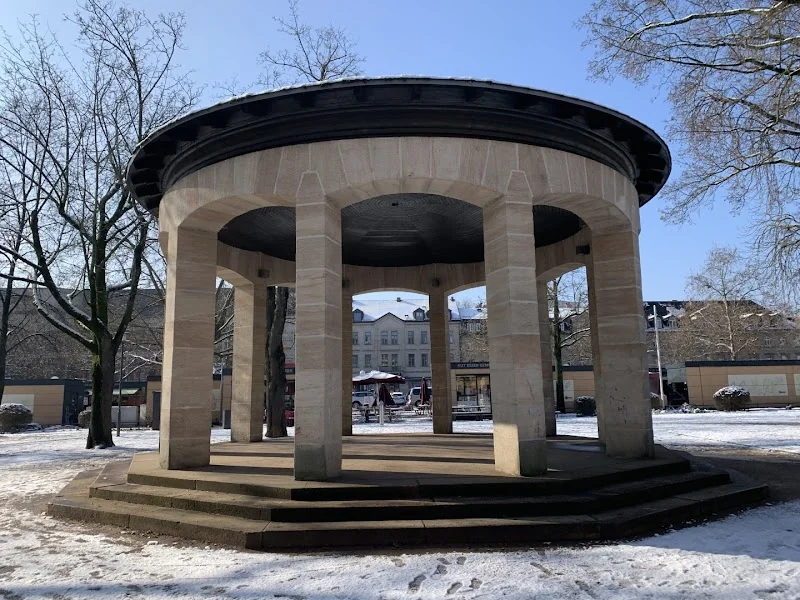
The pavilion in Fürth is much more than a single building: it is the visible heart of the Dr.-Konrad-Adenauer-Anlage and thus part of one of the oldest public green spaces in the city. The facility was created in 1827 as an English garden and is now located directly at Fürther Freiheit, exactly where the city center, weekly market, and public space meet. The pavilion itself is considered the central point of the city garden; in municipal documents, it is described as the renovated centerpiece of the facility. Therefore, visitors to the site experience not only a green space but also a piece of Fürth's city history that has remained practical to this day. Between fountains, play areas, and open paths, a space is created that works for both short breaks and longer stays. This mix of historical depth, urban location, and family-friendly use makes the pavilion one of the most distinctive places around the city center. ([fuerth.de](https://www.fuerth.de/kultur-freizeit/veranstaltungen-termine/fuerther-glanzlichter/dr-konrad-adenauer-anlage/))
History of the Pavilion in the Dr.-Konrad-Adenauer-Anlage
The history of the pavilion is inseparably linked to the development of the Dr.-Konrad-Adenauer-Anlage. The then English garden was established as early as 1827; according to the city of Fürth, it was one of the first public urban green spaces in Fürth. Later redesigns changed the character of the place without losing its basic idea: a green urban space that allows for relaxation in the middle of the city. Today, the pavilion stands in the tradition of this historical garden facility and, together with the paths, the fountain, and the open green spaces, forms an ensemble that not only looks beautiful but also tells the history of Fürth's city center. Understanding the facility also means understanding a piece of urban development, as it shows how an early green space has become a modern urban gathering place. Thus, the current significance of the place arises not only from its appearance but from a long development in which Fürth has repeatedly reconsidered what public space in the center should look like. ([fuerth.de](https://www.fuerth.de/kultur-freizeit/veranstaltungen-termine/fuerther-glanzlichter/dr-konrad-adenauer-anlage/))
In local historical representations, the facility appears under several names, including English garden, Hindenburg garden, and Freedom garden, before it received its current name Dr.-Konrad-Adenauer-Anlage in 1967. The pavilion itself also has a varied history: the city of Fürth assumes that the central pavilion was probably built in the 1930s. At the latest, with the comprehensive redesign from 2003 to 2005 and the renovation of the pavilion, the place was significantly upgraded again; in municipal documents, it is described as the center of the city garden. Thus, the facility connects historical layers with a clear current utility. This makes it exciting for visitors who want to see not just a place but a location with urban depth and visible traces of different eras. This mix of history, renewal, and everyday life is typical for the pavilion in Fürth and explains why the facility has remained so present to this day. ([fuerthwiki.de](https://www.fuerthwiki.de/wiki/index.php/Dr.-Konrad-Adenauer-Anlage))
Location at Fürther Freiheit and in the Heart of the City Center
The location is one of the greatest advantages of this address: the pavilion is located on Rudolf-Breitscheid-Straße opposite Fürther Freiheit and thus in the middle of the city center. The tourist information describes Fürther Freiheit as a central market and event square, with the Adenauer-Anlage connecting on its north side. This very neighborhood makes the place so special, as only a few steps separate the quiet green from the pulsating urban space. For visitors, this means short distances, good orientation, and an environment that is perfect for a break between shopping, market visits, walks, or events. The pavilion thus acts as a calm anchor in a very lively environment. One does not perceive the facility as an isolated island but as a seamless part of the city center, where people are on the move daily and where the green space consciously forms a counterpoint to the buildings. This proximity to everyday life is an essential part of its appeal. ([fuerthwiki.de](https://www.fuerthwiki.de/wiki/index.php/Dr.-Konrad-Adenauer-Anlage))
Historically, the location is also closely linked to the development of Fürther Freiheit. The city points out that here in 1835 the Adler, the first German railway, reached its destination and that the square later became the new center of Fürth. Today, Fürther Freiheit is not only a piece of transportation history but also a public space with parking, events, and a direct connection to the Adenauer-Anlage. For the pavilion, this means an exceptionally central position: it is neither an isolated park remnant nor a pure monument but part of an urban space where history, everyday life, and leisure intertwine. This connection makes it easily understandable and accessible for both locals and guests. Those who have little time in the city center can still easily integrate the pavilion into a short stay. It is located where Fürth becomes particularly legible: between the past, the market, and public presence. ([tourismus-fuerth.de](https://www.tourismus-fuerth.de/poi/fuerther-freiheit/))
Playground, Fountain, and Family-Friendly Offers
Those visiting the pavilion with children quickly notice that the facility is not only decorative but also functionally designed. The official tourism site describes the Dr.-Konrad-Adenauer-Anlage as an ensemble of fountain, pavilion, and playground. This is ideal for families, as it allows for a combination of relaxation, movement, and brief moments of experience in one place. Children can play while adults keep an eye on them or linger on the seating areas. The fact that the facility is freely accessible and offers a restroom facility further increases its practical value. Especially in the city center, this combination of green space, play, and infrastructure is a real plus. The facility thus functions not only as a beautiful destination for a short walk but also as a practical gathering place that allows for spontaneous visits as well as planned family stops. The proximity to the weekly market and Fürther Freiheit enhances this impression, as one can easily combine a park visit with other errands. ([tourismus-fuerth.com](https://www.tourismus-fuerth.com/poi/spielplatz-adenauer-anlage))
The playground itself was newly established in 2004 as part of the general renovation and, with 1452 square meters, is a manageable but very well-utilized area in the middle of the city. The equipment includes a sandbox, double swing, play combinations, jumping plates, balance devices, ground trampoline, and a U36 area for smaller children. In addition, there are numerous seating options, making the place pleasant for longer stays. For families, this is practical because there is not just a single play device but a cohesive offering that combines movement, observation, and resting. Those traveling with a stroller or for a quick stop in the city center also benefit from the immediate proximity to Fürther Freiheit and the weekly market. This creates a family-friendly urban space that does not feel artificial but is firmly anchored in the real life of the city. It is small enough to remain manageable and large enough to provide children with varied play opportunities. ([fuerth.de](https://www.fuerth.de/kultur-freizeit/freizeit/fuerth-im-freien/spielplaetze/spielplatz-dr-konrad-adenauer-anlage/))
Access and Parking at the Pavilion in Fürth
Getting to the pavilion is uncomplicated. The tourist information recommends the walkability from the main train station for Fürther Freiheit, as well as several bus lines that lead directly to Fürther Freiheit. For many visitors, this is the most pleasant way, as the facility integrates seamlessly into a walk through the city center. At the same time, the city indicates designated parking options for the city center, and there are also parking spaces available at Fürther Freiheit. Those arriving by car should keep in mind the central character of the place: city center locations work best when one plans with some flexibility and utilizes the available municipal parking options. For a short visit, the combination of bus and walking often suffices, while longer stays or family visits may make one of the central parking spaces sensible depending on the time of day. The good accessibility is thus a real location advantage of the pavilion. ([tourismus-fuerth.de](https://www.tourismus-fuerth.de/poi/fuerther-freiheit/))
For visitors with special needs, the environment also offers practical points of reference. The city lists designated disabled parking spaces near Rudolf-Breitscheid-Straße and around the city center; there are also additional public parking spaces and parking garages in the city center. This is particularly relevant because the pavilion is not a remote excursion destination but is located in a heavily frequented urban space. Those who want to keep the distances short should therefore best combine public transport with the available city center parking or use the central location for a visit on foot. This keeps the stay around the pavilion comfortable, planable, and practical for everyday life. The traffic logic of the place is thus quite clear: first the location in the center, then the good connection, and finally the possibility to adapt the visit flexibly to one's daily routine. This mix makes the location in Fürth so pleasantly usable. ([fuerth.de](https://www.fuerth.de/bauen-mobilitaet/mobilitaet/kfz-und-parken/behindertenparkplaetze/?utm_source=openai))
Events, Market Life, and Urban Light Art around the Pavilion
The pavilion is not only a beautiful garden motif but also part of the urban event landscape. The city of Fürth describes Fürther Freiheit as a central event location that is used throughout the year for different formats. Directly at the facility, there is also the series of Fürther Glanzlichter, where artists illuminate places in the city with light. In this context, the pavilion itself is repeatedly perceived as a visually striking part of the staging. Those who experience the place at such an event see it in a special role: not as a background but as the centerpiece of an atmospheric urban space. Especially at dusk or during illuminated formats, the perception of the place changes significantly, as the historical structure of the pavilion then, together with the green space and the surrounding city, creates a particularly clear image. ([tourismus-fuerth.de](https://www.tourismus-fuerth.de/poi/fuerther-freiheit/))
In addition, there is proximity to markets and seasonal formats. The city names the historic square as the setting for the Fürther Michaelis-Kirchweih, and during Christmas and winter events, the facility with its light and sight axes plays an important role. The combination of market, green space, and pavilion makes the place so versatile: during the day it is a retreat, in the evening a stage for light and atmosphere, and during festive times part of a large urban overall experience. This multiple use is a real unique selling point, as it shows that the pavilion is not only historically interesting but is actively used throughout the year. This keeps it visible, relevant, and interesting for different target groups. For visitors, this also means that a detour is almost always worthwhile, whether one is in the area for a market, a city walk, or a cultural event. The place thrives on this constant connection between everyday life and occasion. ([tourismus-fuerth.de](https://www.tourismus-fuerth.de/poi/fuerther-freiheit/))
Why the Pavilion as a City Garden and Meeting Point is Convincing
What ultimately makes the pavilion in Fürth so convincing is the rare mix of urban centrality and green relief. It is located in an area where historical urban development, public space, play opportunities, and event use directly intersect. This is exactly why the place works so well: one can stop by briefly, take time consciously, or use the pavilion as a starting point for a walk through the city center. The place never feels arbitrary because it has a clear center and is never over-staged because the facility has preserved its character as a public green space. Those looking for such places find here not only a photo motif but a real piece of Fürth with utility and identity. For many visitors, this combination is crucial: the facility not only provides beautiful views but also a comprehensible urban function that one experiences directly. Especially in contrast to the lively Fürther Freiheit, the place gains additional quality because it offers tranquility not outside the city but right in the middle of it. ([fuerth.de](https://www.fuerth.de/kultur-freizeit/veranstaltungen-termine/fuerther-glanzlichter/dr-konrad-adenauer-anlage/))
For visitors looking for Pavilion Fürth, Adenauer-Anlage, Fürther Freiheit, or a family-friendly green space in the city center, this place is therefore a very suitable address. The history dates back to 1827, the current use is clearly focused on everyday life, leisure, and events, and the accessibility is good both on foot and by bus. Thus, those visiting the pavilion get more than just a look at a historic building: they experience a well-connected, well-maintained, and vibrant city garden that adds a calm and identity-forming note to Fürth's city center. This is exactly what makes it so valuable for the city: it is small enough to feel personal and central enough to be seamlessly integrated into urban everyday life. ([fuerth.de](https://www.fuerth.de/kultur-freizeit/veranstaltungen-termine/fuerther-glanzlichter/dr-konrad-adenauer-anlage/))
Sources:
Mehr anzeigenWeniger anzeigen
Pavilion Fürth | Adenauer-Anlage & Fürther Freiheit
The pavilion in Fürth is much more than a single building: it is the visible heart of the Dr.-Konrad-Adenauer-Anlage and thus part of one of the oldest public green spaces in the city. The facility was created in 1827 as an English garden and is now located directly at Fürther Freiheit, exactly where the city center, weekly market, and public space meet. The pavilion itself is considered the central point of the city garden; in municipal documents, it is described as the renovated centerpiece of the facility. Therefore, visitors to the site experience not only a green space but also a piece of Fürth's city history that has remained practical to this day. Between fountains, play areas, and open paths, a space is created that works for both short breaks and longer stays. This mix of historical depth, urban location, and family-friendly use makes the pavilion one of the most distinctive places around the city center. ([fuerth.de](https://www.fuerth.de/kultur-freizeit/veranstaltungen-termine/fuerther-glanzlichter/dr-konrad-adenauer-anlage/))
History of the Pavilion in the Dr.-Konrad-Adenauer-Anlage
The history of the pavilion is inseparably linked to the development of the Dr.-Konrad-Adenauer-Anlage. The then English garden was established as early as 1827; according to the city of Fürth, it was one of the first public urban green spaces in Fürth. Later redesigns changed the character of the place without losing its basic idea: a green urban space that allows for relaxation in the middle of the city. Today, the pavilion stands in the tradition of this historical garden facility and, together with the paths, the fountain, and the open green spaces, forms an ensemble that not only looks beautiful but also tells the history of Fürth's city center. Understanding the facility also means understanding a piece of urban development, as it shows how an early green space has become a modern urban gathering place. Thus, the current significance of the place arises not only from its appearance but from a long development in which Fürth has repeatedly reconsidered what public space in the center should look like. ([fuerth.de](https://www.fuerth.de/kultur-freizeit/veranstaltungen-termine/fuerther-glanzlichter/dr-konrad-adenauer-anlage/))
In local historical representations, the facility appears under several names, including English garden, Hindenburg garden, and Freedom garden, before it received its current name Dr.-Konrad-Adenauer-Anlage in 1967. The pavilion itself also has a varied history: the city of Fürth assumes that the central pavilion was probably built in the 1930s. At the latest, with the comprehensive redesign from 2003 to 2005 and the renovation of the pavilion, the place was significantly upgraded again; in municipal documents, it is described as the center of the city garden. Thus, the facility connects historical layers with a clear current utility. This makes it exciting for visitors who want to see not just a place but a location with urban depth and visible traces of different eras. This mix of history, renewal, and everyday life is typical for the pavilion in Fürth and explains why the facility has remained so present to this day. ([fuerthwiki.de](https://www.fuerthwiki.de/wiki/index.php/Dr.-Konrad-Adenauer-Anlage))
Location at Fürther Freiheit and in the Heart of the City Center
The location is one of the greatest advantages of this address: the pavilion is located on Rudolf-Breitscheid-Straße opposite Fürther Freiheit and thus in the middle of the city center. The tourist information describes Fürther Freiheit as a central market and event square, with the Adenauer-Anlage connecting on its north side. This very neighborhood makes the place so special, as only a few steps separate the quiet green from the pulsating urban space. For visitors, this means short distances, good orientation, and an environment that is perfect for a break between shopping, market visits, walks, or events. The pavilion thus acts as a calm anchor in a very lively environment. One does not perceive the facility as an isolated island but as a seamless part of the city center, where people are on the move daily and where the green space consciously forms a counterpoint to the buildings. This proximity to everyday life is an essential part of its appeal. ([fuerthwiki.de](https://www.fuerthwiki.de/wiki/index.php/Dr.-Konrad-Adenauer-Anlage))
Historically, the location is also closely linked to the development of Fürther Freiheit. The city points out that here in 1835 the Adler, the first German railway, reached its destination and that the square later became the new center of Fürth. Today, Fürther Freiheit is not only a piece of transportation history but also a public space with parking, events, and a direct connection to the Adenauer-Anlage. For the pavilion, this means an exceptionally central position: it is neither an isolated park remnant nor a pure monument but part of an urban space where history, everyday life, and leisure intertwine. This connection makes it easily understandable and accessible for both locals and guests. Those who have little time in the city center can still easily integrate the pavilion into a short stay. It is located where Fürth becomes particularly legible: between the past, the market, and public presence. ([tourismus-fuerth.de](https://www.tourismus-fuerth.de/poi/fuerther-freiheit/))
Playground, Fountain, and Family-Friendly Offers
Those visiting the pavilion with children quickly notice that the facility is not only decorative but also functionally designed. The official tourism site describes the Dr.-Konrad-Adenauer-Anlage as an ensemble of fountain, pavilion, and playground. This is ideal for families, as it allows for a combination of relaxation, movement, and brief moments of experience in one place. Children can play while adults keep an eye on them or linger on the seating areas. The fact that the facility is freely accessible and offers a restroom facility further increases its practical value. Especially in the city center, this combination of green space, play, and infrastructure is a real plus. The facility thus functions not only as a beautiful destination for a short walk but also as a practical gathering place that allows for spontaneous visits as well as planned family stops. The proximity to the weekly market and Fürther Freiheit enhances this impression, as one can easily combine a park visit with other errands. ([tourismus-fuerth.com](https://www.tourismus-fuerth.com/poi/spielplatz-adenauer-anlage))
The playground itself was newly established in 2004 as part of the general renovation and, with 1452 square meters, is a manageable but very well-utilized area in the middle of the city. The equipment includes a sandbox, double swing, play combinations, jumping plates, balance devices, ground trampoline, and a U36 area for smaller children. In addition, there are numerous seating options, making the place pleasant for longer stays. For families, this is practical because there is not just a single play device but a cohesive offering that combines movement, observation, and resting. Those traveling with a stroller or for a quick stop in the city center also benefit from the immediate proximity to Fürther Freiheit and the weekly market. This creates a family-friendly urban space that does not feel artificial but is firmly anchored in the real life of the city. It is small enough to remain manageable and large enough to provide children with varied play opportunities. ([fuerth.de](https://www.fuerth.de/kultur-freizeit/freizeit/fuerth-im-freien/spielplaetze/spielplatz-dr-konrad-adenauer-anlage/))
Access and Parking at the Pavilion in Fürth
Getting to the pavilion is uncomplicated. The tourist information recommends the walkability from the main train station for Fürther Freiheit, as well as several bus lines that lead directly to Fürther Freiheit. For many visitors, this is the most pleasant way, as the facility integrates seamlessly into a walk through the city center. At the same time, the city indicates designated parking options for the city center, and there are also parking spaces available at Fürther Freiheit. Those arriving by car should keep in mind the central character of the place: city center locations work best when one plans with some flexibility and utilizes the available municipal parking options. For a short visit, the combination of bus and walking often suffices, while longer stays or family visits may make one of the central parking spaces sensible depending on the time of day. The good accessibility is thus a real location advantage of the pavilion. ([tourismus-fuerth.de](https://www.tourismus-fuerth.de/poi/fuerther-freiheit/))
For visitors with special needs, the environment also offers practical points of reference. The city lists designated disabled parking spaces near Rudolf-Breitscheid-Straße and around the city center; there are also additional public parking spaces and parking garages in the city center. This is particularly relevant because the pavilion is not a remote excursion destination but is located in a heavily frequented urban space. Those who want to keep the distances short should therefore best combine public transport with the available city center parking or use the central location for a visit on foot. This keeps the stay around the pavilion comfortable, planable, and practical for everyday life. The traffic logic of the place is thus quite clear: first the location in the center, then the good connection, and finally the possibility to adapt the visit flexibly to one's daily routine. This mix makes the location in Fürth so pleasantly usable. ([fuerth.de](https://www.fuerth.de/bauen-mobilitaet/mobilitaet/kfz-und-parken/behindertenparkplaetze/?utm_source=openai))
Events, Market Life, and Urban Light Art around the Pavilion
The pavilion is not only a beautiful garden motif but also part of the urban event landscape. The city of Fürth describes Fürther Freiheit as a central event location that is used throughout the year for different formats. Directly at the facility, there is also the series of Fürther Glanzlichter, where artists illuminate places in the city with light. In this context, the pavilion itself is repeatedly perceived as a visually striking part of the staging. Those who experience the place at such an event see it in a special role: not as a background but as the centerpiece of an atmospheric urban space. Especially at dusk or during illuminated formats, the perception of the place changes significantly, as the historical structure of the pavilion then, together with the green space and the surrounding city, creates a particularly clear image. ([tourismus-fuerth.de](https://www.tourismus-fuerth.de/poi/fuerther-freiheit/))
In addition, there is proximity to markets and seasonal formats. The city names the historic square as the setting for the Fürther Michaelis-Kirchweih, and during Christmas and winter events, the facility with its light and sight axes plays an important role. The combination of market, green space, and pavilion makes the place so versatile: during the day it is a retreat, in the evening a stage for light and atmosphere, and during festive times part of a large urban overall experience. This multiple use is a real unique selling point, as it shows that the pavilion is not only historically interesting but is actively used throughout the year. This keeps it visible, relevant, and interesting for different target groups. For visitors, this also means that a detour is almost always worthwhile, whether one is in the area for a market, a city walk, or a cultural event. The place thrives on this constant connection between everyday life and occasion. ([tourismus-fuerth.de](https://www.tourismus-fuerth.de/poi/fuerther-freiheit/))
Why the Pavilion as a City Garden and Meeting Point is Convincing
What ultimately makes the pavilion in Fürth so convincing is the rare mix of urban centrality and green relief. It is located in an area where historical urban development, public space, play opportunities, and event use directly intersect. This is exactly why the place works so well: one can stop by briefly, take time consciously, or use the pavilion as a starting point for a walk through the city center. The place never feels arbitrary because it has a clear center and is never over-staged because the facility has preserved its character as a public green space. Those looking for such places find here not only a photo motif but a real piece of Fürth with utility and identity. For many visitors, this combination is crucial: the facility not only provides beautiful views but also a comprehensible urban function that one experiences directly. Especially in contrast to the lively Fürther Freiheit, the place gains additional quality because it offers tranquility not outside the city but right in the middle of it. ([fuerth.de](https://www.fuerth.de/kultur-freizeit/veranstaltungen-termine/fuerther-glanzlichter/dr-konrad-adenauer-anlage/))
For visitors looking for Pavilion Fürth, Adenauer-Anlage, Fürther Freiheit, or a family-friendly green space in the city center, this place is therefore a very suitable address. The history dates back to 1827, the current use is clearly focused on everyday life, leisure, and events, and the accessibility is good both on foot and by bus. Thus, those visiting the pavilion get more than just a look at a historic building: they experience a well-connected, well-maintained, and vibrant city garden that adds a calm and identity-forming note to Fürth's city center. This is exactly what makes it so valuable for the city: it is small enough to feel personal and central enough to be seamlessly integrated into urban everyday life. ([fuerth.de](https://www.fuerth.de/kultur-freizeit/veranstaltungen-termine/fuerther-glanzlichter/dr-konrad-adenauer-anlage/))
Sources:
Pavilion Fürth | Adenauer-Anlage & Fürther Freiheit
The pavilion in Fürth is much more than a single building: it is the visible heart of the Dr.-Konrad-Adenauer-Anlage and thus part of one of the oldest public green spaces in the city. The facility was created in 1827 as an English garden and is now located directly at Fürther Freiheit, exactly where the city center, weekly market, and public space meet. The pavilion itself is considered the central point of the city garden; in municipal documents, it is described as the renovated centerpiece of the facility. Therefore, visitors to the site experience not only a green space but also a piece of Fürth's city history that has remained practical to this day. Between fountains, play areas, and open paths, a space is created that works for both short breaks and longer stays. This mix of historical depth, urban location, and family-friendly use makes the pavilion one of the most distinctive places around the city center. ([fuerth.de](https://www.fuerth.de/kultur-freizeit/veranstaltungen-termine/fuerther-glanzlichter/dr-konrad-adenauer-anlage/))
History of the Pavilion in the Dr.-Konrad-Adenauer-Anlage
The history of the pavilion is inseparably linked to the development of the Dr.-Konrad-Adenauer-Anlage. The then English garden was established as early as 1827; according to the city of Fürth, it was one of the first public urban green spaces in Fürth. Later redesigns changed the character of the place without losing its basic idea: a green urban space that allows for relaxation in the middle of the city. Today, the pavilion stands in the tradition of this historical garden facility and, together with the paths, the fountain, and the open green spaces, forms an ensemble that not only looks beautiful but also tells the history of Fürth's city center. Understanding the facility also means understanding a piece of urban development, as it shows how an early green space has become a modern urban gathering place. Thus, the current significance of the place arises not only from its appearance but from a long development in which Fürth has repeatedly reconsidered what public space in the center should look like. ([fuerth.de](https://www.fuerth.de/kultur-freizeit/veranstaltungen-termine/fuerther-glanzlichter/dr-konrad-adenauer-anlage/))
In local historical representations, the facility appears under several names, including English garden, Hindenburg garden, and Freedom garden, before it received its current name Dr.-Konrad-Adenauer-Anlage in 1967. The pavilion itself also has a varied history: the city of Fürth assumes that the central pavilion was probably built in the 1930s. At the latest, with the comprehensive redesign from 2003 to 2005 and the renovation of the pavilion, the place was significantly upgraded again; in municipal documents, it is described as the center of the city garden. Thus, the facility connects historical layers with a clear current utility. This makes it exciting for visitors who want to see not just a place but a location with urban depth and visible traces of different eras. This mix of history, renewal, and everyday life is typical for the pavilion in Fürth and explains why the facility has remained so present to this day. ([fuerthwiki.de](https://www.fuerthwiki.de/wiki/index.php/Dr.-Konrad-Adenauer-Anlage))
Location at Fürther Freiheit and in the Heart of the City Center
The location is one of the greatest advantages of this address: the pavilion is located on Rudolf-Breitscheid-Straße opposite Fürther Freiheit and thus in the middle of the city center. The tourist information describes Fürther Freiheit as a central market and event square, with the Adenauer-Anlage connecting on its north side. This very neighborhood makes the place so special, as only a few steps separate the quiet green from the pulsating urban space. For visitors, this means short distances, good orientation, and an environment that is perfect for a break between shopping, market visits, walks, or events. The pavilion thus acts as a calm anchor in a very lively environment. One does not perceive the facility as an isolated island but as a seamless part of the city center, where people are on the move daily and where the green space consciously forms a counterpoint to the buildings. This proximity to everyday life is an essential part of its appeal. ([fuerthwiki.de](https://www.fuerthwiki.de/wiki/index.php/Dr.-Konrad-Adenauer-Anlage))
Historically, the location is also closely linked to the development of Fürther Freiheit. The city points out that here in 1835 the Adler, the first German railway, reached its destination and that the square later became the new center of Fürth. Today, Fürther Freiheit is not only a piece of transportation history but also a public space with parking, events, and a direct connection to the Adenauer-Anlage. For the pavilion, this means an exceptionally central position: it is neither an isolated park remnant nor a pure monument but part of an urban space where history, everyday life, and leisure intertwine. This connection makes it easily understandable and accessible for both locals and guests. Those who have little time in the city center can still easily integrate the pavilion into a short stay. It is located where Fürth becomes particularly legible: between the past, the market, and public presence. ([tourismus-fuerth.de](https://www.tourismus-fuerth.de/poi/fuerther-freiheit/))
Playground, Fountain, and Family-Friendly Offers
Those visiting the pavilion with children quickly notice that the facility is not only decorative but also functionally designed. The official tourism site describes the Dr.-Konrad-Adenauer-Anlage as an ensemble of fountain, pavilion, and playground. This is ideal for families, as it allows for a combination of relaxation, movement, and brief moments of experience in one place. Children can play while adults keep an eye on them or linger on the seating areas. The fact that the facility is freely accessible and offers a restroom facility further increases its practical value. Especially in the city center, this combination of green space, play, and infrastructure is a real plus. The facility thus functions not only as a beautiful destination for a short walk but also as a practical gathering place that allows for spontaneous visits as well as planned family stops. The proximity to the weekly market and Fürther Freiheit enhances this impression, as one can easily combine a park visit with other errands. ([tourismus-fuerth.com](https://www.tourismus-fuerth.com/poi/spielplatz-adenauer-anlage))
The playground itself was newly established in 2004 as part of the general renovation and, with 1452 square meters, is a manageable but very well-utilized area in the middle of the city. The equipment includes a sandbox, double swing, play combinations, jumping plates, balance devices, ground trampoline, and a U36 area for smaller children. In addition, there are numerous seating options, making the place pleasant for longer stays. For families, this is practical because there is not just a single play device but a cohesive offering that combines movement, observation, and resting. Those traveling with a stroller or for a quick stop in the city center also benefit from the immediate proximity to Fürther Freiheit and the weekly market. This creates a family-friendly urban space that does not feel artificial but is firmly anchored in the real life of the city. It is small enough to remain manageable and large enough to provide children with varied play opportunities. ([fuerth.de](https://www.fuerth.de/kultur-freizeit/freizeit/fuerth-im-freien/spielplaetze/spielplatz-dr-konrad-adenauer-anlage/))
Access and Parking at the Pavilion in Fürth
Getting to the pavilion is uncomplicated. The tourist information recommends the walkability from the main train station for Fürther Freiheit, as well as several bus lines that lead directly to Fürther Freiheit. For many visitors, this is the most pleasant way, as the facility integrates seamlessly into a walk through the city center. At the same time, the city indicates designated parking options for the city center, and there are also parking spaces available at Fürther Freiheit. Those arriving by car should keep in mind the central character of the place: city center locations work best when one plans with some flexibility and utilizes the available municipal parking options. For a short visit, the combination of bus and walking often suffices, while longer stays or family visits may make one of the central parking spaces sensible depending on the time of day. The good accessibility is thus a real location advantage of the pavilion. ([tourismus-fuerth.de](https://www.tourismus-fuerth.de/poi/fuerther-freiheit/))
For visitors with special needs, the environment also offers practical points of reference. The city lists designated disabled parking spaces near Rudolf-Breitscheid-Straße and around the city center; there are also additional public parking spaces and parking garages in the city center. This is particularly relevant because the pavilion is not a remote excursion destination but is located in a heavily frequented urban space. Those who want to keep the distances short should therefore best combine public transport with the available city center parking or use the central location for a visit on foot. This keeps the stay around the pavilion comfortable, planable, and practical for everyday life. The traffic logic of the place is thus quite clear: first the location in the center, then the good connection, and finally the possibility to adapt the visit flexibly to one's daily routine. This mix makes the location in Fürth so pleasantly usable. ([fuerth.de](https://www.fuerth.de/bauen-mobilitaet/mobilitaet/kfz-und-parken/behindertenparkplaetze/?utm_source=openai))
Events, Market Life, and Urban Light Art around the Pavilion
The pavilion is not only a beautiful garden motif but also part of the urban event landscape. The city of Fürth describes Fürther Freiheit as a central event location that is used throughout the year for different formats. Directly at the facility, there is also the series of Fürther Glanzlichter, where artists illuminate places in the city with light. In this context, the pavilion itself is repeatedly perceived as a visually striking part of the staging. Those who experience the place at such an event see it in a special role: not as a background but as the centerpiece of an atmospheric urban space. Especially at dusk or during illuminated formats, the perception of the place changes significantly, as the historical structure of the pavilion then, together with the green space and the surrounding city, creates a particularly clear image. ([tourismus-fuerth.de](https://www.tourismus-fuerth.de/poi/fuerther-freiheit/))
In addition, there is proximity to markets and seasonal formats. The city names the historic square as the setting for the Fürther Michaelis-Kirchweih, and during Christmas and winter events, the facility with its light and sight axes plays an important role. The combination of market, green space, and pavilion makes the place so versatile: during the day it is a retreat, in the evening a stage for light and atmosphere, and during festive times part of a large urban overall experience. This multiple use is a real unique selling point, as it shows that the pavilion is not only historically interesting but is actively used throughout the year. This keeps it visible, relevant, and interesting for different target groups. For visitors, this also means that a detour is almost always worthwhile, whether one is in the area for a market, a city walk, or a cultural event. The place thrives on this constant connection between everyday life and occasion. ([tourismus-fuerth.de](https://www.tourismus-fuerth.de/poi/fuerther-freiheit/))
Why the Pavilion as a City Garden and Meeting Point is Convincing
What ultimately makes the pavilion in Fürth so convincing is the rare mix of urban centrality and green relief. It is located in an area where historical urban development, public space, play opportunities, and event use directly intersect. This is exactly why the place works so well: one can stop by briefly, take time consciously, or use the pavilion as a starting point for a walk through the city center. The place never feels arbitrary because it has a clear center and is never over-staged because the facility has preserved its character as a public green space. Those looking for such places find here not only a photo motif but a real piece of Fürth with utility and identity. For many visitors, this combination is crucial: the facility not only provides beautiful views but also a comprehensible urban function that one experiences directly. Especially in contrast to the lively Fürther Freiheit, the place gains additional quality because it offers tranquility not outside the city but right in the middle of it. ([fuerth.de](https://www.fuerth.de/kultur-freizeit/veranstaltungen-termine/fuerther-glanzlichter/dr-konrad-adenauer-anlage/))
For visitors looking for Pavilion Fürth, Adenauer-Anlage, Fürther Freiheit, or a family-friendly green space in the city center, this place is therefore a very suitable address. The history dates back to 1827, the current use is clearly focused on everyday life, leisure, and events, and the accessibility is good both on foot and by bus. Thus, those visiting the pavilion get more than just a look at a historic building: they experience a well-connected, well-maintained, and vibrant city garden that adds a calm and identity-forming note to Fürth's city center. This is exactly what makes it so valuable for the city: it is small enough to feel personal and central enough to be seamlessly integrated into urban everyday life. ([fuerth.de](https://www.fuerth.de/kultur-freizeit/veranstaltungen-termine/fuerther-glanzlichter/dr-konrad-adenauer-anlage/))
Sources:
Upcoming Events
No events found
Frequently Asked Questions
Reviews
Arthur M
24. August 2025
The pavilion serves as a local meeting place for many locals. It looks great as the centerpiece of the park.
Ouroboros
12. April 2025
The pavilion is located in the center of the Adenauer-Anlage park on Fürther Freiheit. On one side, families can enjoy a children's playground, and on the other side, there is a fountain with benches for relaxation and a public bookcase with reading material for guests to linger.
Pallavi Athalye
30. August 2024
Bauchredner Pelle
22. November 2023
Beautiful, well-maintained park
J. Leick
16. November 2024