
Garmisch-Partenkirchen
82467, Ludwigstraße, 82467 Garmisch-Partenkirchen, Deutschland
Historic Ludwig Street | Photos & Parking
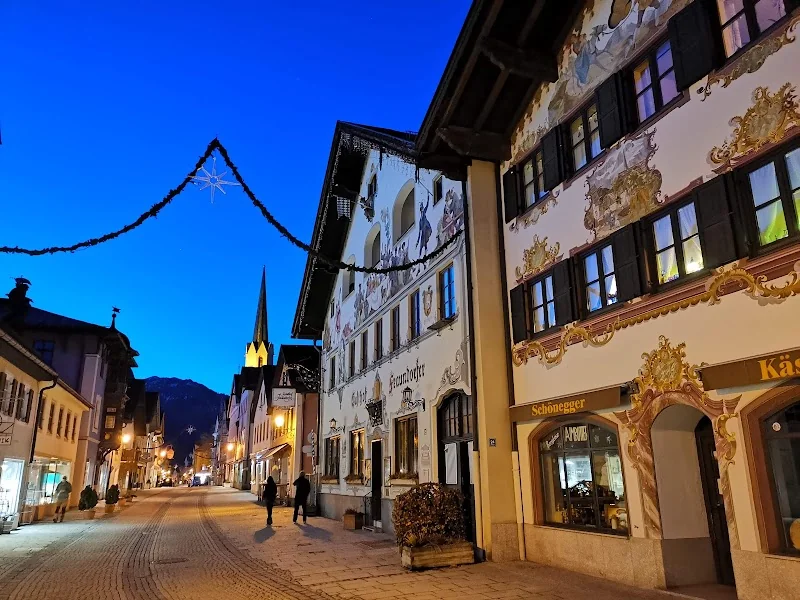
The Historic Ludwig Street is one of the most impressive streets in Garmisch-Partenkirchen, not only because it looks beautiful but also because it makes history visible in a compact area. Those who stroll here move through the old core of Partenkirchen, which is considered the older part of the municipality and dates back to a Roman settlement on an important long-distance route. The current street follows the course of a very old transport axis and is also an ensemble that was reshaped after the great fires of the 19th century. This creates the special mix of tradition, reconstruction, and lived local culture that makes Ludwig Street so distinctive to this day. Lüftlmalerei, well-maintained facades, historic churches, a museum in an old trading house, and small details like gate arches, signs, and alleys create an image that immediately captivates visitors. ([geodaten.bayern.de](https://geodaten.bayern.de/denkmal_static_data/externe_denkmalliste/pdf/denkmalliste_merge_180117.pdf))
Why the Historic Ludwig Street is so important as Untermarkt
The history of Ludwig Street is closely linked to the development of Partenkirchen. The official monument text describes the street as a relatively narrow market street that lies along an old long-distance road and follows the course of a Roman route. Thus, Ludwig Street is not just a pretty old town alley but a historical backbone of the town center. In the area known as Untermarkt, one can still see how strongly the former function as a trade and transport area has shaped the townscape. The houses were positioned so that rear areas were not directly accessible from the side, which can be seen in the typical tenant gates and the elongated building forms. The development of the town itself is also closely tied to trade and market rights: The boom of the Rott traffic in the early 14th century and the granting of market rights in 1305 significantly shaped the town and promoted the expansion of today's Ludwig Street. This explains why this street is still considered a place of identity for Partenkirchen and why it is of particular importance not only touristically but also urbanistically. ([geodaten.bayern.de](https://geodaten.bayern.de/denkmal_static_data/externe_denkmalliste/pdf/denkmalliste_merge_180117.pdf))
What is particularly exciting is that the current shape of Ludwig Street is closely related to the reconstruction after the city fires of 1811 and 1865. The monument text emphasizes that the older Alt-Werdenfels street scene was largely lost due to these fires and that only a few testimonies like the Old House and the Wackerle House remain from the older buildings. The majority of the buildings seen today were built after 1811 or after 1865 and have been repeatedly adapted over time to the tastes and expectations of Alpine tourism. This layering is what makes it appealing: One does not see a museum-like frozen backdrop but a grown street landscape where farmhouses, inns, residential buildings, and sacred buildings stand in close proximity. The street scene tells of reconstruction, artisanal tradition, regional pride, and the ability to fill the historical framework with new life. Therefore, anyone who wants to understand Ludwig Street should not only pay attention to the beautiful facades but also to the history behind them: trade, fire, reconstruction, and cultural self-assertion form a visible unity to this day. ([geodaten.bayern.de](https://geodaten.bayern.de/denkmal_static_data/externe_denkmalliste/pdf/denkmalliste_merge_180117.pdf))
Photos, Lüftlmalerei, and Facades: the Typical Image of the Street
Those searching for photos of the Historic Ludwig Street are usually looking for this unmistakable interplay of color, structure, and tradition. The official tourism description speaks of magnificently painted facades, artistic shop and inn signs, and even a golden roof. In addition, there are the typical gable houses, wooden elements, decorative brackets, and carefully restored fronts that make the street so photogenic. In Garmisch-Partenkirchen, facade design is not just mere decoration but part of local history. Especially in the early 20th century, many buildings were shaped in the Heimat style, creating the well-known Alpine image that guests associate with the region. The wall paintings by Heinrich Bickel have made remarkable contributions and continue to shape the image of individual houses and inns to this day. This creates numerous sightlines along Ludwig Street, where architecture, customs, and everyday life overlap. For queries like photos, reviews, or attractions, the street is particularly attractive because it provides a wide variety of different motifs in a short distance. ([gapa-tourismus.de](https://www.gapa-tourismus.de/en/Tourenplanner/Through-Partenkirchen-in-the-footsteps-of-the-Romans_tour_120))
Among the particularly striking photo motifs are the Old House, which is said to date back in parts to the Barbarossa era, as well as the historically grown row of houses with their picturesque fronts. The Wackerle House, which is one of the few older testimonies, also lends depth and authenticity to the street. Additionally, details like the large tenant gates, which still remind of the agricultural use of the houses, and the signs of the small shops and inns give the place a lively, almost cinematic atmosphere. Precisely because Ludwig Street does not function as an isolated attraction but as a inhabited and used street, it appears so credible in photos. This is of interest for both SEO and visitors: people want not only a beautiful picture but an experience that can also be traced during a walk. Ludwig Street achieves both. One can view the street as a motif while simultaneously reading the historical functions that continue to live on in the facades and buildings. This makes it appealing for photographing guests, cultural travelers, and day visitors alike. ([gapa-tourismus.de](https://www.gapa-tourismus.de/en/Tourenplanner/Through-Partenkirchen-in-the-footsteps-of-the-Romans_tour_120))
Attractions along the Historic Ludwig Street
The Historic Ludwig Street is not only worth seeing in itself but also an ideal starting point for a small walk through Partenkirchen. The official Roman path passes several stations that make the historical overall picture truly understandable. At the Sebastianskapelle, one begins or accompanies the part of Ludwig Street that is still known today as Untermarkt. From there, one notices the large tenant gates and the special structure of the old houses. Not far away is the Schäfflerplatz with the fountain as a reminder of the cooper and the Schäffler dance, which is also practiced in Partenkirchen. On the way uphill, one also comes to the Antonius Fountain, the pilgrimage church of St. Anton, and the Florian Fountain, which is connected to the oldest settlement layer of the town. This sequence of stations shows how closely the street space is intertwined with religious, economic, and artisanal history. ([gapa-tourismus.de](https://www.gapa-tourismus.de/en/Tourenplanner/Through-Partenkirchen-in-the-footsteps-of-the-Romans_tour_120))
Among the most important attractions directly on or near Ludwig Street are the parish church of Maria Himmelfahrt and the Werdenfels Museum. The official tourism route describes the church as newly built and restored in 1865; it is considered worth a visit and continues to shape the street space to this day. Opposite is the Werdenfels Museum in a former merchant house from the 17th century. The house survived the great fires and today houses the history and culture of the Werdenfels region across five floors. Those who love historical old towns and local identity will find here a very compact form of regional history. The Post Hotel, with its history as a Roman post station Partanum, also belongs in this context as it shows how old the transport and transmission strands in this street are. Therefore, Ludwig Street is not just a pretty passage but a genuine ensemble of buildings, narratives, and places of memory. This creates a dense, very varied round for visitors that can be experienced on foot without much effort. ([gapa-tourismus.de](https://www.gapa-tourismus.de/en/Tourenplanner/Through-Partenkirchen-in-the-footsteps-of-the-Romans_tour_120))
One particularly beautiful aspect is that many of these places are connected by short paths. The tours of the region lead from the Tourist Information or from Badgasse and Rathausstraße into Ludwig Street, further over the Untermarkt and back again. This allows the street to be easily integrated into a day trip without long planning. Those who enjoy spontaneous city walks can use Ludwig Street as a red thread and make detours as they wish: to the Sebastianskirche, to the pilgrimage church of St. Anton, to the museum, or to the small squares with fountains and benches. This makes the area particularly attractive for people who want to experience attractions not just as a checklist but at their own pace. This is precisely where the value of this historic street lies: it is an open, accessible open-air museum with functioning everyday life, where history does not disappear behind glass but continues to breathe in the town center. ([gapa-tourismus.de](https://www.gapa-tourismus.de/de/Tourenplanner/Partenkirchen-Rundgang_tour_70))
Access and Parking around Ludwig Street
For getting to the Historic Ludwig Street, the central location in Partenkirchen is an advantage, but one should also expect limited space due to the historic street. The official arrival service for Garmisch-Partenkirchen describes the approach by car via the B2 as well as from the north and south via the regional road connections. Those arriving by train reach the town directly in the center and thus save themselves the search for parking during peak times. This is particularly practical for Ludwig Street, as the street is best experienced on foot. The tourism information also mentions the Badgasse underground garage and other parking options in the town area. For electric and plug-in hybrid vehicles, there are numerous public parking spaces with regulated maximum parking duration in the town area according to the official site; however, some parking garages and underground garages such as those in Badgasse, Klammstraße, or at the casino are excluded. ([gapa-tourismus.de](https://www.gapa-tourismus.de/gapaconvention/de/Service/Anreise))
When it comes to barrier-free or wheelchair-accessible parking spaces, the service specifically mentions several locations near the town center. These include, among others, the Badgasse underground garage with two spaces, the town hall, the Marienplatz, the congress hall, and also Ludwig Street itself with designated parking spaces. For visitors who prefer a short distance on foot, this is an important note, as the old town structure can be lively depending on the time of day and season. It is also officially pointed out that all parking spaces are summarized on the arrival page so that one can choose the appropriate option before the visit. For the SEO topic of parking, this is crucial: the Historic Ludwig Street is not a car location but a pedestrian and walking location in the historic center. Therefore, it is worthwhile to always think about access, parking options, and walking distance together. Those who want to arrive relaxed should plan a little time for parking and the short walk. This way, the visit begins calmly, and one can absorb the historical atmosphere directly instead of first dealing with parking searches. ([gapa-tourismus.de](https://www.gapa-tourismus.de/gapaconvention/de/Service/Anreise))
Practical connections are also helpful for the visit. In the official tours, the path around Ludwig Street often starts or ends at Badgasse, Rathausstraße, or the Tourist Information area. This shows that the street is well integrated into the town center and is ideally suited as part of a round tour. Those traveling by public transport can thus easily join the walk without much thought. Those arriving by car should follow the official parking instructions and not rely on finding a free spot directly in front of the historic backdrop. Especially in high season, a slightly larger buffer is sensible. For families, seniors, or anyone who wants to make the visit as stress-free as possible, the train station or a central garage is often the more relaxing solution. This leaves more energy for what it’s really about: walking, looking, and photographing in one of the most characteristic streets of Partenkirchen. ([gapa-tourismus.de](https://www.gapa-tourismus.de/gapaconvention/de/Service/Anreise))
Walk, Events, and the Special Experience on Site
The Historic Ludwig Street works particularly well as part of a walk. The official tour Partenkirchen Rundgang leads from the Tourist Information through Ludwig Street to the pilgrimage church of St. Anton and back, while the Roman walk through Partenkirchen places even more emphasis on the history of the Untermarkt, the Florianplatz, and the historic buildings. This is ideal for visitors because one does not view the street in isolation but embeds it in a comprehensible route. The tours also show that Ludwig Street can be visited at any time of the year. The historical character is made tangible not only by individual buildings but also by the sequence of stations: Sebastianskapelle, Untermarkt, Schäfflerplatz, Floriansbrunnen, Maria Himmelfahrt, Werdenfels Museum, and finally the return to the lively town center. Those who experience the street on foot quickly understand why it is considered one of the most important townscapes of Partenkirchen. ([gapa-tourismus.de](https://www.gapa-tourismus.de/de/Tourenplanner/Partenkirchen-Rundgang_tour_70))
Additionally, there is a gentle cultural presence. The official GaPa Live locations area lists the Kirchplatz Ludwigstraße as a venue, so the street and its surroundings are not only a historical backdrop but also a stage for musical offerings. This fits very well with a place that connects tradition and present. Ludwig Street indeed does not only live from its past but also from being integrated into the tourist and cultural everyday life. This makes the visit pleasantly versatile: one can simply walk through, deliberately photograph, participate in a guided tour, or attend a cultural event in the vicinity. For people who want to combine events, culture, and local history, this is a clear advantage. Particularly in queries around programs, walks, photos, and attractions, it becomes clear: Ludwig Street is not a single object but a small experience space that caters to and brings together different interests. ([gapa-tourismus.de](https://www.gapa-tourismus.de/de/Kultur/Musik/GaPa%20Live/Orte))
The design of the visit can also be thought of flexibly. Those with little time can focus on the central highlights along the Untermarkt and the museum opposite the parish church. Those with more time can extend the walk over Sonnenbergstraße to the fountains, to St. Anton, and to the historic alleys around the square. This way, Ludwig Street becomes not just a photo stop but half a town walk. This is one of the reasons why the street works well for both locals and guests: it is compact but not banal; historical but not closed; beautiful but also lively. This balance makes it particularly interesting for those seeking reviews, photos, and practical visit information. ([gapa-tourismus.de](https://www.gapa-tourismus.de/de/Tourenplanner/Auf-den-Spuren-der-Romer-durch-Partenkirchen_tour_120))
Reviews, Atmosphere, and Practical Tips for the Visit
With 4.6 stars from 528 reviews, the Historic Ludwig Street appears to be very popular from the perspective of many visitors. This fits well with what one expects on site: a very characterful historical environment that is equally suitable for photos, walks, and short cultural moments. Those visiting the street should not rely on a single highlight but absorb the atmosphere as a whole. The strength of this place lies precisely in the fact that it bundles many small impressions. A facade alone is pretty, but it is the sequence of houses, churches, fountain tablets, museum, and views into the side streets that makes the visit a real experience. For families, couples, solo travelers, and culture enthusiasts, Ludwig Street is therefore a very rewarding destination because one can easily adapt the visit to one's own daily form. One can just walk through briefly or take one's time consciously. Both works. ([geodaten.bayern.de](https://geodaten.bayern.de/denkmal_static_data/externe_denkmalliste/pdf/denkmalliste_merge_180117.pdf))
It is also practical that the street connects excellently with other destinations in the town center. Those starting at the town hall, the Tourist Information, or an underground garage can switch to the historic area without detours and later return to the modern parts of the town. This combination of everyday place and monument ensemble makes Ludwig Street so interesting. For the search intention reviews, it is important that visitors apparently appreciate the mix of authenticity and beautiful backdrop; for the search intention photos, the variety of motifs is decisive; and for the search intention parking, the official infrastructure with central parking spaces and barrier-free options counts. Therefore, those who plan their visit sensibly gain multiple benefits: less stress, more time, and better impressions. The Historic Ludwig Street is thus not a place for haste but for calm, attentive discoveries. ([gapa-tourismus.de](https://www.gapa-tourismus.de/gapaconvention/de/Service/Anreise))
Ultimately, the Historic Ludwig Street is a destination for all those who seek not only nature but also local history in Garmisch-Partenkirchen. The street stands for the historic Partenkirchen, for the memory of trade routes and market traditions, for the reconstruction after fires, and for a facade culture that is still maintained today. This is precisely why it remains attractive for SEO, for travelers, and for day visitors alike: it is a visible anchor point in the town, a popular photo motif, and a sensible starting point for further discoveries. Those who bring together the key themes behind the search queries always end up with the same terms: history, photos, parking, attractions, walks, and atmosphere. And that best describes Ludwig Street. ([geodaten.bayern.de](https://geodaten.bayern.de/denkmal_static_data/externe_denkmalliste/pdf/denkmalliste_merge_180117.pdf))
Sources:
- GaPa Tourism - In the Footsteps of the Romans through Partenkirchen ([gapa-tourismus.de](https://www.gapa-tourismus.de/en/Tourenplanner/Through-Partenkirchen-in-the-footsteps-of-the-Romans_tour_120))
- GaPa Tourism - Partenkirchen Walk ([gapa-tourismus.de](https://www.gapa-tourismus.de/de/Tourenplanner/Partenkirchen-Rundgang_tour_70))
- Bavarian State Office for Monument Preservation - Monument List Ludwig Street ([geodaten.bayern.de](https://geodaten.bayern.de/denkmal_static_data/externe_denkmalliste/pdf/denkmalliste_merge_180117.pdf))
- GaPa Tourism - Arrival and Mobility ([gapa-tourismus.de](https://www.gapa-tourismus.de/gapaconvention/de/Service/Anreise))
- GaPa Convention - Frequently Asked Questions and Parking ([gapa-tourismus.de](https://www.gapa-tourismus.de/gapaconvention/de/Service/H%C3%A4ufige%20Fragen))
- GaPa Live - Locations and Kirchplatz Ludwigstraße ([gapa-tourismus.de](https://www.gapa-tourismus.de/de/Kultur/Musik/GaPa%20Live/Orte))
Mehr anzeigenWeniger anzeigen
Historic Ludwig Street | Photos & Parking
The Historic Ludwig Street is one of the most impressive streets in Garmisch-Partenkirchen, not only because it looks beautiful but also because it makes history visible in a compact area. Those who stroll here move through the old core of Partenkirchen, which is considered the older part of the municipality and dates back to a Roman settlement on an important long-distance route. The current street follows the course of a very old transport axis and is also an ensemble that was reshaped after the great fires of the 19th century. This creates the special mix of tradition, reconstruction, and lived local culture that makes Ludwig Street so distinctive to this day. Lüftlmalerei, well-maintained facades, historic churches, a museum in an old trading house, and small details like gate arches, signs, and alleys create an image that immediately captivates visitors. ([geodaten.bayern.de](https://geodaten.bayern.de/denkmal_static_data/externe_denkmalliste/pdf/denkmalliste_merge_180117.pdf))
Why the Historic Ludwig Street is so important as Untermarkt
The history of Ludwig Street is closely linked to the development of Partenkirchen. The official monument text describes the street as a relatively narrow market street that lies along an old long-distance road and follows the course of a Roman route. Thus, Ludwig Street is not just a pretty old town alley but a historical backbone of the town center. In the area known as Untermarkt, one can still see how strongly the former function as a trade and transport area has shaped the townscape. The houses were positioned so that rear areas were not directly accessible from the side, which can be seen in the typical tenant gates and the elongated building forms. The development of the town itself is also closely tied to trade and market rights: The boom of the Rott traffic in the early 14th century and the granting of market rights in 1305 significantly shaped the town and promoted the expansion of today's Ludwig Street. This explains why this street is still considered a place of identity for Partenkirchen and why it is of particular importance not only touristically but also urbanistically. ([geodaten.bayern.de](https://geodaten.bayern.de/denkmal_static_data/externe_denkmalliste/pdf/denkmalliste_merge_180117.pdf))
What is particularly exciting is that the current shape of Ludwig Street is closely related to the reconstruction after the city fires of 1811 and 1865. The monument text emphasizes that the older Alt-Werdenfels street scene was largely lost due to these fires and that only a few testimonies like the Old House and the Wackerle House remain from the older buildings. The majority of the buildings seen today were built after 1811 or after 1865 and have been repeatedly adapted over time to the tastes and expectations of Alpine tourism. This layering is what makes it appealing: One does not see a museum-like frozen backdrop but a grown street landscape where farmhouses, inns, residential buildings, and sacred buildings stand in close proximity. The street scene tells of reconstruction, artisanal tradition, regional pride, and the ability to fill the historical framework with new life. Therefore, anyone who wants to understand Ludwig Street should not only pay attention to the beautiful facades but also to the history behind them: trade, fire, reconstruction, and cultural self-assertion form a visible unity to this day. ([geodaten.bayern.de](https://geodaten.bayern.de/denkmal_static_data/externe_denkmalliste/pdf/denkmalliste_merge_180117.pdf))
Photos, Lüftlmalerei, and Facades: the Typical Image of the Street
Those searching for photos of the Historic Ludwig Street are usually looking for this unmistakable interplay of color, structure, and tradition. The official tourism description speaks of magnificently painted facades, artistic shop and inn signs, and even a golden roof. In addition, there are the typical gable houses, wooden elements, decorative brackets, and carefully restored fronts that make the street so photogenic. In Garmisch-Partenkirchen, facade design is not just mere decoration but part of local history. Especially in the early 20th century, many buildings were shaped in the Heimat style, creating the well-known Alpine image that guests associate with the region. The wall paintings by Heinrich Bickel have made remarkable contributions and continue to shape the image of individual houses and inns to this day. This creates numerous sightlines along Ludwig Street, where architecture, customs, and everyday life overlap. For queries like photos, reviews, or attractions, the street is particularly attractive because it provides a wide variety of different motifs in a short distance. ([gapa-tourismus.de](https://www.gapa-tourismus.de/en/Tourenplanner/Through-Partenkirchen-in-the-footsteps-of-the-Romans_tour_120))
Among the particularly striking photo motifs are the Old House, which is said to date back in parts to the Barbarossa era, as well as the historically grown row of houses with their picturesque fronts. The Wackerle House, which is one of the few older testimonies, also lends depth and authenticity to the street. Additionally, details like the large tenant gates, which still remind of the agricultural use of the houses, and the signs of the small shops and inns give the place a lively, almost cinematic atmosphere. Precisely because Ludwig Street does not function as an isolated attraction but as a inhabited and used street, it appears so credible in photos. This is of interest for both SEO and visitors: people want not only a beautiful picture but an experience that can also be traced during a walk. Ludwig Street achieves both. One can view the street as a motif while simultaneously reading the historical functions that continue to live on in the facades and buildings. This makes it appealing for photographing guests, cultural travelers, and day visitors alike. ([gapa-tourismus.de](https://www.gapa-tourismus.de/en/Tourenplanner/Through-Partenkirchen-in-the-footsteps-of-the-Romans_tour_120))
Attractions along the Historic Ludwig Street
The Historic Ludwig Street is not only worth seeing in itself but also an ideal starting point for a small walk through Partenkirchen. The official Roman path passes several stations that make the historical overall picture truly understandable. At the Sebastianskapelle, one begins or accompanies the part of Ludwig Street that is still known today as Untermarkt. From there, one notices the large tenant gates and the special structure of the old houses. Not far away is the Schäfflerplatz with the fountain as a reminder of the cooper and the Schäffler dance, which is also practiced in Partenkirchen. On the way uphill, one also comes to the Antonius Fountain, the pilgrimage church of St. Anton, and the Florian Fountain, which is connected to the oldest settlement layer of the town. This sequence of stations shows how closely the street space is intertwined with religious, economic, and artisanal history. ([gapa-tourismus.de](https://www.gapa-tourismus.de/en/Tourenplanner/Through-Partenkirchen-in-the-footsteps-of-the-Romans_tour_120))
Among the most important attractions directly on or near Ludwig Street are the parish church of Maria Himmelfahrt and the Werdenfels Museum. The official tourism route describes the church as newly built and restored in 1865; it is considered worth a visit and continues to shape the street space to this day. Opposite is the Werdenfels Museum in a former merchant house from the 17th century. The house survived the great fires and today houses the history and culture of the Werdenfels region across five floors. Those who love historical old towns and local identity will find here a very compact form of regional history. The Post Hotel, with its history as a Roman post station Partanum, also belongs in this context as it shows how old the transport and transmission strands in this street are. Therefore, Ludwig Street is not just a pretty passage but a genuine ensemble of buildings, narratives, and places of memory. This creates a dense, very varied round for visitors that can be experienced on foot without much effort. ([gapa-tourismus.de](https://www.gapa-tourismus.de/en/Tourenplanner/Through-Partenkirchen-in-the-footsteps-of-the-Romans_tour_120))
One particularly beautiful aspect is that many of these places are connected by short paths. The tours of the region lead from the Tourist Information or from Badgasse and Rathausstraße into Ludwig Street, further over the Untermarkt and back again. This allows the street to be easily integrated into a day trip without long planning. Those who enjoy spontaneous city walks can use Ludwig Street as a red thread and make detours as they wish: to the Sebastianskirche, to the pilgrimage church of St. Anton, to the museum, or to the small squares with fountains and benches. This makes the area particularly attractive for people who want to experience attractions not just as a checklist but at their own pace. This is precisely where the value of this historic street lies: it is an open, accessible open-air museum with functioning everyday life, where history does not disappear behind glass but continues to breathe in the town center. ([gapa-tourismus.de](https://www.gapa-tourismus.de/de/Tourenplanner/Partenkirchen-Rundgang_tour_70))
Access and Parking around Ludwig Street
For getting to the Historic Ludwig Street, the central location in Partenkirchen is an advantage, but one should also expect limited space due to the historic street. The official arrival service for Garmisch-Partenkirchen describes the approach by car via the B2 as well as from the north and south via the regional road connections. Those arriving by train reach the town directly in the center and thus save themselves the search for parking during peak times. This is particularly practical for Ludwig Street, as the street is best experienced on foot. The tourism information also mentions the Badgasse underground garage and other parking options in the town area. For electric and plug-in hybrid vehicles, there are numerous public parking spaces with regulated maximum parking duration in the town area according to the official site; however, some parking garages and underground garages such as those in Badgasse, Klammstraße, or at the casino are excluded. ([gapa-tourismus.de](https://www.gapa-tourismus.de/gapaconvention/de/Service/Anreise))
When it comes to barrier-free or wheelchair-accessible parking spaces, the service specifically mentions several locations near the town center. These include, among others, the Badgasse underground garage with two spaces, the town hall, the Marienplatz, the congress hall, and also Ludwig Street itself with designated parking spaces. For visitors who prefer a short distance on foot, this is an important note, as the old town structure can be lively depending on the time of day and season. It is also officially pointed out that all parking spaces are summarized on the arrival page so that one can choose the appropriate option before the visit. For the SEO topic of parking, this is crucial: the Historic Ludwig Street is not a car location but a pedestrian and walking location in the historic center. Therefore, it is worthwhile to always think about access, parking options, and walking distance together. Those who want to arrive relaxed should plan a little time for parking and the short walk. This way, the visit begins calmly, and one can absorb the historical atmosphere directly instead of first dealing with parking searches. ([gapa-tourismus.de](https://www.gapa-tourismus.de/gapaconvention/de/Service/Anreise))
Practical connections are also helpful for the visit. In the official tours, the path around Ludwig Street often starts or ends at Badgasse, Rathausstraße, or the Tourist Information area. This shows that the street is well integrated into the town center and is ideally suited as part of a round tour. Those traveling by public transport can thus easily join the walk without much thought. Those arriving by car should follow the official parking instructions and not rely on finding a free spot directly in front of the historic backdrop. Especially in high season, a slightly larger buffer is sensible. For families, seniors, or anyone who wants to make the visit as stress-free as possible, the train station or a central garage is often the more relaxing solution. This leaves more energy for what it’s really about: walking, looking, and photographing in one of the most characteristic streets of Partenkirchen. ([gapa-tourismus.de](https://www.gapa-tourismus.de/gapaconvention/de/Service/Anreise))
Walk, Events, and the Special Experience on Site
The Historic Ludwig Street works particularly well as part of a walk. The official tour Partenkirchen Rundgang leads from the Tourist Information through Ludwig Street to the pilgrimage church of St. Anton and back, while the Roman walk through Partenkirchen places even more emphasis on the history of the Untermarkt, the Florianplatz, and the historic buildings. This is ideal for visitors because one does not view the street in isolation but embeds it in a comprehensible route. The tours also show that Ludwig Street can be visited at any time of the year. The historical character is made tangible not only by individual buildings but also by the sequence of stations: Sebastianskapelle, Untermarkt, Schäfflerplatz, Floriansbrunnen, Maria Himmelfahrt, Werdenfels Museum, and finally the return to the lively town center. Those who experience the street on foot quickly understand why it is considered one of the most important townscapes of Partenkirchen. ([gapa-tourismus.de](https://www.gapa-tourismus.de/de/Tourenplanner/Partenkirchen-Rundgang_tour_70))
Additionally, there is a gentle cultural presence. The official GaPa Live locations area lists the Kirchplatz Ludwigstraße as a venue, so the street and its surroundings are not only a historical backdrop but also a stage for musical offerings. This fits very well with a place that connects tradition and present. Ludwig Street indeed does not only live from its past but also from being integrated into the tourist and cultural everyday life. This makes the visit pleasantly versatile: one can simply walk through, deliberately photograph, participate in a guided tour, or attend a cultural event in the vicinity. For people who want to combine events, culture, and local history, this is a clear advantage. Particularly in queries around programs, walks, photos, and attractions, it becomes clear: Ludwig Street is not a single object but a small experience space that caters to and brings together different interests. ([gapa-tourismus.de](https://www.gapa-tourismus.de/de/Kultur/Musik/GaPa%20Live/Orte))
The design of the visit can also be thought of flexibly. Those with little time can focus on the central highlights along the Untermarkt and the museum opposite the parish church. Those with more time can extend the walk over Sonnenbergstraße to the fountains, to St. Anton, and to the historic alleys around the square. This way, Ludwig Street becomes not just a photo stop but half a town walk. This is one of the reasons why the street works well for both locals and guests: it is compact but not banal; historical but not closed; beautiful but also lively. This balance makes it particularly interesting for those seeking reviews, photos, and practical visit information. ([gapa-tourismus.de](https://www.gapa-tourismus.de/de/Tourenplanner/Auf-den-Spuren-der-Romer-durch-Partenkirchen_tour_120))
Reviews, Atmosphere, and Practical Tips for the Visit
With 4.6 stars from 528 reviews, the Historic Ludwig Street appears to be very popular from the perspective of many visitors. This fits well with what one expects on site: a very characterful historical environment that is equally suitable for photos, walks, and short cultural moments. Those visiting the street should not rely on a single highlight but absorb the atmosphere as a whole. The strength of this place lies precisely in the fact that it bundles many small impressions. A facade alone is pretty, but it is the sequence of houses, churches, fountain tablets, museum, and views into the side streets that makes the visit a real experience. For families, couples, solo travelers, and culture enthusiasts, Ludwig Street is therefore a very rewarding destination because one can easily adapt the visit to one's own daily form. One can just walk through briefly or take one's time consciously. Both works. ([geodaten.bayern.de](https://geodaten.bayern.de/denkmal_static_data/externe_denkmalliste/pdf/denkmalliste_merge_180117.pdf))
It is also practical that the street connects excellently with other destinations in the town center. Those starting at the town hall, the Tourist Information, or an underground garage can switch to the historic area without detours and later return to the modern parts of the town. This combination of everyday place and monument ensemble makes Ludwig Street so interesting. For the search intention reviews, it is important that visitors apparently appreciate the mix of authenticity and beautiful backdrop; for the search intention photos, the variety of motifs is decisive; and for the search intention parking, the official infrastructure with central parking spaces and barrier-free options counts. Therefore, those who plan their visit sensibly gain multiple benefits: less stress, more time, and better impressions. The Historic Ludwig Street is thus not a place for haste but for calm, attentive discoveries. ([gapa-tourismus.de](https://www.gapa-tourismus.de/gapaconvention/de/Service/Anreise))
Ultimately, the Historic Ludwig Street is a destination for all those who seek not only nature but also local history in Garmisch-Partenkirchen. The street stands for the historic Partenkirchen, for the memory of trade routes and market traditions, for the reconstruction after fires, and for a facade culture that is still maintained today. This is precisely why it remains attractive for SEO, for travelers, and for day visitors alike: it is a visible anchor point in the town, a popular photo motif, and a sensible starting point for further discoveries. Those who bring together the key themes behind the search queries always end up with the same terms: history, photos, parking, attractions, walks, and atmosphere. And that best describes Ludwig Street. ([geodaten.bayern.de](https://geodaten.bayern.de/denkmal_static_data/externe_denkmalliste/pdf/denkmalliste_merge_180117.pdf))
Sources:
- GaPa Tourism - In the Footsteps of the Romans through Partenkirchen ([gapa-tourismus.de](https://www.gapa-tourismus.de/en/Tourenplanner/Through-Partenkirchen-in-the-footsteps-of-the-Romans_tour_120))
- GaPa Tourism - Partenkirchen Walk ([gapa-tourismus.de](https://www.gapa-tourismus.de/de/Tourenplanner/Partenkirchen-Rundgang_tour_70))
- Bavarian State Office for Monument Preservation - Monument List Ludwig Street ([geodaten.bayern.de](https://geodaten.bayern.de/denkmal_static_data/externe_denkmalliste/pdf/denkmalliste_merge_180117.pdf))
- GaPa Tourism - Arrival and Mobility ([gapa-tourismus.de](https://www.gapa-tourismus.de/gapaconvention/de/Service/Anreise))
- GaPa Convention - Frequently Asked Questions and Parking ([gapa-tourismus.de](https://www.gapa-tourismus.de/gapaconvention/de/Service/H%C3%A4ufige%20Fragen))
- GaPa Live - Locations and Kirchplatz Ludwigstraße ([gapa-tourismus.de](https://www.gapa-tourismus.de/de/Kultur/Musik/GaPa%20Live/Orte))
Historic Ludwig Street | Photos & Parking
The Historic Ludwig Street is one of the most impressive streets in Garmisch-Partenkirchen, not only because it looks beautiful but also because it makes history visible in a compact area. Those who stroll here move through the old core of Partenkirchen, which is considered the older part of the municipality and dates back to a Roman settlement on an important long-distance route. The current street follows the course of a very old transport axis and is also an ensemble that was reshaped after the great fires of the 19th century. This creates the special mix of tradition, reconstruction, and lived local culture that makes Ludwig Street so distinctive to this day. Lüftlmalerei, well-maintained facades, historic churches, a museum in an old trading house, and small details like gate arches, signs, and alleys create an image that immediately captivates visitors. ([geodaten.bayern.de](https://geodaten.bayern.de/denkmal_static_data/externe_denkmalliste/pdf/denkmalliste_merge_180117.pdf))
Why the Historic Ludwig Street is so important as Untermarkt
The history of Ludwig Street is closely linked to the development of Partenkirchen. The official monument text describes the street as a relatively narrow market street that lies along an old long-distance road and follows the course of a Roman route. Thus, Ludwig Street is not just a pretty old town alley but a historical backbone of the town center. In the area known as Untermarkt, one can still see how strongly the former function as a trade and transport area has shaped the townscape. The houses were positioned so that rear areas were not directly accessible from the side, which can be seen in the typical tenant gates and the elongated building forms. The development of the town itself is also closely tied to trade and market rights: The boom of the Rott traffic in the early 14th century and the granting of market rights in 1305 significantly shaped the town and promoted the expansion of today's Ludwig Street. This explains why this street is still considered a place of identity for Partenkirchen and why it is of particular importance not only touristically but also urbanistically. ([geodaten.bayern.de](https://geodaten.bayern.de/denkmal_static_data/externe_denkmalliste/pdf/denkmalliste_merge_180117.pdf))
What is particularly exciting is that the current shape of Ludwig Street is closely related to the reconstruction after the city fires of 1811 and 1865. The monument text emphasizes that the older Alt-Werdenfels street scene was largely lost due to these fires and that only a few testimonies like the Old House and the Wackerle House remain from the older buildings. The majority of the buildings seen today were built after 1811 or after 1865 and have been repeatedly adapted over time to the tastes and expectations of Alpine tourism. This layering is what makes it appealing: One does not see a museum-like frozen backdrop but a grown street landscape where farmhouses, inns, residential buildings, and sacred buildings stand in close proximity. The street scene tells of reconstruction, artisanal tradition, regional pride, and the ability to fill the historical framework with new life. Therefore, anyone who wants to understand Ludwig Street should not only pay attention to the beautiful facades but also to the history behind them: trade, fire, reconstruction, and cultural self-assertion form a visible unity to this day. ([geodaten.bayern.de](https://geodaten.bayern.de/denkmal_static_data/externe_denkmalliste/pdf/denkmalliste_merge_180117.pdf))
Photos, Lüftlmalerei, and Facades: the Typical Image of the Street
Those searching for photos of the Historic Ludwig Street are usually looking for this unmistakable interplay of color, structure, and tradition. The official tourism description speaks of magnificently painted facades, artistic shop and inn signs, and even a golden roof. In addition, there are the typical gable houses, wooden elements, decorative brackets, and carefully restored fronts that make the street so photogenic. In Garmisch-Partenkirchen, facade design is not just mere decoration but part of local history. Especially in the early 20th century, many buildings were shaped in the Heimat style, creating the well-known Alpine image that guests associate with the region. The wall paintings by Heinrich Bickel have made remarkable contributions and continue to shape the image of individual houses and inns to this day. This creates numerous sightlines along Ludwig Street, where architecture, customs, and everyday life overlap. For queries like photos, reviews, or attractions, the street is particularly attractive because it provides a wide variety of different motifs in a short distance. ([gapa-tourismus.de](https://www.gapa-tourismus.de/en/Tourenplanner/Through-Partenkirchen-in-the-footsteps-of-the-Romans_tour_120))
Among the particularly striking photo motifs are the Old House, which is said to date back in parts to the Barbarossa era, as well as the historically grown row of houses with their picturesque fronts. The Wackerle House, which is one of the few older testimonies, also lends depth and authenticity to the street. Additionally, details like the large tenant gates, which still remind of the agricultural use of the houses, and the signs of the small shops and inns give the place a lively, almost cinematic atmosphere. Precisely because Ludwig Street does not function as an isolated attraction but as a inhabited and used street, it appears so credible in photos. This is of interest for both SEO and visitors: people want not only a beautiful picture but an experience that can also be traced during a walk. Ludwig Street achieves both. One can view the street as a motif while simultaneously reading the historical functions that continue to live on in the facades and buildings. This makes it appealing for photographing guests, cultural travelers, and day visitors alike. ([gapa-tourismus.de](https://www.gapa-tourismus.de/en/Tourenplanner/Through-Partenkirchen-in-the-footsteps-of-the-Romans_tour_120))
Attractions along the Historic Ludwig Street
The Historic Ludwig Street is not only worth seeing in itself but also an ideal starting point for a small walk through Partenkirchen. The official Roman path passes several stations that make the historical overall picture truly understandable. At the Sebastianskapelle, one begins or accompanies the part of Ludwig Street that is still known today as Untermarkt. From there, one notices the large tenant gates and the special structure of the old houses. Not far away is the Schäfflerplatz with the fountain as a reminder of the cooper and the Schäffler dance, which is also practiced in Partenkirchen. On the way uphill, one also comes to the Antonius Fountain, the pilgrimage church of St. Anton, and the Florian Fountain, which is connected to the oldest settlement layer of the town. This sequence of stations shows how closely the street space is intertwined with religious, economic, and artisanal history. ([gapa-tourismus.de](https://www.gapa-tourismus.de/en/Tourenplanner/Through-Partenkirchen-in-the-footsteps-of-the-Romans_tour_120))
Among the most important attractions directly on or near Ludwig Street are the parish church of Maria Himmelfahrt and the Werdenfels Museum. The official tourism route describes the church as newly built and restored in 1865; it is considered worth a visit and continues to shape the street space to this day. Opposite is the Werdenfels Museum in a former merchant house from the 17th century. The house survived the great fires and today houses the history and culture of the Werdenfels region across five floors. Those who love historical old towns and local identity will find here a very compact form of regional history. The Post Hotel, with its history as a Roman post station Partanum, also belongs in this context as it shows how old the transport and transmission strands in this street are. Therefore, Ludwig Street is not just a pretty passage but a genuine ensemble of buildings, narratives, and places of memory. This creates a dense, very varied round for visitors that can be experienced on foot without much effort. ([gapa-tourismus.de](https://www.gapa-tourismus.de/en/Tourenplanner/Through-Partenkirchen-in-the-footsteps-of-the-Romans_tour_120))
One particularly beautiful aspect is that many of these places are connected by short paths. The tours of the region lead from the Tourist Information or from Badgasse and Rathausstraße into Ludwig Street, further over the Untermarkt and back again. This allows the street to be easily integrated into a day trip without long planning. Those who enjoy spontaneous city walks can use Ludwig Street as a red thread and make detours as they wish: to the Sebastianskirche, to the pilgrimage church of St. Anton, to the museum, or to the small squares with fountains and benches. This makes the area particularly attractive for people who want to experience attractions not just as a checklist but at their own pace. This is precisely where the value of this historic street lies: it is an open, accessible open-air museum with functioning everyday life, where history does not disappear behind glass but continues to breathe in the town center. ([gapa-tourismus.de](https://www.gapa-tourismus.de/de/Tourenplanner/Partenkirchen-Rundgang_tour_70))
Access and Parking around Ludwig Street
For getting to the Historic Ludwig Street, the central location in Partenkirchen is an advantage, but one should also expect limited space due to the historic street. The official arrival service for Garmisch-Partenkirchen describes the approach by car via the B2 as well as from the north and south via the regional road connections. Those arriving by train reach the town directly in the center and thus save themselves the search for parking during peak times. This is particularly practical for Ludwig Street, as the street is best experienced on foot. The tourism information also mentions the Badgasse underground garage and other parking options in the town area. For electric and plug-in hybrid vehicles, there are numerous public parking spaces with regulated maximum parking duration in the town area according to the official site; however, some parking garages and underground garages such as those in Badgasse, Klammstraße, or at the casino are excluded. ([gapa-tourismus.de](https://www.gapa-tourismus.de/gapaconvention/de/Service/Anreise))
When it comes to barrier-free or wheelchair-accessible parking spaces, the service specifically mentions several locations near the town center. These include, among others, the Badgasse underground garage with two spaces, the town hall, the Marienplatz, the congress hall, and also Ludwig Street itself with designated parking spaces. For visitors who prefer a short distance on foot, this is an important note, as the old town structure can be lively depending on the time of day and season. It is also officially pointed out that all parking spaces are summarized on the arrival page so that one can choose the appropriate option before the visit. For the SEO topic of parking, this is crucial: the Historic Ludwig Street is not a car location but a pedestrian and walking location in the historic center. Therefore, it is worthwhile to always think about access, parking options, and walking distance together. Those who want to arrive relaxed should plan a little time for parking and the short walk. This way, the visit begins calmly, and one can absorb the historical atmosphere directly instead of first dealing with parking searches. ([gapa-tourismus.de](https://www.gapa-tourismus.de/gapaconvention/de/Service/Anreise))
Practical connections are also helpful for the visit. In the official tours, the path around Ludwig Street often starts or ends at Badgasse, Rathausstraße, or the Tourist Information area. This shows that the street is well integrated into the town center and is ideally suited as part of a round tour. Those traveling by public transport can thus easily join the walk without much thought. Those arriving by car should follow the official parking instructions and not rely on finding a free spot directly in front of the historic backdrop. Especially in high season, a slightly larger buffer is sensible. For families, seniors, or anyone who wants to make the visit as stress-free as possible, the train station or a central garage is often the more relaxing solution. This leaves more energy for what it’s really about: walking, looking, and photographing in one of the most characteristic streets of Partenkirchen. ([gapa-tourismus.de](https://www.gapa-tourismus.de/gapaconvention/de/Service/Anreise))
Walk, Events, and the Special Experience on Site
The Historic Ludwig Street works particularly well as part of a walk. The official tour Partenkirchen Rundgang leads from the Tourist Information through Ludwig Street to the pilgrimage church of St. Anton and back, while the Roman walk through Partenkirchen places even more emphasis on the history of the Untermarkt, the Florianplatz, and the historic buildings. This is ideal for visitors because one does not view the street in isolation but embeds it in a comprehensible route. The tours also show that Ludwig Street can be visited at any time of the year. The historical character is made tangible not only by individual buildings but also by the sequence of stations: Sebastianskapelle, Untermarkt, Schäfflerplatz, Floriansbrunnen, Maria Himmelfahrt, Werdenfels Museum, and finally the return to the lively town center. Those who experience the street on foot quickly understand why it is considered one of the most important townscapes of Partenkirchen. ([gapa-tourismus.de](https://www.gapa-tourismus.de/de/Tourenplanner/Partenkirchen-Rundgang_tour_70))
Additionally, there is a gentle cultural presence. The official GaPa Live locations area lists the Kirchplatz Ludwigstraße as a venue, so the street and its surroundings are not only a historical backdrop but also a stage for musical offerings. This fits very well with a place that connects tradition and present. Ludwig Street indeed does not only live from its past but also from being integrated into the tourist and cultural everyday life. This makes the visit pleasantly versatile: one can simply walk through, deliberately photograph, participate in a guided tour, or attend a cultural event in the vicinity. For people who want to combine events, culture, and local history, this is a clear advantage. Particularly in queries around programs, walks, photos, and attractions, it becomes clear: Ludwig Street is not a single object but a small experience space that caters to and brings together different interests. ([gapa-tourismus.de](https://www.gapa-tourismus.de/de/Kultur/Musik/GaPa%20Live/Orte))
The design of the visit can also be thought of flexibly. Those with little time can focus on the central highlights along the Untermarkt and the museum opposite the parish church. Those with more time can extend the walk over Sonnenbergstraße to the fountains, to St. Anton, and to the historic alleys around the square. This way, Ludwig Street becomes not just a photo stop but half a town walk. This is one of the reasons why the street works well for both locals and guests: it is compact but not banal; historical but not closed; beautiful but also lively. This balance makes it particularly interesting for those seeking reviews, photos, and practical visit information. ([gapa-tourismus.de](https://www.gapa-tourismus.de/de/Tourenplanner/Auf-den-Spuren-der-Romer-durch-Partenkirchen_tour_120))
Reviews, Atmosphere, and Practical Tips for the Visit
With 4.6 stars from 528 reviews, the Historic Ludwig Street appears to be very popular from the perspective of many visitors. This fits well with what one expects on site: a very characterful historical environment that is equally suitable for photos, walks, and short cultural moments. Those visiting the street should not rely on a single highlight but absorb the atmosphere as a whole. The strength of this place lies precisely in the fact that it bundles many small impressions. A facade alone is pretty, but it is the sequence of houses, churches, fountain tablets, museum, and views into the side streets that makes the visit a real experience. For families, couples, solo travelers, and culture enthusiasts, Ludwig Street is therefore a very rewarding destination because one can easily adapt the visit to one's own daily form. One can just walk through briefly or take one's time consciously. Both works. ([geodaten.bayern.de](https://geodaten.bayern.de/denkmal_static_data/externe_denkmalliste/pdf/denkmalliste_merge_180117.pdf))
It is also practical that the street connects excellently with other destinations in the town center. Those starting at the town hall, the Tourist Information, or an underground garage can switch to the historic area without detours and later return to the modern parts of the town. This combination of everyday place and monument ensemble makes Ludwig Street so interesting. For the search intention reviews, it is important that visitors apparently appreciate the mix of authenticity and beautiful backdrop; for the search intention photos, the variety of motifs is decisive; and for the search intention parking, the official infrastructure with central parking spaces and barrier-free options counts. Therefore, those who plan their visit sensibly gain multiple benefits: less stress, more time, and better impressions. The Historic Ludwig Street is thus not a place for haste but for calm, attentive discoveries. ([gapa-tourismus.de](https://www.gapa-tourismus.de/gapaconvention/de/Service/Anreise))
Ultimately, the Historic Ludwig Street is a destination for all those who seek not only nature but also local history in Garmisch-Partenkirchen. The street stands for the historic Partenkirchen, for the memory of trade routes and market traditions, for the reconstruction after fires, and for a facade culture that is still maintained today. This is precisely why it remains attractive for SEO, for travelers, and for day visitors alike: it is a visible anchor point in the town, a popular photo motif, and a sensible starting point for further discoveries. Those who bring together the key themes behind the search queries always end up with the same terms: history, photos, parking, attractions, walks, and atmosphere. And that best describes Ludwig Street. ([geodaten.bayern.de](https://geodaten.bayern.de/denkmal_static_data/externe_denkmalliste/pdf/denkmalliste_merge_180117.pdf))
Sources:
- GaPa Tourism - In the Footsteps of the Romans through Partenkirchen ([gapa-tourismus.de](https://www.gapa-tourismus.de/en/Tourenplanner/Through-Partenkirchen-in-the-footsteps-of-the-Romans_tour_120))
- GaPa Tourism - Partenkirchen Walk ([gapa-tourismus.de](https://www.gapa-tourismus.de/de/Tourenplanner/Partenkirchen-Rundgang_tour_70))
- Bavarian State Office for Monument Preservation - Monument List Ludwig Street ([geodaten.bayern.de](https://geodaten.bayern.de/denkmal_static_data/externe_denkmalliste/pdf/denkmalliste_merge_180117.pdf))
- GaPa Tourism - Arrival and Mobility ([gapa-tourismus.de](https://www.gapa-tourismus.de/gapaconvention/de/Service/Anreise))
- GaPa Convention - Frequently Asked Questions and Parking ([gapa-tourismus.de](https://www.gapa-tourismus.de/gapaconvention/de/Service/H%C3%A4ufige%20Fragen))
- GaPa Live - Locations and Kirchplatz Ludwigstraße ([gapa-tourismus.de](https://www.gapa-tourismus.de/de/Kultur/Musik/GaPa%20Live/Orte))
Frequently Asked Questions
Reviews
No reviews found