
Fürth
Helmpl. 2, 90762 Fürth, Deutschland
Old Fire Station Fürth | History & Parking
The Old Fire Station Fürth at Helmplatz 2 is a place where city history, architecture, and future cultural planning directly overlap. Today, those searching for this location find not only a historic building in a prime city center location but also a site that has been closely linked to the development of Fürth for over a century. The building was opened in 1908 as a fire department headquarters, situated at the edge of a technical and urban breakthrough and designed for the demands of a completely different mobility. Today, the house stands on a threshold between past and future: parts are still in use, while the cultural repurposing is already politically and planning-wise prepared. Thus, the Old Fire Station is not an ordinary event venue but a building with identity, memory, and great potential.([fuerth.de](https://www.fuerth.de/bauen-mobilitaet/aktuelle-bauprojekte/technische-infrastruktur/neue-feuerwache/?utm_source=openai))
History of the Old Fire Station Fürth at Helmplatz
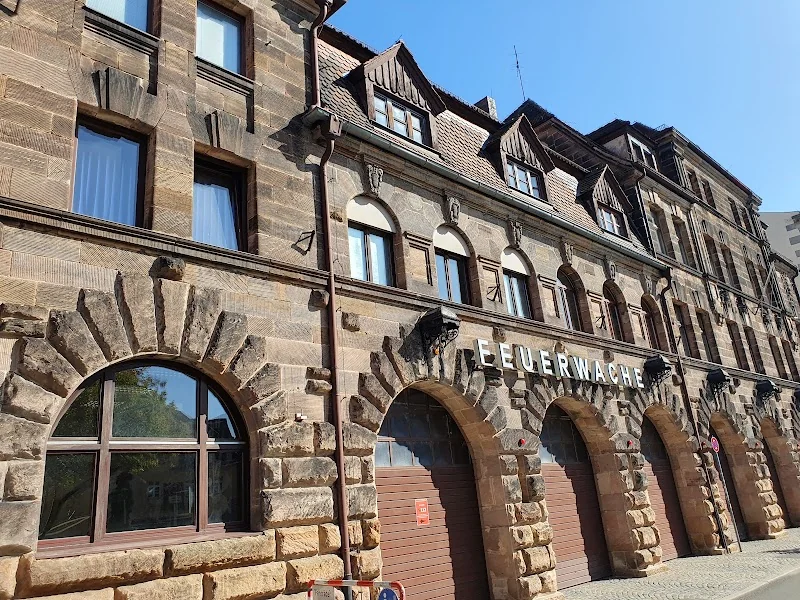
The history of the Old Fire Station begins at a time when urban safety, technical modernization, and representative architecture were closely interconnected. The building complex was inaugurated and occupied in 1908 as a new fire department headquarters; the facility then had the address Helmplatz 2. Historical reports make it clear that the building was not only designed functionally but also intended to serve as a visible sign of modern urban organization. The large exit gates made the purpose of the building recognizable from the outside. It was also important for the fire station at that time that vehicles and equipment could quickly move from the yard into the halls. The street in front of the building offered a particularly favorable exit situation for that time, which was crucial for the fire department's readiness.([fuerthwiki.de](https://www.fuerthwiki.de/wiki/index.php?title=Feuerwache))
The historical logic of the house is also evident in its design for the use of horse-drawn vehicles. Sources describe that fire department vehicles and equipment were still pulled by horses at that time, which is why stables for six horses were necessary. In addition to the vehicle hall, there was a harness room, above it hay and oats storage, as well as living and service areas for personnel and management. The facility was therefore not merely a garage for emergency vehicles but a complete workplace and living space. Over the decades, the house was remodeled and expanded several times, including in 1939 with a bomb shelter, central heating, and hose washing, as well as in 1971 with additional sleeping and teaching rooms and a radio station. The history of the Old Fire Station is thus also a story of continuous adaptation to new requirements.([fuerthwiki.de](https://www.fuerthwiki.de/wiki/index.php?title=Feuerwache))
Particularly exciting is the transitional phase of the recent past. The professional fire department Fürth permanently moved to the new station on Kapellenstraße on October 22, 2023, after the old location had been used for over 100 years. The old facility was no longer suitable for modern operations, partly due to too narrow exits, too small sleeping quarters, and too few parking spaces. At the same time, the historic building did not simply remain empty: The volunteer fire department Fürth-Stadt has been using parts of the social rooms and the vehicle hall again since May 2024. Thus, the Old Fire Station remains a functioning part of the city's safety infrastructure while its long-term cultural transformation is already being prepared. For an SEO page, this mix of history, present, and future is particularly valuable.([fuerth.de](https://www.fuerth.de/bauen-mobilitaet/aktuelle-bauprojekte/technische-infrastruktur/neue-feuerwache/?utm_source=openai))
Architecture and Spatial Structure of the Historic Building
Architecturally, the Old Fire Station is a distinctive building in the Fürth city center. In the monument description, it is described as a group building in a corner location with two- and three-story components, mansard roof, corner pavilions, and sandstone facade. The style is classified as a baroque-inspired Art Nouveau, designed by Georg Groß, dated 1908, and listed as part of the ensemble of the old town. This classification explains why the building is perceived not only as a former emergency building but also as a significant urban structure. The combination of representative facade design, functional halls, and urban corner location makes the charm of the object. It is a building that consciously connects technical practicality and urban representation.([fuerthwiki.de](https://www.fuerthwiki.de/wiki/index.php?title=Feuerwache))
The internal organization of the house was also highly functional for its time. Sources mention five building components, four of which were directly used by the fire department. On the ground floor was the fire station with an attached sleeping area, while the upper floor contained a day room, sleeping area, cloakroom, kitchen, washing room, as well as shower and bathtub. There were also apartments for supervisory staff and employees. For the fire department of that time, this made sense because daily life consisted of being on duty, readiness to respond, and immediate proximity to emergencies. The building thus early on demonstrated that fire department work consists not only of operations but also of presence, supply, and organization. For this reason, the Old Fire Station remains a credible place for uses that focus on community, public life, and exchange.([fuerthwiki.de](https://www.fuerthwiki.de/wiki/index.php?title=Feuerwache))
The later remodeling and expansion phases make the building additionally interesting. In 1939, among other things, a central heating system, a hose washing facility in the basement, and a bomb shelter were created. In 1971, new sleeping and teaching rooms, sanitary facilities, a 24-meter-high hose tower, a fixed radio station, and a lift in the yard followed. These interventions show that the house was never a static monument but a working building that continuously changed. For today's perception, this means: The Old Fire Station is neither a museum piece nor a mere ruin but a historic building with signs of use, technical layers, and a clear architectural identity. This makes it particularly attractive for future cultural or mixed-use.([fuerthwiki.de](https://www.fuerthwiki.de/wiki/index.php?title=Feuerwache))
Location, Access, and Parking in the Fürth City Center
The location of the Old Fire Station is one of its strongest arguments. It is located at Helmplatz 2 in the Fürth city center, directly at a central square that borders Königstraße. The environment is urban, dense, and historically shaped. At the same time, the site is part of an area where the city is visibly reorganizing itself. For those searching for access, parking, or a central location, this is important: The Old Fire Station is not located somewhere on the outskirts but in the middle of the urban fabric. Those who want to visit the house, photograph it, or keep an eye on the future cultural use will find a place here with short distances, good accessibility, and a clear city center profile.([fuerth.de](https://www.fuerthwiki.de/wiki/index.php?mobileaction=toggle_view_mobile&title=Helmplatz&utm_source=openai))
When parking, one should note the special location in the resident parking area. Helmplatz is designated as Zone A08 in the official resident parking documents, as are the surrounding inner-city streets such as Helmstraße and Königsplatz. This does not mean that there are no parking options, but it does mean that space is tight and regulated. For visitors, it is therefore advisable to check the city's parking information and the current occupancy of parking garages. The city of Fürth provides a central parking overview, including occupancy data for parking garages, as available. Those who want to travel stress-free should best combine the city center location with public transport, walking, or a carefully planned drive by car.([fuerth.de](https://www.fuerth.de/fileadmin/redaktion/02-Bauen-Mobilitaet/02-Dokumente-Allgemein/Bewohnerparken-Strassen-Verzeichnis-Fuerth.pdf))
From an urban planning perspective, the location is also crucial. The Old Fire Station is located in the heart of an area described by the city as part of the Pegnitz Quarter. In this environment, Helmplatz, Königstraße, the old Heinrich-Schliemann-Gymnasium, Dr.-Henry-Kissinger-Platz, the Old Eichamt, Wolfsgrubermühle, and Mühlstraße intersect. This proximity explains why the site is interesting not only as an individual building but also as a building block of a larger urban system. For inquiries such as access, city center, parking, or location, the Old Fire Station thus provides a very clear answer: central, historical, pedestrian-friendly, and in an area where urban development is becoming visible.([fuerth.de](https://www.fuerth.de/bauen-mobilitaet/aktuelle-bauprojekte/strassen-wege-bruecken-plaetze/pegnitzquartier/))
Repurposing, art gallery Fürth, and cultural perspectives
The most important future question for the Old Fire Station is: What happens after the fire department's use? There are already very concrete answers from the city. In a resolution proposal, the Old Fire Station is described as an opportunity for a cultural flagship project. A house of participation for all citizens of Fürth is planned. The ground floor is to feature an attractive entrance area, an open meeting point, fair and sustainable gastronomy, and the premises of the art gallery Fürth. This perspective is crucial for the visibility of the house because it transforms a technical functional building into an open place for public life, art, and encounters.([stadtrat.fuerth.de](https://stadtrat.fuerth.de/getfile.asp?id=4241246&type=do))
The role of the art gallery Fürth is particularly important. The city describes the gallery as a municipal gallery for contemporary art with changing exhibitions, artist talks, lectures, and educational offerings. In the planned use of the Old Fire Station, the spatial situation of the gallery is expected to improve significantly, especially regarding perception, reception of art, quality of stay, and opportunities for encounters. At the same time, the integration of exhibition spaces and art education offerings will enable contemporary standards. For location communication, this means: The Old Fire Station is not only historically interesting but can also become a true cultural anchor in the inner-city area that connects exhibitions, exchange, and the local scene.([fuerth.de](https://www.fuerth.de/service-fuerther-rathaus/aemter-von-a-bis-z/detail/kunst-galerie-fuerth-staedtische-galerie-312581/?utm_source=openai))
Furthermore, the city sees more in the repurposing than just a single cultural offering. A cooperation between independent initiatives, the free art and cultural scene, and the municipal departments is mentioned. A future and creative center is also described, which is intended to bridge gaps between different population groups as a socio-cultural space. This will include open workshops, participatory offerings, and various access points for citizens. For SEO content, this is a strong signal: Keywords such as repurposing, cultural site, art gallery, or creative center are not just buzzwords here but reflect a real, politically prepared development. The Old Fire Station is therefore very likely not to be marketed as a mere event shell but as a place with a public claim and social added value.([stadtrat.fuerth.de](https://stadtrat.fuerth.de/getfile.asp?id=4241246&type=do))
Pegnitz Quarter and the transformation around Helmplatz and Königstraße
The Old Fire Station is part of a larger area of change that the city describes as the Pegnitz Quarter. The official project description states that the area between the old Heinrich-Schliemann-Gymnasium, Dr.-Henry-Kissinger-Platz, the Old Fire Station, the Old Eichamt, Helmplatz, Wolfsgrubermühle, Mühlstraße, and Königsplatz is undergoing structural change. An urban planning competition is intended to create the foundations for the redesign of public space. This is crucial for the classification of the building because the Old Fire Station should not be viewed in isolation but as part of a comprehensive urban reorganization with high relevance for stay and design.([fuerth.de](https://www.fuerth.de/bauen-mobilitaet/aktuelle-bauprojekte/strassen-wege-bruecken-plaetze/pegnitzquartier/))
This context also explains why the Old Fire Station is regularly mentioned in current planning documents together with other neighborhood components. The city and various planning documents refer to a lively and popular urban area where new connections, edge spaces, and usage blocks are to be created. In this environment, the Old Fire Station has a dual function: on the one hand, it is a historical testimony, and on the other hand, it is a potential driver for activating public space. When art, gastronomy, encounters, and creative offerings move in later, it will not only enhance the property itself but also rejuvenate the entire area between Helmplatz, Königstraße, and Pegnitz. This is exactly why the object is so relevant for inquiries about city center development, culture, and neighborhood transformation.([fuerth.de](https://www.fuerth.de/fileadmin/redaktion/02-Bauen-Mobilitaet/Projekte/Dokumente/Pegnitzquartier/Pegnitzquartier-Landschaftsarchitekt-Tautorat.pdf?utm_source=openai))
For visitors and city enthusiasts, the Pegnitz Quarter is also a good argument to broaden the view beyond the individual house. Those who want to see the Old Fire Station experience not only a building but also an urban transition: historical old town structure, former fire department use, new cultural perspective, and public space planning come together here directly. This significantly increases the experience value of the location. Instead of a closed institution, a connected place emerges that is thought together with paths, squares, neighboring buildings, and future uses. Thus, the Old Fire Station fits excellently with search intentions around city history, cultural site, city center, and modern neighborhood development.([fuerth.de](https://www.fuerth.de/bauen-mobilitaet/aktuelle-bauprojekte/strassen-wege-bruecken-plaetze/pegnitzquartier/))
What visitors should know about the Old Fire Station
Important for any description of the Old Fire Station is the current reality on-site. The building is historically significant and highly interesting from a planning perspective, but it is not automatically open as a classic event location in full operation. Part of the facility is still used by the volunteer fire department Fürth-Stadt, while the cultural repurposing is in planning and implementation. Therefore, one should understand the house more as a place of transition: visible, relevant, in motion, and full of potential. For users looking for programs, tickets, or room plans, this is an important note, as this information is currently not comparable to an established event venue.([fuerthwiki.de](https://www.fuerthwiki.de/wiki/index.php?title=Feuerwache))
For practical orientation, the classification in the urban space is particularly helpful. The Old Fire Station is located in the inner-city area, in direct proximity to other cultural and urban planning reference points. This makes it ideal for walks, photo opportunities, and observing ongoing urban changes. Those following the development should also pay attention to the city's project pages regarding the new fire station, the Pegnitz Quarter, and the repurposing. There, it becomes visible how the city of Fürth wants to connect the historic stock with new functions. Especially at a time when city centers should be more than just commercial places, the Old Fire Station is a good example of the connection between memory, public use, and cultural future.([fuerth.de](https://www.fuerth.de/bauen-mobilitaet/aktuelle-bauprojekte/technische-infrastruktur/neue-feuerwache/?utm_source=openai))
From an SEO perspective, this results in a clear positioning. The strongest search topics are history, location, access, parking, repurposing, and art. Additionally, terms like Helmplatz 2, Pegnitz Quarter, and city center Fürth come into play. Connecting these topics cleanly reflects the real use and the political development of the place without exaggeration. That is why the Old Fire Station Fürth is suitable for a factual yet emotional location text: The house tells of 1908, of fire department history, of transformation, and of a future cultural site in the heart of the city.([fuerthwiki.de](https://www.fuerthwiki.de/wiki/index.php?title=Feuerwache))
Sources:
Mehr anzeigenWeniger anzeigen
Old Fire Station Fürth | History & Parking
The Old Fire Station Fürth at Helmplatz 2 is a place where city history, architecture, and future cultural planning directly overlap. Today, those searching for this location find not only a historic building in a prime city center location but also a site that has been closely linked to the development of Fürth for over a century. The building was opened in 1908 as a fire department headquarters, situated at the edge of a technical and urban breakthrough and designed for the demands of a completely different mobility. Today, the house stands on a threshold between past and future: parts are still in use, while the cultural repurposing is already politically and planning-wise prepared. Thus, the Old Fire Station is not an ordinary event venue but a building with identity, memory, and great potential.([fuerth.de](https://www.fuerth.de/bauen-mobilitaet/aktuelle-bauprojekte/technische-infrastruktur/neue-feuerwache/?utm_source=openai))
History of the Old Fire Station Fürth at Helmplatz
The history of the Old Fire Station begins at a time when urban safety, technical modernization, and representative architecture were closely interconnected. The building complex was inaugurated and occupied in 1908 as a new fire department headquarters; the facility then had the address Helmplatz 2. Historical reports make it clear that the building was not only designed functionally but also intended to serve as a visible sign of modern urban organization. The large exit gates made the purpose of the building recognizable from the outside. It was also important for the fire station at that time that vehicles and equipment could quickly move from the yard into the halls. The street in front of the building offered a particularly favorable exit situation for that time, which was crucial for the fire department's readiness.([fuerthwiki.de](https://www.fuerthwiki.de/wiki/index.php?title=Feuerwache))
The historical logic of the house is also evident in its design for the use of horse-drawn vehicles. Sources describe that fire department vehicles and equipment were still pulled by horses at that time, which is why stables for six horses were necessary. In addition to the vehicle hall, there was a harness room, above it hay and oats storage, as well as living and service areas for personnel and management. The facility was therefore not merely a garage for emergency vehicles but a complete workplace and living space. Over the decades, the house was remodeled and expanded several times, including in 1939 with a bomb shelter, central heating, and hose washing, as well as in 1971 with additional sleeping and teaching rooms and a radio station. The history of the Old Fire Station is thus also a story of continuous adaptation to new requirements.([fuerthwiki.de](https://www.fuerthwiki.de/wiki/index.php?title=Feuerwache))
Particularly exciting is the transitional phase of the recent past. The professional fire department Fürth permanently moved to the new station on Kapellenstraße on October 22, 2023, after the old location had been used for over 100 years. The old facility was no longer suitable for modern operations, partly due to too narrow exits, too small sleeping quarters, and too few parking spaces. At the same time, the historic building did not simply remain empty: The volunteer fire department Fürth-Stadt has been using parts of the social rooms and the vehicle hall again since May 2024. Thus, the Old Fire Station remains a functioning part of the city's safety infrastructure while its long-term cultural transformation is already being prepared. For an SEO page, this mix of history, present, and future is particularly valuable.([fuerth.de](https://www.fuerth.de/bauen-mobilitaet/aktuelle-bauprojekte/technische-infrastruktur/neue-feuerwache/?utm_source=openai))
Architecture and Spatial Structure of the Historic Building
Architecturally, the Old Fire Station is a distinctive building in the Fürth city center. In the monument description, it is described as a group building in a corner location with two- and three-story components, mansard roof, corner pavilions, and sandstone facade. The style is classified as a baroque-inspired Art Nouveau, designed by Georg Groß, dated 1908, and listed as part of the ensemble of the old town. This classification explains why the building is perceived not only as a former emergency building but also as a significant urban structure. The combination of representative facade design, functional halls, and urban corner location makes the charm of the object. It is a building that consciously connects technical practicality and urban representation.([fuerthwiki.de](https://www.fuerthwiki.de/wiki/index.php?title=Feuerwache))
The internal organization of the house was also highly functional for its time. Sources mention five building components, four of which were directly used by the fire department. On the ground floor was the fire station with an attached sleeping area, while the upper floor contained a day room, sleeping area, cloakroom, kitchen, washing room, as well as shower and bathtub. There were also apartments for supervisory staff and employees. For the fire department of that time, this made sense because daily life consisted of being on duty, readiness to respond, and immediate proximity to emergencies. The building thus early on demonstrated that fire department work consists not only of operations but also of presence, supply, and organization. For this reason, the Old Fire Station remains a credible place for uses that focus on community, public life, and exchange.([fuerthwiki.de](https://www.fuerthwiki.de/wiki/index.php?title=Feuerwache))
The later remodeling and expansion phases make the building additionally interesting. In 1939, among other things, a central heating system, a hose washing facility in the basement, and a bomb shelter were created. In 1971, new sleeping and teaching rooms, sanitary facilities, a 24-meter-high hose tower, a fixed radio station, and a lift in the yard followed. These interventions show that the house was never a static monument but a working building that continuously changed. For today's perception, this means: The Old Fire Station is neither a museum piece nor a mere ruin but a historic building with signs of use, technical layers, and a clear architectural identity. This makes it particularly attractive for future cultural or mixed-use.([fuerthwiki.de](https://www.fuerthwiki.de/wiki/index.php?title=Feuerwache))
Location, Access, and Parking in the Fürth City Center
The location of the Old Fire Station is one of its strongest arguments. It is located at Helmplatz 2 in the Fürth city center, directly at a central square that borders Königstraße. The environment is urban, dense, and historically shaped. At the same time, the site is part of an area where the city is visibly reorganizing itself. For those searching for access, parking, or a central location, this is important: The Old Fire Station is not located somewhere on the outskirts but in the middle of the urban fabric. Those who want to visit the house, photograph it, or keep an eye on the future cultural use will find a place here with short distances, good accessibility, and a clear city center profile.([fuerth.de](https://www.fuerthwiki.de/wiki/index.php?mobileaction=toggle_view_mobile&title=Helmplatz&utm_source=openai))
When parking, one should note the special location in the resident parking area. Helmplatz is designated as Zone A08 in the official resident parking documents, as are the surrounding inner-city streets such as Helmstraße and Königsplatz. This does not mean that there are no parking options, but it does mean that space is tight and regulated. For visitors, it is therefore advisable to check the city's parking information and the current occupancy of parking garages. The city of Fürth provides a central parking overview, including occupancy data for parking garages, as available. Those who want to travel stress-free should best combine the city center location with public transport, walking, or a carefully planned drive by car.([fuerth.de](https://www.fuerth.de/fileadmin/redaktion/02-Bauen-Mobilitaet/02-Dokumente-Allgemein/Bewohnerparken-Strassen-Verzeichnis-Fuerth.pdf))
From an urban planning perspective, the location is also crucial. The Old Fire Station is located in the heart of an area described by the city as part of the Pegnitz Quarter. In this environment, Helmplatz, Königstraße, the old Heinrich-Schliemann-Gymnasium, Dr.-Henry-Kissinger-Platz, the Old Eichamt, Wolfsgrubermühle, and Mühlstraße intersect. This proximity explains why the site is interesting not only as an individual building but also as a building block of a larger urban system. For inquiries such as access, city center, parking, or location, the Old Fire Station thus provides a very clear answer: central, historical, pedestrian-friendly, and in an area where urban development is becoming visible.([fuerth.de](https://www.fuerth.de/bauen-mobilitaet/aktuelle-bauprojekte/strassen-wege-bruecken-plaetze/pegnitzquartier/))
Repurposing, art gallery Fürth, and cultural perspectives
The most important future question for the Old Fire Station is: What happens after the fire department's use? There are already very concrete answers from the city. In a resolution proposal, the Old Fire Station is described as an opportunity for a cultural flagship project. A house of participation for all citizens of Fürth is planned. The ground floor is to feature an attractive entrance area, an open meeting point, fair and sustainable gastronomy, and the premises of the art gallery Fürth. This perspective is crucial for the visibility of the house because it transforms a technical functional building into an open place for public life, art, and encounters.([stadtrat.fuerth.de](https://stadtrat.fuerth.de/getfile.asp?id=4241246&type=do))
The role of the art gallery Fürth is particularly important. The city describes the gallery as a municipal gallery for contemporary art with changing exhibitions, artist talks, lectures, and educational offerings. In the planned use of the Old Fire Station, the spatial situation of the gallery is expected to improve significantly, especially regarding perception, reception of art, quality of stay, and opportunities for encounters. At the same time, the integration of exhibition spaces and art education offerings will enable contemporary standards. For location communication, this means: The Old Fire Station is not only historically interesting but can also become a true cultural anchor in the inner-city area that connects exhibitions, exchange, and the local scene.([fuerth.de](https://www.fuerth.de/service-fuerther-rathaus/aemter-von-a-bis-z/detail/kunst-galerie-fuerth-staedtische-galerie-312581/?utm_source=openai))
Furthermore, the city sees more in the repurposing than just a single cultural offering. A cooperation between independent initiatives, the free art and cultural scene, and the municipal departments is mentioned. A future and creative center is also described, which is intended to bridge gaps between different population groups as a socio-cultural space. This will include open workshops, participatory offerings, and various access points for citizens. For SEO content, this is a strong signal: Keywords such as repurposing, cultural site, art gallery, or creative center are not just buzzwords here but reflect a real, politically prepared development. The Old Fire Station is therefore very likely not to be marketed as a mere event shell but as a place with a public claim and social added value.([stadtrat.fuerth.de](https://stadtrat.fuerth.de/getfile.asp?id=4241246&type=do))
Pegnitz Quarter and the transformation around Helmplatz and Königstraße
The Old Fire Station is part of a larger area of change that the city describes as the Pegnitz Quarter. The official project description states that the area between the old Heinrich-Schliemann-Gymnasium, Dr.-Henry-Kissinger-Platz, the Old Fire Station, the Old Eichamt, Helmplatz, Wolfsgrubermühle, Mühlstraße, and Königsplatz is undergoing structural change. An urban planning competition is intended to create the foundations for the redesign of public space. This is crucial for the classification of the building because the Old Fire Station should not be viewed in isolation but as part of a comprehensive urban reorganization with high relevance for stay and design.([fuerth.de](https://www.fuerth.de/bauen-mobilitaet/aktuelle-bauprojekte/strassen-wege-bruecken-plaetze/pegnitzquartier/))
This context also explains why the Old Fire Station is regularly mentioned in current planning documents together with other neighborhood components. The city and various planning documents refer to a lively and popular urban area where new connections, edge spaces, and usage blocks are to be created. In this environment, the Old Fire Station has a dual function: on the one hand, it is a historical testimony, and on the other hand, it is a potential driver for activating public space. When art, gastronomy, encounters, and creative offerings move in later, it will not only enhance the property itself but also rejuvenate the entire area between Helmplatz, Königstraße, and Pegnitz. This is exactly why the object is so relevant for inquiries about city center development, culture, and neighborhood transformation.([fuerth.de](https://www.fuerth.de/fileadmin/redaktion/02-Bauen-Mobilitaet/Projekte/Dokumente/Pegnitzquartier/Pegnitzquartier-Landschaftsarchitekt-Tautorat.pdf?utm_source=openai))
For visitors and city enthusiasts, the Pegnitz Quarter is also a good argument to broaden the view beyond the individual house. Those who want to see the Old Fire Station experience not only a building but also an urban transition: historical old town structure, former fire department use, new cultural perspective, and public space planning come together here directly. This significantly increases the experience value of the location. Instead of a closed institution, a connected place emerges that is thought together with paths, squares, neighboring buildings, and future uses. Thus, the Old Fire Station fits excellently with search intentions around city history, cultural site, city center, and modern neighborhood development.([fuerth.de](https://www.fuerth.de/bauen-mobilitaet/aktuelle-bauprojekte/strassen-wege-bruecken-plaetze/pegnitzquartier/))
What visitors should know about the Old Fire Station
Important for any description of the Old Fire Station is the current reality on-site. The building is historically significant and highly interesting from a planning perspective, but it is not automatically open as a classic event location in full operation. Part of the facility is still used by the volunteer fire department Fürth-Stadt, while the cultural repurposing is in planning and implementation. Therefore, one should understand the house more as a place of transition: visible, relevant, in motion, and full of potential. For users looking for programs, tickets, or room plans, this is an important note, as this information is currently not comparable to an established event venue.([fuerthwiki.de](https://www.fuerthwiki.de/wiki/index.php?title=Feuerwache))
For practical orientation, the classification in the urban space is particularly helpful. The Old Fire Station is located in the inner-city area, in direct proximity to other cultural and urban planning reference points. This makes it ideal for walks, photo opportunities, and observing ongoing urban changes. Those following the development should also pay attention to the city's project pages regarding the new fire station, the Pegnitz Quarter, and the repurposing. There, it becomes visible how the city of Fürth wants to connect the historic stock with new functions. Especially at a time when city centers should be more than just commercial places, the Old Fire Station is a good example of the connection between memory, public use, and cultural future.([fuerth.de](https://www.fuerth.de/bauen-mobilitaet/aktuelle-bauprojekte/technische-infrastruktur/neue-feuerwache/?utm_source=openai))
From an SEO perspective, this results in a clear positioning. The strongest search topics are history, location, access, parking, repurposing, and art. Additionally, terms like Helmplatz 2, Pegnitz Quarter, and city center Fürth come into play. Connecting these topics cleanly reflects the real use and the political development of the place without exaggeration. That is why the Old Fire Station Fürth is suitable for a factual yet emotional location text: The house tells of 1908, of fire department history, of transformation, and of a future cultural site in the heart of the city.([fuerthwiki.de](https://www.fuerthwiki.de/wiki/index.php?title=Feuerwache))
Sources:
Old Fire Station Fürth | History & Parking
The Old Fire Station Fürth at Helmplatz 2 is a place where city history, architecture, and future cultural planning directly overlap. Today, those searching for this location find not only a historic building in a prime city center location but also a site that has been closely linked to the development of Fürth for over a century. The building was opened in 1908 as a fire department headquarters, situated at the edge of a technical and urban breakthrough and designed for the demands of a completely different mobility. Today, the house stands on a threshold between past and future: parts are still in use, while the cultural repurposing is already politically and planning-wise prepared. Thus, the Old Fire Station is not an ordinary event venue but a building with identity, memory, and great potential.([fuerth.de](https://www.fuerth.de/bauen-mobilitaet/aktuelle-bauprojekte/technische-infrastruktur/neue-feuerwache/?utm_source=openai))
History of the Old Fire Station Fürth at Helmplatz
The history of the Old Fire Station begins at a time when urban safety, technical modernization, and representative architecture were closely interconnected. The building complex was inaugurated and occupied in 1908 as a new fire department headquarters; the facility then had the address Helmplatz 2. Historical reports make it clear that the building was not only designed functionally but also intended to serve as a visible sign of modern urban organization. The large exit gates made the purpose of the building recognizable from the outside. It was also important for the fire station at that time that vehicles and equipment could quickly move from the yard into the halls. The street in front of the building offered a particularly favorable exit situation for that time, which was crucial for the fire department's readiness.([fuerthwiki.de](https://www.fuerthwiki.de/wiki/index.php?title=Feuerwache))
The historical logic of the house is also evident in its design for the use of horse-drawn vehicles. Sources describe that fire department vehicles and equipment were still pulled by horses at that time, which is why stables for six horses were necessary. In addition to the vehicle hall, there was a harness room, above it hay and oats storage, as well as living and service areas for personnel and management. The facility was therefore not merely a garage for emergency vehicles but a complete workplace and living space. Over the decades, the house was remodeled and expanded several times, including in 1939 with a bomb shelter, central heating, and hose washing, as well as in 1971 with additional sleeping and teaching rooms and a radio station. The history of the Old Fire Station is thus also a story of continuous adaptation to new requirements.([fuerthwiki.de](https://www.fuerthwiki.de/wiki/index.php?title=Feuerwache))
Particularly exciting is the transitional phase of the recent past. The professional fire department Fürth permanently moved to the new station on Kapellenstraße on October 22, 2023, after the old location had been used for over 100 years. The old facility was no longer suitable for modern operations, partly due to too narrow exits, too small sleeping quarters, and too few parking spaces. At the same time, the historic building did not simply remain empty: The volunteer fire department Fürth-Stadt has been using parts of the social rooms and the vehicle hall again since May 2024. Thus, the Old Fire Station remains a functioning part of the city's safety infrastructure while its long-term cultural transformation is already being prepared. For an SEO page, this mix of history, present, and future is particularly valuable.([fuerth.de](https://www.fuerth.de/bauen-mobilitaet/aktuelle-bauprojekte/technische-infrastruktur/neue-feuerwache/?utm_source=openai))
Architecture and Spatial Structure of the Historic Building
Architecturally, the Old Fire Station is a distinctive building in the Fürth city center. In the monument description, it is described as a group building in a corner location with two- and three-story components, mansard roof, corner pavilions, and sandstone facade. The style is classified as a baroque-inspired Art Nouveau, designed by Georg Groß, dated 1908, and listed as part of the ensemble of the old town. This classification explains why the building is perceived not only as a former emergency building but also as a significant urban structure. The combination of representative facade design, functional halls, and urban corner location makes the charm of the object. It is a building that consciously connects technical practicality and urban representation.([fuerthwiki.de](https://www.fuerthwiki.de/wiki/index.php?title=Feuerwache))
The internal organization of the house was also highly functional for its time. Sources mention five building components, four of which were directly used by the fire department. On the ground floor was the fire station with an attached sleeping area, while the upper floor contained a day room, sleeping area, cloakroom, kitchen, washing room, as well as shower and bathtub. There were also apartments for supervisory staff and employees. For the fire department of that time, this made sense because daily life consisted of being on duty, readiness to respond, and immediate proximity to emergencies. The building thus early on demonstrated that fire department work consists not only of operations but also of presence, supply, and organization. For this reason, the Old Fire Station remains a credible place for uses that focus on community, public life, and exchange.([fuerthwiki.de](https://www.fuerthwiki.de/wiki/index.php?title=Feuerwache))
The later remodeling and expansion phases make the building additionally interesting. In 1939, among other things, a central heating system, a hose washing facility in the basement, and a bomb shelter were created. In 1971, new sleeping and teaching rooms, sanitary facilities, a 24-meter-high hose tower, a fixed radio station, and a lift in the yard followed. These interventions show that the house was never a static monument but a working building that continuously changed. For today's perception, this means: The Old Fire Station is neither a museum piece nor a mere ruin but a historic building with signs of use, technical layers, and a clear architectural identity. This makes it particularly attractive for future cultural or mixed-use.([fuerthwiki.de](https://www.fuerthwiki.de/wiki/index.php?title=Feuerwache))
Location, Access, and Parking in the Fürth City Center
The location of the Old Fire Station is one of its strongest arguments. It is located at Helmplatz 2 in the Fürth city center, directly at a central square that borders Königstraße. The environment is urban, dense, and historically shaped. At the same time, the site is part of an area where the city is visibly reorganizing itself. For those searching for access, parking, or a central location, this is important: The Old Fire Station is not located somewhere on the outskirts but in the middle of the urban fabric. Those who want to visit the house, photograph it, or keep an eye on the future cultural use will find a place here with short distances, good accessibility, and a clear city center profile.([fuerth.de](https://www.fuerthwiki.de/wiki/index.php?mobileaction=toggle_view_mobile&title=Helmplatz&utm_source=openai))
When parking, one should note the special location in the resident parking area. Helmplatz is designated as Zone A08 in the official resident parking documents, as are the surrounding inner-city streets such as Helmstraße and Königsplatz. This does not mean that there are no parking options, but it does mean that space is tight and regulated. For visitors, it is therefore advisable to check the city's parking information and the current occupancy of parking garages. The city of Fürth provides a central parking overview, including occupancy data for parking garages, as available. Those who want to travel stress-free should best combine the city center location with public transport, walking, or a carefully planned drive by car.([fuerth.de](https://www.fuerth.de/fileadmin/redaktion/02-Bauen-Mobilitaet/02-Dokumente-Allgemein/Bewohnerparken-Strassen-Verzeichnis-Fuerth.pdf))
From an urban planning perspective, the location is also crucial. The Old Fire Station is located in the heart of an area described by the city as part of the Pegnitz Quarter. In this environment, Helmplatz, Königstraße, the old Heinrich-Schliemann-Gymnasium, Dr.-Henry-Kissinger-Platz, the Old Eichamt, Wolfsgrubermühle, and Mühlstraße intersect. This proximity explains why the site is interesting not only as an individual building but also as a building block of a larger urban system. For inquiries such as access, city center, parking, or location, the Old Fire Station thus provides a very clear answer: central, historical, pedestrian-friendly, and in an area where urban development is becoming visible.([fuerth.de](https://www.fuerth.de/bauen-mobilitaet/aktuelle-bauprojekte/strassen-wege-bruecken-plaetze/pegnitzquartier/))
Repurposing, art gallery Fürth, and cultural perspectives
The most important future question for the Old Fire Station is: What happens after the fire department's use? There are already very concrete answers from the city. In a resolution proposal, the Old Fire Station is described as an opportunity for a cultural flagship project. A house of participation for all citizens of Fürth is planned. The ground floor is to feature an attractive entrance area, an open meeting point, fair and sustainable gastronomy, and the premises of the art gallery Fürth. This perspective is crucial for the visibility of the house because it transforms a technical functional building into an open place for public life, art, and encounters.([stadtrat.fuerth.de](https://stadtrat.fuerth.de/getfile.asp?id=4241246&type=do))
The role of the art gallery Fürth is particularly important. The city describes the gallery as a municipal gallery for contemporary art with changing exhibitions, artist talks, lectures, and educational offerings. In the planned use of the Old Fire Station, the spatial situation of the gallery is expected to improve significantly, especially regarding perception, reception of art, quality of stay, and opportunities for encounters. At the same time, the integration of exhibition spaces and art education offerings will enable contemporary standards. For location communication, this means: The Old Fire Station is not only historically interesting but can also become a true cultural anchor in the inner-city area that connects exhibitions, exchange, and the local scene.([fuerth.de](https://www.fuerth.de/service-fuerther-rathaus/aemter-von-a-bis-z/detail/kunst-galerie-fuerth-staedtische-galerie-312581/?utm_source=openai))
Furthermore, the city sees more in the repurposing than just a single cultural offering. A cooperation between independent initiatives, the free art and cultural scene, and the municipal departments is mentioned. A future and creative center is also described, which is intended to bridge gaps between different population groups as a socio-cultural space. This will include open workshops, participatory offerings, and various access points for citizens. For SEO content, this is a strong signal: Keywords such as repurposing, cultural site, art gallery, or creative center are not just buzzwords here but reflect a real, politically prepared development. The Old Fire Station is therefore very likely not to be marketed as a mere event shell but as a place with a public claim and social added value.([stadtrat.fuerth.de](https://stadtrat.fuerth.de/getfile.asp?id=4241246&type=do))
Pegnitz Quarter and the transformation around Helmplatz and Königstraße
The Old Fire Station is part of a larger area of change that the city describes as the Pegnitz Quarter. The official project description states that the area between the old Heinrich-Schliemann-Gymnasium, Dr.-Henry-Kissinger-Platz, the Old Fire Station, the Old Eichamt, Helmplatz, Wolfsgrubermühle, Mühlstraße, and Königsplatz is undergoing structural change. An urban planning competition is intended to create the foundations for the redesign of public space. This is crucial for the classification of the building because the Old Fire Station should not be viewed in isolation but as part of a comprehensive urban reorganization with high relevance for stay and design.([fuerth.de](https://www.fuerth.de/bauen-mobilitaet/aktuelle-bauprojekte/strassen-wege-bruecken-plaetze/pegnitzquartier/))
This context also explains why the Old Fire Station is regularly mentioned in current planning documents together with other neighborhood components. The city and various planning documents refer to a lively and popular urban area where new connections, edge spaces, and usage blocks are to be created. In this environment, the Old Fire Station has a dual function: on the one hand, it is a historical testimony, and on the other hand, it is a potential driver for activating public space. When art, gastronomy, encounters, and creative offerings move in later, it will not only enhance the property itself but also rejuvenate the entire area between Helmplatz, Königstraße, and Pegnitz. This is exactly why the object is so relevant for inquiries about city center development, culture, and neighborhood transformation.([fuerth.de](https://www.fuerth.de/fileadmin/redaktion/02-Bauen-Mobilitaet/Projekte/Dokumente/Pegnitzquartier/Pegnitzquartier-Landschaftsarchitekt-Tautorat.pdf?utm_source=openai))
For visitors and city enthusiasts, the Pegnitz Quarter is also a good argument to broaden the view beyond the individual house. Those who want to see the Old Fire Station experience not only a building but also an urban transition: historical old town structure, former fire department use, new cultural perspective, and public space planning come together here directly. This significantly increases the experience value of the location. Instead of a closed institution, a connected place emerges that is thought together with paths, squares, neighboring buildings, and future uses. Thus, the Old Fire Station fits excellently with search intentions around city history, cultural site, city center, and modern neighborhood development.([fuerth.de](https://www.fuerth.de/bauen-mobilitaet/aktuelle-bauprojekte/strassen-wege-bruecken-plaetze/pegnitzquartier/))
What visitors should know about the Old Fire Station
Important for any description of the Old Fire Station is the current reality on-site. The building is historically significant and highly interesting from a planning perspective, but it is not automatically open as a classic event location in full operation. Part of the facility is still used by the volunteer fire department Fürth-Stadt, while the cultural repurposing is in planning and implementation. Therefore, one should understand the house more as a place of transition: visible, relevant, in motion, and full of potential. For users looking for programs, tickets, or room plans, this is an important note, as this information is currently not comparable to an established event venue.([fuerthwiki.de](https://www.fuerthwiki.de/wiki/index.php?title=Feuerwache))
For practical orientation, the classification in the urban space is particularly helpful. The Old Fire Station is located in the inner-city area, in direct proximity to other cultural and urban planning reference points. This makes it ideal for walks, photo opportunities, and observing ongoing urban changes. Those following the development should also pay attention to the city's project pages regarding the new fire station, the Pegnitz Quarter, and the repurposing. There, it becomes visible how the city of Fürth wants to connect the historic stock with new functions. Especially at a time when city centers should be more than just commercial places, the Old Fire Station is a good example of the connection between memory, public use, and cultural future.([fuerth.de](https://www.fuerth.de/bauen-mobilitaet/aktuelle-bauprojekte/technische-infrastruktur/neue-feuerwache/?utm_source=openai))
From an SEO perspective, this results in a clear positioning. The strongest search topics are history, location, access, parking, repurposing, and art. Additionally, terms like Helmplatz 2, Pegnitz Quarter, and city center Fürth come into play. Connecting these topics cleanly reflects the real use and the political development of the place without exaggeration. That is why the Old Fire Station Fürth is suitable for a factual yet emotional location text: The house tells of 1908, of fire department history, of transformation, and of a future cultural site in the heart of the city.([fuerthwiki.de](https://www.fuerthwiki.de/wiki/index.php?title=Feuerwache))
Sources:
Frequently Asked Questions
Reviews
No reviews found