
Bickram Ghosh
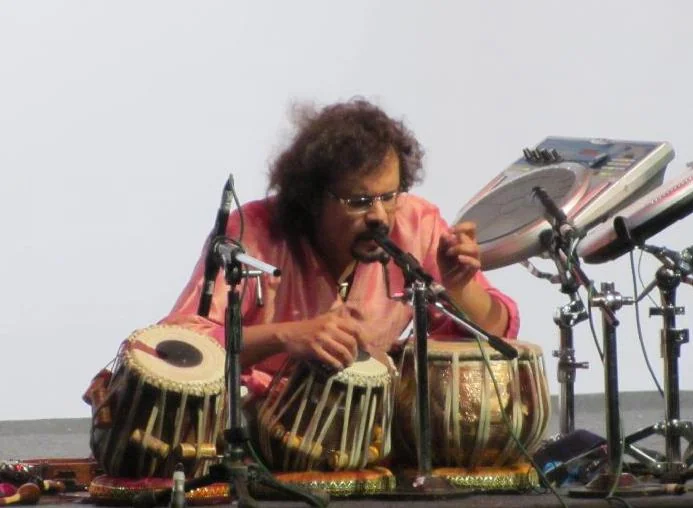
Image from Wikipedia
Image from Wikipedia
Bickram Ghosh: The Tabla Visionary Between Indian Classical, Fusion, and Film Music
An artist portrait of one of India's most influential rhythm innovators
Bickram Ghosh, born on October 20, 1966, in Kolkata, is one of the most versatile musicians of contemporary India. As a tabla player, composer, fusion pioneer, and film composer, he has forged an artistic position over decades that is rooted in classical tradition while also reaching far into modernity. His career encompasses concert stages, studio work, international collaborations, and an extraordinary range of styles. ([de.wikipedia.org](https://de.wikipedia.org/wiki/Bickram_Ghosh?utm_source=openai))
Biographical Roots and Musical Influence
Bickram Ghosh's musical heritage is closely tied to a tradition-rich family. He is the son of the renowned tabla master Shankar Ghosh and the singer Sanjukta Ghosh; he also learned the nuances of Carnatic percussion from S. Sekhar. This dual grounding in North Indian and South Indian rhythmic culture forms the core of his later artistic development. ([de.wikipedia.org](https://de.wikipedia.org/wiki/Bickram_Ghosh?utm_source=openai))
His education and environment laid the foundation for a music career that cannot be reduced to mere virtuosity. Ghosh was recognized early on as an accompanying musician and soloist but soon developed his own distinct style. Particularly formative was his collaboration with Pandit Ravi Shankar, with whom he played for over a decade. This connection anchored him deeply in the canon of classical Indian music. ([de.wikipedia.org](https://de.wikipedia.org/wiki/Bickram_Ghosh?utm_source=openai))
The Journey from Accompanist to Independent Sound Architect
In his early career, Ghosh moved in the highest circles of Indian classical music, collaborating with great names such as Ali Akbar Khan, Amjad Ali Khan, and Shivkumar Sharma. At the same time, he developed a profile that set him apart from many purely accompanying musicians: he became an artist who understands rhythm not just as support but as a narrative center. This is a significant part of his authority as a musician. ([de.wikipedia.org](https://de.wikipedia.org/wiki/Bickram_Ghosh?utm_source=openai))
With the album Rhythmscapes released in 2002, Ghosh marked a milestone. The work led to the founding of the band of the same name and established him as a defining figure in the Indian fusion scene. The official biography describes this project as one of the most successful fusion formats in the country; subsequent solo albums further solidified his reputation as a renewer between tradition and experimentation. ([bickramghosh.com](https://www.bickramghosh.com/biography.php?utm_source=openai))
Fusion, Stage, and International Presence
Bickram Ghosh represents a form of fusion music that respects classical grammar while not compromising on sonic movement. His performances in prestigious venues such as the Royal Albert Hall, Carnegie Hall, Kennedy Center, and other international houses highlight the global reach of his art. At the same time, his stage presence is closely tied to major Indian events, including the 2010 Commonwealth Games finale and a UNESCO tribute to Rabindranath Tagore in 2012. ([bickramghosh.com](https://www.bickramghosh.com/biography.php?utm_source=openai))
His work in the live context illustrates how consistently he has expanded the tabla part. For him, rhythm becomes a dramatic language, an organism of tension, accent, and movement. This sets his music career apart from many classical careers, making him an artist who translates traditional forms into a contemporary concert context. ([bickramghosh.com](https://www.bickramghosh.com/biography.php?utm_source=openai))
Film Composition and the Expansion of Artistic Spectrum
Alongside his concert career, Ghosh developed into a successful film composer. According to his official biography, he has composed for 54 feature films, 42 in Bengali and 12 in Hindi. A significant milestone was JAL, which earned him an Oscar contender status for Original Music; other accolades include several Filmfare and Global Music Awards. ([bickramghosh.com](https://www.bickramghosh.com/biography.php?utm_source=openai))
This filmography showcases an artistic evolution that goes far beyond being merely an instrumentalist. Ghosh thinks in terms of dramaturgy, mood, and texture—categories that are essential for composition and arrangement in film. His music combines melodic accessibility with rhythmic complexity, creating a sound that works in both popular and elevated contexts. ([bickramghosh.com](https://www.bickramghosh.com/biography.php?utm_source=openai))
Discography, Key Albums, and Artistic Signature
Bickram Ghosh's discography is extensive and reflects his versatility. His official website lists titles such as Samaa, Beyond Rhythmscape, Interface, White Note, Electro Classical, Paperboats, Ishq, Maya, Tagore Lounge, Fusion Hits, and Back to the Classics. These titles mark different phases between classical rigor, experimental openness, and melodic accessibility. ([bickramghosh.com](https://bickramghosh.com/albums.php?utm_source=openai))
Notably, his releases are heavily driven by concepts. Titles like Electro Classical or Tagore Lounge demonstrate the willingness to reframe musical traditions. Within this tension, Ghosh's hallmark emerges: tabla not just as a solo instrument but as a bearer of an entire aesthetic. ([bickramghosh.com](https://bickramghosh.com/albums.php?utm_source=openai))
Critical Reception and Cultural Influence
The press has described Bickram Ghosh for years as a master of percussion and a pioneer of a modern, hybrid sound language. According to the Hindustan Times, he faced criticism with some of his works but remained undeterred, consistently continuing his releases. This attitude—tradition-conscious yet not conservative—shapes his cultural influence. ([hindustantimes.com](https://www.hindustantimes.com/music/sounds-on-tagore/story-ETwxP64ng7salC71mSWHkO.html?utm_source=openai))
Later reports emphasize that he has redefined the role of the tabla in contemporary Indian music. In interviews and portraits, it is highlighted that he has dissolved the boundary between accompaniment and authorship. Thus, a virtuosic instrumentalist has become a music architect whose influence remains perceptible in classical music, fusion, and film music simultaneously. ([stg-www.hindustantimes.com](https://stg-www.hindustantimes.com/htcity/htcity-delhi-junction/harmonies-redefined-the-trailblazers-series-the-magic-of-rhythms-bickram-ghosh-101747458739301.html?utm_source=openai))
Current Projects, Awards, and New Chapters
In recent years, Bickram Ghosh has remained highly productive. In 2023, he received the Sangeet Natak Akademi Award, the highest state honor for performing arts in India. His official site and recent press reports also mention newer projects like Glorious India - The New Sound of Tradition, RamTa with Taufiq Qureshi, and the album Rhythmscape 2.0. ([bickramghosh.com](https://www.bickramghosh.com/biography.php?utm_source=openai))
The 2024 and 2025 documented projects show that Ghosh views his artistic development not as a retrospective but as an ongoing dialogue. Glorious India was introduced in 2024 as a project that brings together classical musicians from North and South India; RamTa was released in 2025 as a collaborative rhythm statement with Taufiq Qureshi. Such releases strengthen his reputation as a curious, collaborative musician with a pronounced engagement with the present. ([indulgexpress.com](https://www.indulgexpress.com/culture/music/2024/feb/01/tablamaestrobickram-ghosh-releases-album-glorious-india-57360.html?utm_source=openai))
Why Bickram Ghosh Remains Relevant Today
Bickram Ghosh remains compelling because he does not treat tradition as a museum artifact but understands it as a living energy. His music career combines classical mastery, experimental production, cinematic narrative power, and international presence into a rare whole. This combination makes him interesting to listeners from various musical backgrounds. ([bickramghosh.com](https://www.bickramghosh.com/biography.php?utm_source=openai))
Those who follow his work experience an artist who understands rhythm as language, identity, and attitude. His concerts and projects demonstrate how far the tabla can reach in the 21st century when it is in the hands of a true visionary. Experiencing Bickram Ghosh live means witnessing a sound body in motion that remains deeply rooted yet astonishingly open. ([bickramghosh.com](https://www.bickramghosh.com/biography.php?utm_source=openai))
Voices of Fans
No official social media profile has been clearly verified in the web research; therefore, this section is omitted without fan quotes. ([bickramghosh.com](https://www.bickramghosh.com/?utm_source=openai))
Conclusion
Bickram Ghosh is not only an outstanding tabla player but also an artist with a clear signature, high compositional authority, and considerable cultural reach. His career demonstrates how Indian classical music, fusion, and film music can inspire each other when a musician is willing to take risks while nurturing his roots. This is exactly where his lasting fascination lies. ([bickramghosh.com](https://www.bickramghosh.com/biography.php?utm_source=openai))
Anyone interested in modern Indian music, rhythmic innovation, and cross-genre sound art will find in Bickram Ghosh an artist of extraordinary depth. His works deserve attention, his stage work deserves closeness, and his development deserves respect. Those who get the chance to see him live should take it. ([bickramghosh.com](https://www.bickramghosh.com/biography.php?utm_source=openai))
Official Channels of Bickram Ghosh:
- Instagram: no official profile found
- Facebook: no official profile found
- YouTube: no official profile found
- Spotify: no official profile found
- TikTok: no official profile found
Sources:
- Maestro Bickram Ghosh - Official Website
- Biography – Maestro Bickram Ghosh - Official Biography
- Albums – Maestro Bickram Ghosh - Official Discography
- Wikipedia: Bickram Ghosh - Image and Text Source
- Hindustan Times - Sounds on Tagore
- Indulge Express - Tabla maestro Bickram Ghosh releases album Glorious India
- Mid-Day - RamTa and new collaboration with Taufiq Qureshi
- The Week - RamTa: Indian Percussion Fusion