Modern Architecture in Fürth – Glass Pyramid & New Center
Experience Modern Architecture in Fürth: Ideas for Your Next Architecture Day (Self-Guided)
A practical plan for a future walk to Fürth's modern architecture – with viewpoints, observation tasks, and tips for a fair assessment within the historical cityscape.
Overview: What to Expect on Your Next Visit
If you want to explore Fürth with a focus on contemporary architecture in the future, a tour that deliberately seeks contrasts is worthwhile: glass and steel next to sandstone, clear volumes next to Art Nouveau decor, new urban spaces next to established street lines. Instead of just ticking off buildings, this guide helps you compare materials, proportions, ground floor zones and the integration into public space.
The following suggestion is designed so you can flexibly adapt it (duration, shortcuts, breaks). It is expressly intended as a plan for a future tour.
Suggestion for Your Future Route (in Stages)
Stage 1: Kickoff with “Glass as Landmark” (Europaallee / Glass Pyramid)
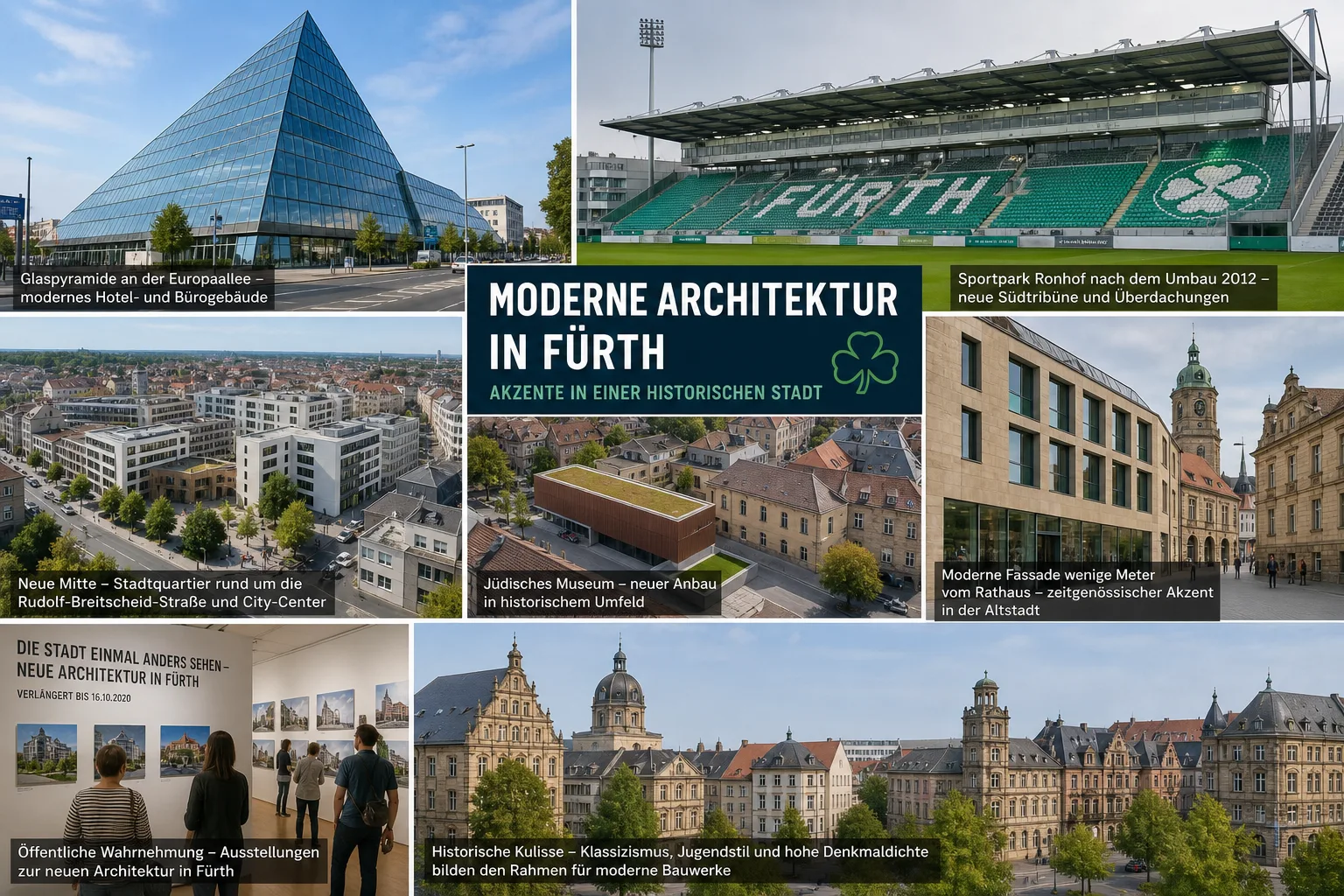
Start your next architecture tour at the Glass Pyramid on Europaallee. It is suitable as an entry point because its formal language (geometry, transparency, reflections) is very clear. Take a few minutes on site for two perspectives:
- Distant Effect: How does the silhouette read from a greater distance? Does it act as a landmark or as a solitary object without context?
- Close-up Effect: What details do you see on the facade and supporting structure? How does the impression change depending on the light?
Observation task for your next visit: Pay close attention to the transitions at ground level: How is the entrance designed, how do the base zone, forecourt, and pathways appear?
Stage 2: City Center as a Laboratory for “New Center” and Mixed Use
Plan the next section as a walk towards the city center around Rudolf-Breitscheid-Straße (often mentioned in connection with “Neue Mitte”/City Center area). Here you can particularly well observe how modern architecture functions in everyday life: shops, gastronomy, services, and pathways create an “urban feeling” not only through facades but through use and quality of stay.
- Ground Floor Check: Are entrances easy to find? Is there transparency, shop windows, seating, weather protection?
- Scale & Small-Scale Structure: Do large buildings appear structured through setbacks, loggias, or material changes?
- Paths & Squares: Is there a comprehensible network of crossings, forecourts, and “quiet” areas?
Tip for planning: If you want to photograph architecture, choose two times of day for your next outing (e.g., morning and late afternoon). This way you can see how much shadows, reflections, and interior lighting change the effect.
Stage 3: Culture of Remembrance & Contemporary Addition (Jewish Museum)
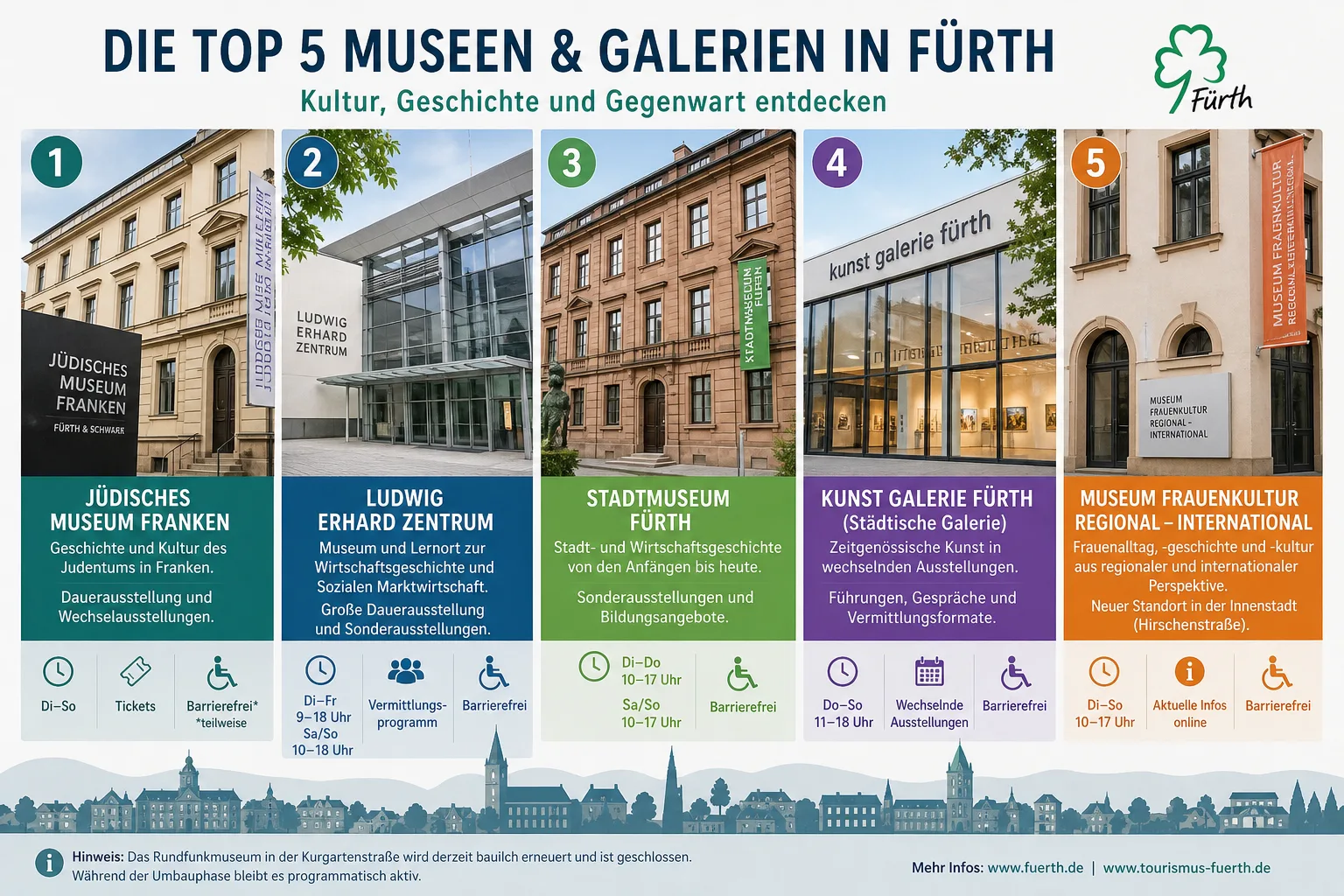
Continue your future walk with a stop at the Jewish Museum Franconia in Fürth. For architecture enthusiasts, this is particularly exciting because you can observe the topic of “extension/addition” and the dialogue between existing and contemporary structures.
- Respect vs. Contrast: Where is there deliberate contrast, where is there deliberate adaptation?
- Openings: How are windows, sightlines, and entrance areas used to provide orientation?
- Atmosphere: How “calm” or “accentuated” does the design appear in the immediate surroundings?
Note for your next visit: Check the current opening hours and possible restrictions (e.g., special openings, events) directly with the museum in advance.
Stage 4: Sports Architecture as an Urban Building Block (Sportpark Ronhof)
If you want to extend your upcoming tour, plan to finish (or as a separate appointment) at the Sportpark Ronhof. Stadium architecture is a good example of how design, safety, routing, and acoustics interact – and how much “everyday architecture” bundles emotions.
- Arrival & Distribution: How do paths, stairs, and entrances guide visitor flows?
- Roof & Spatial Feeling: What role do roofs and edges play for atmosphere and “cauldron” effect?
- Urban Edge: How does the stadium appear in the neighborhood: open, repellent, permeable, connected?
Planning tip: If you want to experience the stadium in operation, find out about publicly accessible areas and rules (e.g., during events) before your planned visit.
Why This Tour Is Especially Worthwhile in Fürth
Fürth is, for many visitors, first and foremost a city of historic facades. Precisely for this reason, a future architecture walk focusing on modernity is so instructive: you can immediately see how contemporary design can coexist with historic settings – sometimes as a contrast, sometimes as a calm addition.
To make your walk more than just “nice photos,” a simple evaluation framework helps for your next visit:
- Urban Design: Does the building fit the street space, sightlines, and square edges?
- Use: Does the ground floor make the surroundings livelier (access, offerings, transparency)?
- Material & Detail: Does the execution appear durable and careful (joints, edges, connections)?
- Accessibility: Are paths, entrances, and orientation aids well designed?
- Climate & Comfort: Is there shade, greenery, wind protection, seating?
Practical Tips for Your Next Architecture Outing
- Pre-Check: Check opening hours and accessibility (museum, event-related areas) before your planned visit.
- Photo Plan: Plan for two lighting moods (e.g., earlier/later in the day) to better understand the effect of facades.
- Notes Instead of Just Pictures: Write down three keywords at each stop: “form,” “base,” “surroundings.” This sharpens your eye.
- Consideration: Please be discreet in courtyards, entrances, and residential areas.