Discover Children's University & Science Events in Fürth
Children's University & Science Events in Fürth: What Families Can Expect in the Coming Months
Fürth will continue to offer many ways for children to discover science, technology, music, and culture with curiosity – from hands-on labs to moderated family concerts. This guide helps you find upcoming events, choose them wisely, and prepare well.
For whom? Families with children (approx. 5–16 years), teachers, youth workers, and anyone in Fürth looking for science-related hands-on formats.
What Counts as a "Children's University" or Science Event in Fürth?
The term "Children's University" is used very broadly in everyday life. For Fürth, it's worth taking a practical look at formats that are typically announced in the coming months and semesters:
- Hands-on workshops (e.g., programming, robotics, electronics, 3D printing, experiment stations)
- Family lectures with experiments and Q&A sessions
- Cultural formats with a learning component (moderated concerts, museum programs, readings with factual topics)
- Science-related holiday and weekend courses (often via educational providers, libraries, or youth programs)
For an event to be truly "science-related," at least one of these features should be clearly recognizable: a guiding question, a learning objective, an illustrative explanation of backgrounds, or the opportunity to observe and experiment yourself.
Hands-on Science: Technology and Maker Formats (Outlook)
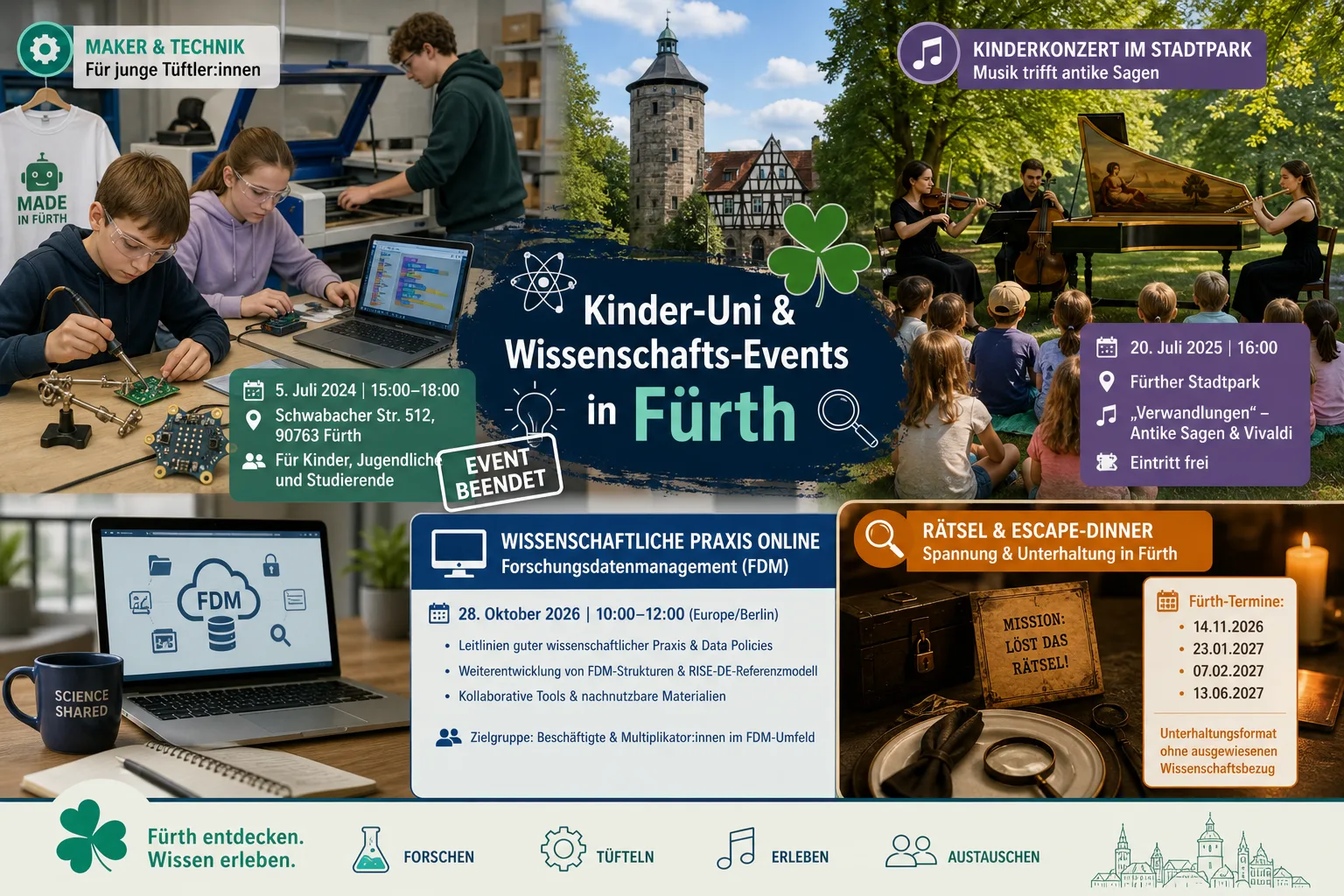
In and around Fürth, courses and open hands-on opportunities are regularly announced, where children and young people can build, test, and iterate themselves. Typical are formats that start with everyday topics (e.g., "How does an LED light up?") and then lead step by step to small projects.
Which topics are particularly common in upcoming workshops?
- Beginner programming (block-based or first text languages) – with visible results such as animation, game, or sensor project
- Electronics & soldering – safely guided, often with simple circuits and battery power
- Digital fabrication (e.g., plotting, laser cutting, 3D printing) – from idea to object
- Robotics & tinkering – building, finding errors, trying again: exactly what "real research" is all about
How can parents recognize good quality?
- Safety concept (safety glasses/extraction, age-appropriate tools, clear supervision)
- Small groups or sufficient supervisors
- Open-ended work: not just "copying," but also allowing your own variations
- Transparent age information and clear notes on prior knowledge
Planning tip: Especially maker and technology offerings are often limited in capacity. When announcements for the coming weeks go online, early registration is worthwhile.
When Music Becomes Children's University: Family Concerts & Cultural Formats (Outlook)
In the coming seasons, family concerts, moderated music programs, and cultural events will continue to be regularly announced in Fürth and the region, which convey knowledge "on the side": How are sounds created? What does a legend tell us about its time? How does music change when a theme is varied?
Such formats are particularly family-friendly because they often combine short units, understandable moderation, and interactive moments. For children, this is a low-threshold introduction to cultural-historical thinking: observing, comparing, asking questions – without exam pressure.
Good to know for upcoming dates
- Location & weather: For outdoor events (e.g., in the park), seat pads, sun protection, and a plan B are important.
- Admission & duration: Family programs are often more compact – still, it's worth checking the approximate length in advance.
- Costs: Some cultural formats are free or inexpensive, others require tickets. Pay attention to advance sale deadlines.
Digital Science in the Future: Online Workshops for Teachers, Libraries & Volunteers
Not every science-related training has to take place on site. For teachers, library staff, and project leaders in youth work, online workshops on topics such as research data management, open science, and good scientific practice will continue to be offered regularly in the coming months. This is especially helpful if you want to develop new science formats for children in Fürth yourself.
Typical content of future training includes:
- Good scientific practice and traceable documentation
- Data management: structuring, storing, sharing – appropriate to data protection and project size
- FAIR principles (Findable, Accessible, Interoperable, Reusable) as a comprehensible quality framework
- Material development: worksheets, tutorials, and reusable content suitable for school and holiday projects
The benefit for families is indirect but great: The better adult teams plan, the safer, more understandable, and more sustainable the offerings that later reach children will be.
Puzzle Shows, Escape Formats & "Real Science": How to Classify Upcoming Offerings
New puzzle, crime, and escape formats are regularly announced in the region. They can be motivating for children and young people because they train problem-solving and teamwork. At the same time, they are not automatically scientific education.
If you want to evaluate upcoming dates, these questions help:
- Are there explanatory parts? Are backgrounds (e.g., physics, history, cryptology) explained in an understandable way?
- Is there transfer? Do children take away a method (e.g., forming hypotheses, testing, documenting)?
- Is the age group appropriate? Good providers state target age, difficulty level, and duration transparently.
- Is the educational claim honest? Entertainment is valuable – but should not be labeled as "science" if it only uses a topic decoratively.
Trends for the Next Seasons (2026/2027): Where Are Science Offerings in Fürth Heading?
For the coming months and the next year, many cities and educational providers are showing similar trends – it can also be expected in Fürth that offerings will be planned more along these principles:
- More participation: less lecture, more experiment, making, and small take-home projects.
- Low-threshold learning venues: libraries, cultural centers, parks, youth centers, and temporary pop-up labs as practical event locations.
- Inclusion & access: clear language, age-appropriate tasks, clear information on accessibility and costs.
- Hybrid modules: short online preparation plus in-person event – especially attractive for family logistics.
- Cooperations: joint series between the city, schools, cultural institutions, and initiatives, so that offerings reliably recur.
Practical Tips: How to Find Upcoming Children's University and Science Events in Fürth
- Bundle calendars: Start with the official event calendar of the city and supplement it with vhs, library, and cultural calendars (links in the sources).
- Filter by "family," "workshop," "hands-on," "experiment": Many portals use recurring categories.
- Take age information seriously: A good offering matches the developmental stage; for mixed groups, beginner/advanced slots help.
- Check duration & time of day: Short formats often work better for younger children; longer workshops are more suitable for teenagers.
- Keep preparation minimal: If material lists exist, they are usually brief – better to read early than improvise on the day of the event.
- Ask about learning objectives: If it's not clear in the announcement, a quick inquiry is worthwhile (What exactly do the children learn? Is there time for questions?).
If you check regularly, you will usually find ongoing new announcements in Fürth and the Nuremberg metropolitan region – especially around holiday times, semester starts, and cultural seasons.