Cultural Education & Cultural Funding in Fürth
Cultural Education & Societal Discourse in Fürth: What Will Be Possible in the Coming Months
Note on timeliness: This article describes only plans, next steps, and possible future formats (no retrospectives).
Cultural Education as a Task for the Future: Goals for Dialogue, Participation, and Democracy
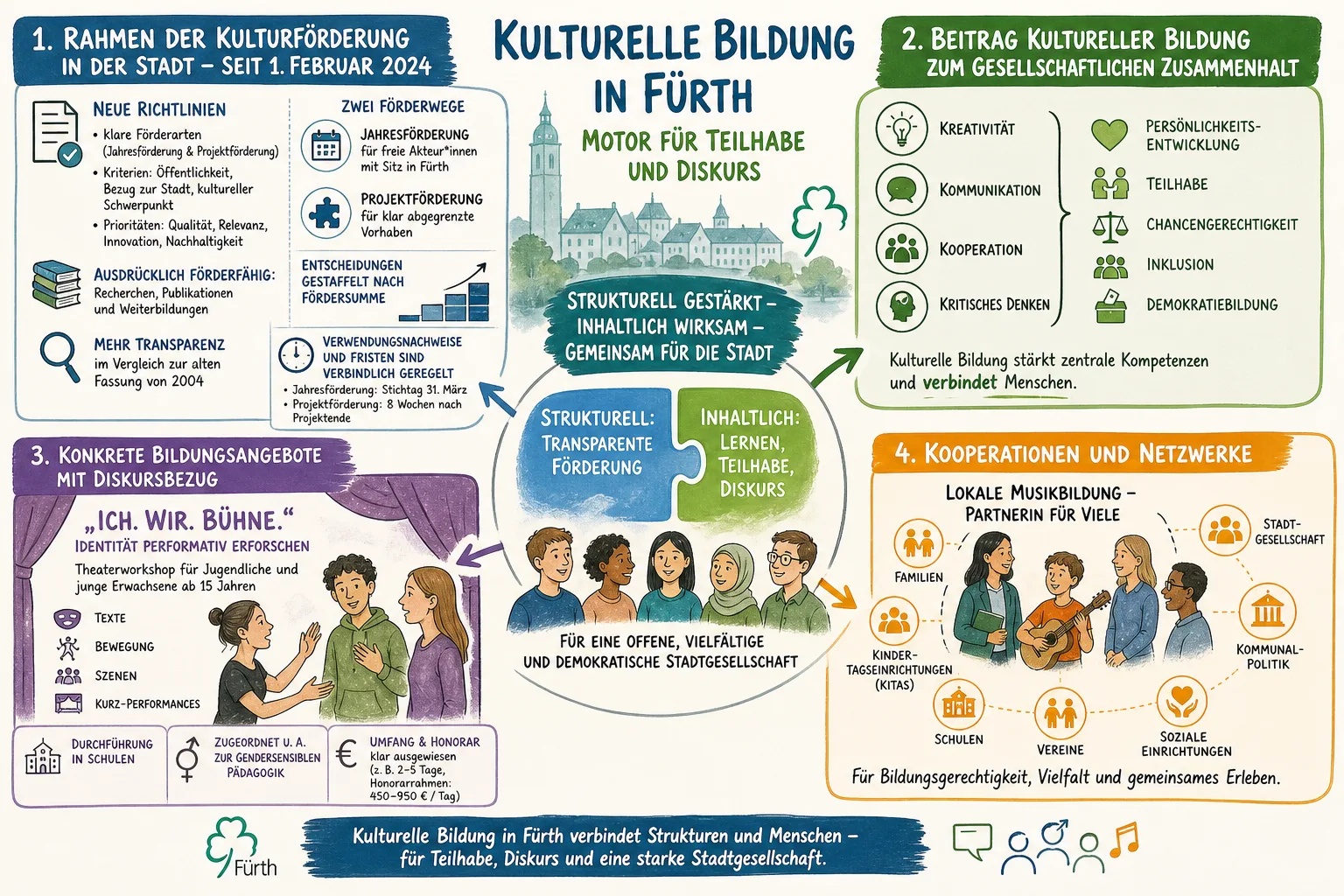
In the coming years, cultural education in municipalities will have a particular impact where it is understood as competence and attitude development and planned as part of everyday democratic culture. For Fürth, this means: formats that not only produce “products” (performances, exhibitions) but also create spaces for learning and conversation will continue to gain importance.
Competencies That Future Formats Can Specifically Promote
- Creativity & Design Competence: Developing ideas, justifying aesthetic decisions, experimenting.
- Expression & Communication: Telling stories nonverbally and verbally, listening, giving feedback, enduring conflicts.
- Cooperation: Ensemble work, sharing responsibility, changing roles, jointly taking responsibility for results.
- Reflection: Examining perspectives, recognizing power and role images, translating social questions into artistic forms.
To credibly achieve these goals in the next step, planned projects should make their educational methodology transparent: How is moderation handled? How are sensitive topics addressed safely? What protection concepts apply when working with minors? How are participants involved without being overwhelmed? Such clarity strengthens trust and facilitates cooperation with schools, youth work, and parents.
Formats That Will Be Especially in Demand in 2026/2027
For future programs in Fürth, formats are emerging that offer both artistic quality and social connectivity. Projects that enable participation and reflect results back into public spaces or school contexts are particularly sustainable.
Practice-Oriented Format Modules for Upcoming Calls and Cooperations
- School Cooperations with Clear Time Structure: Workshops with a fixed scope, transparent process, and defined result form (presentation, reading, mini-performance).
- Neighborhood-Oriented Cultural Work: Mobile formats, low-threshold participation offers, pop-up stages in easily accessible locations.
- Music and Ensemble Projects as Meeting Spaces: Intergenerational choirs, band or orchestra projects with moderated discussion components.
- Writing and Media Workshops: Storytelling, podcast or video formats that make youth perspectives visible and structure discussions.
- Training & Multiplication: Further training for teachers and cultural education teams to anchor methods in institutions in the long term.
To ensure these formats are sustainably implemented in the future, a clear separation is recommended between artistic process (rehearsals/production), educational process (support/reflection), and public mediation (invitation, moderation, documentation). Especially for discourse topics, a moderated setting increases safety for participants and audiences.
Format Idea “Me. Us. Stage.”: What Performative Identity Work Could Look Like in the Future
If schools, youth projects, or cultural partners in Fürth plan a performative format for identity and democracy education in the coming months, a workshop type like “Me. Us. Stage.” can serve as a blueprint: a clearly framed theater lab that combines biographical work, scene development, and moderated group discussions.
How a Future Workshop of This Kind Can Be Designed Safely and Effectively
- Protected Setting: Clear group rules, voluntary levels of participation, sensitive moderation, and respectful handling of personal stories.
- Mix of Methods: Warm-ups, improvisation, text work, movement, image/sound impulses, short writing phases.
- Gender-Sensitive and Anti-Discrimination Approach: Language and role offers that reflect diversity; reflection on stereotypes without exposing anyone.
- Reliable Result Form: A workshop presentation or “open showing” that is framed as a learning moment (not as a performance assessment).
- Connectivity: Handouts for teachers/youth teams so that topics can be further worked on after the workshop.
“Stage work can become a place in the future where young people not only discuss social questions, but also try them out physically, verbally, and emotionally—and thus become capable of action.”
Cooperations & Networks: How Stakeholders Can Prepare for the Next Steps
For cultural education in Fürth to function reliably in the upcoming project phases, cooperation between culture, schools, youth work, and civil society will continue to be the decisive lever. Future projects benefit especially when responsibilities and communication channels are established early on.
Cooperation Models Suitable for Upcoming Projects
- School × Cultural Partner: Fixed contact persons, coordinated dates, clear supervision and protection concepts.
- Social Organizations × Cultural Actors: Access to target groups, support with barriers (language, time, mobility), trust-based communication.
- Multi-Partner Projects in the Neighborhood: Cultural venues, clubs, and initiatives pool resources, share public relations, and offer different entry points.
- External Communication: A joint project text, uniform participation conditions, and transparent presentation of goals and boundaries.
For future projects, it is also advisable to firmly plan feedback loops: brief interim updates with partners, participants, and—if public—the audience. This increases quality, reduces conflicts, and strengthens legitimacy with regard to funding logic.
Practical Roadmap: From Idea to Public Event
Anyone planning a cultural education project in Fürth in the coming months can follow a pragmatic process that takes into account typical requirements of institutions and funding structures.
- Define Project Core: Target group, topic, artistic method, expected learning outcomes, public form.
- Secure Partners: Clarify roles (leadership, education, organization, technology), establish communication channels.
- Clarify Protection & Responsibility: Consents, data protection, supervision, handling sensitive content, crisis procedures.
- Plan Resources: Schedule, spaces, materials, fees, accessibility, documentation.
- Prepare Publicity: Invitation text, target group approach, moderation for discussions after presentations.
- Implementation & Quality: Gather feedback, document process, make results accessible.
- Ensure Transfer: Brief evaluation, handout for partners, perspective for follow-up formats.
In future project communication, it is helpful to clearly formulate the balance: culture as a space for free artistic work—and at the same time as a reliable educational offer with a framework of responsibility. This transparency strengthens trust among parents, schools, funding partners, and the public.
Sources & Further Standards
- UNESCO – Culture & Education — Overview of culture and education as a policy field (accessed 2026-11-04)
- Standing Conference of the Ministers of Education and Cultural Affairs (KMK) – Cultural Education — Classification of cultural education in the school and educational context (accessed 2026-11-04)
- Federal Ministry of Education and Research (BMBF) — Framework information on education and funding logic in Germany (accessed 2026-11-04)
- Federal Agency for Civic Education (bpb) — Background knowledge on democracy education, discourse, and participation (accessed 2026-11-04)